Did you know that there are volcanos in New Mexico?
Volcanos in New Mexico
Did you know that there are volcanos in New Mexico?
Did you know that there are volcanos in New Mexico?

It’s a gangly mutt, large for an Indian dog, with dirt-matted curly black hair. Old One Eye Pete looks at it in disgust as it half-crouches at his feet. It’s been following him and the mule for the past two hours, ever since they left the Ute Indian encampment down canyon. “Damned if the thing ain’t smilin’,” Pete mutters. He pokes the dog’s side with his foot. “You a doe or a buck?” The animal rolls over obligingly, paws in the air. Buck.
Old Pete toes it again. “Well, I expect you won’t last long. You’ll be running off to the first camp with a bitch in heat.” He turns and twitches the mule’s lead rope. “Giddup.”
They trail the Cimarron River up canyon through the afternoon and settle into camp under an overhanging sandstone boulder as the light begins to fade. It’s still early. The sunlight goes sooner as the canyon walls narrow. But Old Pete’s in no particular hurry and the pup’s acting a mite tired.
“Gonna have to keep up,” Pete tells it as he cuts pieces of venison off the haunch he traded from the Utes. The dog slinks toward the fire and Pete tosses it a scrap. “Too small for my roaster anyway,” he mutters as he skewers a larger chunk onto a sharpened willow stick and holds it out over the flames.
~ ~ ~ ~
“Where’d that damn pup get to now?” Old Pete mutters as he and the mule reach the rocky outcropping that overlooks the valley. He can see through the ponderosa into a good stretch of grassland below, but there’s no evidence of the curly-haired black Indian dog. Pete shakes his head in disgust, jams his rabbit fur hat farther down on his head, and snaps the mule’s lead rope impatiently.
At least the mule doesn’t need voice direction. Which is more than can be said for the dog, but Pete refuses to call the damn thing, no matter how aggravated he might feel.
Jicarilla Apaches are likely roaming the valley for elk, and Pete’s taking no chance of being found before he wants to be. The dog can go to hell, for all he cares. He grunts irritably as he works his way down the hillside. Idiot pup.
He pauses at the tree line, getting his bearings, the air crisp on his face. A light snow powders the ground. A herd of perhaps thirty elk is bunched on the hillside to his left. He squints his good eye. They seem a mite restless.
Then he sees the wolves, eight or nine of them waiting downwind while two big ones trot the herd’s perimeter, checking for weakness.
At his feet to his right, a low whine emanates from the prickly ground-hugging branches of a juniper bush. As Pete turns his head, the black pup eases from the grasping needles. The dog slinks to Pete’s feet and crouches beside him, tail between its legs. Then it looks anxiously toward the wolves and whines again.
“Not as dumb as I took you fer,” Old Pete says, adjusting his hat.
~ ~ ~ ~
There’s a reason it’s called Apache Canyon and Old Pete proceeds cautiously, aware that there’s been a recent outbreak of hostilities between the Jicarillas and the locals. Somebody got twitchy-brained and shot off their gun without thinking twice and now the whole Sangre de Cristo range is on edge. And it doesn’t matter at all that he had no part in the original quarrel.
However, Pete hasn’t seen a soul in three days, and he’s beginning to think he’s going to get to Taos in one piece after all, if the damn half-grown dog tagging him will quit wandering off, then coming back, widening the scent trail with his idiot nosing around.
Pete scowls as the puppy reappears, this time from a thicket of scrub oak, dead leaves rattling on the ground. As the dog gets closer, it goes into a half crouch. It’s holding something in its mouth and its curly black tail droops anxiously.
“What’ve you got there?” Pete asks. He squats and holds out his hand, and the dog releases the item into his palm. “Shit!” Pete says, dropping it.
Then he leans closer and sniffs. It really is shit. Human, too. Fresh enough to still stink. He rises, studying the slopes on either side, turning to examine the Pass behind him. So much for being alone.
“Thankee, pup,” he mutters. “I think.”
from Old One Eye Pete

Newly appointed Governor Albino Pérez arrived in New Mexico in May 1835 to general relief. The previous governor, Francisco Sarracino, was generally viewed as inept and Pérez was a breath of energetic fresh air. He brought funds for the Presidio troops and immediately set out on a tour that included visits to outlying communities as well as a successful action against the Navajo, who’d been picking off sheep and other prizes. When Pérez returned to Santa Fe, he gave an inaugural address in which he praised New Mexicans’ peaceful habits, love of order, and obedience to justice, among other virtues.
However, the longer Pérez was in office, the more complicated things became. The money he’d brought was spent and more was needed. Sarracino, now New Mexican Treasurer, was accused of embezzling funds. The Navajo were active again and another campaign was necessary. And Pérez’s idea of paying for it with forced loans from the region’s ricos was not met with universal acclaim.
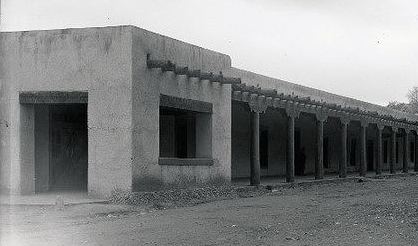
Then New Mexico’s exemption from the national sales tax expired. The governing council asked Pérez to forward a petition for its renewal to Mexico City, but he didn’t do so right away. Instead, he started talking about how to collect the tax.
This didn’t go well with the populace. In fact, it may have been the spark that ignited what is popularly known as the Chimayó revolt, the rebellion that resulted in Pérez’s death in early August 1837. The good feeling surrounding Pérez’s arrival had disappeared completely by the time he lost his life and his head on the road outside the village of Agua Fría south of Santa Fe.
Which is a good reminder that no matter how an official begins their term, it’s what they do afterwards—and how their time in the sun ends—that people are most likely to remember.
Sources: Lansing B. Bloom, “New Mexico Under Mexican Administration,” Old Santa Fe Magazine, Vol. 2. Santa Fe: Old Santa Fe Press, 1914-1915; Janet Lecompte, Rebellion in Río Arriba 1837, Albuquerque: University of New Mexico Press, 1985; Read, Benjamin M. Illustrated History of New Mexico, Santa Fe: New Mexican Printing Company, 1912; Joseph P. Sanchez, “It happened in Old Santa Fe, The Death of Governor Albino Pérez, 1835-1837,” All Trails Lead to Santa Fe, Santa Fe: Sunstone Press, 2010; F. Stanley, Giant in Lilliput, the Story of Donaciano Vigil, Pampa, TX: Pampa Press Shop, 1963.
“Now what’re you gettin’ yourself all fired up for?” the matted-haired trapper demanded. “I’m your pa and I can do I want.” He lifted the pottery jug from the wooden table with both hands. “I been feelin’ a mite poorly since I come in from the mountains and this here’s a right good anti-fogmatic.”
“Aquardiente,” the girl said contemptuously. “Your so-called water of life.” She pushed her long black hair away from her face. “Water of hell!”
“Ah, now girlie.” He grasped the jug’s narrow neck with one hand and reached for her arm with the other.
She slapped at him. “I’m not your girlie any longer. Don’t you touch me!”
His eyes narrowed. “I’m still your pappy,” he said. “Just ’cuz I been gone five months don’t mean you can be disrespectin’ me.”
She sniffed and turned away.
He gulped down a swig of the liquor. “Where’s your ma, anyways?”
“She went to the merchant’s to settle her bill.”
“Don’t want me to know how much she spent while I was gone, huh? What new piece of fooferaw have the two of you took a cotton to now?”
The girl whirled. “You mean the cotton for your shirts? The white wheat flour she saved for your biscuits while we spent the entire winter eating cheap corn tortillas?”
The jug thudded onto the table. “What’s eatin’ you girl, that you think you can chaw on me so right catawamptiously? It ain’t fitten!” He surged from the chair, his hand raised. “I’m thinkin’ you need a rememberance of who’s head o’ this household!”
Her lower lip curled. “That’s right. Beat me. Just give me an excuse to leave. That’s everything I could wish for.”
He dropped his hand. “And why would you leave, girl?” He peered at her. “You find a young man to spark you while I was gone?”
She lifted her chin. “I don’t need a man.”
He threw back his head. “Hah! And what else you gonna go and do?” Then his face changed. “You ain’t gone and done something you’ll regret, have you now?”
Her lips twitched with amusement. “You might regret it,” she said. “I won’t be of much use to you.”
He moved toward her. “What the tarnation have you gone and done?”
“You’ll know when I’m ready to tell you.”
As he grabbed her arm, the door opened.
“Be careful of her, por favor!” the girl’s mother said as she entered. “She has been accepted into the convent in Santa Fe, to serve as a helper! Our child is a matter of grace to us now!”
The mountain man stared at his wife, then his daughter. He turned to the table. “Women!” he muttered as he lifted his jug.
from Old One Eye Pete
On Wednesday, May 16, 1827, a man named Ignacio Sandoval showed up in Santa Fe, New Mexico with important information for Governor Antonio Narbona. Sandoval had just returned from a trapping expedition led by an American named Ewing Young. Young, who didn’t have a permit to trap, had come back with thirteen packs of furs—probably mostly beaver—and hidden them south of Santa Fe at the Peña Blanca home of Luis María Cabeza de Baca.
Narbona, in one of his last official acts as governor, sent men to confiscate the furs. Cabeza de Baca, trying to protect them, died as a result. Manuel Armijo, who took over as Governor on May 21, promptly issued an order for Ewing Young’s arrest in connection with the illegally obtained furs.
Young escaped incarceration for the time being, but the pelts remained confiscated. Well, most of them did. Some of them belonged to another American, Milton Sublette.

In July, Young and two other Americans obtained permission to clean the furs, which they worried had become damaged in storage. They and the local alcalde were busy shaking them out and taking inventory when Sublette appeared, grabbed a pack, threw it over his shoulder, and took off for the nearby home of Cristobal Torres.
The local authorities converged on the house, but it was too late. Sublette and his pelts had disappeared. Armijo blamed Young and called him into his office for explanations. When he threatened to incarcerate the American, Young walked out. Armijo had him arrested, threw him in jail, then released him when Young claimed a debilitating fever. But Armijo didn’t release the furs. Legally, they were now government property. They would eventually be sold, though at a fraction of what their original value.
So once again, a conflict between the Mexican administration and the Americans in New Mexico ended in a standoff, with no one the clear winner. I find this a fascinating story because it highlights the conflicts and complexities of American-Mexican interactions twenty years before the 1847 revolt at Taos, which stunned the Americans with its ferocity.
They weren’t looking at the larger picture. The kind of high-handedness and disregard for local customs Young and Sublette displayed were common among the American trappers during the Mexican period. The 1827 incident, among many others, appears to me to be directly linked to the events of early 1847, when the newly appointed American governor and former trapper and merchant Charles Bent was killed.
Retribution, no matter how long it takes, is still retribution.
Source: David J. Weber, The Taos Trappers, Norman: University of Oklahoma Press, 1971.
The rain was behind him and gaining fast.
Timothy looked back, down the valley, and kicked at the mule, but it was hot and the mule had been going for a long time. Its pace quickened for a few yards, then dropped back into an easy trot.
The boy groaned and looked back again. His mother had told him to take his slicker, but he’d been in a hurry. “C’mon Boss,” he begged, but the mule just flicked its ears and jogged onward.
Somehow, they made it to the barn before the clouds reached them. Timothy turned the mule into the stall and made a dash for the house. The first raindrops bit into the dust as he reached the steps.
His mother opened the door. “Get wet?” she asked meaningfully.
He grinned at her. “Dry as a bone!” he said.
from Valley of the Eagles

If you recognize the name Albert Fountain, you’ll almost certainly associate him with his disappearance in the New Mexico desert in 1896 along with his eight-year-old son. And that’s probably almost everything you know about the man.
But Fountain’s disappearance happened as the result of events that took place well before that early February day. In fact, he’d been a polarizing figure in southern New Mexico for a number of years. He’d defended Billy the Kid in court and made other decisions that brought attention to himself—and not necessarily in a good way.
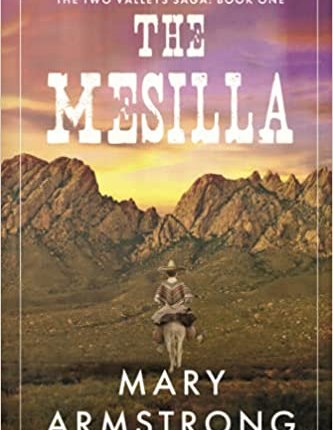
Mary Armstrong’s novel The Mesilla provides a fictional account of some of the events in Fountain’s career prior to his disappearance. This story, the first in Armstrong’s Two Valleys Saga series, centers around Fountain’s defense of Bronco Sue, a woman who was accused of killing her husband, one of a series of men she’d cohabitated with. The courtroom scenes alone are worth the price of this book.
Armstrong has clearly done her homework. The novel is packed with information and anecdotes about New Mexico’s Mesilla and Tularosa Valleys in the late 1800s, which she feeds seamlessly into the story line. If you’re interested in the history of these areas or are just looking for a well-written historical novel, I recommend The Mesilla.
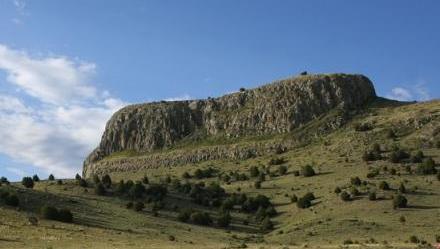
In early May 1850, three men headed across the plains toward Santa Fe with the U.S. mail. Seven other men had joined them for safety’s sake. It wasn’t enough. Around May 7, a band of Jicarilla Apache and Mouache Ute led by a man named White Wolf struck near Wagon Mound. When the ensuing running fight was over, the entire party of Americans lay dead on the greening grass. The bodies were found by other travellers on Sunday, May 19.
The number of men killed made this incident even worse than the one the previous October when Mrs. White died, and her slave woman and daughter were captured. At a glance, it appeared that the Apache and Utes had gone on a senseless killing spree.
But there was a reason for these deaths. In August 1849, a band of Jicarilla had visited Las Vegas, New Mexico to discuss a possible peace treaty. Not much discussion seems to have taken place. Instead, the Jicarillas were attacked by armed men who killed fourteen of them and captured White Wolf’s daughter.

After the White party deaths two months later, White Wolf’s daughter was pulled out of jail and taken along on a mission to find the survivors. The idea was to use her as an interpreter/negotiator as well as a bargaining chip. En route, she decided to take matters into her own hands and escape. In the process, she shot two men and did her best to stampede the group’s mules herd but was herself shot and killed.
So no one should have been at all surprised that the mail carriers and their companions died at the hands of White Wolf and his fellow warriors. What else had the men of Las Vegas expected?
Sources: Howard Bryan, Wildest of the Wild West, Santa Fe: Clear Light Publishing, 1988; Leo E. Oliva, Fort Union and the Frontier Army in the Southwest, Southwest Cultural Resources Center, National Park Service, Santa Fe, 1993; Morris F. Taylor, First Mail West, Albuquerque: UNM Press, 2000.

“Did you know the Maxwell Land Grant Company is evicting people who’ve been farming here for decades?” the Reverend Franklin Tolby demands.
At the other end of the small pine table, Mary Tolby moves a raised biscuit from the chipped ceramic platter to her plate. “That’s terrible,” she says. “These biscuits are quite good this time. I think I’ve finally become used to that stove. Rachel, eat your peas or there’ll be no dessert.”
Her husband picks absently at his food. “It’s a moral outrage,” he says. “The Company has no right.”
Mary looks anxiously at his pale face. Since they arrived in Cimarron, Franklin has been on horseback constantly, west to Elizabethtown, south to Fort Union and beyond, yet his cheeks show no evidence of windburn or sun.
“I’ve made strawberry pie for desert,” she says. “An Indian girl came by selling berries. They’re very sweet. The result should be quite tasty.”
Franklin’s eyes focus on her for a split second, then his head snaps up, as if he’s listening to something outside the house. “And the Indians,” he says. “With this much land, there’s room for them also.” He pauses for a long moment, fork in the air, then says, “Excuse me,” drops his frayed linen napkin onto the table, and hurries from the room.
Mary can hear him scrabbling through the papers on his desk as he prepares to write down whatever has just come to him. She sighs and reaches to cover the food on his half-empty plate with a clean napkin. “Rachel, eat your peas,” she says absently.
~ ~ ~ ~
The tiny Elizabethtown church reeks with the late June stench of unwashed miners, but Dr. Robert Longwill presses through the door anyway. He nods at Old One Eye Pete, who’s standing to one side, his battered hat clasped politely in his hands.
Then the doctor focuses on the front of the room. He can just see the top of Reverend Tolby’s head. On Cimarron’s dusty streets, the little man’s carefully groomed handlebar mustache has often given Longwill the urge to laugh, but here in Etown the miners and old trappers aren’t snickering.
Tolby’s voice fills the room. “The Maxwell Land Grant Company has no right to the land on which your mines and farmlands rest,” he says flatly. “You work the land and bring forth value from it. They sit in their offices and collect the rewards of your God-driven labor. Let us be done with such greed! Let us return to the scriptural truth that a man must work by the sweat of his brow and reap the labor of his hands!”
Dr. Longwill eases out the church door and down the hillside, toward the livery stable where he left his horse. “That preacher’s been here less than six months, and already he’s an expert on the Grant and the miners’ and farmers’ rights,” he mutters bitterly. Which wouldn’t be a problem, if no one were listening to him.
~ ~ ~ ~
Mary Tolby frowns at the potatoes she’s peeling, then out the kitchen window at the dusty Cimarron sky. It seems as if a grit-filled wind has blown every day of the eighteen months since she and Franklin arrived here to begin his Methodist Episcopal mission work. Mary sighs, washes her hands, and lifts the towel that shelters her rising bread dough. It’s taking longer than usual to double its size.
But then, Franklin is taking longer than usual to return from his Sunday services at Elizabethtown. He’s usually back before Tuesday noon, following his meeting with the church board and various other discussions on Monday.
Mary frowns and looks out the window again. There’s so much dust in the air, she can hardly see the sun. Franklin’s undoubtedly talking with someone in Etown or Ute Park about the Maxwell Land Grant Company and its wholesale eviction of the miners and small farmers who were here before the corporation purchased the grant.
She shakes her head and returns to her work. She very much doubts that her husband is speaking with anyone about the state of their soul. Not that many people in Colfax County seem to care about God or religion. Land and water are all that matter. That and gold. How she longs sometimes for Indiana!
~ ~ ~ ~
Two days before, the man had hovered outside Etown’s tiny Protestant church just long enough to confirm that Franklin Tolby was preaching there. He couldn’t stay longer than a few minutes. The air sucked out of his lungs at the thought of Tolby’s teachings, so contrary to Holy Church. But he’d been there long enough to confirm that the heretic minister will be traveling down canyon this Tuesday morning, as he always does after a Sunday in Elizabethtown.
The man waits now, rifle tucked to his chest, in the shadow of the big ponderosa at the mouth of Clear Creek. How pleasant it will be to stop the minister’s preaching.
The men who are paying him to silence Tolby have other reasons for desiring his death, reasons of power and money and land. But the waiting man cares nothing for these things, although the gold they’ve given him will be useful enough. He can leave the grant now, take his family someplace where americanos have not yet stolen the land from those who know how to do something useful with it, those whose fathers tilled it before them.
He turns his head, listening. Someone is coming. A man singing a raucous heretical hymn. Tolby, most certainly. The minister will stop at Clear Creek as usual, to water his horse and drink from the hollowed-out wooden trough placed there for the refreshment of travelers.
His back will be to the big ponderosa that shields the man with the gun. But there is no dishonor in shooting a heretic in the back. A man who will steal one’s very soul if he can, destroy the very fabric of one’s Catholic life. The rider in his clay-brown coat dismounts and the gunman eases into position. He holds his breath as his finger touches the trigger, squeezing so gently and slowly that Tolby drops to the ground before the shooter registers the sound of the bullet’s discharge, sees the neat hole it makes in the shabby brown coat.
from Old One Eye Pete
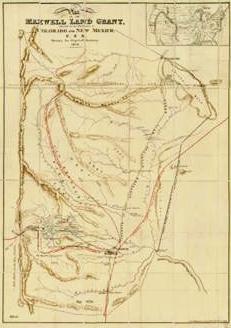
Mid-April 1871 was a busy time for the newly-formed Maxwell Land Grant Company. Lucien and Luz Maxwell had received their cash for the grant, moved out of the house at Cimarron, and were busy spending their money. Lucien had used a good chunk of it to set up the First National Bank in Santa Fe. He’d also bought land at Fort Sumner. While Luz turned the former the officers quarters into a home, he bought racehorses.
However, the Company wasn’t having an easy time establishing their control over the former Beaubien-Miranda Land Grant’s vast acreage. There’d been an initial dust-up in late 1870, when the Elizabethtown miners rioted against the new owners and the Governor had to send soldiers in to squelch them. But that wasn’t the end of it. In early April 1871, the Cimarron Squatters Club organized a mass protest and fundraising meeting in front of the county courthouse.
The Company apparently decided to demonstrate a little force in response. They sent a group of employees into the Ute Creek placer mines and took over. That strategy didn’t work out too well—the miners disarmed the Company’s men and held them hostage.
Again, the Governor got involved. This time he came himself, forced the miners to free the prisoners, ordered them to abstain from further violence, and then got the Army to station soldiers from Fort Union in the area to enforce the peace.
The soldiers’ presence does seem to have calmed the boiling pot for a little while. But it was bound to boil over again—the Company was enforcing rent payments Maxwell had never bothered to collect and also kicking people off range and farmland Maxwell had allowed them to use.

Whether the Company was within their rights isn’t clear. Things got even murkier in late January 1873, when the U.S. Department of Interior ordered much of the Grant’s acreage to be treated as public lands. This brought more settlers (the Company called them “squatters”) into the area and, with them, more unrest.
With the newcomers came Methodist Episcopal missionary Rev. Franklin J. Tolby. Tolby sided with the settlers and miners and didn’t hesitate to speak his mind. In mid-September 1875 he was ambushed and killed on the canyon road between Elizabethtown and Cimarron, and the Colfax County War was on in earnest.
The conflict didn’t end until April 18, 1887, when the U.S. Supreme Court confirmed the Company’s right to almost two million acres. Even then, the violence didn’t come to an immediate halt. However, even the most ardent settlers didn’t have any legal arguments left in their arsenal and the Colfax County War gradually faded away.
Once again, money and political power had prevailed in the fight for control of New Mexico’s lands.
Sources: David L. Caffey, Chasing The Santa Fe Ring, Albuquerque: University of New Mexico Press, 2014; Harriet Freiberger, Lucien Maxwell,Villain or Visionary, Santa Fe: Sunstone Press, 1999; Larry Murphy, Out in God’s Country: A History of Colfax County, New Mexico, Springer, NM: 1969; Lawrence R. Murphy, Philmont: A history of New Mexico’s Cimarron Country, Albuquerque: University of New Mexico Press, 1972; Moreno Valley Writers Guild, Lure, Lore and Legends of the Moreno Valley, Angel Fire, NM: Columbine Books, 1997; Stephen Zimmer, For Good or Bad, The People of the Cimarron Country, Santa Fe: Sunstone Press, 1999.
 Fiction and Fact From Old New Mexico