John Fremont Stumbles Into Taos

On this day in 1849, Saturday, January 13, celebrated explorer John C. Fremont stumbled into the Taos plaza so battered by exposure and starvation that no one recognized him.

Fremont had left what is now Pueblo, Colorado, 52 days earlier on a mission to identify a practicable railroad route across the Rockies to California. He had 32 men and 120 supply-laden mules with him.

Even before he’d left Pueblo, there was trouble. He’d already lost a guide. When former mountain man “Uncle Bill” Wootton took a look at the signs and realized just how bad the coming winter was likely to be, he backed out. But former Army Colonel Fremont refused to give up. He’d been forced to resign from the military in a cloud of disgrace two years earlier and was determined to redeem himself. Come hell or high water, he was determined to prove that a year-round transcontinental railroad operation across the mountains was feasible. If men and mules could cross the path he had in mind under winter conditions, then surely trains could, too.

Fremont hired “Old Bill” Williams to take Wootton’s place. While Williams was a brilliant tracker, he  wasn’t exactly known for his tact. Since Fremont was known for his stubbornness, the partnership seemed destined for trouble. And trouble happened pretty quickly. When Williams announced that the expedition should veer from the route Fremont had laid out, trouble ensued. Fremont relieved Williams of his guide duties and gave them to men who Fremont had worked with before but who didn’t know the region.

As Wootton had predicted, the weather turned treacherously nasty and grew increasingly difficult as Fremont’s men tried to force their way through snow-bound canyons and across icy mountainsides. All of the mules either died of starvation or froze to death. Frostbite and snow blindness plagued both the animals and the men. Not only was the expedition’s goal doomed, but the conditions were so bad that the men feared for their lives. In a desperate attempt to make it to safety, Fremont divided his company into small groups and sent them south to try to reach Taos.
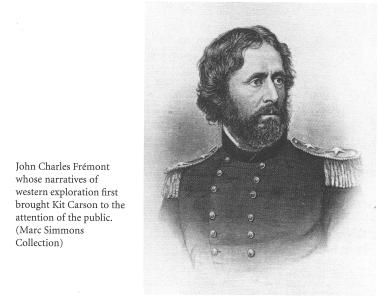
John C. Fremont.Simmons 3 wives

Only 21 men of the original 32 would make it out alive and Fremont himself would need weeks of nursing by Josefa Carson before he fully recovered from the ordeal. Even with the survivors in Taos and whole, the loss of life would continue. Williams would die trying to retrieve valuable records and medical equipment  that had been left behind in the rush to escape the winter conditions Uncle Bill Wootton had warned Fremont about.

Although a year-round transcontinental railroad was eventually built across the Rocky Mountains, it was not constructed on the route that Fremont tried to blaze that winter of 1848/49. The glory of that deed would go to other men.  Fremont’s exploring days were over .

Sources:  Alpheus H. Favour, Old Bill Williams, Mountain Man, U of Oklahoma Press,  Norman, 1962; Leroy R. Hafen, Ed., Fur Trappers and Traders of the Far Southwest, Utah State U Press, Logan, 1972; Marc Simmons, Kit Carson and His Three Wives, UNM Press, Albuquerque, 2003.


Kit Carson’s Home is Attacked!

On June 26, 1850, while Kit Carson was traveling home from Missouri with trade goods, a band of Native Americans attacked the Carson’s hamlet of Rayado, in the shadow of the Cimarron mountains. Despite the presence of a company of Army dragoons at Rayado, the Indians—no one was sure if they were Ute or Jicarilla Apache—drove off six horses, four mules, and 175 head of cattle valued at over $5000. Two Rayado men were killed: an unarmed Army bugler and a civilian (possibly trapper William New).

The dragoons had been stationed at Rayado in response to the Indian raids against the communities on the eastern mountain slopes and on the Santa Fe Trail on the eastern plains since the middle of 1849. Some of the violence was undoubtedly triggered by events in August 1849, when Jicarilla Apache Chief Chacón took his band to Las Vegas to make peace, but was attacked by an armed party led by Lt. Ambrose E. Burnside, the future Civil War General. Burnside’s men killed fourteen Jicarilla and  captured the daughter of Chief White Wolf, who was then incarcerated in a Las Vegas jail. She was shot and killed during an escape attempt later that year.

June 26 illustration
Source: Fort Union and the Frontier Army of the Southwest by Leo E. Oliva

Following the June attack, the army sent another company of dragoons from Las Vegas and called for citizen volunteers to assist with a campaign against the Indians. The resulting expedition doesn’t seem to have helped much, although people died. Only after Fort Union was constructed in the Spring of 1851 did things settle down a bit.

Rayado had been established in 1848 by Lucien B. Maxwell and Christopher “Kit” Carson on land owned by Maxwell’s father-in-law. The idea seems to have been to raise stock. When the military unit was stationed there, Maxwell took the opportunity to rent out living space to them as well selling them fodder for their animals.


Sources: Howard Bryan, Wildest of the Wild West, Clear Light Publishers, 1988. Leo E. Oliva, Fort Union and the Frontier Army of the Southwest, Southwest Cultural Resources Center, National Park Service, 1993; Marc Simmons, Kit Carson and His Three Wives, UNM Press, 2003.

HOLLOW

Lucien Maxwell, single largest landowner in New Mexico Territory, stepped from the Middaugh Mercantile porch into early June sunlight and gazed unseeing across the green valley. On the flanks of Baldy Mountain, construction workers scurried like ants around a long wooden aquaduct-like structure. When finished, the flume it held would carry water from the Red River’s source to Baldy Mountain’s base. Then high pressure hoses would spray the sides of the gulches that drained the mountain, flushing out gravel and the gold the miners hoped it contained.

They were calling the flume the Big Ditch. It was a first for New Mexico Territory. Maxwell was a major investor, likely to make a substantial return both from water sales and from men wanting to buy mining rights. Yet all he could see was the letter in his hand.

Kit Carson was dead. Kit, the companion of so many of Lucien’s wilderness adventures, always so full of energy, so confident in his quiet-spoken way, with his sixth sense for trouble and how to meet it. Yes, Kit had been ill, but it was still incomprehensible that he could be gone. Lucien Maxwell gazed at the men scrambling across the hillside opposite and could feel no joy in their activity and its outcomes. It all seemed rather hollow, somehow.


Copyright © 2016 Loretta Miles Tollefson