What’s the Name of That Town Again?

What’s the Name of That Town Again?

The name “Taos” conjures many things. An ancient pueblo. A Mexican outpost. Gringo mountain men. A violent revolt. A funky 21st century village. But the village and pueblo are two separate places. There are Spanish villages and Indigenous pueblos side by side all over New Mexico. As far as I know, only in the Taos valley do the two settlements carry the same name.

And where does the name come from and what does it mean? Now there’s a question. According to F.R. Bob Romero in Santistevan and Moore, Taos, A Topical History, it’s been attributed “to an Indian word meaning ‘Red Willow’ or ‘people of the Red Willow.’” But no one knows for sure. All we know is that it’s what the pueblo was called after the Spanish arrived. Romero says it’s likely a “Tiwa Indian term that perhaps began with the T sound and was Hispanicized as Taos.”

So that explains (or doesn’t!) that. But then there’s the question of the name of the village which is three miles southwest. We call it “Taos,” but it was originally called Don Fernando de Taos, San Fernando de Taos, San Fernandez de Taos, and various forms of these three names, such as Don Fernando, San Fernando, San Fernandez, or simply Fernando or Fernandez. Although the latter two don’t appear very often in the historical record. Even then, if the name is shortened, it becomes simply “Taos.”

As far as I know, Don Fernando de Taos is the only location in New Mexico which has the honorific “Don” attached to it. The Don Fernando for whom it was named was actually a Don Fernando Durán y Chávez, who had a hacienda near Taos Pueblo in the late 1600s. He and his son fled south during the Pueblo Revolt of 1680 and didn’t return. In 1795, the grant was ceded to settlers from the nearby Cañon area, but the village didn’t really start to thrive until French-Canadian and American mountain men [post link here] began to trickle in in the 1820s.The village was a restocking and trading point for the fur trappers. Some of them stayed to set up mercantile businesses and intermarry and the community became the center of americano settlement in the valley.

Ironically, the location that developed in response to the American presence became the flash point of resistance to the 1846 American invasion. Maybe the locals just got sick of us.

© Loretta Miles Tollefson

Sources: Source: Francis L. and Roberta B. Fugate, Roadside History of New Mexico; Robert Julyan, The Place Names of New Mexico, Revised Edition; F.R. Bob Romero in Santistevan and Moore eds., Taos, A Topical History; http://taoscountyhistoricalsociety.org/taoshistory.html, accessed Jan 3, 2017
Courtroom Lynching in Taos

In 1867, the village of Don Fernando de Taos started its new year with a lynching. By Wednesday, January 2, the citizens of Taos had had enough of the antics of  Thomas Means. The man had been on yet another drunken binge. During this one, he’d bounced around the plaza threatening people with a knife and pistol. When he finally went home, he took out his frustrations on his wife, nearly killing her in the process. That was when the authorities stepped in and arrested him.

Means was incarcerated in the local jail but there was apparently some concern that he wouldn’t get the justice he deserved:  New Mexico juries were known for being reluctant to judge defendants guilty of death.  To solve this problem, a group of citizens mob stormed the jail and removed Means from his guards’ protection. But they didn’t take him very far. 1867 must have started out cold, because the impromptu extra-legal jury decided to hang Means in the room next door to the jail: the courtroom where he would have been tried if they’d been a little more patient. The vigilantes dragged him into the space reserved for justice and hanged him from one of the vigas there. Although a judge may not have thought so, the men who dealt with Means clearly thought that justice was a good use for the room in question.

Source:  Robert J. Torrez, Myth of the Hanging Tree, UNM Press, Albuquerque, 2008.

Serial Killer’s Baby is Christened in Taos

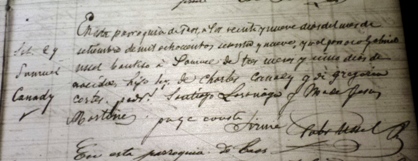
On this day in 1869, (Wednesday, September 29), three month old Samuel Kennedy was christened in Our Lady of Guadalupe Church in Don Fernando de Taos. He hadn’t been baptized sooner because he’d been born 25 miles east of town, at the foot of Taos Pass (today’s Palo Flechado Pass). It wasn’t a simple matter to get to Taos from what is now the Angel Fire area in those days.

Within a year, Samuel would be dead and his father about to die as a result. His father, Charles Kennedy (sometimes spelled Canady), had spent the last three years murdering and robbing men who visited the Palo Flechado cabin and Samuel’s teenage mother, Maria Gregoria, had kept silent. But in a fit of rage in late September 1870, Charles Kennedy killed his fifteen-month-old son and Samuel’s grieving mother finally took action. She fled twelve miles north to Elizabethtown to report her husband’s nefarious activities.

Samuel christening illustration

Justice was a little confused, but in the end it was served—at the hands of a lynch mob. Legend says Kennedy’s severed head ended up on a pike outside a local restaurant and saloon as a grisly reminder that even on the New Mexico Territory frontier, the death of a child would not go unrevenged.

For a fictional account of the Kennedy story, see my recently-published novel The Pain and The Sorrow (Sunstone Press).