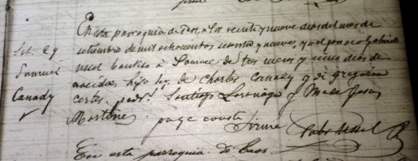
On this day in 1869, (Wednesday, September 29), three month old Samuel Kennedy was christened in Our Lady of Guadalupe Church in Don Fernando de Taos. He hadn’t been baptized sooner because he’d been born 25 miles east of town, at the foot of Taos Pass (today’s Palo Flechado Pass). It wasn’t a simple matter to get to Taos from what is now the Angel Fire area in those days.
Within a year, Samuel would be dead and his father about to die as a result. His father, Charles Kennedy (sometimes spelled Canady), had spent the last three years murdering and robbing men who visited the Palo Flechado cabin and Samuel’s teenage mother, Maria Gregoria, had kept silent. But in a fit of rage in late September 1870, Charles Kennedy killed his fifteen-month-old son and Samuel’s grieving mother finally took action. She fled twelve miles north to Elizabethtown to report her husband’s nefarious activities.
Justice was a little confused, but in the end it was served—at the hands of a lynch mob. Legend says Kennedy’s severed head ended up on a pike outside a local restaurant and saloon as a grisly reminder that even on the New Mexico Territory frontier, the death of a child would not go unrevenged.
For a fictional account of the Kennedy story, see my recently-published novel The Pain and The Sorrow (Sunstone Press).
The trapper studied the beaver pond carefully. The lodge lay to his left, a four foot high mound of mud and sticks surrounded landward by a thick stand of whip-like coyote willow. Water gurgled over the dam beyond it. Directly across the pond, on a small slick of mud, lay several short thin willow pieces, recently cut, carefully pealed.
The trapper slipped away from the pond and headed upstream, then waded into the icy water and back to the pond. He waded near the bank to within a few feet of the pealed sticks. He unslung the beaver trap from his shoulder and scraped at the bottom muck with his foot. He positioned the trap firmly in the mud, carefully set and baited it with castoreum, then retreated well upstream before climbing out. He headed back to camp to dry out. Now it was just a matter of time.
Alison straightened and put her gloved fists on her hips, pushing her shoulders back. Ten two-hundred foot rows of potato plants stretched before her. She twisted her torso, looking behind her and stretching her muscles at the same time. She had dug up the potatoes from about half a row. Full bushel baskets marked her progress. The yield was good this year, but her back was tired already.
She looked up. There were no clouds at the moment, except for a small gathering over Cimarron Canyon. An east wind was starting up, which meant rain at some point this afternoon or evening. She turned in a slow circle, looking up at the peaks surrounding her high Rocky Mountain valley. Snow dusted the tops of Baldy Mountain to the northeast and Wheeler Peak to the west. She went back to her digging. She didn’t have much time.
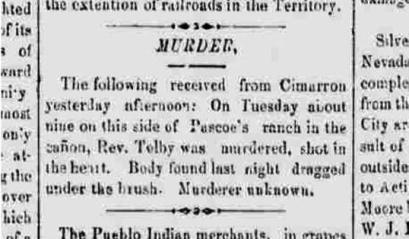
On Thursday, September 16, 1875, 142 years ago today, the body of Methodist missionary Franklin J. Tolby was found lying beside the Cimarron Canyon road near the mouth of Clear Creek, shot in the back. He’d been there two days, killed while returning from church services at Elizabethtown. His horse was tethered nearby and none of Tolby’s goods were missing. It was clearly a case of assassination and many people believed they knew why he was killed. But who did it and who’d ordered the killing? Those were the burning questions that some people believe were never answered.
Tolby had begun preaching vehemently against the Maxwell Land Grant & Railway Company almost as soon as he’d arrived in Colfax County in early 1874. The Company had bought the Beaubien-Miranda Grant from Lucien B. Maxwell and his wife four years before. The fact that the Grant boundaries were disputed wasn’t going to stop them from maximizing their profits from every bit of its roughly 1.9 million acres. They would use whatever means necessary to keep anyone they deemed a squatter off the Grant, even people the Maxwells had work/share agreements with prior to the sale.
Source: Las Vegas Gazette, Sept. 18, 1875
The 33 year old Reverend Tolby preached that the farmers and ranchers were more in the right than the Grant people. After all, the U.S. Department of the Interior had ordered the grant land to be treated as public, which made it available to homesteaders.
In addition, Tolby advocated that part of the grant be set aside a reservation for the bands of Utes and Arapahoes who traditionally hunted there. And he said so quite strongly.
Tolby became increasingly annoying to the Company, whose board of directors included Dr. Robert Longwill (Colfax County Probate Judge), Stephen B. Elkins (New Mexico Territorial delegate to Congress), and Thomas B. Catron (U.S. Attorney for New Mexico Territory), all members of the Santa Fe Ring and working hard to extract as much money as possible from the Territory in general and the former Maxwell Grant in particular.
Any of these men and their associates, including Cimarron Attorney Melvin W. Mills and its part-time Justice of the Peace (who was Mills’ office clerk) had reason to wish Tolby dead. After all, the Reverend was interfering with their business interests! But consensus among the anti-Grant folks in the County was that none of the Ring men were likely to dirty their hands with the actual deed itself. In fact, many suspected substitute mail carrier Cruz Vega of killing Tolby. After all, Vega’s Tuesday, September 14 mail route took him through the Cimarron Canyon, but he hadn’t reported seeing a body. This seemed mighty suspicious. Clearly, he knew something.
But Vega spoke only Spanish, which was a problem for the primarily English-speaking men who suspected him. They couldn’t find out what he knew. And they weren’t getting much help from the County’s Spanish-speaking population.
But there was another stubborn Methodist minister in Cimarron, and this one would prove to be even more tenacious than his predecessor. Rev. Tolby’s assistant Rev. Oscar P. McMains was now in charge, and he was hell bent on finding out what Vega knew. It would take six weeks before that confrontation occurred, and when it did it would create even more havoc. Stay tuned . . .
Sources: David L. Caffey, Chasing the Santa Fe Ring, UNM Press, 2014; Moreno Valley Writers Guild, Lure, Lore and Legends of the Moreno Valley, Columbine Books 1997; Chuck Parsons, Clay Allison, Portrait of a Shootist, Pioneer Book Publishers, 1983; Stephen Zimmer, For Good or Bad, People of the Cimarron Country, Stephen Zimmer, Sunstone Press, 1999.
Mary Tolby frowned at the potatoes she was peeling, then out the kitchen window at the dusty Cimarron sky. It seemed as if a grit-filled wind had blown every day of the eighteen months since she and Franklin had arrived here to begin his Methodist Episcopal mission work. Mary sighed, washed her hands, and lifted the towel sheltering her rising bread dough. It was taking longer than usual to double its size. But then, Franklin was taking longer than usual to return from his Sunday services at Elizabethtown. He was usually back before Tuesday noon, following his meeting with the church board and various other discussions on Monday.
Mary frowned and looked out the window again. There was so much dust in the air, she could hardly see the sun. Franklin was undoubtedly talking with someone in Etown or Ute Park about the Maxwell Land Grant and its wholesale eviction of the small farmers who’d been here before the present corporation had purchased the grant.
She shook her head and turned back to her work. She very much doubted that her husband was speaking with anyone about the state of their soul. Not many people in Colfax County seemed to care about God or religion. Land and water were all that mattered. That and gold. How she longed sometimes for Indiana!
* * *
Two days before, the man had hovered outside Etown’s tiny Protestant church just long enough to confirm that Franklin Tolby was preaching there. He couldn’t stay longer: the air sucked out of his lungs at the thought of Tolby’s teachings, so contrary to Holy Church. But it was long enough to confirm that the heretic minister would be traveling down-canyon this Tuesday morning, as he always did after a Sunday in Elizabethtown.
The man waited now, rifle tucked to his chest, in the shadow of the big ponderosa at the mouth of Clear Creek. How pleasant it would be to stop the minister’s preaching. The men who’d paid him to silence Tolby had other reasons for desiring his death, reasons of power and money and land. The waiting man cared nothing for those things, although the gold they’d given him would be useful enough. He could leave the grant now, take his family someplace where americanos had not yet stolen the land from those who farmed it, those whose fathers had tilled it before them.
He turned his head, listening. Someone was coming: A man singing a raucous heretical hymn. Tolby, most certainly. The minister would stop at Clear Creek as usual, to water his horse and drink from the hollowed-out wooden trough placed there for the refreshment of travelers. His back would be to the big ponderosa. But there was no dishonor in shooting a heretic in the back: a man who would steal one’s very soul if he could, destroy the very fabric of one’s Catholic life.
The rider in his clay-brown coat dismounted and the gunman eased into position. He held his breath as his finger touched the trigger, squeezing so gently and slowly that Tolby dropped to the ground before the shooter registered the sound of the bullet’s discharge, saw the neat hole it made in the brown coat.
The tiny Elizabethtown church reeked with the late June stench of unwashed miners, but Dr. Robert Longwill pressed through the door anyway. He could just see the top of Reverend Tolby’s blond head at the front of the room. On Cimarron’s dusty streets, the little man’s carefully groomed handlebar mustache had often given Longwill the urge to laugh, but here in Etown the miners weren’t snickering.
Tolby’s voice filled the room. “The Maxwell Land Grant Company has no right to the land on which your mines rest,” he said flatly. “You work the land and bring forth value from it. They sit in their offices and collect the rewards of your God-driven labor. Let us be done with such greed! Let us return to the scriptural truth that a man must work by the sweat of his brow and reap the labor of his hands!”
Dr. Longwill eased out the church door and down the hillside, toward the livery stable where he’d left his horse. “The man’s been here less than six months, and already he’s an expert on the Grant and the miners’ rights,” he muttered bitterly. Which wouldn’t be a problem, if the miners weren’t listening to him.
Andrew had pilfered some of the chicken feed and scattered it on the snow for the finches.
Suzanna shook her head as she looked out the window. “That child,” she said.
“What’d he do now?” his father asked. He was sitting near the fire, mending mule harness.
“How did you know it was Andrew I spoke of?”
“You had that tone.” He smiled at her.
A small boy appeared on the ladder from the loft as Suzanna said, “There is chicken feed scattered outside, and the chickens are still penned up against the cold.”
The boy stopped suddenly, then began retreating upward.
“That’s not gonna work, son,” his father said.
“Perhaps next summer you should gather grass seed and set it aside for the birds,” Suzanna said, without turning.
He came to stand beside her. “They’re pretty, aren’t they?”
“And you are incorrigible.” She reached out to ruffle his hair.
On Sunday, August 25, 1867, the miners of New Mexico Territory’s Willow Creek Mining District organized themselves for the second time that year. They’d done a rush job in June. With miners pouring onto the slopes of Baldy Mountain, there hadn’t been time for organizing and mining too. But it didn’t look like things were going to settle down any time soon: There were up to 7,000 miners in the region, and activity everywhere. On Willow Creek alone, over 350 placer claims would be staked between 1867 and 1868, from high up Baldy Mountain almost to the edge of what is now Eagle Nest Lake. With the staking of claims came the potential for conflict. The only answer was to take the time to reorganize, and Sunday seemed as good a day as any.
The new Willow Creek rules allowed four claims per miner. A man could file a ravine claim (200 feet along the bottom and from bank to bank); a hill claim (200 feet along the stream by 300 feet toward the ridge), a flat claim ( 300 feet by 300 feet); and a quartz or lode claim (300 feet along the lode, with no specified width). In addition, a man who discovered a new creek, hill, flat, or load claim could also file one extra claim of any of the four types. To be considered “alive,” a claim had to be worked one day in every ten and at least once within the 15 days after it was recorded.
The Willow Creek Mining District lay on the south slopes of Baldy Mountain, much of it within the boundaries of the 20th century town of Eagle Nest, NM. The District was bounded on the east and north by the ridges that extended south from Baldy, and on the west by a divide that separated the creek’s drainage from Anniseta Gulch, which ran west in the direction of Moreno Creek and Elizabethtown.
While it never produced much lode gold, the Willow Creek District yielded well to placer operations. In fact, at one point, the main channel of Willow Creek was the highest producing creek bottom along the south and west slopes of Baldy Mountain, topping both Humbug Gulch and Grouse Gulch (see the table below). In addition, a Willow Creek side canyon called Last Chance Gulch and an area at the head of this gulch called Last Chance Flats, were both rich in gold. As a result, the District’s placers brought in 40% of the area’s placer gold in 1868 and 1869 and remained just behind Grouse Gulch’s placer production throughout the next decade.
The high levels of gold from Willow Creek may explain why there were at least twenty miners involved in an 1869 court fight over placer claims and water rights on the creek. The battle was not resolved until Spring 1870, when Lucien Maxwell intervened, purchased all the water rights in question, and then proceeded to lease them back to just a handful of individuals. Even though Maxwell was in the process of selling the land grant, he was keeping the Willow Creek Mining District water rights—perhaps its most lasting wealth—firmly in his own hands.
Sources: R. F. Pettit, Jr. “History of mining in Colfax County, New Mexico,” Taos-Raton-Spanish Peaks Country (New Mexico and Colorado), Northrop, S. A. & Read, C. B., eds., New Mexico Geological Society 17th Annual Fall Field Conference Guidebook, 128 p., 1966; R. F. Pettit, Jr., Mineral Resources in Colfax County, NM, NMBM&MR Open-File Report 15, 1946; Colfax County New Mexico real estate records.
Harry nudged the cow pony with his heels and she trotted out to edge the spotted cow and its calf back into the bunch moving downhill toward the creek. While the pony did her work, Harry turned his attention to the trees topping the rise on his left. He’d been through them once already, but he had a suspicion he’d missed something. Then he saw it. A massive black bull rose slowly from a hollow in the ground, gazed at the herd below, then turned and headed into the trees.
Harry sighed. “Collect ’em all,” Gallagher had said. “Even the bastards.”
The cow and calf were now meandering alongside the rest of the herd, which continued its downward trek.
Harry turned his pony’s head toward the rise. The bull was nowhere to be seen. Harry shook his head. Damndest thing, herding cows up here. Too many trees entirely. When he got his month’s pay, he was headin’ to Cimarron, maybe beyond. Out on the plains, where people knew how to ranch. No more mountain valley cowpunching for him.
Those of you who are members of a book club may be interested in knowing that there’s a Readers Guide included in The Pain and The Sorrow. The guide is also available here, so you can take a look at it and decide whether the book might be a good fit for your club. Remember, you can order the book online or from your local bookstore! I hope you’ll consider adding the book to your 2018 line up!

 Fiction and Fact From Old New Mexico