The newest book in my Old New Mexico series went live this morning! Please help me welcome No Secret Too Small! This novel is set in New Mexico in the late 1830s, during what is popularly known as the Chimayó Revolt. If you’ve seen my historical blog posts in the last couple months (start here), you know a little about that event.
The story is from the perspective of Alma Locke, the eight-year-old daughter of Gerald and Suzanna. Gerald and Suzanna have been married almost ten years. In that time, he’s never told her that his grandmother was a runaway slave.
When Gerald’s father shows up in the valley, the truth comes out. Suzanna is furious. She leaves the family’s New Mexico mountain home and takes Alma and six-year-old Andrew with her. As she and the children reach Santa Fe, revolt breaks out and Alma and Andrew are exposed to sights no child should ever have to experience.
This trauma and the prejudice they experience because of their heritage makes Alma long for home.
But even if her mother can forgive past secrets, the way back to the valley is now blocked by winter weather and entrenched rebels. Will Alma’s family ever be reunited?
Early readers agree that this is a heart-breaking yet ultimately triumphant story about secrets, prejudice, love, and the impact of adult conflict on our children.
I hope you’ll think so, too! Here’s the link for the ebook. I’ll post the ones for the paperback as soon as they’re available.
This book is set in 1837 against the backdrop of what is commonly known as New Mexico’s Chimayó revolt. However, the story is centered on the relationships of the Locke family. I don’t want to give away too much of the plot here, but I will say this: when Suzanna and the children leave the valley, they end up at Chimayó for a while, where Suzanna gets instruction from a master weaver in both spinning and weaving.
My primary source for the weaving scenes in this book was Chimayo Weaving by Helen R. Lucero and Suzanne Baizerman. However, I had trouble visualizing how drop spindle spinning is done. This video of Navajo weaver Clara Sherman came to my rescue. I hope you learn as much from it as I did!
“I had me a little señorita once,” the old trapper said. “She was a real firecracker, that one. I never did learn Spanish real good and she could pull herself up all royal like and tighter’n a beaver trap all set to snap and not near as useful. She’d start spittin’ Spanish at me like some kinda wildcat and I didn’ know what she was sayin’ but I knew enough to let her be ’til she got over her fuss. She’d push her black hair away from her fire-flashin’ eyes and let out with ‘Es más feo que un dolor de estómago!’ and then she’d yell ‘Es más sabio que Salomón!’ I didn’t know a word o’ what she was sayin’ but I could tell from her tone that it was high time to skedaddle on outa there and go huntin’.”
The old man shook his head. “Guess I went huntin’ one too many times, ’cuz one day I come back with a nice big cougar pelt and she was done gone. Too bad. That was the prettiest skin I ever saw.”
He leaned forward. “What’s that you say? I was uglier’n a stomach ache and thought I was smarter’n King Solomon? That’s all she was sayin’? Here I was sure she was ready t’ take a knife t’ me or send her brother Sol t’ do it for her. An’ all she was doin’ was grumblin’? Hah! Well, if I’da known that I mighta stuck around more and tried lovin’ her back into some kinda reason. She sure sounded god awful unreasonable at the time.”
The old man sat back, clicked his tongue against his teeth, and shook his head. “Huh, ” he said. “You don’t say.”
However, Armijo was convinced the insurgency would erupt again. Before he left the capitol for Albuquerque in mid-October, he gave Captain Jose Caballero explicit instructions about what to do if this happened—the imprisoned rebels were to be executed at once.
Early the morning of Wednesday, October 18, it appeared that Armijo’s orders would need to be carried out. Word reached the capitol that the rebels were rallying in the mountains east of Santa Cruz, where the August insurgency had been headquartered. Armijo got the news in Albuquerque about the same time Caballero did in Santa Fe. The next day, he sent a letter north, ordering that the four hostages be executed.
But on Friday, the Captain staged a small rebellion of his own. When he received Armijo’s instructions, he didn’t follow them. Instead, he called a meeting of Presidio officers to consider how to respond. He had several concerns with Armijo’s directive. For one thing, the prisoners had still not been formally tried for their crimes. Also, there was a good chance that following Armijo’s orders would inflame revolutionary sentiment in Santa Fe instead of quelling it. And the garrison wasn’t at full strength. Successfully putting down a full-scale revolt would required reinforcements.
Given all this, Caballero and his officers decided they would obey Armijo’s orders only if and when there was an imminent threat to the city and they had the forces necessary to repel it. The prisoners would be executed only if the rebels attacked. On Sunday, Captain Caballero sent a formal letter south to Armijo, explaining what he was doing and why. Although the missive was in his name, the other men signed it.
Some of the signatures on Captain Caballero’s letter. Source: New Mexico State archives
The governor was not happy when he received this news. Early the next week, he responded with a letter criticizing Caballero’s decision. But he didn’t overturn it. And he sent a troop of active Albuquerque militia north to help in case of attack.
It was all a moot point anyway. The rebel threat dissipated. The men in the Santa Fe jail would live several more months, though Governor Armijo’s orders were eventually implemented. When rebellion burst out again in early 1838, the four prisoners were publicly garroted.
There are still historians who wonder if this action was really necessary. The threat of the executions didn’t stop the rebels from rising or keep the subsequent battle from being any less bloody. But Armijo did get the last word.
Sources: Lansing B. Bloom, “New Mexico Under Mexican Administration,” Old Santa Fe Magazine, Vol. II, Santa Fe: Old Santa Fe Press, 1914-1915; Paul Horgan, Great River: The Rio Grande in North American History, Middleton: Wesleyan University Press, 1984; Janet Lecompte, Rebellion in Rio Arriba, 1837, Albuquerque: UNM Press, 1985; F. Stanley, Giant in Lilliput, The Story of Donaciano Vigil, Pampa, TX: Pampa Print Shop, 1963.
I’m pleased to announce that the sequel to Not My Father’s House will be released Thursday, November 5.
This is No Secret Too Small,the book set during New Mexico’s 1837 tax rebellion, the series of events commonly called the Chimayó Revolt. If you’ve had a chance to read my historical blog posts in the last couple months (start here), you know a little about the revolt. It provides the background for No Secret Too Small, which centers on the Locke family’s personal upheaval.
The story is from eight-year-old Alma’s perspective. Ten years ago, her father, Gerald, chose not to tell her mother, Suzanna, that some of his ancestors were born in Africa. When Gerald’s father shows up in the valley, Alma’s mother learns the truth.
Stunned and furious, Suzanna leaves the family’s mountain valley and takes Alma and six-year-old Andrew with her. Gerald allows the children to go because he believes they’ll be safer with their mother than with him in the mountains.
However, as Suzanna, Alma, and Andrew reach Santa Fe, revolt breaks out and the children are exposed to sights no child should ever have to experience. This trauma and the prejudice they experience because of their heritage makes Alma long for home.
But even if her mother can forgive past secrets, the way back to the valley is now blocked by winter weather and entrenched rebels. Will Alma’s family ever be reunited?
Early readers agree that this is a heart-breaking yet ultimately triumphant story about secrets, prejudice, love, and the impact of adult conflict on our children.
I hope you’ll think so, too! You can pre-order the ebook here. I’ll post the sale links for the paperback as soon as they’re available.
If you haven’t had a chance to read Diana Holguin-Balough’s excellent book Rosary Without Beads, now’s your chance to get an audio copy to listen to! See below for details.
The two trappers had met by chance in the Gila wilderness: Old One Eye Pete hunting beaver on his lonesome, the way he liked it, Marion Buckman on a scout to find his son Jedediah. Jed was with a large trapping group, out from Taos a good three months longer than expected. His father was sure in his bones that something was wrong and, against all advice, had taken out after them.
One Eye Pete was on his fourth straight day of spotting Apache sign when he came across the elder Buckman. Given the circumstances, Pete felt right pleased to encounter another white man, despite his preference for trapping alone.
Buckman had been out six weeks. He was hunting blind at that point and about ready to give up. Pete convinced him that there was always a chance that they’d run across evidence of Jedediah’s bunch up one stream or another. They might as well collect some furry bank notes while they were looking and before the Apaches got wind of them and they were forced back to the settlements for good and all. So he and Buckman located a likely creek in the bottom of a small canyon and followed it, watching for beaver sign.
The west end of the third pond looked promising. Pete leaned his rifle and gear against a downed cottonwood and waded into the water to make the first set. He’d just shoved the trap stake into place when Buckman let out a grunt, as if someone had slugged him in the gut. Pete jerked around, his hand to the pistol at his waist, but Buckman was unhurt and staring wide-eyed at the barren ridge north of the creek.
“Apache?” Pete asked.
Buckman shook his head, his eyes still fixed on the ridge. He took off his hat and ran his fingers through his graying hair as he stared upward. Then he blinked and looked at Pete. “I thought—” He shook his head again, his eyes puzzled. “I thought I saw Jed.”
Pete turned and squinted at the ridge with his good eye. There did appear to be something moving up there, just below the canyon’s rim. Somebody hunched over and doing his best to stay below the ridgeline and unseen. Pete moved cautiously out of the water and reached for his rifle. “Let’s just wait and see,” he said.
Buckman refocused on the ridge. “There’s three of ’em. I can tell that much. And they look to be white men. See the rifles?”
Old Pete studied the side of the slope. Sunlight glinted from a gun barrel. “I see one of ’em,” he said.
“Injun’s ’ll dull down the barrel,” Buckman said authoritatively. “White men like to keep ’em shiny-like. My Jed’s real partic’lar ’bout that.”
Pete nodded and didn’t say what he was thinking: that any man fool enough to polish his rifle barrel deserved the shooting he was likely to get. Instead, he watched the men above work their way around and between the boulders scattered across the slope. As they got closer, he saw that they were dressed like white men, in woolen trousers and low moccasins, rather than Apache breech clouts and tall leg-protecting footwear.
Beside him, Marion Buckman made a sucking sound between his teeth. “It is him!” he hissed. Then he plunged along the bank to where the stream narrowed just below the beaver dam.
“You sure about that?” One Eye Pete asked. But he followed anyway. There was no sense in letting the man walk alone into a trap. After all, Buckman’s concern for his son was something to be admired, even if it did lead them both into danger.
Pete paused at the base of the dam and squinted again at the men on the slope. The middle one raised his head and registered the trappers below. He lifted an arm and waved it wildly until the man in front of him turned and raised a warning hand. Then the three of them went back to working their way down through the rocks.
Definitely white men. Old Pete shrugged. Unless they had Indians tracking them, he and Buckman were safe enough. And if Apaches were indeed following them, they’d all be in for it, anyways. He followed Buckman across the creek.
The other man was already angling through the brush toward the bottom of the ridge, on a line that would intersect the path of the descending men. Suddenly, he disappeared behind a boulder twice the height of a man. Old Pete heard a voice shout “Pa!” and then silence.
When Pete rounded the big rock a few minutes later, he found Buckman holding a younger man by the shoulders while two other men looked on, their faces streaked with dirt and lank with exhaustion.
Marion Buckman turned, his face wet with tears. “My son,” he said. “My Jedediah. I found him.”
The fall of 1837 was a tense time for the people of Santa Fe. Not only was the capitol invaded by rebels in August, but there was another threat in late September. Then after former Governor Manuel Armijo fended that off, a different kind of incursion began. Refugees started arriving in town.
Most of the newcomers came from down river, following the militia, men who were ordinarily tasked with keeping the settlements there safe. With the militia now in Santa Fe, these villages were susceptible to raids from the First Nation groups New Mexicans called the “wild tribes”—primarily Apache in the south and Navajo in the west.
While the Apache seem to have contented themselves with raiding Chihuahua-bound merchant caravans, the Navajo went after the settlements, venturing as close to Albuquerque as Bernalillo and as far northeast as the Taos Valley. New Mexico’s unrest was a great opportunity for the Navajo warriors to supplement their sheep herds and perhaps pick up a few captives to replace people taken by New Mexicans in earlier raids. In response to the danger, New Mexican families who could afford to do so headed to Santa Fe.
Almost 75 years later, one of those refugees, a boy who turned eight that winter, left behind a record of what the capitol was like during that time. Jose Francisco Perea’s family arrived in early October from Bernalillo. “We found the place full of soldiers, citizens, and a miscellaneous gathering of humanity,” he recalled. The plaza was “crowded with all kinds of vehicles, beginning with the cart that was made entirely of wood . . . to the well-constructed wagon that had brought a consignment of merchandise over the Santa Fe Trail; together with teamsters, camp-cooks, roustabouts, horses, mules, burros, pigs and goats. Some were about their camp-fires, preparing their food, while others were feeding and caring for their animals. Near the northeast corner of the plaza, which was then surrounded on its four sides with flat-roofed one-story buildings, with portals (porches) in front of them, were three cottonwood trees of the mountain variety, and opposite the Palace (the capital) stood a flagstaff (pirome), from the top of which was displayed the Mexican flag in all its glory: and the four entrances at the corners of the square were guarded, each with a single cannon of small caliber.”
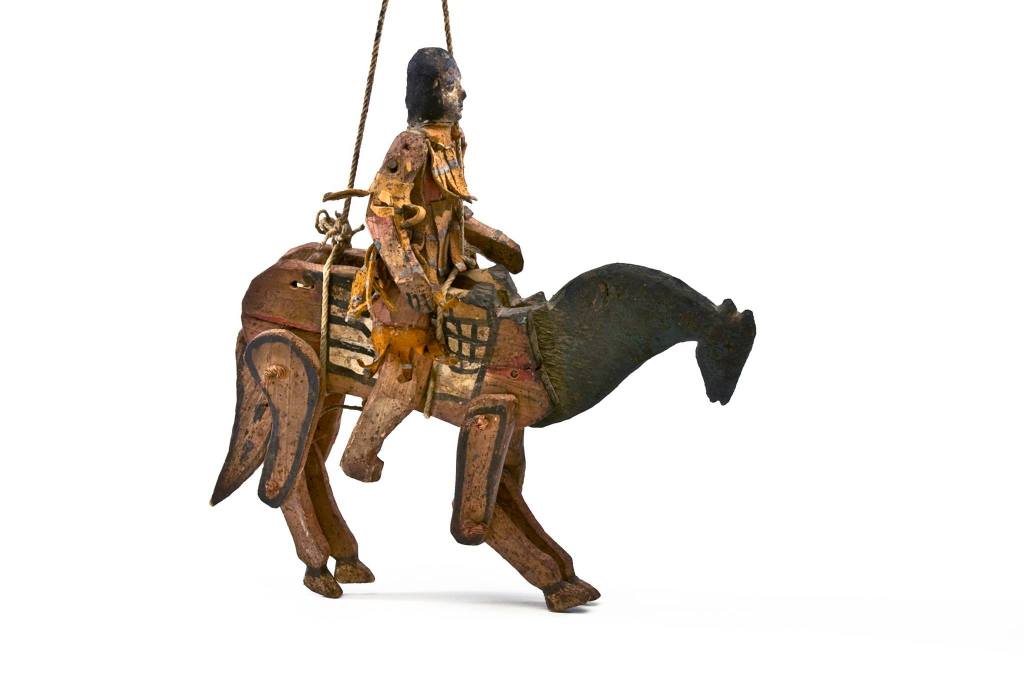
What seems to have fascinated him even more was the entertainment available. “Dancing was much indulged in,” he reported. “Particularly during Sunday nights and evenings following marriages, baptisms, and feast days. Theatricals, principally rudely constructed after the writings of Cervantes (Don Quixote de la Mancha) and Gil Blas, were occasionally played. . . Some of these were played with figures and images hung on strings, to be moved about when required.”
A marionette from Old New Mexico. Source: New Mexico History Museum
He also apparently peaked into establishments “where wine and other liquors were sold by the drink” and gambling occurred. These games of chance included Spanish monte, three-card monte, roulette, and dice. For boys Francisco’s age, there were outside games such as pitarria, played on smooth ground inside a marked square with short sticks of two colors, and quoit pitching at pegs driven into the ground. When he tired of games, he could watch dancers from the nearby pueblos perform on the plaza.
It was all quite an education for the young Perea, one supplemented by three months of classroom experience. Some time in January 1838, he and his younger brother began attending a school run by a Captain Sena and his wife. This ended when the Perea family returned to Bernalillo in late April, but his Santa Fe adventures were only the beginning of Jose Francisco Perea’s experience of the world beyond his family’s hacienda. As an adult, he would return to Santa Fe to sit on the New Mexico Territorial Council. During the Civil War, he would fight for the Union as a Lieutenant Colonel and would later serve as New Mexico’s Congressional representative in Washington, D.C.
He would also leave behind an evocative glimpse of Santa Fe in the winter of 1837/38, one for which we storytellers are quite thankful.
Sources: W.H.H. Allison as narrated by Col. Francisco Perea, “Santa Fe During the Winter of 1837/38.” Old Santa Fe Magazine, Vol. II, Santa Fe: Old Santa Fe Press, 1914-1915; James F. Brooks, Captives and Cousins: Slavery, Kinship and Community in the Southwest Borderlands, Chapel Hill: U of North Carolina Press, 2002; Janet Lecompte, Rebellion in Rio Arriba, 1837, Albuquerque: UNM Press, 1985; F. Stanley, Giant in Lilliput, The Story of Donaciano Vigil, Pampa, TX: Pampa Print Shop, 1963.
On Monday, September 18, 1837, word reached Santa Fe that the rebels who had been so successful in August were approaching the capital again. The threat of Manuel Armijo’s troops wasn’t enough to keep them away.
And Armijo had a crises of confidence. He who’d been named head of the New Mexico militia by his rico compatriots asked Judge Juan Estevan Pino to take command. When Pino declined, Armijo’s political skills kicked in. He might not know military tactics, but he did know people.
He sent word to the rebels that he wanted to negotiate. Pablo Montoya, now head of the rebels, took the bait. The insurgents camped five miles north of the capitol and negotiations commenced via correspondence.
New Mexico Governor Manuel Armijo
Eventually, Armijo invited Montoya to come into town to talk. The talks, though somewhat contentious, were ultimately successful. The rebels agreed to dissolve their organization, turn over four of the initial instigators, and recognize Armijo as New Mexico’s political and military leader.
The negotiations were undoubtedly facilitated by the fact that the rebels were short on guns and ammunition, and—without Jose Angel Gonzales’ presence—military organization and discipline. In addition, not all of them considered Armijo an enemy. He had a track record as a former governor who did what he could for the people of New Mexico, even if it meant bending or judiciously ignoring Mexican law.
The treaty was signed on Thursday, September 21, and the rebels disbanded. The conflict was over. But not really. As part of the deal, Jose Angel Gonzales was released from the Santa Fe jail where he’d been lingering the last couple weeks. He was back in Chimayo with his wife and family by the end of the month.
It was a decision Armijo would live to regret. Rebellion still stirred in northern New Mexico. It wouldn’t break out again in full force until the following January, but it would break out. Armijo’s political and verbal skills delayed the conflict, but they didn’t end it.
Sources: Lansing B. Bloom, “New Mexico Under Mexican Administration,” Old Santa Fe Magazine, Vol. II, Santa Fe: Old Santa Fe Press, 1914-1915; Fray Angelico Chavez, But Time And Chance,The Story of Padre Martinez of Taos, 1793-1867, Santa Fe: Sunstone Press, 1981; Janet Lecompte, Rebellion in Rio Arriba, 1837, Albuquerque: UNM Press, 1985; Rubén Sálaz Márquez, New Mexico, A Brief Multi-History, Albuquerque: Cosmic House, 1999; F. Stanley, Giant in Lilliput, The Story of Donaciano Vigil, Pampa, TX: Pampa Print Shop, 1963.
In the middle of the night, the baby began wailing frantically.
“¡A redo vaya! Good heavens!” Ramona said, sitting up in bed. As she slipped from the blankets, Carlos grunted but didn’t open his eyes. Ramona paused to look down at him, and shook her head. How a man could sleep through that much crying was beyond her comprehension. He must be very tired from the digging he did for the Baldy Mountain miners every day.
As she crossed the room to the baby, she rubbed her ears with her fingers. The Spring wind was howling, which always made them uncomfortable.
She lifted Carlito from his blankets and opened her nightdress. He began suckling eagerly, whimpering a little as he did so, and rubbing his free hand against the side of his head.
So his ears were uncomfortable, too. She looked down at him as she walked the floor, and sighed. He had a lifetime of discomfort before him and there was nothing she could do about it.



 Fiction and Fact From Old New Mexico