Didn’t I Already Write This Book?

Didn’t I Already Write This Book?

When I finished writing No Secret Too Small, I had every intention of moving directly into another novel about the Locke family and their friends, this one focusing on the 1841 Texan Santa Fe Expedition.

But New Mexico’s 1837 revolt wouldn’t leave me alone. I kept thinking about all the people who’d been involved on both sides of the rebellion and how little I’d been able to plumb the depths of their experience in No Secret Too Small. There was so much more to explore.

“What did it feel like to be there?” is always the first question I ask about historical events. For example, how did it feel to be Governor Pérez on the night he fled Santa Fe? Why did he return the next day? What was Taos Pueblo-born José Angel Gonzalez’s reaction to replacing Pérez? What was it like for him to try to govern a divided New Mexico? And what exactly was Manuel Armijo doing in the meantime?

And all the others: Santa Cruz de la Cañada alcalde and rebel leader Juan José Esquibel. Gambling salon owner Gertrudes “Doña Tules” Barceló and the women who went with her to the rebel camp. Padre Antonio José Martínez  of Taos, trying to keep the rebels there in check. The children of the families who refugeed to Santa Fe. The spouses of the rebels. What was it like for them?

I just couldn’t let it go. I had to tell their stories. But whose should I tell? The rebels? The government officials? The refugees? Any point of view I chose limited my ability to explore the full complexity of events, reduced my scope for examining the class differences, long-standing racial divides, and deep-seated frustrations that I believe lay behind the rebellion’s more immediate precipitating factors.

So I decided to take a huge risk and tell all the stories in one book. Well, not really. But at least part of them. All the points of view. Each section of the forthcoming There Will Be Consequences (February 2022) moves the narrative forward in time and tells that portion from a different perspective, including the wife of a rebel leader, Pérez, Doña Tules, Gonzales, Esquibel, Armijo, Martínez , and others.

Is this too many points of view? My editor tells me it works. I’ll be interested to hear what you think.

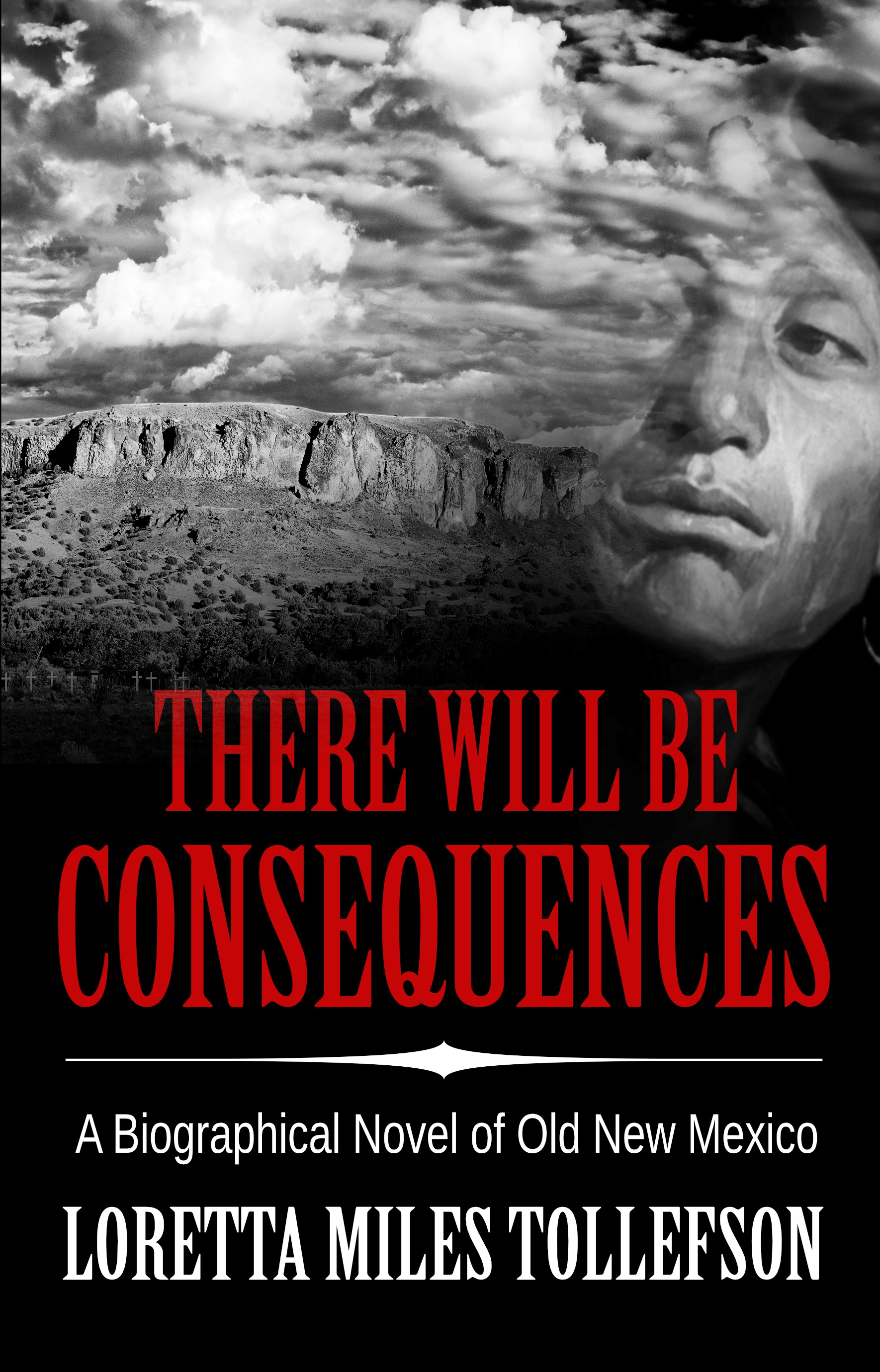
Cover Reveal, There Will Be Consequences

Cover Reveal, There Will Be Consequences

Here it is, the cover of my forthcoming biographical novel There Will Be Consequences! Thank you to everyone on my author Facebook page who provided feedback about the image and color options!

I’m very pleased with the end result and want to give a huge shout out to D.K. Marley at TheHistoricalFictionCompany.com for her design work on this.

You can find information about There Will Be Consequences at Amazon and Books2Read. Ebook preorders are now open!

Deep In The Heart of 1837

Deep In The Heart of 1837

If it seems like I’ve been a little disengaged lately, it’s because I’ve been deep in the heart of 1837 New Mexico again, working on another novel about the tax rebellion that occurred here in the winter of 1837/38.

If you’ve read No Secret Too Small, you know I’ve already written a novel about these events. That story was from the point of view of a child whose family drama ultimately took precedence over even a governor’s grisly death.

This new novel, There Will Be Consequences,focuses on the adults who participated on both sides of the 1837/38 rebellion. This book is a departure for me in that it contains only people who actually lived through the events in the story, including Governor Albino Pérez, rebel leader José Angel Gonzales, Santa Fe gambler Gertrudes “Doña Tules” Barceló, Taos priest Antonio José Martinez, and that most flexible of New Mexico’s politicians, Manuel Armijo. It dives deeply into their responses to events and the rationale for their actions.

I’m excited about this book. Writing “real” characters was a challenge, but invigorating at the same time. I’m looking forward to seeing what you think of it! Watch this space for more information and the cover reveal/preorder link on November 10!

New Old New Mexico Ebook Set Available!

New Old New Mexico Ebook Set Available!

I’m pleased to announce that the first three novels of my Old New Mexico series, Not Just Any Man, Not My Father’s House, and No Secret Too Small are now available in ebook form as a “boxed set” titled The Locke Family Saga.

This story of secrets, prejudice, and the power of love, is told in three books, each from the perspective of a different family member. 

In Not Just Any Man, Gerald must survive the Sangre de Cristo mountains, the Mohave Indians, the arid south rim of the Grand Canyon, and the fellow trapper who hates him for the color of his skin before he can return to Taos and the girl he hopes is waiting for him. Can he prove to himself and to her that he is, after all, not just any man?

In Not My Father’s House, Suzanna does her unhappy best to adjust to married life in an isolated valley of the Sangre de Cristos, but postpartum depression, the cold, and the lack of sunlight push her to the edge. However, the mountains contain a menace far more dangerous than Suzanna’s internal struggles. The man Gerald killed in the Gila wilderness two years ago isn’t as dead as everyone thought. And his lust for Suzanna is even stronger than his desire for Gerald’s blood.

In No Secret Too Small, 1837 New Mexico is teetering on the verge of revolution when the Locke family experiences an upheaval of its own. Eight-year-old Alma’s father, Gerald, has never told her mother that his grandmother was a runaway slave. When his father shows up, the truth comes out. Stunned and furious, Suzanna leaves, taking Alma and six-year-old Andrew with her. However, by the time they reach Santa Fe, rebellion has broken out. Will the Locke family survive the resulting chaos? 

The Locke Family Saga is available at your favorite ebook retailer, Amazon.com, and Barnes and Noble.

BENT’S FORT

BENT’S FORT

“After what you been through these last couple weeks, I’d of thought you’d be right tickled to get inside four solid walls,” the old man said. He pulled off his boots and lay back on the thin pallet with its mangy once-green wool blanket. His socks were black with grime. The stench of them in the windowless room turned Timothy’s stomach.  

“I’ll sleep out,” Timothy repeated. “I suppose I’ve become used to having stars over my head at night.”

The teamster shrugged and stretched his arms luxuriously. “Me, I seen too many downpours,” he said. “Give me a dry bed under a solid roof and I’m in heaven, for sure. All I want to finish it off is a woman.” He propped himself up on one elbow, eyes bright. “You think you could do somethin’ about that third item while you’re out there?”

Timothy laughed. “I don’t speak Indian.”

“Ah, all you need is whiskey and a kiss. And you’re a good lookin’ cub. You probably wouldn’t even need whiskey.” The old man grinned toothlessly. “But you wouldn’t likely bring me that kind of gift, would you now? I know I sure wouldn’t if I was you. Guess I’ll just hafta see what I can rustle up for myself.” He sat up and reached for his boots.

Timothy chuckled and moved to the door. “Good luck with getting all three of your heavenly requirements,” he said.

“Huh?” The teamster was spitting on his hands, then using the moisture to slick back his grimy hair. He stopped his grooming process and frowned. “What requirements?”

“Bed, roof, and woman,” Timothy explained. “Me, I think I’ll just settle for a nice quiet bed.”

“Good luck.” The old man chuckled. “What with those two mule trains that followed us in here this afternoon, I doubt you’re gonna find a quiet spot anywhere near this old fort.”

from Valley of the Eagles

Image by Mike Goad from Pixabay

200th Anniversary of the Santa Fe Trail

200th Anniversary of the Santa Fe Trail

This Fall marks the 200th anniversary of the opening of the Santa Fe Trail between Missouri and New Mexico. The article in the link below provides an overview of what happened and why the Trail is important in the history of the United States and New Mexico.

https://www.nps.gov/places/santa-fe-national-historic-trail.htm

What’s the Big Deal About the Santa Fe Trail?

This Fall marks the 200th anniversary of the opening of the Santa Fe Trail from Missouri to New Mexico. I was going to write a piece about why the Trail was important to the U.S., then I found this. I think it pretty much covers everything I was going to say…..

https://www.nps.gov/articles/000/becknell-s-1821-journey-to-santa-fe.htm

JUST A MAN

JUST A MAN

“I seen him! I seen him!” The boy stopped, breathless, just inside the kitchen door.

“You mean you saw him.” His mother shook her head at him as she lifted the lid from the Dutch oven in the fireplace to check the biscuits. She smiled. “Who did you see?”

“Kit Carson! He was on the other side of the street, going into the Governor’s house.”

She nodded. “I heard this morning that he was back. What is he like?”

His shoulders sagged. “He didn’t look anything like the pictures in the book Grandpa gave me when we left Kansas City.”

“That was just a story,” she pointed out. She turned to stir the great pot of venison stew.

“I know,” he said. “But he wasn’t what I expected at all. He’s just a man.”

Copyright ©2013 Loretta Miles Tollefson

Image by Mike Goad from Pixabay

William Becknell and the Santa Fe Trail

William Becknell and the Santa Fe Trail

About this time 200 years ago, a man named William Becknell was on his way from Missouri to the Rocky Mountains to trade with the Indians. Or so he said. This is his story, as told by the Kansas Genealogy website. I love the old-fashioned language used in this report. I think it may closely reflect how he would have described what happened. I hope you enjoy it as much as I do.

Captain William Becknell

“The first successful venture to Santa Fe over the Santa Fe Trail was made by Captain William Becknell. With him, according to Gregg, were “four trusty companions.” They left Arrow Rock, on the Missouri, near Franklin, but in Saline County, September 1, 1821. On the 13th of November they met a troop of Mexican soldiers, who prevailed upon them to voluntarily go, in their company, to Santa Fe, whither they were returning. At San Miguel they found a Frenchman who acted as interpreter for them. They were accorded a friendly reception at Santa Fe and provided the facilities necessary to dispose of their goods. These sold at such rates as astonished the Missourians, calicoes and domestic cotton cloth bringing as much as three dollars a yard. The enterprise proved most remunerative. The party set out on the return journey on the 13th of December and reached home in forty-eight days.

That adventure may be said to have established the Santa Fe trade, and Captain Becknell had justly been called the father of the Santa Fe Trail, for that which he followed was accepted as The Trail from the Missouri River to Santa Fe.

The favorable termination of the trading-journey of Captain Becknell being extensively told on the borders of Missouri, others determined to engage in that commerce. Colonel Benjamin Cooper organized a company which left Franklin for Santa Fe early in May, 1822. His nephews, Braxton, and Stephen Cooper, were members of the party, which numbered some fifteen souls. They carried goods to the value of some five thousand dollars to Taos, using pack-horses. The result of the expedition must have been satisfactory for the Coopers remained in the trade for some years, Braxton Cooper meeting his death at the hands of the Comanches some years after this first trip across the Plains.

Captain Becknell was resolved to continue in the trade which had given him such good returns. Within a month after the departure of Colonel Cooper he again took the trail from Franklin to Santa Fe. The value of his cargo was about five thousand dollars, and there were thirty men in the expedition. On this journey he abandoned the use of packhorses and used for his transportation, wagons drawn by mules, the first wagon-train over the Santa Fe Trail and the first to cross the Great Plains. It was four years before Ashley took his wheel-mounted cannon into the valley of the Great Salf Lake, eight years before Smith, Jackson & Sublette went into the Wind River country with wagons, and ten years before Captain Bonneville drove wagons into the valley of Green River. This first caravan to depart from the usual means of transportation used three wagons.

This second expedition of Captain Becknell was the pioneer party over the Cimarron Route of the Santa Fe Trail. Captain Becknell had, through his travels, conceived the true geography of the Southwest. It was plain to him that the nearest way to Santa Fe from the Arkansas River was to the southwest by the Cimarron. When he had arrived at that point afterwards known as the “Caches” he turned south. He was not familiar with the country which he was entering. It bore a desert aspect and proved entirely destitute of water between the Arkansas and the Cimarron. The supply carried in canteens was exhausted at the end of two days. It seemed that they were destined to die of thirst on those parched and blasted plains. They killed their dogs and out off the ears of their mules to drink the blood, but this desperate expedient served only to aggravate their suffering. The mirage taunted them with the appearance of water rippling against the shores of false lakes. They had, however, come near the Cimarron without knowing it. They resolved to turn about and try to regain the Arkansas, something they never could have done. In the last extremity, when despair was settling upon them, some of the party observed a buffalo coming up from a depression they had not before seen. It seemed to come up as from the depths and stand upon the burning plain with distended sides, as though gorged with water. It was immediately killed and opened. The stomach was filled with water taken but a few minutes before from the Cimarron. This filthy water was drunk as nectar from paradise. Search was at once made for the stream whence had come this lone providential buffalo, and the Cimarron was found. Water was carried back by the refreshed travelers to those perishing on the desert, and the party was saved. The journey was continued over that route, and water was fortunately found in quantities sufficient to enable the party to reach San Miguel.

The misfortunes of the party under Baird, which went out in 1812, the members of which were imprisoned so many years at Chihuahua, did not quench the passion for trade over the Plains in their leader. In 1822 he induced some adventurers at St. Louis to join him in taking a trading expedition over the Santa Fe Trail. He was joined also by Samuel Chambers, who had aided in securing the cargo to be carried, and who had descended the Canadian in 1821. The expedition consisted of some fifty men and an ample supply of horses and mules. It left Franklin late in the season and was overtaken by severe weather on the Upper Arkansas. It took refuge on an island in that river, no doubt for the reason that it was covered with willow and cottonwood timber. So rigorous did the winter prove that these men were compelled to remain there three months, and most of their animals perished from exposure and starvation. This calamity left them without the means to carry their merchandise into New Mexico. They were under the necessity of concealing their goods there while they went to New Mexico for horses and mules to carry in their lading. They left the island and went up the north bank of the river some distance where they dug pits or “caches” in which they placed their goods, covering them in very carefully. They then went to Taos, where they secured the necessary animals, with which they returned and on which they packed their merchandise to that town. The several pits were left unfilled when the goods were removed, and they stood open there on the Trail for many years. In Gregg’s day they were still open and their walls were covered with moss. They came to be a marking point on the Trail, and this point was known as the “Caches.” The “Caches” were about five miles west of the present Dodge City, Kansas.

In the year 1823, there is record of but one expedition from Missouri to Santa Fe. Early in May Colonel Cooper left Franklin with two packhorses laden with goods valued at two hundred dollars. He returned the following October with four hundred “jacks, jinnies, and mules” and some bales of furs.

Gregg erroneously dates the commencement of the Santa Fe trade from the year 1824. And he falls into another error in saying that the first wagons were used in the trade that year. At the Franklin Tavern, about the first of April, 1824, there was a meeting to discuss the trade to Santa Fe. The point of assembly for the expedition that year was fixed at Mount Vernon, Missouri, and the time was set for the 5th of May. Each man was to carry a good rifle, a dependable pistol, four pounds of powder, eight pounds of lead, and rations for twenty days. The expedition was composed of eighty-one men, one hundred and fifty-six horses and mules, and twenty-five wagons. Thirty thousand dollars was the value of the goods carried. The expedition started on the 15th of May, 1824, crossing the Missouri about six miles above Franklin. The organization for the long journey was effected as soon as the caravan was well under way. A. Le Grand was elected Captain. M. M. Marmaduke, later Governor of Missouri, was one of the party. The Arkansas River was reached on the 10th of June, and the expedition arrived at Santa Fe on the 28th day of July. The financial results of the venture were satisfactory.

It is not necessary to the scope of this work to present an account of every expedition over the Santa Fe Trail, and it is not the intention to do so. The design is to give a historical review of the Trail which will furnish the student or casual reader of history such information as will establish in his mind a clear but not a detailed outline of this important highway of the Plains.

By the year 1825 the Santa Fe trade had assumed sufficient proportions to attract the attention of Congress. There was also a growing apprehension of the wild Indians of the Plains. While there had been no trader killed on the Trail and no robberies of enough importance to report, there was a gathering of Indians along the way, and it was feared that outrages would be committed. Congress, in the winter of 1824-25, passed a bill (approved March 3, 1825) authorizing the President to have the Santa Fe Trail marked from Missouri to the frontiers of New Mexico. The Commissioners appointed to carry that act into effect were enjoined to secure the consent of the Indians whose lands were infringed, to the survey and marking of the road. For that purpose a treaty was entered into, at Council Grove, between the Great and Little Osages and the Kansas Indians on the 11th day of August, 1825. The object of the treaty and what resulted from it will be best shown by the instrument itself. There were in fact two treaties—one with the Osages and one with the Kansas. As they are identical in terms, except as to the preliminary paragraphs, only that with the Osages is given.”

from kansasgenealogy.com/history/captain_william_becknell.htm

DECISION POINT

DECISION POINT

Five years after the Great Rebellion had ended, Benjamin still drifted. There was nothing behind him in Georgia and nothing further west than San Francisco. Not that he wanted to go there. The California gold fields were played out.

But he needed to get out of Denver. A man could stand town life only so long, and he’d been here three months. The Colorado gold fields had collapsed, anyway. Played out before he even got here.

“I’ve been too late since the day I was born,” he muttered as he put his whisky glass on the long wooden bar.

“I hear tell there’s gold in Elizabethtown,” the bartender said. He reached for Benjamin’s glass and began wiping it out. He knew Benjamin’s pockets were empty.

“Where’s Elizabethtown?”

“New Mexico Territory. East of Taos somewheres.” Benjamin nodded and pushed himself away from the bar. “Elizabethtown,” he repeated as he hitched up his trousers. “Now there’s an idea.”

from Valley of the Eagles