Courtroom Lynching in Taos

In 1867, the village of Don Fernando de Taos started its new year with a lynching. By Wednesday, January 2, the citizens of Taos had had enough of the antics of  Thomas Means. The man had been on yet another drunken binge. During this one, he’d bounced around the plaza threatening people with a knife and pistol. When he finally went home, he took out his frustrations on his wife, nearly killing her in the process. That was when the authorities stepped in and arrested him.

Means was incarcerated in the local jail but there was apparently some concern that he wouldn’t get the justice he deserved:  New Mexico juries were known for being reluctant to judge defendants guilty of death.  To solve this problem, a group of citizens mob stormed the jail and removed Means from his guards’ protection. But they didn’t take him very far. 1867 must have started out cold, because the impromptu extra-legal jury decided to hang Means in the room next door to the jail: the courtroom where he would have been tried if they’d been a little more patient. The vigilantes dragged him into the space reserved for justice and hanged him from one of the vigas there. Although a judge may not have thought so, the men who dealt with Means clearly thought that justice was a good use for the room in question.

Source:  Robert J. Torrez, Myth of the Hanging Tree, UNM Press, Albuquerque, 2008.

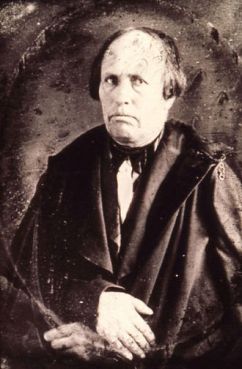
Padre Martinez’ Ministry Begins

On Saturday, December 22, 1821 Antonio José Martinez of Taos was ordained in Durango, Mexico as a deacon in the Catholic church. He was 28 years old. Martinez had arrived at Durango’s Tridentine Seminary four years earlier just after his 25th birthday. He came to the ministry late, following the death of his wife in childbirth. The ceremony on December 22, 1821 marked the beginning of the end of Martinez’ life at the Seminary. A year later, he would be an ordained priest  and on his way by to New Mexico, where he would eventually become pastor in exclusive charge at Taos.

Antonio_José_Martínez
Padre Antonio Jose Martinez

Besides his priestly duties, Padre Martinez would be a force to be reckoned with in New Mexico cultural and political affairs, both before and after the 1846 American takeover. Before the war, he was consul for expatriate Americans in New Mexico, he founded a school in Taos and also installed a printing press in Taos for literary publications as well as church forms , and he served as one of seven deputies to New Mexico’s Departmental Assembly. After the American invasion,  the Padre served as president of both New Mexico’s 1848 and 1849 state constitutional conventions and of the 1851 New Mexican Legislative Assembly.

To describe Antonio José Martinez as a busy man seems like an understatement.  One wonders whether he had any idea  on that long ago day in late 1821 just how much he would accomplish for New Mexico and for Taos before he died almost 50 years later at the age of 75.

Sources: Fray Angelico Chavez, But Time and Chance, the story of Padre Martinez of Taos, Sunstone Press, Santa Fe, 1981; Thomas C. Donnelly, The Government of New Mexico, UNM Press, Albuquerque, 1953; Richard W. Etulain, New Mexican Lives: Profiles and Historical Stories, UNM Press, Albuquerque, 2002; Dan Galbraith, Turbulent Taos, Sunstone Press, Santa Fe, 1983; Pedro Sanchez, Recollections of the Life of the Priest Don Antonio José Martínez, Sunstone Press, Santa Fe, 2006.

Taos’ Lake Influences National Legislation

On Tuesday, December 15, 1970, United States President Richard Nixon signed the bill that effectively returned Taos Pueblo’s sacred Blue Lake and the surrounding 48,000 acres of National Forest to the people of Taos Pueblo.

The pristine lake, which lies at the bottom of a glacier-carved depression in the Sangre de Cristo mountains east of Taos pueblo, is the Pueblo’s most sacred shrine and the site of some of its most important yearly rituals. Blue Lake and its watershed had been confiscated by President Theodore Roosevelt’s administration in June 1906 as part of the U.S. Forest Service process of creating Carson National Park.

Pueblo leaders took action almost immediately following Roosevelt’s actions, but met with resistance from Washington. Various attempts were made to accommodate the multiple potential uses for the lake and its watershed, but, because the area was national forest, it was subject to non-recreational uses like logging. In the early 1960’s, increased interest in logging the area created a renewed sense of urgency. The resulting pressure on Washington culminated in the legislation Nixon signed in late 1970, sixty-four years after Roosevelt’s signature.

While the return of Blue Lake was of major significance to the Taos Pueblo people, it also had a wider value, because the legislation set a legal precedent for the idea of Native American land ownership based on religious significance. The law also inspired the Indian Religious Freedoms Act of 1978. This act required the U.S. government to preserve and protect  American Indians’ inherent right to believe, express, and exercise their traditional religions. It also enabled access to religious sites and the use and possession of sacred objects. So, while the loss of Blue Lake for so many years was tragic, its return was a blessing that extended far beyond Taos Pueblo itself and is an event worth celebrating.
Sources:  William deBuys, Enchantment and Exploitation, UNM Press, Albuquerque, 1985; Rubén Sálaz Márquez, New Mexico: a brief multi-history, Cosmic House, Albuquerque, 1999; Corina A. Santisteven and Julia Moore, eds., Taos, a topical history, Museum of NM Press, Santa Fe, 2013; Marc Simmons, New Mexico, UNM Press, Albuquerque, 1993.

Taos Gets New Mexico’s First Press

When New Mexico’s first printing press arrived in Taos in late November 1835, its new owner Padre Antonio José Martinez didn’t waste any time putting it to work. On Friday, November 27, he announced that the press was be available to residents to use to publish “literary contributions.”

Antonio_José_Martínez
Padre Antonio Jose Martinez circa 1848

The press and its printer, Jesús María Baca of Durango, Mexico, had arrived in Santa Fe in 1832, brought there by Don Antonio Barreriro, a barrister and governmental deputy from Mexico City, apparently at the behest of nuevomexico Legislature’s Secretary, Don Ramón Abreu.

Barreriro used the new press to print a short-lived newspaper El Crepúsculo de la Libertad (The Dawn of Liberty), the first newspaper in New Mexico and possibly the first paper published west of the Mississippi. Abreu may have also used it to publish the first book printed in New Mexico, a spelling primer titled Cuaderno de Ortografía.

Following Barreriro’s return to Mexico, Ramón Abreu sold the printing equipment to Padre Martinez, the priest assigned to Taos’ Our Lady of Guadalupe chapel, who moved it to Taos. Once it and its printer were in place, Martinez put them to work, with output ranging from diligencia matrimonials (the standard forms for pre-nuptial investigations) to religious books. And hopefully Taos residents’ “literary contributions,” as well!

Sources: Fray Angelico Chavez, But Time and Chance, Sunstone Press, Santa Fe, NM 1981; Richard W. Etulain, New Mexican Lives: Profiles and Historical Stories, UNM Press, Albuquerque 2002; Rubén Saláz Márquez, New Mexico A Brief Multi-History, Cosmic House, Albuquerque, 1999.

Serial Killer’s Baby is Christened in Taos

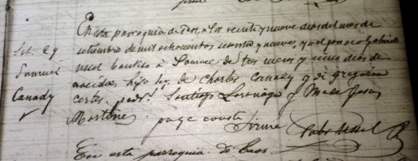
On this day in 1869, (Wednesday, September 29), three month old Samuel Kennedy was christened in Our Lady of Guadalupe Church in Don Fernando de Taos. He hadn’t been baptized sooner because he’d been born 25 miles east of town, at the foot of Taos Pass (today’s Palo Flechado Pass). It wasn’t a simple matter to get to Taos from what is now the Angel Fire area in those days.

Within a year, Samuel would be dead and his father about to die as a result. His father, Charles Kennedy (sometimes spelled Canady), had spent the last three years murdering and robbing men who visited the Palo Flechado cabin and Samuel’s teenage mother, Maria Gregoria, had kept silent. But in a fit of rage in late September 1870, Charles Kennedy killed his fifteen-month-old son and Samuel’s grieving mother finally took action. She fled twelve miles north to Elizabethtown to report her husband’s nefarious activities.

Samuel christening illustration

Justice was a little confused, but in the end it was served—at the hands of a lynch mob. Legend says Kennedy’s severed head ended up on a pike outside a local restaurant and saloon as a grisly reminder that even on the New Mexico Territory frontier, the death of a child would not go unrevenged.

For a fictional account of the Kennedy story, see my recently-published novel The Pain and The Sorrow (Sunstone Press).