She wasn’t sure what she had been expecting, but it wasn’t this. Her heart sank as she looked down at the low mud-colored town. The clouds were low and threatening.
“Mama?”
She turned, gathering her long calico skirts in one hand and reaching for him with the other.
“Is that it?”
She nodded. They stood together, looking down. The sky grumbled again and she closed her eyes. How was she going to do this, just her and this fragile boy?
“Look!”
She opened her eyes and followed his pointing arm. The clouds had parted above the town and a broad beam of light now danced on the rooftops, turning the walls golden.
She squeezed his hand and they smiled at each other. “Yes, this is it,” she said. “Our new life.”
On this day June 3, 1787, one of the West’s most memorable mountain men, William Sherley Williams, was born in North Carolina. The fourth of nine children, he was called “Will” by family members, although before he was 40, his fellow mountain men were calling him “Old Bill.”
The Williams family moved to Missouri when Bill was 9 years old. Seven years later, at 16, Bill left home to live among the Osage Indians. Twenty-one years later, after the death of his ostrich wife and the dissolution of the reservation, Bill headed west. He would become a legendary mountain man, known as much for his eccentricities as his prowess in the wilderness.
The lean, 6’1”, red-headed Williams was based in Taos and had a propensity for hunting beaver on his own, or with only a camp-follower as a companion. Where he went was anyone’s guess–he also had a propensity for keeping his hunting grounds secret.
Before he left home, Williams had received an education that included training in Greek and Latin. This, along with excellent hunting and tracking skills and a gift for languages, gave him a self-confidence that didn’t suffer fools gladly. Especially people who doubted his geographic knowledge of the West.
This strong personality was bound to get Williams in trouble when he encountered someone with a similar character. In Williams’ case, this was former Army Colonel John C. Fremont.
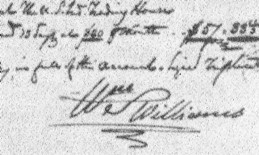
Bill Williams signature. Source: Old Bill Williams, A. H. Favour
In late 1848, Fremont hired Williams as guide for an expedition into the Rocky Mountains to identify an all-season railroad route to California. When Williams insisted that the expedition should veer from the route Fremont had already identified, Fremont relieved Williams of his guide duties and gave them to others.
Unfortunately, Williams was right. Fremont’s route was a mistake. Winter set in with a vengeance and Fremont’s men were trapped in the Rockies. Only 21 men of Fremont’s original 32 made it out alive. Although this would include Williams, he would die a couple months later, trying to retrieve valuable records and medical equipment that had been left behind.
So, while Williams’ vivid personality and self-confidence made him a legend in his own time, it also cut his time short. But the stories of his exploits would live on, and some of us still wonder just where those secret beaver hunting grounds actually were.
Sources: Robert Glass Cleland, This Reckless Breed of Men, UNM Press, Albuquerque, 1976; Leroy R. Hafen, Ed., Fur Trappers and Traders of the Far Southwest, Utah State UP, Logan, 1997; Alpheus H. Favour, Old Bill Williams, Mountain Man, U of Oklahoma P, Norman, 1962
Ewing Young had thirteen 90-pound packs of beaver fur in his possession in early May 1827, and he wasn’t interested in having them confiscated. According to the rumors, outgoing Governor Narbona was cracking down on trappers without the proper permissions and incoming Governor Manuel Armijo was likely to be even stricter than Narbona.
So Young did the only sensible thing an American trapper could do. He hid his furs at the Pena Blanca home of his associate Luis Maria Cabeza de Baca.
But he had neglected to realize that some of the men with him might have different ideas about the most sensible approach to government mandates. A member of his trapping party, Ignacio Sandoval, told officials in Santa Fe what Young was up to.
From that point on, things took a turn for the worse. Governor Narbona ordered soldiers to Pena Blanca to confiscate the furs and, in the process, Luis Maria Cabeza de Baca was killed. Then Manuel Armijo became governor on May 20 and signed an order for Young’s arrest for illegal trapping. Young seems to have talked his way out of that predicament and instead got permission to clean the confiscated furs. He and the Santa Fe alcalde were in front of the governor’s long adobe palace, shaking out and inventorying the furs, when another member of Young’s trapping party appeared on the scene. Milton Sublette grabbed a bundle of pelts and made off with them.
When Sublette and the furs disappeared, the governor blamed Ewing Young. He called Young to the palace and threatened him with jail. Young turned on his heel and walked out of Armijo’s office, but he wasn’t free for long. And when the soldiers did catch up with him, he was thrown in the calaboza, where he languished until he became ill and was finally released.
Source: Illustrated History of New Mexico, Reed
But he didn’t get his furs back. Many of them had been badly damaged by rain leaking through the roof of the building where they were stored, so they were sold for about two-thirds what they would have brought in good condition. The total was still a decent amount, about $3500. But it’s not clear who received the resulting funds. After all, the plews were government-confiscated property.
Sources: Carl P. Russell, Firearms, Traps, and Tools of the Mountain Men, Skyhorse Publishing, 2010; David J. Weber, The Taos Trappers, University of Oklahoma Press, 1970.
In April 1827, as Thomas L. Smith returned from a rough, though productive, fur trapping season, he learned that there was a new Mexican Governor in New Mexico and he not as sympathetic as past administrations had been to Americans who trapped without the required permits. In fact, the new Governor was on the hunt for Americans with illegal furs.
Smith decided that the only way to protect his plews was to smuggle them to Taos, where the border was more porous and he was likely find someone willing to take the risk of smuggling them over the Mexican/American border to Missouri. Accordingly, Smith and his trapping partners skirted Santa Fe and headed north.
Source: Mountain Men and the Fur Trade of the Southwest, Vol. IV, Leroy R. Hafen
After a close brush with the law at an outlying cabin, they made it to the small settlement of Riitos. Here, they hid the packs of furs among the trees and stopped for breakfast. The people were neighborly and came out to offer the trappers tortillas and eggs. However, the local kids discovered the packs in the trees. Smith did some quick thinking and explained that the furs were hidden because the sun would damage them. No one objected to this explanation, and the trappers continued on their way.
They hid the furs in a cave near the Rio Grande and rode into Taos the next day, where Smith was able to make the necessary arrangements. Although illegal and somewhat dangerous, Smith’s approach seems to have been the wiser one.
Ewing Young’s party cached their furs a little too close to Santa Fe, in the Pena Blanca home of a gentleman named Cabeza de Baca. De Baca’s help led to distaser for his family: When the soldiers arrived to confiscate the furs, there was an altercation and de Baca was killed.
Young’s furs were lost as well. When Young attempted to retrieve them from the Santa Fe authorities, he was imprisoned and only released when he came down with a debilitating fever. Eventually, the furs were sold at a fraction of their value. It’s unclear who ended up receiving the little money they brought in.
So, while Thomas Smith circumvented the law, he did make a profit. Ewing Young wasn’t so fortunate. It was a lesson that the American trappers would take to heart. The Mexican government would continue to try to keep the trappers under control, and the Americans would do their best to avoid that supervision.
Sources:Mountain Men and the Fur Trade of the Far West, Vol. IV, Leroy Hafen, Arthur H. Clarke Company, Spokane, 1966; The Taos Trappers, David J. Weber, U of Oklahoma, Norman, 1971.
On Monday, April 14, 1828, Mexico’s Congress spelled out the conditions under which foreigners could become Mexican citizens. The rules were simple: They had to have lived in Mexico at least two years and be Roman Catholic, employed, and well-behaved. If these conditions were met, the governor of the Deparment could issue a certificate of citizenship.
It seems to have taken a while for word about the new law to get to New Mexico, but once it did, at least twelve French-Canadians and Americans applied for citizenship the following year. One of these men was John Rowland, trapper, trader, and owner of both a Taos flour mill and a Taos Lightning distillery.
John Rowland. Source: Mountain Men and the Fur Trade of the Southwest, Vol. IV, Leroy R. Hafen
Rowland didn’t remain in New Mexico, although he did remain a Mexican citizen. In 1840, he and his England-born distillery partner William Workman, supposedly without their knowledge or consent, were named temporary commissioners for the Republic of Texas. Feelings against Texas were strong in northern New Mexico and the two men’s apparent support for Texas and the hated 1841 Texas-Santa Fe expedition was enough to make New Mexico too hot for them. In 1841, they emigrated to California.
Both men did well in California. Workman became an important figure in the Los Angeles business community and Rowland became one of California’s most important wine manufacturers while continuing his work to produce both flour and distilled spirits. He died in 1873 and was buried in the cemetary of the Catholic church built on the 48,790 acre Rancho la Puente, which he co-owned with Workman.
Sources: Mountain Men and the Fur Trade of the Far West, Vol. IV, Leroy Hafen, Arthur H. Clarke Company, Spokane, 1966; The Taos Trappers, David J. Weber, U of Oklahoma, Norman, 1971. www.homesteadmuseum.org
“I seen him! I seen him!” The boy stopped, breathless, just inside the kitchen door.
“You mean you saw him.” His mother shook her head at him as she lifted the lid from the Dutch oven in the fireplace to check the biscuits. She smiled. “Who did you see?”
“Kit Carson! He was on the other side of the street, going into the Governor’s house.”
She nodded. “I heard this morning that he was back. What is he like?”
His shoulders sagged. “He didn’t look anything like the pictures in the book Grandpa gave me when we left Kansas City.”
“That was just a story,” she pointed out. She turned to stir the great pot of venison stew.
“I know,” he said. “But he wasn’t what I expected at all. He’s just a man.”
It happened every spring in the early 1800s: Taos was invaded by trappers, either future or current. It made law enforcement rather complicated
In 1817, Jules DeMun didn’t even make it to Taos before he was headed off by a contingent of Spanish soldiers, who had been sent out in response to rumors in Taos that DeMun and his partner Pierre Chouteau had 20,000 Americans camped on the Purgatoire River, set to invade New Mexico. Even though the rumors weren’t true, DeMun and Chouteau were ordered to return to St. Louis. Somehow, they talked the soldiers into allowing them to travel north before heading east, ostensibly to avoid the Pawnee. Of course, they didn’t head directly to St. Louis. They trapped, supposedly outside of the boundaries of New Spain.
When news of Mexico’s independence from Spain reached the United States in 1821, things only got worse. Trappers and merchants could now enter New Mexico legally, but they still had trouble following Mexico’s rules. Up to this point, the Sangre de Cristo mountains had provided a protective barrier between Taos and incursions from the eastern plains. But they didn’t stop the Americans. In fact, the mountains were a great place to cache furs before smuggling them east to Missouri without paying export taxes. And Taos was still the favorite way to enter, especially if you were doing something slightly illegal. There were just so many ways to get there from the Santa Fe trail, which paralleled the mountains between it and Taos.
“Uncle Dick” Wootton, Source: Leading Facts of New Mexico History, R.E. Twitchell
It got so bad that Mexico Customs Officer Juan Bautista Vigil y Alarid had to deputize Rafael Luna as Taos’ border guard. Even that wasn’t enough. Eventually, Alarid authorized Luna and Taos Alcalde Severino Martinez to use the militia to intercept the Americans.
Calling out the militia seems like overkill until you realize how valuable the furs in question were. In 1837, “Uncle Dick” Wootton brought furs worth $25,000 into Taos. And that’s just what he was willing to pay the tax on. The trappers had incentive to skirt the law. And the Mexican authorities had incentive to try to keep them from doing so.
And so each spring the dance began again….
Sources: Den Galbraith, Turbulent Taos, Sunstone Press, Santa Fe, 1983; Leroy R. Hafen, Fur Trappers and Traders of the Far Southwest, Utah State UP, Logan, 1997; Joy L. Poole, editor, Over the Santa Fe Trail to Mexico, U of Oklahoma Press, Norman, 2015; David J. Weber, The Taos Trappers, U of Oklahoma Press, Norman, 1971.
By the middle of February, 1849, mountain man Bill Williams and the two men who’d survived the failure of the Fremont expedition in the Sangre de Cristos with him, were in Taos recovering. Before the end of the month was out, the 62-year old Williams and the Fremont expedition medical doctor Benjamin Kern headed back out into the snow-covered wilderness. Their mission was to retrieve Dr. Kern’s medical equipment and supplies and his two brothers’ art materials and papers. The goods were in a cache on the Continental Divide near the Rio Grande headwaters, where they’d been placed after the expedition’s pack mules succumbed to starvation and cold. Williams and Kerns were accompanied by a handful of Mexican assistants, who managed the pack outfit.
It was a fateful trip for the two Americans. While they made it back to the cache, they did not make it out alive.
The Utes in the region had been in war mode since the previous summer. Since then, they’d been raiding the settlements up and down the Southern Rockies and the plains to the east. When they combined with the Apaches to clash with U.S. troops in the Raton mountains, the U.S. military leaders started getting concerned. Lt. Joseph H. Whittlesey was ordered out to bring the tribe into line.
Whittlesey started north from Taos on March 11 with 37 men and four scouts, one of them Lucien B. Maxwell. The next day, about fifteen miles north of Red River, his forces attacked a Ute village and forced those they hadn’t killed into the cold and snow. About a dozen Utes fled toward the Rio Grande. When they happened on the Williams/Kerns encampment on the Continental Divide, they saw an opportunity to revenge what Whittlesey had done.
The Utes shot Old Bill Williams and Dr. Kern, ordered the men with them to stay put, and carried off the supplies and pack mules as partial payment for the destruction of their winter camp. It is said that when the Utes realized they’d killed Williams, they gave him a chief’s burial. If this is true, it’s more respect than he received from Fremont, whose family later blamed Williams for the failure of Fremont’s expedition and the subsequent death of so many of his men, an accusation that seems to have no basis in fact.
SOURCES: Robert G. Cleland, This Reckless Breed of Man, UNM Press, 1976; Alpheus H. Favour, Old Bill Williams, mountain man, U of Oklahoma Press, Norman, 1962; Leroy R. Hafen, Ed., Fur Trappers and Traders in the Far Southwest, Utah State UP, Logan, 1997.
On Friday, February 9, 1849 eight of the original 33 in Colonel John C. Fremont’s Fourth Expedition rode into the settlement of Little Pueblo on the Colorado River. They were frostbitten, hungry, and unable to walk, but they were alive, thanks to Alexis Godey.
The Fremont expedition was supposed to identify a railroad route across the Rocky Mountains. Instead, virulent winter conditions brought it to a standstill. They’d started from the eastern slopes in November, but by mid-January it was apparent even to Fremont that they couldn’t go any farther.
With men and supplies giving out, Fremont, Alexis Godey, topographer Charles Preus and two other men went for help. However, by the time they got to Taos on January 13, Fremont was in no condition to return for the rest of his men, who by that time had broken into scattered groups, each trying desperately to survive.
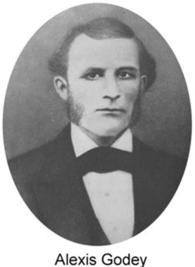
Alexis Gody, originally hired as the expedition’s hunter, almost immediately headed back into the mountains for his companions. He fought his way north with 30 animals and four Mexican assistants. The first group he located consisted of the three Kern brothers, Captains Cathcart and Taplin, Missourian Micajah McGehee, and J.L. Steppenfeldt, all of them close to dying from starvation. He loaded them onto the mules and headed for the closest settlement. It took another three days, through yet more snow and ice, but they when they reached Little Pueblo on February 9, they were all still alive.
Godey was about 30 years old in 1849. He’d been with John Fremont during the Bear Flag Revolt in California and was cited for valor after the Battle of San Pasqual. He was known for his courage, coolness under pressure, and stubborn resolution: courage and resolution he’d need to rescue the men Fremont had left behind.
Godey would go on to act as the head guide for another railroad survey expedition, this one Lt. Robert William’s 1853identification of a route from Texas to California along the 32nd parallel. Godey wasn’t the only member of William’s team who’d been in the mountains with Fremont. Williams’ cartographer was none other than Charles Preuss, Godey’s and Fremont’s companion on that initial January escape to Taos.
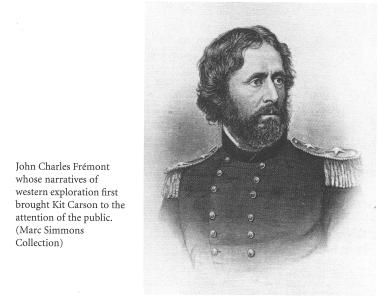
On this day in 1849, Saturday, January 13, celebrated explorer John C. Fremont stumbled into the Taos plaza so battered by exposure and starvation that no one recognized him.
Fremont had left what is now Pueblo, Colorado, 52 days earlier on a mission to identify a practicable railroad route across the Rockies to California. He had 32 men and 120 supply-laden mules with him.
Even before he’d left Pueblo, there was trouble. He’d already lost a guide. When former mountain man “Uncle Bill” Wootton took a look at the signs and realized just how bad the coming winter was likely to be, he backed out. But former Army Colonel Fremont refused to give up. He’d been forced to resign from the military in a cloud of disgrace two years earlier and was determined to redeem himself. Come hell or high water, he was determined to prove that a year-round transcontinental railroad operation across the mountains was feasible. If men and mules could cross the path he had in mind under winter conditions, then surely trains could, too.
Fremont hired “Old Bill” Williams to take Wootton’s place. While Williams was a brilliant tracker, he wasn’t exactly known for his tact. Since Fremont was known for his stubbornness, the partnership seemed destined for trouble. And trouble happened pretty quickly. When Williams announced that the expedition should veer from the route Fremont had laid out, trouble ensued. Fremont relieved Williams of his guide duties and gave them to men who Fremont had worked with before but who didn’t know the region.
As Wootton had predicted, the weather turned treacherously nasty and grew increasingly difficult as Fremont’s men tried to force their way through snow-bound canyons and across icy mountainsides. All of the mules either died of starvation or froze to death. Frostbite and snow blindness plagued both the animals and the men. Not only was the expedition’s goal doomed, but the conditions were so bad that the men feared for their lives. In a desperate attempt to make it to safety, Fremont divided his company into small groups and sent them south to try to reach Taos.
Only 21 men of the original 32 would make it out alive and Fremont himself would need weeks of nursing by Josefa Carson before he fully recovered from the ordeal. Even with the survivors in Taos and whole, the loss of life would continue. Williams would die trying to retrieve valuable records and medical equipment that had been left behind in the rush to escape the winter conditions Uncle Bill Wootton had warned Fremont about.
Although a year-round transcontinental railroad was eventually built across the Rocky Mountains, it was not constructed on the route that Fremont tried to blaze that winter of 1848/49. The glory of that deed would go to other men. Fremont’s exploring days were over .
Sources: Alpheus H. Favour, Old Bill Williams, Mountain Man, U of Oklahoma Press, Norman, 1962; Leroy R. Hafen, Ed., Fur Trappers and Traders of the Far Southwest, Utah State U Press, Logan, 1972; Marc Simmons, Kit Carson and His Three Wives, UNM Press, Albuquerque, 2003.


 Fiction and Fact From Old New Mexico