NOT JUST ANY MAN – CHAPTER 15

NOT JUST ANY MAN – CHAPTER 15

The following material is an extract from NOT JUST ANY MAN, A Novel of Old New Mexico, Copyright © 2018 Loretta Miles Tollefson. Published by Palo Flechado Press, Santa Fe, NM

A Note about Spanish Terms: This novel is set in northern New Mexico and reflects as much as possible the local dialect at that time. Even today, Northern New Mexico Spanish is a unique combination of late 1500s Spanish, indigenous words from the First Peoples of the region and of Mexico, and terms that filtered in with the French and American trappers and traders. I’ve tried to represent the resulting mixture as faithfully as possible. My primary source of information was Rubén Cobos’ excellent work, A Dictionary of New Mexico and Southern Colorado Spanish (University of New Mexico Press, 2003). Any errors in spelling, usage, or definition are solely my responsibility.

CHAPTER 15

The ground is dry and the going easy, and two days bring the trappers to the Chavez rancho, which is sprawled along the river. As Wolfskill’s party moves toward it across the llano, they pass shepherds grazing mixed flocks of goats and sheep. There’s no apparent move to get word to the Los Chavez padrón and former nuevomexico governor Franscisco Javier Chavez that the trappers are coming, but by mid-day a man on horseback has appeared to welcome them and lead them politely to a campsite under the massive cottonwoods beside the river.

Once the animals are unpacked, the men disperse to make themselves presentable to the Don and his daughters. The river is too shallow for proper bathing, but its waters are warmer and wider than the mountain streams in the highlands. Gerald finds a depression near the bank where he can shed his layers of clothing and weigh them down with some rocks, then lower himself into the water and let the river wash away at least some of the stink.

As he’s climbing back into his clothes, Ignacio appears, waving at him. “Come,” he says. “El señor prepares for us a feast.”

Don Chavez’s women have roasted two lambs and cooked several kilos of tortillas, as well as a tender cheese, or queso. Though there is no opportunity for interaction with the Chavez daughters, the food is a welcome change from camp fare. The trappers are in a mellow mood when they head back to the campsite. But their faces darken when William Wolfskill announces that they’re heading up to Taos the next day.

“We don’t all need to go,” he adds. “In fact, it’ll be quicker if most of you stay here.” He grins. “Especially those of you with Taos sweethearts. There just won’t be time for all that. We need to get there, consult with Ewing, and then hightail it back here and decide how to proceed.”

 “Decide?” Thomas Smith growls. “What’s t’ decide? We’re gonna go back in there and teach those mothersuckin’ Apaches a lesson they ain’t gonna forget! Damn Indians!”

“We’ll need more men to do that,” Wolfskill points out. “And more supplies. Since Ewing has the biggest share in this outfit, it’s going to depend on what he wants to do and how much more money he wants to lay out.”

Smith scowls. “It’s my mule that got killed. I’ve got a right to a voice in this.”

“I know it,” Wolfskill says. “And that’ll be part of the considerations. But my partner and I need to confer. And if the decision goes the way I think it might, we’ll need more men.” He shakes his head. “There’s not likely to be many left in Taos this time of year. We’ll be scraping the barrel.” He looks around the circle. “Now, I need a few to go with me. Enough that we can fend off anyone layin’ in wait and get through t’ Taos in good time.” His eyes rest on Gerald, then pass over him. “Sublette, you’ll be wantin’ to stay and rest up that wound.”

Milt Sublette stretches his leg slightly and grimaces. “I’d just slow you down,” he agrees.

Wolfskill’s eyes move on. “I’m thinking Stone and Branch and Dutch George.” He grins. “As far as I know, none of you have sweethearts to distract you.” He nods to Ignacio. “And Sandoval to do the cooking.” He chuckles. “You can check in with your teacher, so he can send news to your pa that you’re workin’ hard.”

Ignacio grins sheepishly and Gerald feels a pang of something almost like jealousy. Had Ignacio been studying with Jeremiah Peabody before he joined Wolfskill’s trapping group? Would he see Peabody’s daughter? It’s more likely that he was working under Taos’ new Catholic priest, Padre Martinez. But there’s still a chance that the boy’s path will cross the Peabodys’ while he’s in Taos, and Gerald feels a twinge of envy. It would be good to see Suzanna again.

But he has no rights to such thoughts. He considers the fact that William Wolfskill didn’t name him as a man with no Taos sweetheart to distract him. He has to admit that Suzanna Peabody would be a distraction, but Gerald isn’t sure whether he’s pleased or annoyed by Wolfskill’s silence. Are others besides Old Bill aware of the pull the Peabody casa has for him? He feels a glimmer of amusement, then discomfort, and remains in the background the next morning, lest someone should decide to ask him what message he wants delivered to the Peabody parlor.

While the Taos party is gone, Gerald devotes himself to grazing his mule along the river in locations that won’t interfere with the Chavez stock and getting his gear back into shape. He also studies the way the Chavez acequia system channels water to the hacienda’s fields, and the primitive but effective wooden gates the laborers use to send it where it’s most needed.

The soil is sandy here, but rich wherever the river has flooded, and he’s told that it produces bountiful crops of chili and corn. The fields are barren now. Brown leaves rattle in the cottonwoods along the river. But Gerald can see that it’s a good land, and fertile wherever the irrigation system’s channels have been extended.

His mind strays to the girl in Taos who’s growing potatoes beside a similar water course, but he forces himself back to the ditch at hand. He has no right to think of her long-limbed stride, her black eyes gazing into his face. He has no right.

Copyright © 2018 Loretta Miles Tollefson

NOT JUST ANY MAN – CHAPTER 13

NOT JUST ANY MAN – CHAPTER 13

The following material is an extract from NOT JUST ANY MAN, A Novel of Old New Mexico, Copyright © 2018 Loretta Miles Tollefson. Published by Palo Flechado Press, Santa Fe, NM

A Note about Spanish Terms: This novel is set in northern New Mexico and reflects as much as possible the local dialect at that time. Even today, Northern New Mexico Spanish is a unique combination of late 1500s Spanish, indigenous words from the First Peoples of the region and of Mexico, and terms that filtered in with the French and American trappers and traders. I’ve tried to represent the resulting mixture as faithfully as possible. My primary source of information was Rubén Cobos’ excellent work, A Dictionary of New Mexico and Southern Colorado Spanish (University of New Mexico Press, 2003). Any errors in spelling, usage, or definition are solely my responsibility.

CHAPTER 13

Gerald stops in the middle of the path and stares at the small fenced-off area beside the brimming irrigation ditch, what in nuevomexico is called an ‘acequia’. The plot is perhaps an eighth of an acre and filled with vibrant green sprigs of pigweed, a sign both that the soil has been turned in the past year and that it’s fertile. The weeds will be easy to pull once the plot is flooded with water from the ditch.

He puts a hand on the rough rail fence. A shallow indentation extends from the acequia along one side of the plot. Only a small ridge of dirt blocks the ditch water from moving down the furrow and into the weeds. Gerald crouches, reaches through the fence, and picks up a small clump of dirt. He lifts it to his face. It smells good. As if it’s been fertilized. Potatoes would do well here.

“Señor?” a boy’s voice asks.

Gerald looks up. A thin dark-skinned teenage boy with large brown eyes and a mass of straight black hair stands behind him, clearly trying to understand why this americano is holding a clod of dirt to his nose.

Gerald doesn’t know the Spanish for ‘garden’ or ‘rent,’ so all he can do is gesture at the garden plot and ask “A cómo?”

The boy frowns, puzzled, then lifts a hand. “Un momento,” he says. He circles around Gerald and the plot of pigweed to the acequia. He moves nimbly across it on a narrow plank of thick wood and disappears into a tangle of young narrow leaf cottonwoods.

Gerald waits, not sure if the boy understood. The sun is warm on his shoulders and he breathes in the green smell of the plants in the plot. It’s good to just stand here, soaking it in.

Just as he’s beginning to think the boy won’t return, two figures emerge from the cottonwoods: the boy and a solidly-constructed woman in a knee length black dress. Gerald holds his breath as first the boy, then the woman, use the plank to cross the ditch.

The woman’s dress is spotted with damp, her long sleeves pushed up, and her hands pale and wrinkled, as if she’s been interrupted in the middle of her washing. Her eyes are narrow and her lips tight. She puts her hands on her hips. “You want buy land?” she asks brusquely.

Well, at least she speaks English, even though she looks ready to do battle. Gerald shakes his head. “I apologize,” he says. “My Spanish is not good.”

Her expression softens a little and she nods.

“I want to know if the plot is for rent,” he explains. “Not to me, but to someone who may wish to use it for her garden.”

The woman looks at him impassively. “How much?”

“I—.” He stops, unsure. After all, he has no idea what price would be appropriate, if this is something that Miss Peabody truly wishes to do, or if her father has the resources to rent the plot. “I would need to consult with the young lady,” he says.

“Ah, una señorita.” She smiles a little and tilts her head to one side. “It depends on la señorita and what it is she wishes to plant.”

“I will need to consult with her,” he says again. What a fool he is. What has he gotten himself into?

The woman shrugs and turns away, then back. “I am Maria Antonia Garcia,” she says. “It is my land.” She gestures across the ditch. “If your young lady wishes to speak to me, she can find me there.”

Gerald hesitates, then nods. The woman turns and heads back across the plank. The boy smiles shyly at Gerald, then follows.

Gerald puts his hands in his pockets and watches them disappear into the trees. Then he turns back to study the garden plot. Would it be presumptuous to use this as an excuse to call on Miss Peabody and her father again? He grins. It’s better than nothing. And she did say that she wants to find a plot for her potatoes.

~ ~ ~ ~

Suzanna Peabody strides so eagerly beside him that Gerald has to lengthen his stride to keep up with her. “I know Antonia Garcia,” she says. “She and Encarnación are related somehow. Antonia does laundry for us sometimes, when Chonita has more baking than usual, or when the load is more than she and I can do on our own.” She glances at him with a small smile. “I may not cook, but I do know how to clean.”

He smiles down at her. “I suspect, though, that you would rather be gardening.”

She laughs. “You suspect rightly!” She looks eagerly up the path. “Is that the plot? Oh, that’s where they were holding the pigs last spring!” She purses her lips, eyes dark with thought. “The fence was too low for them, so they weren’t there very long. Certainly, it’s been enough time that the manure will have cooled sufficiently.” She looks up at him, eyes dancing. “Potatoes could do well here!”

He nods. “I think they might.”

They stop at the fence and gaze into the plot. “There’s access to water from the ditch,” he points out.

She peers across the pigweed at the acequia. Gerald looks at her in amusement, then finds his gaze dropping. Her breasts strain slightly against the cotton of her dress. He pulls his eyes back to her face as she turns to him. “If I’m allowed to access the water, it will do nicely,” she says.

A figure moves in the trees on the other side of the ditch and the teenage boy materializes on the opposite bank. Suzanna waves her hand. “Hola Juan Gregorio!” she calls. She gestures at the acequia. “May we cross?”

The boy smiles and makes a beckoning gesture. Suzanna moves around the garden plot and trots briskly over the wooden plank. She stops on the other side and grins at Gerald. “It looks more narrow than it actually is,” she says.

He raises an eyebrow and follows her gingerly. As he steps onto the opposite bank, his foot slips and he throws his arms out for balance. Suzanna grabs his hand, pulls him to safety, then releases him the instant he’s upright again.

“Thank you!” Gerald exclaims, but she’s already turned away. She and Gregorio plunge into the cottonwoods without looking behind them to make sure Gerald is following.

He lags behind glumly, but by the time he can see the Garcia’s low adobe house through the trees, Suzanna has turned twice to glance behind her, and Gerald’s confidence returns. He’s beside her as they enter the yard. Wooden washtubs stand in a neat row along one side of the building and men’s drawers hang from clothes lines that have been strung from the adobe’s vigas to cottonwoods on the other side of the yard.

Señora Garcia invites them inside and they sit on blanket-covered adobe benches that jut from the walls while she and Suzanna negotiate terms. The Spanish is too rapid for Gerald to follow, though he has the impression that the conversation has moved on from the garden plot when the señora glances at her son, then Gerald, and frowns irritably. She almost seems to puff up with annoyance. But then Suzanna says something soothing and the woman settles.

Finally, the conversation ends. Suzanna and Gerald say their farewells and slip back through the trees. “Isn’t there another route to this house?” he asks.

“There is.” Suzanna waves an arm. “It’s in that direction, but it’s very long and involves trespassing across the land of a man who Antonia is angry with. There was some kind of boundary dispute a number of years ago and she believes she was cheated of her rights. Antonia isn’t one to forgive and forget easily.”

They reach the irrigation ditch. Gerald waves Suzanna ahead of him and she slips easily across the plank. He follows more slowly and makes sure his footing is secure before he steps onto the opposite bank. Suzanna stands back, giving him plenty of room as she pretends to examine her new garden plot.

They head back toward the village. “It’s a good bit of a walk to Taos from here,” Gerald says. “I wasn’t sure if that would be an issue for you.”

“Oh, I love to walk,” Suzanna says. “I constrain my ramblings when the American hunters are in residence, because my father worries, but when you all aren’t here, I often walk to Ranchos and back.”

“You walk for health reasons?”

She looks at him in surprise. “No, I walk because I like to walk.” She smiles mischievously. “I find an errand that requires that I go to Ranchos, and then I go.” She shrugs. “But the garden plot isn’t nearly as far as Ranchos. I’ll explain to Father why it’s important to me, and he won’t protest.” She chuckles. “Not too much, at any rate.”

“Are we American hunters so dangerous?”

She smiles. “Not all of you.” She looks up at him. “Certainly, I wouldn’t be worried about meeting you on the streets.” She makes an annoyed flapping movement with her hand. “But you saw how Enoch Jones is. And there are others like him.” There’s a long pause, as she studies the trees beside the path. Then she glances at him shyly. “I never thanked you for intervening that day.”

“I was happy to do so,” Gerald says a little stiffly.

“Jones is—” Suzanna sighs. “How can I say it? I don’t believe he is an evil man, but he seems persuaded that all women are his property, especially if they are women with brown skin. And that, as his property, we are required to do whatever he wishes.”

Gerald feels a surge of revulsion. “His wishes are pure filth!” he says, more sharply than he intends.

She smiles at him. “That’s what I like about you.” She slows her pace slightly and takes his arm. “That and the fact that you know how to walk quickly.”

“While I’m here, will you allow me to accompany you?” he asks impulsively. “Then you can walk as far as you like.”

“I would like that,” she agrees, her eyes on the path. Then she looks at him again. “Though I expect you won’t be here much longer. You’ll be going out on another hunt soon, will you not?”

He nods glumly, wishing he could walk this path with her for the rest of his days.

“Did you see the look Antonia sent your way?” she asks abruptly.

“She seemed quite annoyed with both me and her son,” Gerald says.

Suzanna chuckles. “She is,” she agrees. “I told her you’re a trapper. Her son has expressed interest in going with the men this fall and she’s unwilling to allow it, but he’s insisting quite strongly. He says he can make more money being a camp keeper than he can staying at home.”

The girl shakes her dark head. “He’s quite strong, although he doesn’t look it. I’m sure you noticed the wash tubs and clothes lines. She may not like trappers, but she does washing for them. Gregorio helps her with the heavy lifting. But he wants very badly to go trapping instead.”

She lifts her hand in a helpless gesture. “Antonia worries that he will be in danger in some way or that he will be treated unjustly. But in the end he will undoubtedly have his way.” She grins ruefully. “As my father says, we only children can be quite willful.” She lifts an eyebrow at Gerald. “Didn’t you say you also are an only child? Did your parents find you willful?”

He laughs. “My mother used to say I was the sweetest obstinate child she ever knew.”

“I’m not sure my father would include ‘sweet’ in his description of me,” Suzanna says ruefully. “I suspect he’d use the term ‘verbal’ instead. He claims that I can talk him into almost anything.” She grins. “I prefer to think of myself as logical.” Then she sobers. “I wasn’t sure what to say to Antonia about Gregorio going out with the hunters. Do you think it would be safe? After all, he is her only child.”

Gerald shrugs. “Is anything completely safe? If he goes with responsible men, he will be as safe as staying here. Even here, there are dangers.”

Suzanna nods. “Yes. A group of Comanches raided some ranchos in the cañon east of here just a week or so ago.”

He looks at her in alarm. “And you still walk alone?”

She laughs. “They weren’t here in the valley. They were out on the fringes.” She grins. “Actually their presence is something of a boon to the American trappers. Governor Narbona stationed soldiers at Taos to monitor the trappers’ activities, but the troops have been too busy chasing Indians to pay much attention to the Americans.” She shakes her head and shrugs. “Even if the Comanches get closer to town, I know enough sign language to communicate with them. And they have dealings with my father. I don’t believe they would harm me.”

Gerald chews on his upper lip. He has no rights, but still— “I hope that while I’m here you will allow me to accompany you when you should feel the need for a walk,” he says, his eyes on the path in front of his feet. “I would blame myself greatly if something were to happen to you as you go to or from that garden plot.”

She pulls her hand away from his arm. “I am quite capable of looking after myself,” she says stiffly.

“I am sure you are,” Gerald says. What has he done? He has no rights. And now she’s angry. “But I cannot forget Enoch Jones and his attitude,” he says lamely.

They walk several more minutes before Suzanna takes his arm again. “It’s just that I dislike being constrained,” she says. “Even the Taos, as small as it is, seems to constrict me sometimes. I long for movement and space.”

“And plants?” he asks, his spirits lifting.

“And plants!” she laughs. She waves a hand at the wild rose bushes between the path and the acequia. “Have you noticed how plump last year’s rosehips are this spring? I must bring a container next time and collect some. Encarnación makes an excellent rose hip jelly which my father particularly enjoys.”

Gerald smiles at her, marveling again at the way her eyes are level with his. But as they enter the town and turn down the lane to the Peabody gate, his spirits drop. He wishes the distance between the house and the garden plot is longer, that there’s somewhere else she wants to go, some other destination to which she needs an escort. But he can think of no good excuse to prolong their walk.

His pain lessens when Suzanna turns at the open gate and looks into his eyes. “Would you mind very much if I ask you to accompany me to the garden plot tomorrow?” she asks. “Gregorio has agreed to irrigate it and pull the epazote for me, but before he does, I’d like to harvest the smaller leaves so Encarnación and I can dry them for her cooking pot this winter.”

“The pigweed?” Gerald asks in surprise.

“Oh yes. It’s an essential addition to the beans that we eat so often here. Besides enhancing the flavor, epazote increases the bean’s digestibility.” She grins mischievously. “My father says it civilizes the beans. Or at least the bean eaters.”

~ ~ ~ ~

Gerald spends the next several weeks accompanying Suzanna back and forth to the new garden plot and helping her plant the seed potatoes. He notes with a relief he doesn’t dare express that she carries a cutting knife with her at all times. She uses it for her gardening, but its sturdy eight-inch blade would do substantial damage if she had to use it against a human foe. She calls it her cuchillito and says Encarnación gave it to her as a gift.

Gerald’s eyes narrow at that. So the Peabody cook also feels Suzanna needs protection. But he has no right to further caution Suzanna. Perhaps someday he will have that privilege— Even then, it’s unlikely. She isn’t a girl who likes to be cautioned.

Somehow this train of thought converts into a mental tally of the funds in Gerald’s possession. His only option for increasing them is to trap. Although he hates the thought of leaving Taos, he pays close attention when the fur brigades begin to form up in August. At least three parties are heading south and west to the Gila River and its tributaries. But that’s all owned by Mexico and a man needs a Mexican passport to trap there. At least, nuevomexico’s Governor is insisting that passports are required, even though no one seems to have actually seen the directive that says so.

But, according to Old Bill, passports aren’t an insoluble problem. “You just got to sign on with someone that has one,” he explains one afternoon in the Peabody parlor. “One guía is good for however many men you tell his Excellency the guvnor you’re taking, and after that nobody’s counting.” He leans toward Gerald, whisky on his breath, and Gerald exchanges an uneasy glance with Suzanna.

“Me and St. Vrain, we’re sayin’ we’ve got around twenty men,” Old Bill says. “But that don’t include camp keepers and such.” He winks and leans back. “We ain’t truly decided just yet where we’re headed, neither.” He grins. “The paper we got says we’re going south to Sonora.” Suzanna looks at him disapprovingly and he swings his red head toward her father. “What do you think, Jeremiah? Think we’ll find beaver in the deserts of Sonora?”

Jeremiah Peabody glances up from the two-week-old newspaper he’s been thumbing through. “I’m sure I couldn’t say,” he says. “Although I understood from St. Vrain that the guía you obtained was for trading, not trapping.”

“Ah, it’ll cover it all!” Williams chuckles and slaps his knee. “And it’ll take in the Gila River quite nicely. Even the mountains to the north of it.”

He looks at the three faces gazing back at him. “Well, I can see you all have more interesting things to cogitate on than mere beaver,” he says mischievously. “So I’ll just mosey on back to the taberna.”

They all say muted goodbyes and Suzanna rises to see him out.

“Are you anticipating a return to hunting with Mr. Williams?” Jeremiah Peabody asks when he and Gerald are alone.

Gerald shakes his head. “He hasn’t suggested it,” he says. “And I doubt I would take him up on such an offer if he did.” He gestures toward the door. “He’s very knowledgeable about the ways of the wilderness, but—”

“I suspect that you may have learned all he can teach you,” Peabody says drily.

Suzanna comes back into the room. “I wish he wouldn’t drink so,” she says. She moves restlessly to the dimly lit window. “Why must men throw themselves away on whisky?”

 “Not all men do so, my dear,” her father says mildly.

“They have nothing else to give their lives meaning,” Gerald says.

She glances around and his eyes meet hers. Her cheeks flush scarlet and she turns back to the window. “I suppose you’ll be leaving with one of the fur brigades soon?” she asks. She moves back across the room, and seats herself beside the tea table. “With Mr. Williams, I presume?”

“Ewing Young has suggested that I join the group he and William Wolfskill are organizing for the southern mountains and the Gila River,” Gerald says. “I believe he has the appropriate permissions.” He turns to her father. “Young will be leading it and some of the men going with him will be free trappers, but he’s offered me a contract. I’d earn a wage instead of taking the risk of bringing back enough furs to make it worth my while.”

“Leaving the risk of a good take to Young is a fine strategy,” Jeremiah Peabody says. “You may not make as much as you would if you were free and your catch was good, but you don’t risk losing all of it, either. And Young and Wolfskill are two men with a fine reputation for good sense.” He accepts a fresh cup of tea from Suzanna, then adds, “I’m glad you aren’t thinking about going out with the party that Michel Robidoux is putting together for the Gila. He doesn’t seem seasoned enough to be heading up such a venture.”

Gerald nods absently and glances at Suzanna. “I hope to add a decent amount to what I’ve already earned,” he says. “Though I’m reluctant to take with me the funds I already have. I understand some men put theirs in trust with a merchant here or in Santa Fe.”

“Either way is a risk,” Peabody says.

“I wondered if you would be so good as to keep my small earnings for me.” Gerald hesitates. “Though, if you don’t wish to carry the burden—.”

“I would be delighted to take on that responsibility for you,” Jeremiah Peabody says with a smile. He glances toward Suzanna. “You honor me with the request to entrust your resources to my care. And I’m sure you’ll come back from this venture with more to add to it. A group led by Young has every chance of doing well.”

But Gerald barely hears this last sentence. He has turned toward Suzanna and is too busy looking into her smiling eyes.

Copyright © 2018 Loretta Miles Tollefson

NOT JUST ANY MAN – CHAPTER 12

NOT JUST ANY MAN – CHAPTER 12

The following material is an extract from NOT JUST ANY MAN, A Novel of Old New Mexico, Copyright © 2018 Loretta Miles Tollefson. Published by Palo Flechado Press, Santa Fe, NM

A Note about Spanish Terms: This novel is set in northern New Mexico and reflects as much as possible the local dialect at that time. Even today, Northern New Mexico Spanish is a unique combination of late 1500s Spanish, indigenous words from the First Peoples of the region and of Mexico, and terms that filtered in with the French and American trappers and traders. I’ve tried to represent the resulting mixture as faithfully as possible. My primary source of information was Rubén Cobos’ excellent work, A Dictionary of New Mexico and Southern Colorado Spanish (University of New Mexico Press, 2003). Any errors in spelling, usage, or definition are solely my responsibility.

CHAPTER 12

“I’m glad you invited him and that he came,” Suzanna says at dinner that evening, interrupting her father’s silent train of thought.

He looks up from his plate. “Who, my dear?”

“Mr. Locke, papá.”

“He’s quite a nice, gentlemanly young man,” he agrees. “Although I fear you may have frightened him off with your diatribe about trapping and the resultant drunkenness.”

“He didn’t seem frightened,” she says. “Besides, if he’s going to visit us, he’ll have to get used to my opinions.” She dips her spoon into the bowl of mutton stew, then pauses to look up at him with narrowed eyes. “And what do you mean by ‘frighten him off’? Why should it matter to me whether he visits or not? After all, he’s not coming to court me. You’ve made it clear enough that I’m not of an age for such things.”

She takes a bite of stew, chews, swallows, then adds firmly, “Not that I’m particularly interested in him or any other young man.”

Her father’s lips twitch. “It would be wise to not become interested in a trapper,” he observes mildly. “Theirs is an unsettled life and prone to discord. Unlike that of, for example, New England.” He bends his head over his food, his eyes clouded.

Suzanna puts down her spoon and studies him. She’s never been certain just why her father left New England. Something about a girl, pistols, and the wounded heir of a powerful family. Jeremiah had just read Lt. Zebulon Pike’s newly-published book about the far-away land of New Mexico, so that’s where he headed. Suzanna knows more about his journey west than the events leading up to it.

Her father rarely speaks of New England, although it’s reflected in the intonation of every word, the turn of his narrow head, his firm and piercing eye. To him, his true life began somewhere on the trek from New England to the Rocky Mountains, found its purpose when he held Suzanna in his arms for the first time.

She doesn’t know much about his early life in the Rockies, either. Once in a long while, a man who knew her father in the two years between his New England life and Suzanna’s birth shows up in Taos. Their reminiscences have given her a glimpse of a man quite different from the dignified scholar she knows. A warrior, a man who dealt with the natives in a way that won their grudging respect, a skilled fur trapper and hunter.

She looks at him thoughtfully. “Did you dislike trapping so very much?” she asks.

He shrugs. “Any man can hunt and trap if he must,” he says. “But it is not well for a man to get caught in that life if his heart is elsewhere.”

“And that appears to be the case with Mr. Locke.”

Her father nods. “It does so appear.” He shakes his head. “He seems to be a man with a dream. Whether or not he can achieve that dream will depend on many things, some of which he cannot control.” He reaches for a tortilla and begins tearing it into small pieces and dropping it into his stew. “I would not desire any daughter of mine to be dependent on the dream of a man without the means or the will to accomplish what he sets out to do.”

Suzanna’s lips tighten. She’s already said she’s not interested in Gerald Locke, Junior. Why does her father persist in this train of thought? Besides, Mr. Locke appears to be perfectly capable of making any dream he may dream a reality.

The thought creates a small bubble of something like hope in her chest, but Suzanna only shakes her head at her father and smiles. “Since you only have one daughter that I know of, and that daughter is known for her independence of mind, I doubt there’s any real danger,” she says lightly. She reaches for a tortilla. “At any rate, your concerns are of a purely hypothetical nature. I’m not interested in becoming dependent on Gerald Locke or anyone else.”

Jeremiah Peabody smiles at his stew, then asks, “Is your garden in the courtyard ready for the soil to be turned? I believe Ramón is bringing us more firewood tomorrow morning. Shall I ask him to start digging?”

“I’ll ask him,” Suzanna says. She grins mischievously. “It’s still cool enough outside that Chonita can invite him into the kitchen to warm his hands. She seems to enjoy feeding him.”

Copyright © 2018 Loretta Miles Tollefson

The Real Gertrudis Barceló

The Real Gertrudis Barceló

The illustration for this post is a picture of New Mexico monte dealer, power broker, and business woman María Gertrudis Barceló. It accompanied an April 1854 Harper’s Weekly Magazine article by Lt. G. Douglas Brewerton about New Mexico. The evidence suggests it was created by a Harper’s artist who never actually met Barceló.

The picture appeared alongside a lengthy quote about Barceló from Josiah Gregg’s 1844 Commerce of the Prairies:

“Some twelve or fifteen years ago, there lived, or rather, roamed in Taos a certain female of very loose habits, known as La Tules. Finding it difficult to obtain the means of subsistence in that district, she finally extended her wanderings to the capital. She there became a constant attendant upon one of those pandemoniums where the favorite game of monte was dealt … for some years she spent her days in lowliness and misery. At last her luck turned … [and she was able] to open a [monte] bank of her own, and being favored with a continuous run of good fortune, she gradually rose higher and higher in the scale of affluence … [and is] now known as Señora Doña Gertrudes Barceló… ”[1]

While Gregg’s book seems to contain solid data about the goods that moved between Missouri and New Mexico in the 1830s, I’ve found him less than accurate in his reports about the people he met in Santa Fe. This is certainly true in the case of Gertrudis Barceló.

For example, Barceló was not from Taos. She was born in Sonora circa 1800 and in 1815 moved with her parents and siblings to the hamlet of Valencia, New Mexico, about 100 miles south of Santa Fe. They were well-off—her parents are identified as Don and Doña in extant baptism records.

In addition to these rico beginnings, Gertrudis became wealthy in her own right as a result of her skill with numbers and cards. As a monte dealer in the mid to late 1820s, she spent time in the mining camps of what is now Cerrillos, New Mexico where she accumulated a large enough stake to set up a gambling salon in Santa Fe. There, she entertained officials, dealt cards, loaned money at interest, purchased property, and provided a home for her mother, an adopted daughter, and more than one foster child.

Barceló had married Manuel Antonio Sisneros on June 20, 1823. She was about 4 months pregnant at the time. That baby boy, and a subsequent son two years later, died in infancy. Her relationship with Sisneros may not have been ideal. They seem to have lived in separate houses on the same Santa Fe street from 1836 to at least 1841. He may have died or it’s possible they simply went their separate ways. The records don’t indicate that he participated in her business activities.

Barceló made ends meet not only as a money lender and monte dealer, but also by taking in boarders. This led to an 1835 accusation that she was illegally cohabiting with americano Lucius Thruston. She refuted the charge and it was withdrawn. She was still renting rooms out in the early 1850s, when she provided space to Governor  John Munroe.

Around 1846, Gertrudis did become romantically involved with a foreigner, a highly-educated Prussian lieutenant in the U.S. Army named Augustus de Marle, who provided security for her monte dealings and represented her in court during at least one debt collection process. They remained close until her death in 1852, when he served as an executor of her will.

Other anglos were not so friendly. In addition to quoting Josiah Gregg’s inaccuracies about Barceló’s background, Brewerton described her face as “scarred and seamed, and rendered unwomanly by those painful lines which unbridled passions … never fail to stamp upon the countenance.”[2]

Susan Shelby Magoffin also encountered Barceló and found her wanting, reporting that the “stately dame of a certain age” wore false hair (probably the curls then fashionable) and teeth, smoked, and exhibited “that shrewd sense and fascinating manner necessary to allure the wayward, inexperienced youth to the hall of final ruin.”[3]

These statements contradict other reports, which tell us Barceló had a neat figure and intelligent, shrewd eyes, and was an elegant dancer. However, she did like fashionable clothes and heavy jewelry, often wearing a gold chain with a large crucifix.[4] The jewelry is included in the Harper’s Weekly image. The artist also uses the fashionable curls and cigarette, wielding them to portray someone who’s everything he believes a woman shouldn’t be—haggard from “fast living,” with long straggly hair, and smoke billowing around her head from a dangling cigarette. In the eastern part of the United States at the time, smoking by women had long been associated with loose morals and dubious sexual behavior. So a picture showing Barceló  with a lit cigarette effectively placed her in the lowest possible social category, that of a sexually promiscuous woman.

I can find no evidence she was, in fact, promiscuous or involved romantically with anyone other than her husband and, later, Augustus de Marle. To the contrary, in some ways, Barceló could be held up as a model of how to behave toward others. She seems to have made a habit of taking in children who needed a home.

In March, 1826, she and Sisneros adopted at least one little girl, Maria del Refugio. In 1832, Gertrudis adopted another child, named María Guadalupé de Altagracia. She also fostered Petra Gutierrez, daughter of Diego Gutierrez and Dolores Sisneros. When Petra became pregnant at 14, Barceló raised the baby herself, freeing Petra to marry James Giddings four years later. When Barceló died, her will included provisions for the unmarried girls still in her care.

But nothing she did would be enough for the americanos. Even after Barceló died and was buried in the Santa Fe parish church, they couldn’t leave her alone. Almost immediately, the Missouri Daily Republican reported that “she took early to two professions [gambling and prostitution] common in this country of easy morals,”[5] a dig at both Barceló and New Mexico.

This attitude continued through the next century. In his 1912 discussion of the 1847 revolt, Ralph Emerson Twitchell called Barceló “a woman of shady reputation”[6] even while he credited her (in a footnote) with warning the Americans of the planned uprising and providing the names of its leaders. In 1984, Paul Horgan described Barceló “with her wig and false teeth”[7] whispering this same warning to Governor Bent, as if her appearance was somehow relevant to the service she provided.

Even in the 21st century, the defamation hasn’t stopped. An essay in the 2009 Telling New Mexico identifies Barceló as an unmarried woman with a dubious reputation.[8] The first statement is flat out wrong and the second depends on who your source is. Certainly, she had a dubious reputation with some Americans.

As far as I can tell, the primary reason they disliked her so much was that she had the audacity to be a successful businesswoman. No other New Mexico monte dealer is singled out in the historical record with the abuse and accusations that are levied against Barceló. This is doubly annoying considering that the U.S. would have had a much more difficult time occupying New Mexico in 1846/47 without her assistance. She not only provided valuable information during a precarious time, she also gave them a loan to cover Army salaries until funds arrived from the East.

The fact that this loan was from a woman must have galled them. A woman who’d acquired her riches via gambling and loaning money at interest. These were provinces of male endeavor, not female. And then (gasp!) she took a lover! So they tried to erase her with ugly words and grotesque drawings.

But María Gertrudis Barceló lives on, the very symbol of the independent New Mexican woman who could love and care for children she didn’t bear while using her brains and skills to amass enough wealth to provide for them after she died. The americanos tried to cancel her with jeering words and an ugly picture. These representations are what should be cancelled. I’ve tried to do so in my forthcoming novel There Will Be Consequences, by showing Barceló’s positive interactions with the women of Santa Fe during the revolt of 1836 and also with her employees and the children in her life. It’s only a small part of what I believe should be done to mitigate the nonsense that has been written about her.


[1] “Incidents of Travel in New Mexico,” G. Douglas Brewerton, Harper’s Weekly Magazine, Vol. XLVII, April 1854, p. 588.

[2] Ibid

[3] Susan Shelby Magoffin, Down the Santa Fe Trail and Into Mexico, Yale UP, 1926, pp. 119-120

[4] John E. Suner ed., Matt Field on the Santa Fe Trail, pp.207-209; Mary J. Straw Cook, Doña Tules,UNM Press, 2007, pp. 26-28

[5] Mary J. Straw Cook, Doña Tules, UNM Press, 2007, p. 100

[6] Ralph Emerson Twitchell, Leading Facts of New Mexican History, Vol. II, The Torce Press, p. 233, note 168

[7] Paul Horgan, Great River, Wesleyan University Press, 1984, p. 762

[8] Michael L. Olsen, “The Santa Fe Trail and  Nineteenth-Century New Mexico,” Telling New Mexico, ed. Marta Weigle, Museum of NM Press, 2009, p. 156.

Is This Historical Record Racist?

Is This Historical Record Racist?

While writing my forthcoming biographical novel, There Will Be Consequences,I struggled with the historical record regarding José Angel Gonzales, rebel leader and governor of New Mexico from August 10 to September 10, 1837. The accounts are unanimous that Gonzales was the son of María Dominga Martín Liston of Taos Pueblo and a mestizo man named José Santos Gonzales. However, they also insist on identifying José Angel as genízaro.

In New Mexico at that time, a genízaro was a person from one of the unchristianized Native groups, or los indios bárbaros—typically the Ute, Apache, Comanche, or Navajo—who had been baptized and now lived among the “civilized” Christians. The term was used both for people who’d been captured directly from these tribes and for their descendants.

What’s odd about the identification of José Angel Gonzales as genízaro is that he almost certainly wasn’t. His father was mestizo, not genízaro. The term mestizo designated someone of mixed heritage, usually Indian and Spanish. It was a different classification from genízaro, which specified the person’s Native ancestry as “barbarous”. José Santos may very well have been the child of a Spanish mother and Pueblo father, or vice versa.

It’s interesting to me that the historical accounts of New Mexico’s 1837 revolt don’t reflect an awareness that José Angel’s forebears may have included Spanish men or women. Instead, he’s labeled genízaro and thus placed firmly in the “barbarous Indian” category. This labeling provides a useful lens for reading the historical record and assisting us in understanding how Gonzales was viewed by his biographers. A “barbarous Indian” was someone a civilized person might do business with, but they weren’t necessarily to be trusted. They wore clothing that was different from the norm and not entirely respectable. They had different customs. Because of this differentness, someone with this heritage might be less than trustworthy and not as cultivated and respectable as people with Spanish ancestors. Gonzales, as genízaro, could be expected to exhibit these traits.

However, that’s not what the historians report. Instead, we’re told Gonzales was a good, brave man but ignorant of politics, that he had a respectable appearance and a reputation as a good buffalo hunter, or cibolero. In fact, according to one early source, Gonzales was named governor because of his hunting skill. Yet, even as the accounts speak of Gonzales’ honesty and bravery, they insist on his ignorance. The fact that he was functionally illiterate—meaning he could sign his name, but little else—is put forth as proof of this “fact.”

These dichotomies of genízaro/respectable, honest/ignorant indicate to me that the historians didn’t know what to make of Gonzales. He was supposedly the descendant of “wild Indians” and yet he had a respectable appearance. He was the leader of rebels who took supplies without paying for them, and yet was honest. He was ignorant and still managed to impress his fellows enough for them to place him in the Governor’s office (there’s no record that he sought the position).

The fact is, Gonzales was far from ignorant. He was a renowned buffalo hunter, an occupation that required deep knowledge of the animals’ habits as well as skill in killing them and getting the resulting meat and hides back home from the plains. Gonzales was also a clever military tactician, leading the rebels to victory in early August 1837 and engineering their successful withdrawal at the Battle of Pojoaque Pass the following January. The insistence on his ignorance is based solely on the fact that he didn’t display the characteristics of Spanish learning, a learning he almost certainly never had access to. Padre Martinez’s school at Don Fernando de Taos didn’t open until Gonzales was an adult and even then wasn’t large enough to provide for every child in the area.

Gonzales was in office barely a month before the ricos from the lower Rio Grande met to plot his ouster. Some of the men at this meeting (including Manuel Armijo) had been in Santa Fe two weeks earlier and watched Gonzales in action as he presided over the Assembly to organize the new government. What had they seen? A man who was honest, who had experience leading men, who was from Taos Pueblo, and who may have had darker skin than they did. And they wanted him out of office. My guess is that it wasn’t Gonzales’s experience on the battlefield that was in question. Clearly, these men had a problem with some aspects of the governor’s person.

So, to answer the question in the title: Yes, I believe the historical record is racist. I realize the historians of the 19th and early 20th century were ensconsed within their world view and couldn’t see past their prejudices, but I have trouble absolving them of their attitude. No matter what Gonzales did, it was going to be wrong, because he was genízaro. I believe the way I’ve portrayed Gonzales in There Will Be Consequences moves beyond what has been written of him in the past to demostrate what even the racist recounting of the 1837/38 events can’t hide: the man’s honesty, ability to think strategically, and deep desire to aid his fellow humans. I hope you’ll agree with me.

Padre Martínez, Not Just a Priest 

Padre Martínez, Not Just a Priest 

As the priest at Taos in the 1830s, Padre Antonio José Martínez  played a pivotal role in the New Mexico government’s attempt to keep discontent at bay. He was especially active in 1837/38, working against the revolt that is the subject of my forthcoming biographical novel, There Will Be Consequences.

The rebellion centered in Santa Cruz de la Cañada, about fifty miles south of Taos, but after its initial suppression in September 1837, many of the revolutionaries seem to have headed north to Taos.

Antonio José had grown up in the Taos area, the oldest of six children from the wealthy Martín-Santistéban family. The fortress-like home his parents built outside town still stands as a monument to their status. Although he was well educated, his family had apparently not planned for Antonio José to enter the priesthood. He married María de la Luz Martín of Abiquiu in May 1812, in a joint ceremony with her brother José Manuel and Antonio José’s sister Juana María.

However, life didn’t go as planned. María de la Luz died the following year after giving birth to a little girl, also named María de la Luz. This seems to have begun a turning point for Antonio José. Four years later, at age 25, he entered the Tridentine Seminary in Durango, Mexico and began studying for the priesthood.  

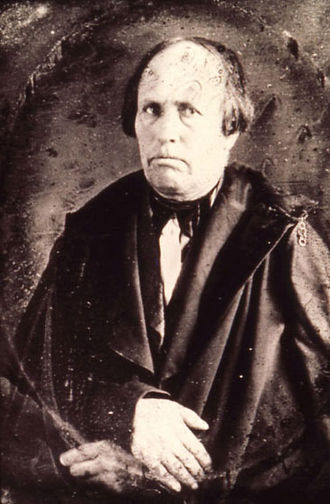
Padre Antonio José Martínez

When he returned to New Mexico in 1823, Antonio José was not only ordained, but he’d also adopted the use of the less-common last name Martínez. After an introductory period serving in temporary positions, he was assigned to the communities in the Taos area.    

By 1837, the padre was responsible for more than the religious lives of his parishioners. He was also running a school for local children and a preparatory seminary. At the same time, he served as consul for Americans in New Mexico, operated a printing press that produced literary publications as well as church forms, and was the Taos representative to New Mexico’s Departmental Assembly.

So Antonio José Martínez was a man to be reckoned with, both in his religious and secular roles. From what we know of his later interactions with Bishop Jean Baptiste Lamy, I think it’s safe to say he was also not someone who bowed easily to the opinions of others. As a rico and a priest, he seems to have been firmly on the side of what he might have called “law and order.” While I was writing There Will Be Consequences, I had great fun imagining his reaction in late 1837 when the rebels at Taos demanded that he quit preaching against the revolt. They also wanted him to stop asking for the customary church burial, baptism, and marriage fees. The evidence indicates that this conversation did not go well.

However, the rebels’ pushback does seem to have slowed Antonio José’s remarks down a little. After all, they were also threatening his younger brother, Subprefect Santiago Martínez.

But Martínez the brother was still padre at Taos. Although the exact sequence of events isn’t clear, we know his actions and language precipitated at least one other confrontation, one so intense that it required the appearance of the local magistrate and other loyalists to keep violence from erupting.

Tensions remained high. By early January 1838, Antonio José sent a letter to interim governor Manuel Armijo warning of the likelihood of another rebel outbreak. In the middle of the month he followed his missive to the capitol.

And stayed there. When Armijo began to prepare to meet the rebels one last time, Martínez volunteered to act as his chaplain. But he didn’t hover in the background. The padre was at the governor’s side during the final battle at Pojoaque Pass on Saturday, January 27. In fact, he reportedly went “heroically about attending to the wounded and consoling the dying with the last rites.”[1]

Antonio José Martínez may have been a man of the cloth, but he was clearly also a man of action. Will we ever know exactly what he was thinking that cold January day? Probably not, but it’s certainly interesting to consider the possibilities.


[1] Fray Angelico Chavez, But Time and Chance, pp. 56-57.

JUST A MAN

JUST A MAN

“I seen him! I seen him!” The boy stopped, breathless, just inside the kitchen door.

“You mean you saw him.” His mother shook her head at him as she lifted the lid from the Dutch oven in the fireplace to check the biscuits. She smiled. “Who did you see?”

“Kit Carson! He was on the other side of the street, going into the Governor’s house.”

She nodded. “I heard this morning that he was back. What is he like?”

His shoulders sagged. “He didn’t look anything like the pictures in the book Grandpa gave me when we left Kansas City.”

“That was just a story,” she pointed out. She turned to stir the great pot of venison stew.

“I know,” he said. “But he wasn’t what I expected at all. He’s just a man.”

Copyright ©2013 Loretta Miles Tollefson

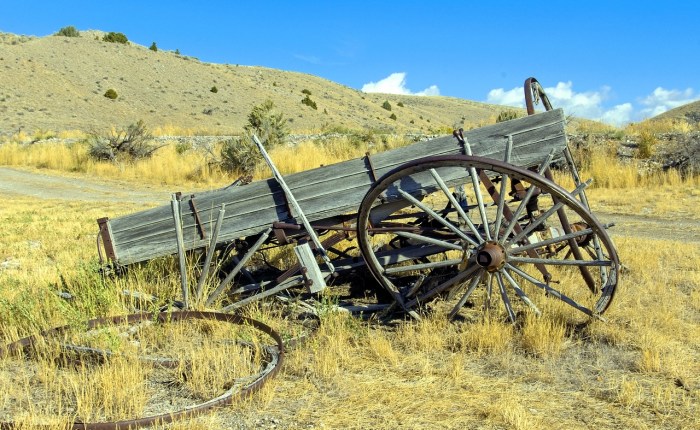
Image by Mike Goad from Pixabay

Old One Eye Pete and the Half-Grown Pup

Old One Eye Pete and the Half-Grown Pup

It’s a gangly mutt, large for an Indian dog, with dirt-matted curly black hair. Old One Eye Pete looks at it in disgust as it half-crouches at his feet. It’s been following him and the mule for the past two hours, ever since they left the Ute Indian encampment down canyon. “Damned if the thing ain’t smilin’,” Pete mutters. He pokes the dog’s side with his foot. “You a doe or a buck?” The animal rolls over obligingly, paws in the air. Buck.

Old Pete toes it again. “Well, I expect you won’t last long. You’ll be running off to the first camp with a bitch in heat.” He turns and twitches the mule’s lead rope. “Giddup.”

They trail the Cimarron River up canyon through the afternoon and settle into camp under an overhanging sandstone boulder as the light begins to fade. It’s still early. The sunlight goes sooner as the canyon walls narrow. But Old Pete’s in no particular hurry and the pup’s acting a mite tired.

“Gonna have to keep up,” Pete tells it as he cuts pieces of venison off the haunch he traded from the Utes. The dog slinks toward the fire and Pete tosses it a scrap. “Too small for my roaster anyway,” he mutters as he skewers a larger chunk onto a sharpened willow stick and holds it out over the flames.

~ ~ ~ ~

“Where’d that damn pup get to now?” Old Pete mutters as he and the mule reach the rocky outcropping that overlooks the valley. He can see through the ponderosa into a good stretch of grassland below, but there’s no evidence of the curly-haired black Indian dog. Pete shakes his head in disgust, jams his rabbit fur hat farther down on his head, and snaps the mule’s lead rope impatiently.

At least the mule doesn’t need voice direction. Which is more than can be said for the dog, but Pete refuses to call the damn thing, no matter how aggravated he might feel.

Jicarilla Apaches are likely roaming the valley for elk, and Pete’s taking no chance of being found before he wants to be. The dog can go to hell, for all he cares. He grunts irritably as he works his way down the hillside. Idiot pup.

He pauses at the tree line, getting his bearings, the air crisp on his face. A light snow powders the ground. A herd of perhaps thirty elk is bunched on the hillside to his left. He squints his good eye. They seem a mite restless.

Then he sees the wolves, eight or nine of them waiting downwind while two big ones trot the herd’s perimeter, checking for weakness.

At his feet to his right, a low whine emanates from the prickly ground-hugging branches of a juniper bush. As Pete turns his head, the black pup eases from the grasping needles. The dog slinks to Pete’s feet and crouches beside him, tail between its legs. Then it looks anxiously toward the wolves and whines again.

“Not as dumb as I took you fer,” Old Pete says, adjusting his hat.

~ ~ ~ ~

There’s a reason it’s called Apache Canyon and Old Pete proceeds cautiously, aware that there’s been a recent outbreak of hostilities between the Jicarillas and the locals. Somebody got twitchy-brained and shot off their gun without thinking twice and now the whole Sangre de Cristo range is on edge. And it doesn’t matter at all that he had no part in the original quarrel.

However, Pete hasn’t seen a soul in three days, and he’s beginning to think he’s going to get to Taos in one piece after all, if the damn half-grown dog tagging him will quit wandering off, then coming back, widening the scent trail with his idiot nosing around.

Pete scowls as the puppy reappears, this time from a thicket of scrub oak, dead leaves rattling on the ground. As the dog gets closer, it goes into a half crouch. It’s holding something in its mouth and its curly black tail droops anxiously.

“What’ve you got there?” Pete asks. He squats and holds out his hand, and the dog releases the item into his palm. “Shit!” Pete says, dropping it.

Then he leans closer and sniffs. It really is shit. Human, too. Fresh enough to still stink. He rises, studying the slopes on either side, turning to examine the Pass behind him. So much for being alone.

“Thankee, pup,” he mutters. “I think.”

from Old One Eye Pete

Josefa Jaramillo is Born in New Mexico!

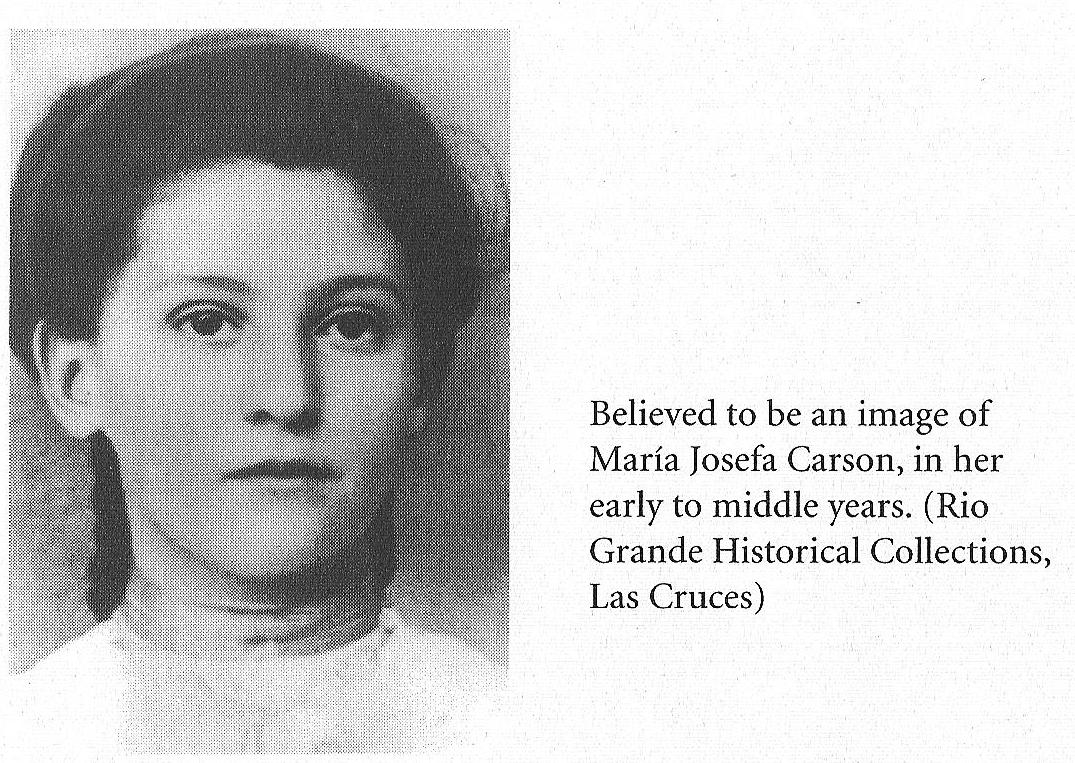
On Thursday, March 27, 1828 in Portrero, New Mexico, María Josefa Jaramillo was born to Francisco Esteban Jaramillo and María Apolonia Vigil in Portrero, New Mexico. Her parents moved to Taos before the end of the year, María Josefa and her older siblings, including three sisters, in tow.

Josefa, called “Josefita” by her family, and her older sister Ignacia would grow up to ally themselves with two prominent americanos—Christopher “Kit” Carson and Charles Bent. In the early 1830s, the now-widowed Ignacia entered into a common-law marriage with American merchant Charles Bent. About ten years later, on February 6, 1843, Josefa married newly-converted Catholic Christopher “Kit” Carson, exactly seven weeks before her fifteenth birthday.

Source: Kit Carson and His Three Wives, Marc Simmons

Four years later in mid-January, while Kit was away and Josefa was staying with Ignacia and Charles in Taos, the Jaramillo girls’ brother and Bent were killed by an angry mob. The nineteen-year-old testified at the trial of the accused men.  Refined in dress and manners, she had a heart-breaking beauty, one observer said, that “would lead a man with the glance of the eye, to risk his life for a smile.”

After that, Josefa’s life settled down a little, though it seems to have never been truly calm. Carson was gone for long stretches of time: trapping and hunting, and serving as a scout for John C. Fremont, as a courier during the Mexican war, as a military officer during the Civil War, and as commander of the troops that forced the Mescalero Apaches and Navajos onto the Bosque Redondo reservation in 1863-64. In the meantime, Josefa moved from Taos to Rayado to Bent’s Fort and back again, then followed Carson to Fort Garland and finally Boggsville, Colorado.

But Carson and the woman he called “Chepita” and “Little Jo” seem to have had a loving relationship. They had eight children, the last one born just ten days before her death in April 1868. Carson followed her a month later. They are buried side by side in a small cemetery in Taos, ending their journey together in the town where it began.

Sources: Don Bullis, New Mexico Biographical Dictionary, 1540-1980, Vol. I, Los Ranchos de Albuquerque: Rio Grande Books, 2007; Lewis H. Garrard, Wah-to-yah and the Taos Trail, Norman: University of Oklahoma Press, 1955; Leroy R. Hafen, Ed., Fur Traders of the Far Southwest, Logan: Utah State University Press, 1997; Howard R. Lamar, Reader’s Encyclopedia of the American West, New York: Harper & Row, 1977; Marc Simmons, Kit Carson and His Three Wives, Albuquerque: University of New Mexico Press, 2003

Charles Beaubien Requests Mexican Citizenship

On Sunday, February 22, 1829, Charles Hipolite Trotier Sieur de Beaubien (aka Carlos Beaubien) submitted his application for Mexican citizenship. One of the first French-Canadian trappers to settle in New Mexico following Mexican independence, Beaubien had already married Paula Lobato, a member of a prominent family, by the time he formalized his decision to stay there.   

Beaubien and Lobato made their home in Taos. In early January 1841, he and then-Secretary of State Guadalupe Miranda asked the Mexican government to give them a swath of land east of Taos. The property was granted to them in January 1843, although they didn’t leave Taos to take possession of it until Wednesday, February 22 that year.

Although they don’t seem to have made much effort to settle the grant, the two men held onto it through the final years of the Mexican period. After the 1846 American occupation, they began the lengthy U.S. process of confirming title, an procedure that wasn’t completed until  1860, almost 28 years after Beaubien became a Mexican citizen.

Charles Beaubien

In that time, he’d been, sequentially, a citizen of the United States, then Mexico, and then the U.S. again. He’d been a successful Taos merchant and a judge under both the Mexican and American systems, lost a son during the insurrection of 1847, and given his daughter Luz in marriage to the mountain man Lucien B. Maxwell.

When Beaubien died in February 1864, Luz and Lucien moved quickly to buy out her sibling’s inherited portions of the grant, as well as Guadalupe Miranda’s share, and take full control. They would sell it in 1870 to the Maxwell Land Grant and Railway Company, a group which became infamous for its treatment of the people Lucien and Luz had allowed to live, ranch, and mine on their holdings.

But it had all started on that February day in 1829 when Charles Hipolite Trotier Sieur de Beaubien became a Mexican citizen.

Sources:  Don Bullis, New Mexico Autobiographical Dictionary, Los Ranchos de Albuquerque: Rio Grande Books, 2007; Harriet Freiberger, Lucien Maxwell, Villain or Visionary, Santa Fe: Sunstone Press, 1999; Victor Westphall, Mercedes Reales, Albuquerque: UNM Press, 1983.