The Real Gertrudis Barceló

The Real Gertrudis Barceló

The illustration for this post is a picture of New Mexico monte dealer, power broker, and business woman María Gertrudis Barceló. It accompanied an April 1854 Harper’s Weekly Magazine article by Lt. G. Douglas Brewerton about New Mexico. The evidence suggests it was created by a Harper’s artist who never actually met Barceló.

The picture appeared alongside a lengthy quote about Barceló from Josiah Gregg’s 1844 Commerce of the Prairies:

“Some twelve or fifteen years ago, there lived, or rather, roamed in Taos a certain female of very loose habits, known as La Tules. Finding it difficult to obtain the means of subsistence in that district, she finally extended her wanderings to the capital. She there became a constant attendant upon one of those pandemoniums where the favorite game of monte was dealt … for some years she spent her days in lowliness and misery. At last her luck turned … [and she was able] to open a [monte] bank of her own, and being favored with a continuous run of good fortune, she gradually rose higher and higher in the scale of affluence … [and is] now known as Señora Doña Gertrudes Barceló… ”[1]

While Gregg’s book seems to contain solid data about the goods that moved between Missouri and New Mexico in the 1830s, I’ve found him less than accurate in his reports about the people he met in Santa Fe. This is certainly true in the case of Gertrudis Barceló.

For example, Barceló was not from Taos. She was born in Sonora circa 1800 and in 1815 moved with her parents and siblings to the hamlet of Valencia, New Mexico, about 100 miles south of Santa Fe. They were well-off—her parents are identified as Don and Doña in extant baptism records.

In addition to these rico beginnings, Gertrudis became wealthy in her own right as a result of her skill with numbers and cards. As a monte dealer in the mid to late 1820s, she spent time in the mining camps of what is now Cerrillos, New Mexico where she accumulated a large enough stake to set up a gambling salon in Santa Fe. There, she entertained officials, dealt cards, loaned money at interest, purchased property, and provided a home for her mother, an adopted daughter, and more than one foster child.

Barceló had married Manuel Antonio Sisneros on June 20, 1823. She was about 4 months pregnant at the time. That baby boy, and a subsequent son two years later, died in infancy. Her relationship with Sisneros may not have been ideal. They seem to have lived in separate houses on the same Santa Fe street from 1836 to at least 1841. He may have died or it’s possible they simply went their separate ways. The records don’t indicate that he participated in her business activities.

Barceló made ends meet not only as a money lender and monte dealer, but also by taking in boarders. This led to an 1835 accusation that she was illegally cohabiting with americano Lucius Thruston. She refuted the charge and it was withdrawn. She was still renting rooms out in the early 1850s, when she provided space to Governor  John Munroe.

Around 1846, Gertrudis did become romantically involved with a foreigner, a highly-educated Prussian lieutenant in the U.S. Army named Augustus de Marle, who provided security for her monte dealings and represented her in court during at least one debt collection process. They remained close until her death in 1852, when he served as an executor of her will.

Other anglos were not so friendly. In addition to quoting Josiah Gregg’s inaccuracies about Barceló’s background, Brewerton described her face as “scarred and seamed, and rendered unwomanly by those painful lines which unbridled passions … never fail to stamp upon the countenance.”[2]

Susan Shelby Magoffin also encountered Barceló and found her wanting, reporting that the “stately dame of a certain age” wore false hair (probably the curls then fashionable) and teeth, smoked, and exhibited “that shrewd sense and fascinating manner necessary to allure the wayward, inexperienced youth to the hall of final ruin.”[3]

These statements contradict other reports, which tell us Barceló had a neat figure and intelligent, shrewd eyes, and was an elegant dancer. However, she did like fashionable clothes and heavy jewelry, often wearing a gold chain with a large crucifix.[4] The jewelry is included in the Harper’s Weekly image. The artist also uses the fashionable curls and cigarette, wielding them to portray someone who’s everything he believes a woman shouldn’t be—haggard from “fast living,” with long straggly hair, and smoke billowing around her head from a dangling cigarette. In the eastern part of the United States at the time, smoking by women had long been associated with loose morals and dubious sexual behavior. So a picture showing Barceló  with a lit cigarette effectively placed her in the lowest possible social category, that of a sexually promiscuous woman.

I can find no evidence she was, in fact, promiscuous or involved romantically with anyone other than her husband and, later, Augustus de Marle. To the contrary, in some ways, Barceló could be held up as a model of how to behave toward others. She seems to have made a habit of taking in children who needed a home.

In March, 1826, she and Sisneros adopted at least one little girl, Maria del Refugio. In 1832, Gertrudis adopted another child, named María Guadalupé de Altagracia. She also fostered Petra Gutierrez, daughter of Diego Gutierrez and Dolores Sisneros. When Petra became pregnant at 14, Barceló raised the baby herself, freeing Petra to marry James Giddings four years later. When Barceló died, her will included provisions for the unmarried girls still in her care.

But nothing she did would be enough for the americanos. Even after Barceló died and was buried in the Santa Fe parish church, they couldn’t leave her alone. Almost immediately, the Missouri Daily Republican reported that “she took early to two professions [gambling and prostitution] common in this country of easy morals,”[5] a dig at both Barceló and New Mexico.

This attitude continued through the next century. In his 1912 discussion of the 1847 revolt, Ralph Emerson Twitchell called Barceló “a woman of shady reputation”[6] even while he credited her (in a footnote) with warning the Americans of the planned uprising and providing the names of its leaders. In 1984, Paul Horgan described Barceló “with her wig and false teeth”[7] whispering this same warning to Governor Bent, as if her appearance was somehow relevant to the service she provided.

Even in the 21st century, the defamation hasn’t stopped. An essay in the 2009 Telling New Mexico identifies Barceló as an unmarried woman with a dubious reputation.[8] The first statement is flat out wrong and the second depends on who your source is. Certainly, she had a dubious reputation with some Americans.

As far as I can tell, the primary reason they disliked her so much was that she had the audacity to be a successful businesswoman. No other New Mexico monte dealer is singled out in the historical record with the abuse and accusations that are levied against Barceló. This is doubly annoying considering that the U.S. would have had a much more difficult time occupying New Mexico in 1846/47 without her assistance. She not only provided valuable information during a precarious time, she also gave them a loan to cover Army salaries until funds arrived from the East.

The fact that this loan was from a woman must have galled them. A woman who’d acquired her riches via gambling and loaning money at interest. These were provinces of male endeavor, not female. And then (gasp!) she took a lover! So they tried to erase her with ugly words and grotesque drawings.

But María Gertrudis Barceló lives on, the very symbol of the independent New Mexican woman who could love and care for children she didn’t bear while using her brains and skills to amass enough wealth to provide for them after she died. The americanos tried to cancel her with jeering words and an ugly picture. These representations are what should be cancelled. I’ve tried to do so in my forthcoming novel There Will Be Consequences, by showing Barceló’s positive interactions with the women of Santa Fe during the revolt of 1836 and also with her employees and the children in her life. It’s only a small part of what I believe should be done to mitigate the nonsense that has been written about her.


[1] “Incidents of Travel in New Mexico,” G. Douglas Brewerton, Harper’s Weekly Magazine, Vol. XLVII, April 1854, p. 588.

[2] Ibid

[3] Susan Shelby Magoffin, Down the Santa Fe Trail and Into Mexico, Yale UP, 1926, pp. 119-120

[4] John E. Suner ed., Matt Field on the Santa Fe Trail, pp.207-209; Mary J. Straw Cook, Doña Tules,UNM Press, 2007, pp. 26-28

[5] Mary J. Straw Cook, Doña Tules, UNM Press, 2007, p. 100

[6] Ralph Emerson Twitchell, Leading Facts of New Mexican History, Vol. II, The Torce Press, p. 233, note 168

[7] Paul Horgan, Great River, Wesleyan University Press, 1984, p. 762

[8] Michael L. Olsen, “The Santa Fe Trail and  Nineteenth-Century New Mexico,” Telling New Mexico, ed. Marta Weigle, Museum of NM Press, 2009, p. 156.

Is This Historical Record Racist?

Is This Historical Record Racist?

While writing my forthcoming biographical novel, There Will Be Consequences,I struggled with the historical record regarding José Angel Gonzales, rebel leader and governor of New Mexico from August 10 to September 10, 1837. The accounts are unanimous that Gonzales was the son of María Dominga Martín Liston of Taos Pueblo and a mestizo man named José Santos Gonzales. However, they also insist on identifying José Angel as genízaro.

In New Mexico at that time, a genízaro was a person from one of the unchristianized Native groups, or los indios bárbaros—typically the Ute, Apache, Comanche, or Navajo—who had been baptized and now lived among the “civilized” Christians. The term was used both for people who’d been captured directly from these tribes and for their descendants.

What’s odd about the identification of José Angel Gonzales as genízaro is that he almost certainly wasn’t. His father was mestizo, not genízaro. The term mestizo designated someone of mixed heritage, usually Indian and Spanish. It was a different classification from genízaro, which specified the person’s Native ancestry as “barbarous”. José Santos may very well have been the child of a Spanish mother and Pueblo father, or vice versa.

It’s interesting to me that the historical accounts of New Mexico’s 1837 revolt don’t reflect an awareness that José Angel’s forebears may have included Spanish men or women. Instead, he’s labeled genízaro and thus placed firmly in the “barbarous Indian” category. This labeling provides a useful lens for reading the historical record and assisting us in understanding how Gonzales was viewed by his biographers. A “barbarous Indian” was someone a civilized person might do business with, but they weren’t necessarily to be trusted. They wore clothing that was different from the norm and not entirely respectable. They had different customs. Because of this differentness, someone with this heritage might be less than trustworthy and not as cultivated and respectable as people with Spanish ancestors. Gonzales, as genízaro, could be expected to exhibit these traits.

However, that’s not what the historians report. Instead, we’re told Gonzales was a good, brave man but ignorant of politics, that he had a respectable appearance and a reputation as a good buffalo hunter, or cibolero. In fact, according to one early source, Gonzales was named governor because of his hunting skill. Yet, even as the accounts speak of Gonzales’ honesty and bravery, they insist on his ignorance. The fact that he was functionally illiterate—meaning he could sign his name, but little else—is put forth as proof of this “fact.”

These dichotomies of genízaro/respectable, honest/ignorant indicate to me that the historians didn’t know what to make of Gonzales. He was supposedly the descendant of “wild Indians” and yet he had a respectable appearance. He was the leader of rebels who took supplies without paying for them, and yet was honest. He was ignorant and still managed to impress his fellows enough for them to place him in the Governor’s office (there’s no record that he sought the position).

The fact is, Gonzales was far from ignorant. He was a renowned buffalo hunter, an occupation that required deep knowledge of the animals’ habits as well as skill in killing them and getting the resulting meat and hides back home from the plains. Gonzales was also a clever military tactician, leading the rebels to victory in early August 1837 and engineering their successful withdrawal at the Battle of Pojoaque Pass the following January. The insistence on his ignorance is based solely on the fact that he didn’t display the characteristics of Spanish learning, a learning he almost certainly never had access to. Padre Martinez’s school at Don Fernando de Taos didn’t open until Gonzales was an adult and even then wasn’t large enough to provide for every child in the area.

Gonzales was in office barely a month before the ricos from the lower Rio Grande met to plot his ouster. Some of the men at this meeting (including Manuel Armijo) had been in Santa Fe two weeks earlier and watched Gonzales in action as he presided over the Assembly to organize the new government. What had they seen? A man who was honest, who had experience leading men, who was from Taos Pueblo, and who may have had darker skin than they did. And they wanted him out of office. My guess is that it wasn’t Gonzales’s experience on the battlefield that was in question. Clearly, these men had a problem with some aspects of the governor’s person.

So, to answer the question in the title: Yes, I believe the historical record is racist. I realize the historians of the 19th and early 20th century were ensconsed within their world view and couldn’t see past their prejudices, but I have trouble absolving them of their attitude. No matter what Gonzales did, it was going to be wrong, because he was genízaro. I believe the way I’ve portrayed Gonzales in There Will Be Consequences moves beyond what has been written of him in the past to demostrate what even the racist recounting of the 1837/38 events can’t hide: the man’s honesty, ability to think strategically, and deep desire to aid his fellow humans. I hope you’ll agree with me.

Manuel Armijo, The Ultimate Politician?

Manuel Armijo, The Ultimate Politician?

A man named Manuel Armijo repeatedly plays a critical role in my forthcoming biographical novel There Will Be Consequences, which is set during the 1837/38 New Mexico tax rebellion. This isn’t the only time Armijo appeared in New Mexico’s history. In fact, you could say he played a repeating role throughout the Mexican period (1821 to 1846).

One of 15 children from a rico Albuquerque-area family, Armijo was around 30 years old when Mexico gained independence in 1821. A tall, good looking man with family connections throughout New Mexico, he became civil governor in May 1827. His term was short, ending in 1828, and marked by conflicts with the American trappers and traders who had arrived with independence.

Over the next decade, Armijo remained active in politics, serving as Albuquerque alcalde and militia lieutenant and using his influence to get the Santa Fe postmaster reinstated after being removed for mismanagement. In Spring 1836, Armijo was made New Mexico’s interim treasurer while the appointee, Francisco Sarracino, was under investigation for embezzlement.

Shortly after Sarracino was reinstated in July 1837, rebellion broke out in northern New Mexico. The insurrectionists were initially successful in taking over the capitol at Santa Fe, but the rico landowners further south quickly rallied and named Armijo commander of the loyalist forces.

Through what appears to have been a combination of lucky breaks (a rebel governor who allowed himself to be jailed instead of fleeing) and persuasion (prominent rebels who later agreed to take the man’s place in said jail). Armijo managed to get the insurrectos out of Santa Fe. But they didn’t disperse, they merely withdrew. Now interim governor, Armijo spent the winter of 1837/38 alternately threatening to kill his rebel prisoners and cajoling the insurrectionists into behaving by asking them to clarify their grievances so he could address them.

In reality, Armijo was biding his time. One of his first actions as commander had been to send a request south to Chihuahua for troops to reinforce New Mexico’s militia and small garrison of presidio soldiers. When the requested dragoons arrived in January 1838, the governor’s gloves came off. He ordered his rebel prisoners beheaded and marched north.

This time, with adequate troops behind him, Armijo was able to deal a decisive blow that effectively ended the rebellion. His reward for suppressing the insurrection was to remain in office as both civil and military governor, positions that were usually split between two people. His administration lasted through 1844, when he was suspended for a short time.

Armijo was reinstated for a third term in 1845, but the third time was not the charm. The following year, the Americans invaded in what is now known as the Mexican-American War. After much rhetoric and possibly a payoff, Armijo fled south ahead of the U.S. Army. He would be much castigated for this, even by later American historians, although his flight may well have saved New Mexican lives.

The pundits saw him as weak, cowardly, and greedy, a view that may have influenced their perspective on events nine years earlier. They reported that Armijo balked at the January 1838 battle until a dragoon captain forced his hand and some accused him of fomenting the rebellion in order to regain his position as governor. They even claimed that he had the prisoners executed in January 1838 in order to suppress what they knew about his involvement in the rebel coup. I have found no evidence to support either assertion. However, the very fact they were made seems to say a great deal about the complexity and power of Armijo’s character and his hold on the imagination of subsequent historians.

While I was writing There Will Be Consequences, I spent a good deal of time ruminating on the motivations of a man who seemed to have a knack for persuading people to do things contrary to their own interests and who was also quick to put people to death if it suited his needs. Was Armijo simply a selfish, cowardly scoundrel? Or was there more to him than met the historians’ eyes? Why would he hesitate to face the rebels at Pojoaque Pass when the odds were in his favor? Perhaps he really cared about the people and peace of New Mexico and worried about the impact of yet more deaths. Maybe he believed the executions two days before would be enough to bring the insurrectionists to heel.

We know a good deal about what Armijo did—or is said to have done—in the Fall and Winter of 1837/38. However, we don’t know what he was thinking. His actions and hesitation together give me the sense of a complex man with varied motivations. This makes him a fascinating character to write.

Which is a good thing, because he’s bound to show up in future Old New Mexico novels, following There Will Be Consequences. After all, he didn’t fade from public view until after 1846. I can hardly wait.

200th Anniversary of the Santa Fe Trail

200th Anniversary of the Santa Fe Trail

This Fall marks the 200th anniversary of the opening of the Santa Fe Trail between Missouri and New Mexico. The article in the link below provides an overview of what happened and why the Trail is important in the history of the United States and New Mexico.

https://www.nps.gov/places/santa-fe-national-historic-trail.htm

What’s the Big Deal About the Santa Fe Trail?

This Fall marks the 200th anniversary of the opening of the Santa Fe Trail from Missouri to New Mexico. I was going to write a piece about why the Trail was important to the U.S., then I found this. I think it pretty much covers everything I was going to say…..

https://www.nps.gov/articles/000/becknell-s-1821-journey-to-santa-fe.htm

William Becknell and the Santa Fe Trail

William Becknell and the Santa Fe Trail

About this time 200 years ago, a man named William Becknell was on his way from Missouri to the Rocky Mountains to trade with the Indians. Or so he said. This is his story, as told by the Kansas Genealogy website. I love the old-fashioned language used in this report. I think it may closely reflect how he would have described what happened. I hope you enjoy it as much as I do.

Captain William Becknell

“The first successful venture to Santa Fe over the Santa Fe Trail was made by Captain William Becknell. With him, according to Gregg, were “four trusty companions.” They left Arrow Rock, on the Missouri, near Franklin, but in Saline County, September 1, 1821. On the 13th of November they met a troop of Mexican soldiers, who prevailed upon them to voluntarily go, in their company, to Santa Fe, whither they were returning. At San Miguel they found a Frenchman who acted as interpreter for them. They were accorded a friendly reception at Santa Fe and provided the facilities necessary to dispose of their goods. These sold at such rates as astonished the Missourians, calicoes and domestic cotton cloth bringing as much as three dollars a yard. The enterprise proved most remunerative. The party set out on the return journey on the 13th of December and reached home in forty-eight days.

That adventure may be said to have established the Santa Fe trade, and Captain Becknell had justly been called the father of the Santa Fe Trail, for that which he followed was accepted as The Trail from the Missouri River to Santa Fe.

The favorable termination of the trading-journey of Captain Becknell being extensively told on the borders of Missouri, others determined to engage in that commerce. Colonel Benjamin Cooper organized a company which left Franklin for Santa Fe early in May, 1822. His nephews, Braxton, and Stephen Cooper, were members of the party, which numbered some fifteen souls. They carried goods to the value of some five thousand dollars to Taos, using pack-horses. The result of the expedition must have been satisfactory for the Coopers remained in the trade for some years, Braxton Cooper meeting his death at the hands of the Comanches some years after this first trip across the Plains.

Captain Becknell was resolved to continue in the trade which had given him such good returns. Within a month after the departure of Colonel Cooper he again took the trail from Franklin to Santa Fe. The value of his cargo was about five thousand dollars, and there were thirty men in the expedition. On this journey he abandoned the use of packhorses and used for his transportation, wagons drawn by mules, the first wagon-train over the Santa Fe Trail and the first to cross the Great Plains. It was four years before Ashley took his wheel-mounted cannon into the valley of the Great Salf Lake, eight years before Smith, Jackson & Sublette went into the Wind River country with wagons, and ten years before Captain Bonneville drove wagons into the valley of Green River. This first caravan to depart from the usual means of transportation used three wagons.

This second expedition of Captain Becknell was the pioneer party over the Cimarron Route of the Santa Fe Trail. Captain Becknell had, through his travels, conceived the true geography of the Southwest. It was plain to him that the nearest way to Santa Fe from the Arkansas River was to the southwest by the Cimarron. When he had arrived at that point afterwards known as the “Caches” he turned south. He was not familiar with the country which he was entering. It bore a desert aspect and proved entirely destitute of water between the Arkansas and the Cimarron. The supply carried in canteens was exhausted at the end of two days. It seemed that they were destined to die of thirst on those parched and blasted plains. They killed their dogs and out off the ears of their mules to drink the blood, but this desperate expedient served only to aggravate their suffering. The mirage taunted them with the appearance of water rippling against the shores of false lakes. They had, however, come near the Cimarron without knowing it. They resolved to turn about and try to regain the Arkansas, something they never could have done. In the last extremity, when despair was settling upon them, some of the party observed a buffalo coming up from a depression they had not before seen. It seemed to come up as from the depths and stand upon the burning plain with distended sides, as though gorged with water. It was immediately killed and opened. The stomach was filled with water taken but a few minutes before from the Cimarron. This filthy water was drunk as nectar from paradise. Search was at once made for the stream whence had come this lone providential buffalo, and the Cimarron was found. Water was carried back by the refreshed travelers to those perishing on the desert, and the party was saved. The journey was continued over that route, and water was fortunately found in quantities sufficient to enable the party to reach San Miguel.

The misfortunes of the party under Baird, which went out in 1812, the members of which were imprisoned so many years at Chihuahua, did not quench the passion for trade over the Plains in their leader. In 1822 he induced some adventurers at St. Louis to join him in taking a trading expedition over the Santa Fe Trail. He was joined also by Samuel Chambers, who had aided in securing the cargo to be carried, and who had descended the Canadian in 1821. The expedition consisted of some fifty men and an ample supply of horses and mules. It left Franklin late in the season and was overtaken by severe weather on the Upper Arkansas. It took refuge on an island in that river, no doubt for the reason that it was covered with willow and cottonwood timber. So rigorous did the winter prove that these men were compelled to remain there three months, and most of their animals perished from exposure and starvation. This calamity left them without the means to carry their merchandise into New Mexico. They were under the necessity of concealing their goods there while they went to New Mexico for horses and mules to carry in their lading. They left the island and went up the north bank of the river some distance where they dug pits or “caches” in which they placed their goods, covering them in very carefully. They then went to Taos, where they secured the necessary animals, with which they returned and on which they packed their merchandise to that town. The several pits were left unfilled when the goods were removed, and they stood open there on the Trail for many years. In Gregg’s day they were still open and their walls were covered with moss. They came to be a marking point on the Trail, and this point was known as the “Caches.” The “Caches” were about five miles west of the present Dodge City, Kansas.

In the year 1823, there is record of but one expedition from Missouri to Santa Fe. Early in May Colonel Cooper left Franklin with two packhorses laden with goods valued at two hundred dollars. He returned the following October with four hundred “jacks, jinnies, and mules” and some bales of furs.

Gregg erroneously dates the commencement of the Santa Fe trade from the year 1824. And he falls into another error in saying that the first wagons were used in the trade that year. At the Franklin Tavern, about the first of April, 1824, there was a meeting to discuss the trade to Santa Fe. The point of assembly for the expedition that year was fixed at Mount Vernon, Missouri, and the time was set for the 5th of May. Each man was to carry a good rifle, a dependable pistol, four pounds of powder, eight pounds of lead, and rations for twenty days. The expedition was composed of eighty-one men, one hundred and fifty-six horses and mules, and twenty-five wagons. Thirty thousand dollars was the value of the goods carried. The expedition started on the 15th of May, 1824, crossing the Missouri about six miles above Franklin. The organization for the long journey was effected as soon as the caravan was well under way. A. Le Grand was elected Captain. M. M. Marmaduke, later Governor of Missouri, was one of the party. The Arkansas River was reached on the 10th of June, and the expedition arrived at Santa Fe on the 28th day of July. The financial results of the venture were satisfactory.

It is not necessary to the scope of this work to present an account of every expedition over the Santa Fe Trail, and it is not the intention to do so. The design is to give a historical review of the Trail which will furnish the student or casual reader of history such information as will establish in his mind a clear but not a detailed outline of this important highway of the Plains.

By the year 1825 the Santa Fe trade had assumed sufficient proportions to attract the attention of Congress. There was also a growing apprehension of the wild Indians of the Plains. While there had been no trader killed on the Trail and no robberies of enough importance to report, there was a gathering of Indians along the way, and it was feared that outrages would be committed. Congress, in the winter of 1824-25, passed a bill (approved March 3, 1825) authorizing the President to have the Santa Fe Trail marked from Missouri to the frontiers of New Mexico. The Commissioners appointed to carry that act into effect were enjoined to secure the consent of the Indians whose lands were infringed, to the survey and marking of the road. For that purpose a treaty was entered into, at Council Grove, between the Great and Little Osages and the Kansas Indians on the 11th day of August, 1825. The object of the treaty and what resulted from it will be best shown by the instrument itself. There were in fact two treaties—one with the Osages and one with the Kansas. As they are identical in terms, except as to the preliminary paragraphs, only that with the Osages is given.”

from kansasgenealogy.com/history/captain_william_becknell.htm

U.S. Mail Heads to Santa Fe!

U.S. Mail Heads to Santa Fe!

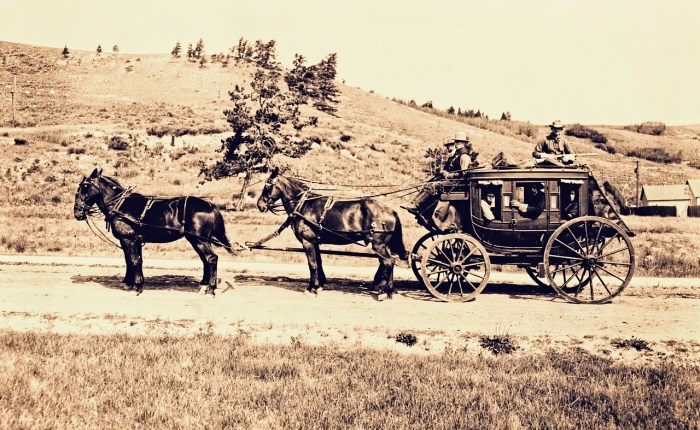
On Monday, July 1, 1850, the first stage-transported U.S. mail left Independence, Missouri for Santa Fe, New Mexico with eight men guarding the mule-drawn coach.

This was the first Congressionally authorized four-year contract for mail transported by vehicle between Independence and New Mexico. It had initially been set to leave Fort Leavenworth but the contract was modified to send it out of Independence instead, reducing the route distance from 885 to 840 miles.

The mail contractors in 1850 were Dr. David Waldo of New Mexico and Jacob Hall of Independence. The stage not only carried the mail, it also provided passenger service, with fares of $100 in the summer and $150 during the winter. A letter of less than half an ounce cost $0.10 and could be sent collect, postage to be paid by the recipient.

The company that Waldo and Hall formed in 1850 dissolved four years later, when Hall bought Waldo out and teamed up with John M. Hockaday to transport the mail for the next contract period. In 1857, service moved to semimonthly and the following year Hall again placed a successful bid, this time as sole proprietor. In 1862, he bid again, but the contract was awarded to George H. Vickroy and Thomas J. Barnum.

The Eastern terminus for the stage also shifted that year, moving west to Kansas City. Now the shortening of the line that had begun on the first run accelerated, responding to the growth of the railroads. Stage service to Santa Fe would end completely in 1880 with the arrival of the Atchison, Topeka, and Santa Fe. But the idea of the stage and its symbolic connection to the American frontier would linger much longer.  

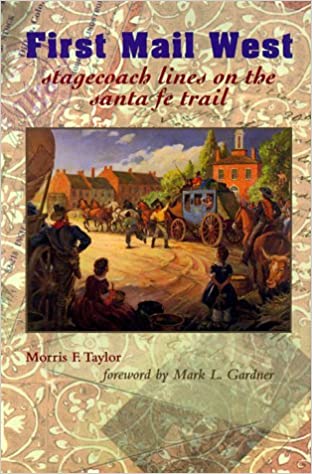
Book Review: First Mail West

Book Review: First Mail West
by Morris F. Taylor, UNM Press, 2000

For many Americans, the stagecoach symbolizes the 1800s in the West. And yet, stage mail and passenger service to Santa Fe lasted just thirty years, from 1850 to 1880. In that time, the route grew shorter and shorter, as the railroad crept toward New Mexico and finally ended the stagecoach era completely.

Morris F. Taylor’s book First Mail West: Stagecoach Lines on the Santa Fe Trail tells that story and much more.  It begins with equine transport of military dispatches and goes on to describe when and how the first Post Office Department contracts were put in place and the many details connected with the mail stage system.

But this is not a dry fact-and-figures kind of book. It’s filled with the names of people associated with New Mexico history—the Bent brothers, David Waldo, Ceran St. Vrain, William W.H. Davis, Kit Carson, Governors Lane and Meriwether, and many more. It also identifies lesser-known individuals, including the stage conductors and drivers, and provides fascinating glimpses into life along the route to Santa Fe—descriptions of the stage stops, how they were operated, the people who ran them, and the dangers they encountered. In addition, because the stage had connections into Denver, there’s a good overview of the early Colorado mine fields and the towns that sprang up around them.

First Mail West is a pleasure to read and full of information you never realized you wanted to know. I recommend it to anyone researching New Mexico and Colorado history in the 1846-1880 time frame and also to those who’d simply like another approach to Old West history.

A Furry Conflict in New Mexico

On Wednesday, May 16, 1827, a man named Ignacio Sandoval showed up in Santa Fe, New Mexico with important information for Governor Antonio Narbona. Sandoval had just returned from a trapping expedition led by an American named Ewing Young. Young, who didn’t have a permit to trap, had come back with thirteen packs of furs—probably mostly beaver—and hidden them south of Santa Fe at the Peña Blanca home of Luis María Cabeza de Baca.

Narbona, in one of his last official acts as governor, sent men to confiscate the furs. Cabeza de Baca, trying to protect them, died as a result.  Manuel Armijo, who took over as Governor on May 21, promptly issued an order for Ewing Young’s arrest in connection with the illegally obtained furs.

Young escaped incarceration for the time being, but the pelts remained confiscated. Well, most of them did. Some of them belonged to another American, Milton Sublette.

Beaver pelt

In July, Young and two other Americans obtained permission to clean the furs, which they worried had become damaged in storage. They and the local alcalde were busy shaking them out and taking inventory when Sublette appeared, grabbed a pack, threw it over his shoulder, and took off for the nearby home of Cristobal Torres.

The local authorities converged on the house, but it was too late. Sublette and his pelts had disappeared. Armijo blamed Young and called him into his office for explanations. When he threatened to incarcerate the American, Young walked out. Armijo had him arrested, threw him in jail, then released him when Young claimed a debilitating fever.  But Armijo didn’t release the furs. Legally, they were now government property. They would eventually be sold, though at a fraction of what their original value.

So once again, a conflict between the Mexican administration and the Americans in New Mexico ended in a standoff, with no one the clear winner. I find this a fascinating story because it highlights the conflicts and complexities of American-Mexican interactions twenty years before the 1847 revolt at Taos, which stunned the Americans with its ferocity.

They weren’t looking at the larger picture. The kind of high-handedness and disregard for local customs Young and Sublette displayed were common among the American trappers during the Mexican period.  The 1827 incident, among many others, appears to me to be directly linked to the events of early 1847, when the newly appointed American governor and former trapper and merchant Charles Bent was killed.

Retribution, no matter how long it takes, is still retribution.

Source: David J. Weber, The Taos Trappers, Norman: University of Oklahoma Press, 1971.

Thomas Catron is Named U.S. Attorney for New Mexico!!!

In early March 1872, Thomas B. Catron was named U.S. Attorney for New Mexico Territory, replacing his good friend Stephen Elkins, who’d just been elected New Mexico’s delegate to Congress. Catron had come to the Territory in 1866 at Elkins’ urging. He used his appointment to become a powerhouse in New Mexico politics and the center of what became known as the Santa Fe Ring, a group of men who sought to keep New Mexico’s political and financial power firmly in their own hands.

Catron and Elkins were business as well as law partners. They focused their efforts on anything that would increase their wealth, including banking, mining, and land speculation. Elkins left the Territory in 1877 and moved to West Virginia, but Catron stayed and continued his business and political activities. He served as Santa Fe’s mayor, president of the New Mexico Bar Association, and—perhaps most importantly—kingpin of New Mexico’s Republican party.

Source: Thomas Benton Catron and His Era by Victor Westphall

These positions and his control of the Santa Fe Ring enabled Catron to amass huge landholdings, many of them fraudulently. By the end of the 1800s, he reportedly owned around two million acres in New Mexico land and had a financial interest in another four million, much of it former Spanish and Mexican land grants.

It seems fitting that Catron County, one of New Mexico’s largest counties in terms of area but smallest in terms of population, is named after Catron. I suspect he was one of those people who didn’t tolerate others well unless they could benefit him in some way, so he needed a certain amount of elbow room. Naming a county for him that contains plenty of acreage but not many people seems appropriate.

Sources: Don Bullis, New Mexico: A Biographical Dictionary, 1540-1980, Vol. 1. Los Ranchos de Albuquerque: Rio Grande Book, 2007; Howard R. Lamar, Ed. The Reader’s Encyclopedia of the American West, New York: Harper and Row, 1977; Hal Stratton and Paul Farley, Office of the Attorney General, State of New Mexico, History, Powers & Responsibilities, 1846-1990. Santa Fe: State of New Mexico, 1990; Victor Westphall, Thomas Benton Catron and his era, Tucson: University of Arizona Press, 1973.