After a torturous journey, George Wilkins Kendall and a small group of fellow Texans finally reached New Mexico in mid-September 1841. And were under lock and key.
The approximately 300 men of the Texas Expedition to Santa Fe had divided into two groups at the end of August and sent 100 (including Kendall) ahead to find provisions for the rest, who waited with the wagons.
On Tuesday, September 14, 1841 Kendall and three other men rode into Anton Chico, New Mexico looking for food. When it became clear that the little village couldn’t supply what was needed, they headed across country toward San Miguel del Bado. They made it, but not quite the way they’d planned. By the time they reached town, they were in the custody of Mexican militia under Captain Damasio Salazar.
Kendall and his group spent just over a month incarcerated at San Miguel del Bado, where flirted with the women, engaged in shooting contests, and observed village life while they waited for word of their comrades. News finally came on Monday, September 20, when the group of 100 (less four) marched through on the way to Mexico City.
The larger group who’d been left farther behind wouldn’t arrive until October 12. After a three-day rest, they also would head south, along with Kendall and his comrades, under the supervision of Captain Salazar.
San Miguel del Bado was a logical place to incarcerate Kendall et al, as it was America’s port of entry into Mexico at the time. The town included barracks for the presidio soldiers stationed there, as well as mercantiles and other services for the 2000-plus residents. It even provided a space west of the church where in-bound merchant trains could wait for the customs official to survey their goods and calculate the import fees necessary to go on to Santa Fe or farther south to Chihuahua.
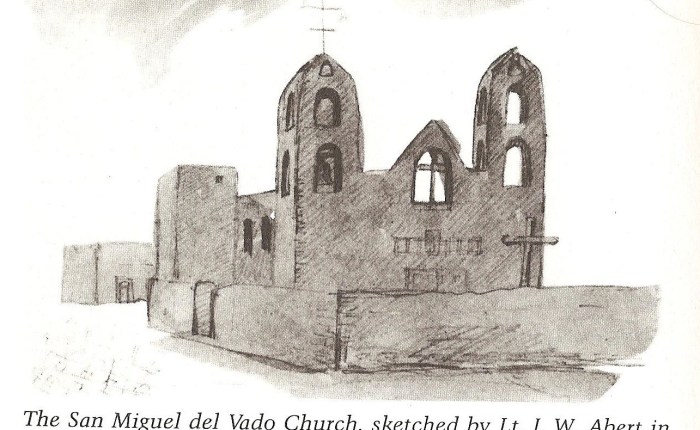
There isn’t much left of 1840s San Miguel del Bado today, except for the church with its three-foot-thick stone walls topped with adobe bricks and its twin bell towers. In Fall 1841, this building was the starting point for at least two religious processions that celebrated and gave thanks for the capture of the Texan Expedition. Kendall sneered at them both, describing the second one as “nonsensical mummeries.” He would have much to learn in the weeks to come.
I’ve mentioned George Wilkins Kendall in recent posts and thought I should explain who he was and why I think he’s important to the events that led to the 1846-47 conflict between the United States and Mexico.
A rather handsome man, Kendall had thick, wavy brown hair and loved fashionable clothes. He was also a quick learner who tended to focus only on what he was particularly interested in. At age 16, he announced that he wanted to become a printer and went to work for the Amherst Herald, which was owned by his first cousin and a friend.
When the paper collapsed 12 months later, Kendall went to Boston, where he apprenticed with the Statesman and experienced Boston theater. This sparked an interest in acting that took him to New York City and a position with a wandering theatrical group.
For the next five or six years, Kendall around the U.S., sometimes working in theater, sometimes in print shops or as a reporter. At one point, he even operated a stage coach line in North Carolina. Somewhere along the way, he returned to his first interest and acquired the skills of a journeyman printer. Around the same time, he began to transition into the role of newspaper reporter, writing for the Mobile, Alabama Register; the United States Telegraph and National Intelligencer in Washington City; the True American in New Orleans; and the Sentinel in Greensboro, Alabama. In 1836, he settled in New Orleans and he and a friend prepared to begin printing what is today the Times-Picayune/New Orleans Advocate.
For folks in New Orleans, Kendall’s legacy would appear to be a newspaper that’s been in print since January 1837. However, in the 1840’s, he had a more immediate impact on events at large. The Picayune had published a series of pieces by a reporter named Matt Field. The articles, based on Field’s 1839 trip to New Mexico, were picked up by papers across the country and as far away as London. Field made New Mexico look both wild and accessible at the same time, and the popularity of his pieces seems to have sparked Kendall’s interest in going there himself.
Around the same time, there was a lot of national discussion about whether the Republic of Texas should be invited to join the Union. Kendall, and other who supported annexation, saw it as an opportunity to expand the U.S. as far west as the Rio Grande.
Since its founding, Texas had claimed that its western boundary extended to the river and included Santa Fe. In 1840, Texan President Mirabeau B. Lamar decided to enforce that claim by sending a group of soldiers to New Mexico along with a few merchants, to make it look like a commercial venture. The Texas Santa Fe Expedition started from Austin in June 1841 and included Kendall, who, unlike his fellow travelers, had a passport from the Mexican vice-consul in New Orleans. As a reporter/publisher, Kendall had developed the habit of carrying a small black notebook, where he recorded ideas, jokes, and “sparks of wit” for future publication. He kept up this practice en route to New Mexico, noting both the good and the bad about the Expedition, its members, and their activities. He was devastated and furious when his notes were confiscated after he and other members were captured by New Mexico militia that Fall.
However, Kendall’s years as a reporter and his time on the stage seem to have stood him in good stead. He remembered in great detail what occurred between his capture, incarceration in Mexico City, and final return to New Orleans in May 1842.
As soon as he reached home, he began writing his memories down. The first installments were published in the Picayune in early June. This and the following chapters were reprinted in newspapers across the country and then into a book, A Narrative of an Expedition Across the Great Southwestern Prairies, from Texas to Santa Fe. The two-volume edition published in 1844 went on to become a best seller, with more than 40,000 copies sold over the next eight years.
The Narrative’s description of Mexico was both inflammatory and racist. Kendall portrayed the Texans as brave risk-taking Anglo adventurers while Damasio Salazar, the man who superintended the first part of the Texans’ journey south to Mexico City, was a “dark-visaged” monster with a vendetta against Americans. In addition, Mexican men in general were shiftless and the Mexican Army in particular was weak and poorly armed.
As the prisoners’ route takes them closer to Mexico City, Kendall begins to provide detail about the condition of the roads and the fortifications in the towns along the way. In fact, the book begins to seem more like a reconnaissance report than a traveler’s narrative. One has the sense Kendall hoped it would serve not only as a rallying cry against the “pernicious” Mexicans, but also as a handbook for an American invasion.
And he appears to have got what he wished for. When the war Mexicans know as “The War of the United States Against Mexico” came in 1846, many of the invading volunteers carried copies of Kendall’s book. After it was over, he published an illustrated book about the conflict, then went to Texas, where he settled in its Hill Country.
He is remembered there for his contributions to Texas sheep ranching. However, I consider the Narrative to be Kendall’s most lasting contribution to history. While many in the United States were already convinced in 1842 that its manifest destiny was to own everything to the Pacific, there was no justification for going to war to get it. But Kendall’s account of what he considered the inhumane treatment of the Texan prisoners gave people the excuse they needed.
He should be remembered for that, not with admiration, but as a caution to ourselves to carefully evaluate what we are told and the possible motivations that might influence that story’s content and message. As a reminder to watch out for the Kendalls in our own midst.
On Friday, June 18, 1841, Texan President Mirabeau Buonaparte Lamar accompanied Texas Santa Fe Expedition on the first leg of their journey to New Mexico.
Lamar sent an open letter with them, printed in both English and Spanish. This missive asserted Texas’s right to New Mexico east of the Rio Grande and said the Republic intended to “admit its remotest citizens to an equal participation of the blessings which have been acquired by our late glorious revolution.” It then went on to invite New Mexico to enter “the doors of the Temple which we have erected to Liberty,” and stated that if they weren’t interested, the Texans would leave quietly.
Mirabeau B. Lamar, courtesy Wikipedia.com
However, Lamar had told the three men he’d appointed to represent him in New Mexico that “upon entering the city of Santa Fe, your first object will be, to endeavor to get into your hands all the public property.” Admittedly, he said to do this without resorting to violence. But ninety percent of the men he’d sent were either current or recent members of the Texas Army. Maybe he thought the mere threat of violence would suffice.
The 300-strong Expedition marched eagerly out of Austin that bright Friday morning in June. On Saturday morning, Lamar reviewed them, delivered a speech, and sent them on their way. Everyone was in good spirits. They’d be home again in a matter of months, and the way to Santa Fe and all its wealth would be open at last.
The trip wouldn’t go quite as planned, but they didn’t know that yet. For now, adventure awaited.
As did New Mexico Governor Manuel Armijo, who was already marshaling troops and ammunition, and arranging for the Comanches to monitor the Texans’ progress. Lamar’s Expedition would not find New Mexico unprepared.
On Monday, May 17, 1841 journalist George Wilkins Kendall sailed from New Orleans, Louisiana to join an expedition the Texas Republic was sending to Santa Fé, New Mexico.
Santa Fé had been a major destination of Americans heading west from Missouri for the past twenty years. Many had returned home wealthy. The Texans wanted to break a trail from Austin that would move that trade south to them instead. The resulting profits could prove critical to the Texan coffers, which were verging on empty.
If the Texans had only intended to trade, the reception the Texas Santa Fe Expedition received might have been different. But five years before, their Legislature had declared that Santa Fé and all its wealth was inside Texan borders. This was followed by President Mirabeau Bonaparte Lamar’s open letter in Spring 1840 telling the New Mexicans the Rio Grande was “the natural and convenient boundary” of Texas and that “we shall take great pleasure in hailing you as fellow citizens.”
Lamar promised to send an expedition in September 1840, with commissioners who would “cement the perfect union” of Santa Fé and Texas. These men would “be accompanied by a military escort for the purpose of repelling any hostile Indians that may infest the passage.”
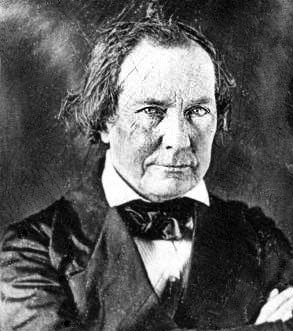
George Wilkins Kendall, circa 1837. Source: Kendall of the Picayune, by Fayette Copeland
The Expedition he sent, which was comprised of three Commissioners, their staff members and companions, roughly ten merchants, and around 270 soldiers, was a little late getting started. It left Austin in June 1841. In the meantime, New Mexico Governor Manual Armijo had been busy gathering his resources while keeping a close eye on the Americans in New Mexico.
Although the Texans had been led to believe they would be welcomed to Santa Fé with open arms, they would find the situation a little more complicated than they assumed. George Kendall had estimated his journey would take a pleasant four months. It would actually be twelve, the majority of them uncomfortable, including time in a Mexican prison.
All because he didn’t take the time before he left New Orleans to check whether Mexico agreed with the Texan desire to take over the Santa Fé trade.
There’s only one problem with the fifth edition ofthe Historic Santa Fe Foundation’s classic Old Santa Fe Today. Every time I dip into it, I get more story ideas. I can’t research and turn them all into fiction! Which is too bad, because there’s a lot of great material in this book.
Old Santa Fe Todaywas originally conceived as a list of historical properties in Santa Fe. To that end, it still includes a register of properties worthy of preservation, information about efforts to do so, and a brief history of Santa Fe’s built environment. This may sound like a specialist’s book and not something for the average reader. However, the beautifully rendered full-color photos and the details about each entry make it highly accessible.
Not only do the authors provide architectural and preservation information about the buildings in question, they also include a brief history: who built it, who lived in it, and who those people were associated with. I, of course, am especially interested in the older buildings, in particular those in use during the mid-1800s. However, the entries include structures built as late as the 1940s, including the Dodge-Bailey house designed by John Gaw Meem and adjacent to Meem’s own home on Old Santa Fe Trail.
Old Santa Fe Today also includes properties outside Santa Fe proper, including Las Acequias, a hundred-acre farm on the banks of the Rio Nambe, and non-building structures such as the Acequia Madre that has transported water into Santa Fe from the Sangre de Cristo mountains for over four hundred years.
So, whether you’d like to know more about Santa Fe’s historic structures, are interested in historic preservation, want to learn about Santa Fe area history, or just like beautiful pictures, I highly recommend Old Santa Fe Today.
By early Summer 1837, tales were spreading across New Mexico about the taxes the Mexican Congress had recently imposed, and getting taller as they went. Rumor had it that collectors would be confiscating one-third of the fruits of individual families’ labor—crops and chickens alike—and also levying charges on community-held water, wood, and pastures. There were even stories that men would have to pay a fee every time they lay with their wives.
Although New Mexicans paid municipal tariffs, they’d hadn’t paid the alcabala, or Federal sales tax, for most of the time since 1795. They’d been exempted in exchange for their role on Mexico’s northern frontier, providing a buffer for the interior against the United States as well as uncolonized Native tribes.
This tax exemption was due to expire in mid-1837. In addition, Congress had added a 12.5 cent per vara tariff on U.S. goods like plain-weave cotton (white or printed), and banned the import of shirting, calico, and other cloth. While the law seems to have been intended to protect Mexican production of these items, it was also likely to raise their cost.
So prices were going to go up. This in itself was upsetting. In addition, Mexico City had given Governor Pérez the authority to supervise tax collections. This was perhaps more worrisome. While New Mexico didn’t send tax revenues to Mexico City, it didn’t receive assistance from it, either. The Santa Fe administration was funded via levies on goods imported from the U.S. over the Santa Fe Trail. With imports being curtailed, government funds were going to have to come from somewhere else.
Since he’d arrived in Santa Fe two years before, the governor had demonstrated a talent for finding new sources of revenue, including enforced loans from rico families and, in 1836, a sweeping set of new fees that affected everyone else. While some taxes, such as the two dollars per vehicle carrying foreign merchandise and additional charges for the animals pulling them, were directed at American traders, those costs were still going to be passed on to consumers.
On top of this, Santa Fe residents now had to pay five dollars a month for the right to cut timber for lumber, twenty-five cents a head for cattle or sheep driven through the city, two dollars per performance for “entertainments” (presumably plays), and fifty cents for a dance license.
So people were already hurting. With the governor’s new authority to supervise collections, there was little chance to get around the coming taxes. There’d be no appeals to friendship, cousinship, or any other kind of interpersonal relation to ease the financial burden that was about to descend.
And then rumors about even more taxes began moving up and down the Río Grande Valley. Governor Pérez apparently made no effort to squash the more exaggerated claims or to let people know he’d asked Mexico City to renew the alcabala exemption. As the stories grew wilder and spread further, they ignited a fire that would cost Perez his life in early August 1837.
Sources: Paul Horgan, Great River: The Rio Grande in North American History, Middleton: Wesleyan University Press, 1984; Janet Lecompte, Rebellion in Río Arriba 1837, Albuquerque: University of New Mexico Press, 1985; Benjamin M. Read, Illustrated History of New Mexico, Santa Fe: New Mexican Printing Company, 1912; Joseph P. Sanchez, “It happened in Old Santa Fe, The Death of Governor Albino Pérez, 1835-1837,” All Trails Lead to Santa Fe, Santa Fe: Sunstone Press, 2010; Marc Simmons, Spanish Government in New Mexico, Albuquerque: University of New Mexico Press, 1968; Ralph E. Twitchell, The Leading Facts of New Mexico History, Vol. 2, Cedar Rapids: Torch Press, 1912.
In early April 1835, Mexican Army Colonel Albino Pérez left Chihuahua for his new post as Governor of New Mexico. He arrived in Santa Fe with 1000 pesos “for the needs of that office,” and a strong reputation as a military man. A “man of fine presence … privileged and well-to-do,” Pérez began his administration with a brisk efficiency that boded well.
However, once New Mexicans got a closer look at the governor, they were less impressed. The funds he brought were depleted fairly quickly. Also, Pérez seemed to think his 3,000-peso-a-year salary was insufficient, even though it was high for New Mexico.He borrowed large gilded mirrors from former governor Francisco Sarracino, a chest of drawers from Justice Santiago Abréu, and a large table clock from Judge Juan Estevan Pino. And local transport options weren’t good enough for him. He ordered an American-made two-wheeled carriage and two horses worth 800 pesos from Santa Fe trader Jesse Sutton.
The new governor also lived an immoral life. Although he was believed to have a wife in Mexico City, he became involved in a relationship with his housekeeper, Trinidad Trujillo, and fathered her child.
New Mexicans might have merely muttered at all this and gone on with their lives, but Federal politics began to exacerbate already-negative feelings.
On October 3, 1835, a decree by President Santa Anna’s centralist Congress abolished Mexico’s State and Territorial legislatures and replaced them with five-member Councils with no decision-making powers. Instead, they were subordinate to the president-appointed—and therefore controlled—governor. This gave Governor Pérez much more authority than he’d had when he arrived.
In addition, and perhaps more importantly, New Mexico’s tax exemption was about to run out. There was no assurance it would be renewed. New Federal decrees made the governor responsible for supervising collections, a potentially lucrative job. He didn’t have much incentive to ask for a continued exemption.
Rumors swirled. The governor was about to impose exorbitant tariffs. Thing never taxed before—like water, wood, and pasture—would be now. It was even whispered that men would be taxed for laying with their wives. Some people believed the new rates were actually being levied by the governor, not Mexico City, as a way to fund his lifestyle. When Pérez called a July 10 meeting to discuss the process for collecting the new revenues, the pot of rebellion began to heat up.
A month later, the governor’s naked body would lie headless in the road south of Santa Fe. All the efficiency and fine presence in the world couldn’t save him from the consequences of his lifestyle choices and Congressional mandates.
Sources: Lansing B. Bloom, “New Mexico Under Mexican Administration,” Old Santa Fe Magazine, Vol. II, Santa Fe: Old Santa Fe Press, 1914-1915; Paul Kraemer, An Alternative View of New Mexico’s 1837 Rebellion, Los Alamos Historical Society, 2009; Janet Lecompte, Rebellion in Río Arriba 1837, Albuquerque: University of New Mexico Press, 1985; Benjamin M. Read, Illustrated History of New Mexico, Santa Fe: New Mexican Printing Company, 1912; Ralph E. Twitchell, The Leading Facts of New Mexico History, Vol. 2, Cedar Rapids: Torch Press, 1912; David J. Weber, The Mexican Frontier, 1821-1846, Albuquerque: University of New Mexico Press, 1982.
On Friday, March 22, 1839, 45-year-old Spanish-born Manuel Alvarez was named U.S. Consul at Santa Fe. He was effectively the first American consul in New Mexico—the one appointed in 1825 had decamped to Chihuahua within the year.
As consul, Alvarez was responsible for dealing with American mercantile matters and also taking provisional possession of the estates of Americans who died without legal representation and sending word of their death back home. In addition, he voiced the concerns of Americans in the region, an activity that didn’t always make him popular with the governor.
Alvarez had been a merchant in New Mexico since 1824 and was comfortable complaining to the authorities. In July 1837, he’d signed on to a complaint to Governor Pérez about a confrontation between a group of Americans and some Mexican soldiers. After Pérez’s death the following month, Alvarez was one of the merchants who petitioned the Mexican government for repayment of loans made to the governor and his officials.
The real test of Alvarez’s ability to get things done came in September 1841, two-and-a-half years after he was named consul. Three hundred Texans, two-thirds of them soldiers, were marching toward Santa Fe and it was making everyone nervous. Some people believed the American merchants in New Mexico supported the Texan plan to take it over. Threats were made.
Manuel Alvarez’s signature. Source: Conflict and Acculturation, Manuel Alvarez’s 1842 Memorial by Thomas E. Chavez
Alvarez asked for formal assurance that the Americans would be protected from angry citizens. Governor Manuel Armijo responded that they would be—as long as no one gave aid to the Texans. If anyone did, Alvarez would be held personally responsible.
This warning doesn’t seem to have slowed the consul down much. When the Expedition members arrived and were taken into custody, he offered to act as intermediary, noting that the Republic of Texas had been recognized by the United States, but not by Mexico.
He also requested permission to meet with the American citizens among the Texans. He may have been especially concerned for the safety of George Wilkins Kendall. As publisher of a New Orleans newspaper that had printed disparaging articles about New Mexico in general and Armijo in particular, Kendall was likely to be unpopular with the governor and his associates.
Certainly, Alvarez’s concerns made him unpopular. In fact, the Governor’s shirt-tail relation Ensign Tomás Martín was so irritated that he and a group of friends confronted the consul in his Santa Fe office. During the ensuing altercation, Martín drew a knife and wounded Alvarez on the cheek. Alvarez likely would have suffered further if fellow merchant and New Mexico Secretary of State Guadalupe Miranda hadn’t arrived and dispersed the crowd.
Alvarez fled Santa Fe shortly thereafter, going East to report to Washington D.C. But he returned to New Mexico and his duties, maintaining his position as consul until the American takeover in 1846. At that point, the position was no longer necessary. But Alvarez didn’t turn to mere money making. He became active in regional politics and in 1850 was elected New Mexico’s Lt. Governor. He was also active in the faction that fought for New Mexico to be made a state instead of a territory.
Alvarez continued to be active politically until his August 1856 death in Santa Fe. The consul before him may have left quickly, but Alvarez, for all his faults, appears to have been committed to New Mexico. Or at least the Americans there.
Sources: William Campbell Binkley, “New Mexico and the Texan Santa Fé Expedition,” Southwestern Historical Quarterly, Vol. 27:2, Oct. 1923, pp. 85-107; Lansing Bloom, “Ledgers of a Santa Fe Trader,” New Mexico Historical Review, Vol. 21, April 1946, pp. 135-139; Lansing Bloom, “Texan Aggressions, 1841-1843,” Old Santa Fe Magazine, Vol. 2, pp. 143-156; Thomas Esteban Chavez, “The Trouble With Texans, Manuel Alvarez and the 1841 ‘Invasion,’” New Mexico Historical Review, Vol. 53:2, April 1978, pp. 133-144; Janet Lecompte, “Manuel Armijo, George Wilkins Kendall, and the Baca-Caballero Conspiracy,” New Mexico Historical Review, Vol. 59:1, Jan. 1984, pp. 49-66; Janet Lecompte, Rebellion in Rio Arriba, University of New Mexico Press: Albuquerque, 1985; Max L. Moorhead, New Mexico’s Royal Road, University of Oklahoma Press: Norman, 1958; Joy L. Poole, Ed., Over The Santa Fe Trail to Mexico: The Travel Diaries and Autobiography of Dr. Rowland Willard, University of Oklahoma Press: Norman, 2015; Benjamin M. Read, Illustrated History of New Mexico, New Mexican Printing Company: Albuquerque, 1912; Daniel Tyler, “Gringo Views of Governor Manuel Armijo,” New Mexico Historical Review, Vol. 45:1, Jan. 1970, pp 23-46; David J. Weber, The Mexican Frontier, 1821-1846, University of New Mexico Press: Albuquerque, 1982; Consular duties: https://adst.org/a-brief-history-of-the-consular-service/ accessed 1/18/22)
On Tuesday, February 7, 1837, Governor Albino Pérez, his New Mexico militia, and their Pueblo allies returned to the Rio Grande Valley from an unsuccessful campaign against the Navajo.
It had been a difficul campaign from its inception. When the Governor issued a call for the militia to assemble in November 1836, nobody came. This was primarily because of the members’ personal finances. They wouldn’t be paid to be on campaign and also had to supply their own ammunition and mounts. And Pérez couldn’t promise to help. He barely had enough funds to pay his Presidio soldiers to guard Santa Fe while he was gone.
So he decided to levy a forced loan on New Mexico’s ricos. This wasn’t exactly met with enthusiasm either. In fact, the necessary funds for the campaign still hadn’t arrived in the capital when Perez mustered the men who’d finally shown up and set out for Navajo country. They would be gone two months.
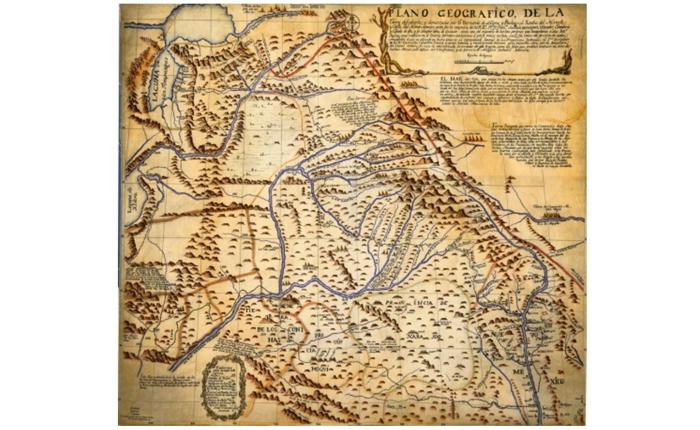
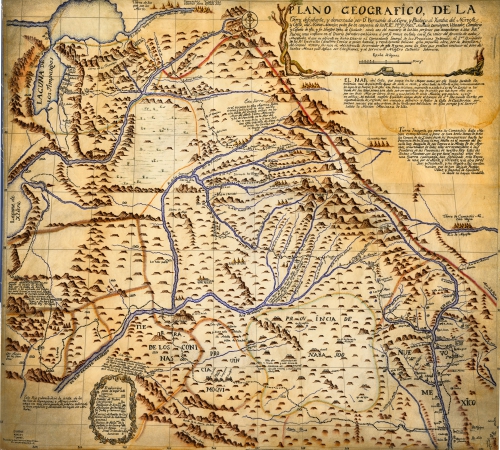
Miera map of New Mexico, circa 1788.
This type of campaign typically lasted forty-five days, so this one was longer than usual. If the militia were going to be paid at the end of it, or at least collect some spoils of war while they were gne, they probably wouldn’t have minded too much. But food supplies ran low. Also, the weather was so cold that one man froze to death and others lost toes and ears to frostbite. The temperatures affected the animals too. The militia’s mounts began to fail. To add insult to injury, the New Mexicans made no contact with the enemy during the entire period they were in the field.
By the time they got home, the New Mexicans and Pueblo warriors were fed up. They headed home in disgust and Governor Pérez turned to local governance issues only to discover that there wasn’t enough money in the treasury to continue paying his Presidio troops. He saw no alternative but to send them home as well. And then the Navajos who hadn’t been anywhere in sight during the winter campaign suddenly materialized and began raiding across the region. The Governor’s year was not starting out well.
It wouldn’t end well, either. Mexico’s Congress had made changes to the Federal constitution, reducing the autonomy of communities throughout the country. In addition, Federal taxes were going up and were set to be collected directly from New Mexicans for the first time in decades. To say people were unhappy is putting it mildly. Navajo raids would be the least of Governor Pérez’s worries in the coming months.
Sources: Lansing Bloom, Old Santa Fe Magazine, Vol. II, Santa Fe: Old Santa Fe Press; Janet Lecompte, Rebellion in Río Arriba 1837, Albuquerque: University of New Mexico Press, 1985; Benjamin M. Read, Illustrated History of New Mexico. Santa Fe: New Mexican Printing Company, 1912, Francis Stanley, Giant in Lilliput: The Story of Donaciano Vigil. Pampa: Pampa Printing, 1963; Daniel Tyler, New Mexico in the 1820’s: The First Administration of Manuel Armijo, PhD Dissertation, 1970, UNM, Albuquerque, New Mexico.
There Will Be Consequences is now available at Bookshop.org, so you can buy it from an independent bookstore without leaving the comfort of your home! Personally, my favorite store to order from is Collected Works here in Santa Fe. If you don’t already have a favorite Bookshop.org store, please give them a try or order from them directly







 Fiction and Fact From Old New Mexico