They climbed a small hill near the headwaters of the Cimarron River to get a better view. The long narrow valley spread out below them. It was a couple miles wide and probably twelve long. The land slanting toward them was mostly grass. Small creeks meandered across it, creating dark indentations. Pine and fir hugged the banks, spreading out occasionally to absorb moisture from a sloughy spot. The streams met in a marshy area just below where Gerald and Suzanna stood, then drained into the small river that flowed eastward through the rocky canyon.
Suzanna studied the valley warily as Gerald plucked a piece of grass from the hillside. He examined it, then bit into the fleshy end and chewed carefully.
He spit it out. “Sweet,” he said approvingly. He gestured at the view below. “It has everything we could want,” he told his wife. “Water, feed, game, timber.”
On Monday, July 1, 1850, the populace of occupied nuevomexico voted overwhelmingly to enter the United States as a state rather than a territory. The Mexican departamento of New Mexico had been seized by the U.S. in 1846 during the Mexican/American war. In the July 1850 referendum, the New Mexico also reaffirmed it’s 1848 decision to not allow slavery in New Mexico, and identified state officers and national representatives to Congress.
However, New Mexico’s decision to request U.S. statehood was nullified before it reached Washington DC. While the new congressional delegation was in route to the capital, news of the compromise of 1850 arrived in New Mexico.
More focused on settling the national slavery question than fulfilling New Mexico’s request, the Compromise admitted California as a free slave state and ignored the results of the July election. Instead, Congress made Utah and New Mexico territories where slavery was allowed. This decision was influenced by Texans who wanted to incorporate New Mexico into Texas, which was a slave state.
The boundary between Texas and Mexico was still amorphous, with Texas claiming land to the east bank of the Rio Grande River. In exchange for relinquishing its claim to eastern New Mexico, Congress gave Texas $10 million. To further keep Texas happy, New Mexico would be neither slave nor free. It and Utah territory would have to vote for or against slavery when they applied for statehood.
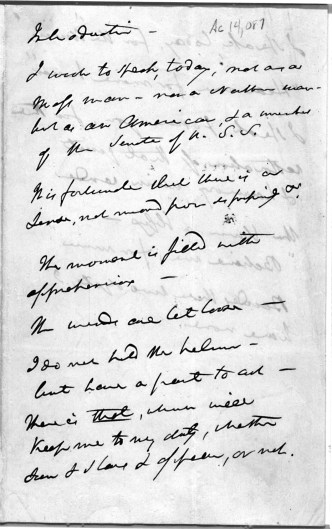
Daniel Webster’s notes for his speech against the Compromise of 1850. Source: U.S. Library of Congress
If New Mexico had entered the union as a state in 1850, it’s almost certain that it was entered as a non-slave state, dramatically altering the balance between slave and free and potentially catapulting the country into the war that would come just over a decade later.
However, by the time New Mexico did become a state, the slavery issue became a moot point, since New Mexico . It would not do so until 1912. Instead, the Congressionally-established New Mexico Territory government took over in Spring 1851. 20 years would pass before another constitutional convention was called and 66 years would go by before New Mexico would shake off its territorial status and officially become one of the United States.
Sources: Thomas C. Donnelly, The Government Of New Mexico, U of NM Press, Albuquerque, 1953; Bruce Glassrud, African-American History In New Mexico, U of NM Press, Albuquerque, 2013; Calvin A and Susan A Roberts, New Mexico, U of NM Press, Albuquerque, 1988; Hal Stratton and Paul Farley, History, Powers, Responsibility, Office Of The Attorney General, State Of New Mexico, State of New Mexico, 1990
Suzanna scowled sleepily at the lopped-off branches that formed the wall of the hillside lean-to and burrowed deeper into the bedding. At least there’s a bear skin to add some warmth, she thought irritably. It was too cold to get up, and if Gerald thought she was going to actually live in this God-forsaken place, he wasn’t thinking clearly.
“Wife?” he asked from the open side of the shelter.
Suzanna burrowed deeper, covering her head.
Gerald chuckled and came to kneel beside her. “I have a fire going,” he said. “I’ve toasted some bread and am heating water for tea.”
Suzanna sighed and reluctantly uncovered her head. “All right,” she said.
“There’s a herd of elk on the other side of the valley,” he said. “I thought I’d try for one after breakfast. We could use the meat. Do you want to come with me?”
“I’m not staying here by myself.” She sat up. “Not until you’ve built me a cabin.”
He leaned in to kiss her forehead. “I love you,” he said.
“And I you.” She shook her head. “Though I still think you’re soft in the head. This valley is so isolated and cold. How does anything grow up here?”
He grinned, stood, and went out. “The water’s hot!” he called from the fireside.
“Things are changing, Mr. Maxwell.” Judge Joseph Palen set his whisky glass on the saloon table and looked around the room. “In another year or so, these ragged placer miners will be replaced by businessmen with laborers to do the rough work.”
Maxwell nodded, following his gaze. “And many of these men will be laborers, instead of independent men with claims of their own.”
“Claims so poorly worked they bring in barely enough to keep body and soul together.” Palen flicked a speck of dust from the sleeve of his dark broadcloth suit.
“That’s all that matters, I suppose.” Maxwell grimaced. “Efficiency.”
“It’s a large territory, and its resources are going to waste.”
“So they tell me,” Maxwell said. He shook his head, put his glass on the table, and reached for his battered black hat. “I’ve been here a long time, Mr. Palen, and I happen to like Nuevo Mexico’s lack of efficiency. So do most of the men in this room, I expect.” He stood, towering over the table. “Good day to you, Judge.” A mischievous smile flashed across his face. “And good luck.”
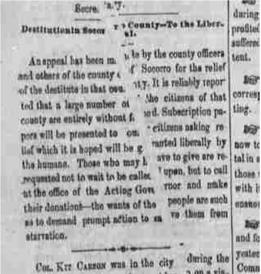
Folks in Socorro County called 1862 the “year of the little doves,” but they weren’t talking about birds. They were speaking of locusts. That Spring, an unusually heavy snow pack in the northern mountains that spring caused major floods along the Rio Grande. In Socorro County, the river was more than a mile wide in places. Newly planted corn and wheat fields, peach orchards and vineyards were inundated, and many acequias were destroyed.
Then the “little doves” arrived. By the time the locusts had left, the County was stripped clean and its inhabitants were close to starvation.
Relief was slow in coming, because the Territory was caught up in pushing back the Navajo depredations that had followed hard on the heels of the Confederate invasion. There were also concerns that the Confederates would try again.
Source: Santa Fe Gazette, May 2, 1863
But help did eventually arrive. In early May, the Santa Fe Gazette printed a plea for help and donations began to pour in. They came from as far north as Arroyo Seco and as far east as Maxwell’s Ranch on the Cimarron. Leading citizens in Taos, Arroyo Seco, Placitas, Cordova, and Espanola contributed $356. Antonio Baca and Francisco Aragon of Arroyo Seco, Francisco Sanchez of Placitas, Pascuel Martinez of Ranchita, Jose Dolores Tafolla of Cordova, Pedro Antonio Vigil of Cordilleras, and Juan Antonio Espinosa and Juan Suaso of San Francisco del Rancho donated 141 fanegas of wheat between them, and Taos’ Fr. Gabriel Ussel raised $82 from his parishioners.
So, while the locusts had destroyed their crops in 1862, “little doves” of help came to Socorro’s rescue in 1863. It was a long time to wait, but help did eventually arrive.
Source: Jerry D. Thompson, A Civil War History of the New Mexico Volunteers & Militia, UNM Press, Albuquerque, 2015. Pages 215-221
“You have an interest in a number of cases before this court,” Judge Palen said sharply.
Lucien Maxwell nodded and tilted his head toward the old lawyer beside him. “Mr. Wheaton is my designated attorney.” He raised an eyebrow. “I believe that releases me from the need to be present.” He adjusted his right foot higher on his left knee.
“You have been indicted on a serious charge.” Palen leaned forward. “That indictment requires your attendance.”
“The Probate Court issue?” Maxwell lifted a shoulder. “We have an excellent probate court clerk. As you’ll see from his records, there was no need to hold formal court.”
Palen’s lips thinned. “You committed to appearing on the first day of this session in regard to the indictment against you. It is now the fourth day.”
“I was unexpectedly detained.”
Palen stared at him for a long moment, then turned to the court clerk. “Let the record show that Mr. Maxwell has appeared and apologized for his failure to appear, and that we are satisfied no contempt was intended.”
Maxwell’s jaw tightened, then he nodded slightly and readjusted his right foot on his knee.
In April 1827, as Thomas L. Smith returned from a rough, though productive, fur trapping season, he learned that there was a new Mexican Governor in New Mexico and he not as sympathetic as past administrations had been to Americans who trapped without the required permits. In fact, the new Governor was on the hunt for Americans with illegal furs.
Smith decided that the only way to protect his plews was to smuggle them to Taos, where the border was more porous and he was likely find someone willing to take the risk of smuggling them over the Mexican/American border to Missouri. Accordingly, Smith and his trapping partners skirted Santa Fe and headed north.
Source: Mountain Men and the Fur Trade of the Southwest, Vol. IV, Leroy R. Hafen
After a close brush with the law at an outlying cabin, they made it to the small settlement of Riitos. Here, they hid the packs of furs among the trees and stopped for breakfast. The people were neighborly and came out to offer the trappers tortillas and eggs. However, the local kids discovered the packs in the trees. Smith did some quick thinking and explained that the furs were hidden because the sun would damage them. No one objected to this explanation, and the trappers continued on their way.
They hid the furs in a cave near the Rio Grande and rode into Taos the next day, where Smith was able to make the necessary arrangements. Although illegal and somewhat dangerous, Smith’s approach seems to have been the wiser one.
Ewing Young’s party cached their furs a little too close to Santa Fe, in the Pena Blanca home of a gentleman named Cabeza de Baca. De Baca’s help led to distaser for his family: When the soldiers arrived to confiscate the furs, there was an altercation and de Baca was killed.
Young’s furs were lost as well. When Young attempted to retrieve them from the Santa Fe authorities, he was imprisoned and only released when he came down with a debilitating fever. Eventually, the furs were sold at a fraction of their value. It’s unclear who ended up receiving the little money they brought in.
So, while Thomas Smith circumvented the law, he did make a profit. Ewing Young wasn’t so fortunate. It was a lesson that the American trappers would take to heart. The Mexican government would continue to try to keep the trappers under control, and the Americans would do their best to avoid that supervision.
Sources:Mountain Men and the Fur Trade of the Far West, Vol. IV, Leroy Hafen, Arthur H. Clarke Company, Spokane, 1966; The Taos Trappers, David J. Weber, U of Oklahoma, Norman, 1971.
On Monday, April 14, 1828, Mexico’s Congress spelled out the conditions under which foreigners could become Mexican citizens. The rules were simple: They had to have lived in Mexico at least two years and be Roman Catholic, employed, and well-behaved. If these conditions were met, the governor of the Deparment could issue a certificate of citizenship.
It seems to have taken a while for word about the new law to get to New Mexico, but once it did, at least twelve French-Canadians and Americans applied for citizenship the following year. One of these men was John Rowland, trapper, trader, and owner of both a Taos flour mill and a Taos Lightning distillery.
John Rowland. Source: Mountain Men and the Fur Trade of the Southwest, Vol. IV, Leroy R. Hafen
Rowland didn’t remain in New Mexico, although he did remain a Mexican citizen. In 1840, he and his England-born distillery partner William Workman, supposedly without their knowledge or consent, were named temporary commissioners for the Republic of Texas. Feelings against Texas were strong in northern New Mexico and the two men’s apparent support for Texas and the hated 1841 Texas-Santa Fe expedition was enough to make New Mexico too hot for them. In 1841, they emigrated to California.
Both men did well in California. Workman became an important figure in the Los Angeles business community and Rowland became one of California’s most important wine manufacturers while continuing his work to produce both flour and distilled spirits. He died in 1873 and was buried in the cemetary of the Catholic church built on the 48,790 acre Rancho la Puente, which he co-owned with Workman.
Sources: Mountain Men and the Fur Trade of the Far West, Vol. IV, Leroy Hafen, Arthur H. Clarke Company, Spokane, 1966; The Taos Trappers, David J. Weber, U of Oklahoma, Norman, 1971. www.homesteadmuseum.org
“I seen him! I seen him!” The boy stopped, breathless, just inside the kitchen door.
“You mean you saw him.” His mother shook her head at him as she lifted the lid from the Dutch oven in the fireplace to check the biscuits. She smiled. “Who did you see?”
“Kit Carson! He was on the other side of the street, going into the Governor’s house.”
She nodded. “I heard this morning that he was back. What is he like?”
His shoulders sagged. “He didn’t look anything like the pictures in the book Grandpa gave me when we left Kansas City.”
“That was just a story,” she pointed out. She turned to stir the great pot of venison stew.
“I know,” he said. “But he wasn’t what I expected at all. He’s just a man.”
On Saturday, February 24, 1821, halfway between Mexico City and Acapulco, General Agustin de Iturbide published the Plan of Iguala and effectively established Mexico’s independence from Spain and set the stage for American conquest of New Mexico, California, and the land in between.
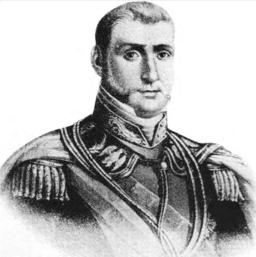
General Augustin de Iturbide. Source: R. E. Twitchell
The plan of Iguala maintained the Catholic Church as the official religion of Mexico, created an independent limited monarchy, and established equal rights for Spaniards and creoles. The new government also reversed the Spanish policy which forbade foreign merchants to enter New Mexico, thus opening the door for William Becknell and his mule train of goods as well as the many trappers and traders who would follow him down the Santa Fe Trail.
However, the new relationship with the United States was fraught with complications. Within a few years, Mexican officials realized that the Americans were taking every opportunity to keep from paying customs duties on the goods they brought into and the furs they took out of nuevomexico. Although officials tried various measures to control the Americans, nothing was really effective. The American trappers and traders continued to be a thorn in the side of the Mexican government. In fact, it could be argued that the Americans that the Mexicans allowed in after 1821 would turn out to be a major factor in the lack of resistance to the American invasion in 1846, 25 years later.
Sources: Paul Horgan, Great River,The Rio Grande in North American History, Wesleyan Univeristy Press, Middletown, CT, 1984; : Ralph E. Twitchell, The Leading Facts of New Mexico History, Vol. II, The Torch Press, Cedar Rapids, 1912; David J. Weber, The Taos Trappers, David J. Weber, U of Oklahoma Press, Norman, OK, 1970.


 Fiction and Fact From Old New Mexico