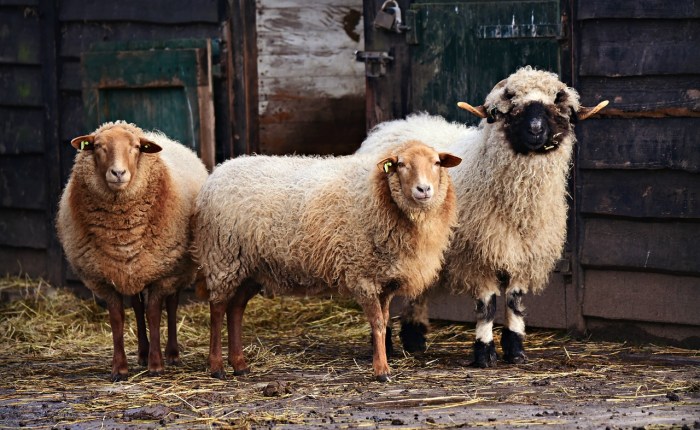
In No Secret Too Small , Suzanna learns how to weave. In her case, the wool has already been taken from the sheep and transformed into yarn. This video and the one I’ll post a couple days from now, provides a lot more information about the entire process than I could have possibly included in the novel. Enjoy!
Suzanna’s eyes narrowed and her lips tightened. “I did not come to this god forsaken valley to live in a cave,” she snapped. The toddler on her hip started fussing but Suzanna only shifted impatiently and continued to glare at her husband on the other side of the room. “You promised me glass windows. You also said you wanted to farm, that you were finished with trapping.”
Gerald gestured at the beaver pelts lying just inside the cabin door. “I was finding the means to buy glass,” he said mildly.
Suzanna turned away. “The money will just go to something else.” Alma fussed again and Suzanna bent to place her on the floor. “The mule will go lame or cougars will take down a couple more calves.”
“Suzanna sweet–”
“Don’t you ‘sweet’ me!” She straightened, hands on her hips. “I will not be sweet-talked out of this! You can’t expect me to live in a cabin with just shutters at the windows, sitting in the dark whenever it rains!”
“We have lamps.”
“It’s not the same and you know it!”
Alma had toddled to her father. She clung to his leg, looking up at him. “Papa stay home?” she asked. “Mama ang’y.” She shook her dark curly head. “Me don’ like Mama ang’y.”
Gerald and Suzanna stared at each other for a long moment. Then Gerald scooped Alma into his arms and Suzanna threw her hands in the air helplessly and crossed the room. She leaned her head against his shoulder. “I had no idea when you would return,” she said into his sleeve.
For many Americans, the stagecoach symbolizes the 1800s in the West. And yet, stage mail and passenger service to Santa Fe lasted just thirty years, from 1850 to 1880. In that time, the route grew shorter and shorter, as the railroad crept toward New Mexico and finally ended the stagecoach era completely.
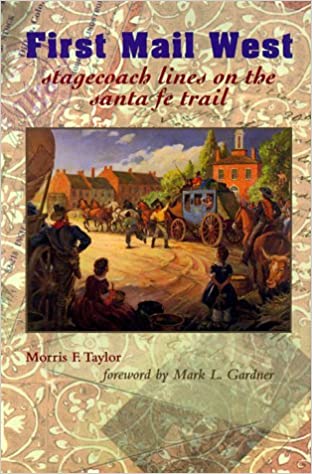
Morris F. Taylor’s book First Mail West: Stagecoach Lines on the Santa Fe Trailtells that story and much more. It begins with equine transport of military dispatches and goes on to describe when and how the first Post Office Department contracts were put in place and the many details connected with the mail stage system.
But this is not a dry fact-and-figures kind of book. It’s filled with the names of people associated with New Mexico history—the Bent brothers, David Waldo, Ceran St. Vrain, William W.H. Davis, Kit Carson, Governors Lane and Meriwether, and many more. It also identifies lesser-known individuals, including the stage conductors and drivers, and provides fascinating glimpses into life along the route to Santa Fe—descriptions of the stage stops, how they were operated, the people who ran them, and the dangers they encountered. In addition, because the stage had connections into Denver, there’s a good overview of the early Colorado mine fields and the towns that sprang up around them.
First Mail Westis a pleasure to read and full of information you never realized you wanted to know. I recommend it to anyone researching New Mexico and Colorado history in the 1846-1880 time frame and also to those who’d simply like another approach to Old West history.
Newly appointed Governor Albino Pérez arrived in New Mexico in May 1835 to general relief. The previous governor, Francisco Sarracino, was generally viewed as inept and Pérez was a breath of energetic fresh air. He brought funds for the Presidio troops and immediately set out on a tour that included visits to outlying communities as well as a successful action against the Navajo, who’d been picking off sheep and other prizes. When Pérez returned to Santa Fe, he gave an inaugural address in which he praised New Mexicans’ peaceful habits, love of order, and obedience to justice, among other virtues.
However, the longer Pérez was in office, the more complicated things became. The money he’d brought was spent and more was needed. Sarracino, now New Mexican Treasurer, was accused of embezzling funds. The Navajo were active again and another campaign was necessary. And Pérez’s idea of paying for it with forced loans from the region’s ricos was not met with universal acclaim.
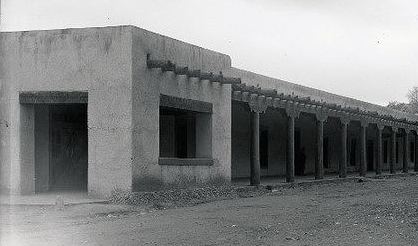
The Governor’s Palace in Santa Fe. Courtesy: NM History Museum
Then New Mexico’s exemption from the national sales tax expired. The governing council asked Pérez to forward a petition for its renewal to Mexico City, but he didn’t do so right away. Instead, he started talking about how to collect the tax.
This didn’t go well with the populace. In fact, it may have been the spark that ignited what is popularly known as the Chimayó revolt, the rebellion that resulted in Pérez’s death in early August 1837. The good feeling surrounding Pérez’s arrival had disappeared completely by the time he lost his life and his head on the road outside the village of Agua Fría south of Santa Fe.
Which is a good reminder that no matter how an official begins their term, it’s what they do afterwards—and how their time in the sun ends—that people are most likely to remember.
Sources: Lansing B. Bloom, “New Mexico Under Mexican Administration,” Old Santa Fe Magazine, Vol. 2. Santa Fe: Old Santa Fe Press, 1914-1915; Janet Lecompte, Rebellion in Río Arriba 1837, Albuquerque: University of New Mexico Press, 1985; Read, Benjamin M. Illustrated History of New Mexico, Santa Fe: New Mexican Printing Company, 1912; Joseph P. Sanchez, “It happened in Old Santa Fe, The Death of Governor Albino Pérez, 1835-1837,” All Trails Lead to Santa Fe, Santa Fe: Sunstone Press, 2010; F. Stanley, Giant in Lilliput, the Story of Donaciano Vigil, Pampa, TX: Pampa Press Shop, 1963.
If you recognize the name Albert Fountain, you’ll almost certainly associate him with his disappearance in the New Mexico desert in 1896 along with his eight-year-old son. And that’s probably almost everything you know about the man.
But Fountain’s disappearance happened as the result of events that took place well before that early February day. In fact, he’d been a polarizing figure in southern New Mexico for a number of years. He’d defended Billy the Kid in court and made other decisions that brought attention to himself—and not necessarily in a good way.
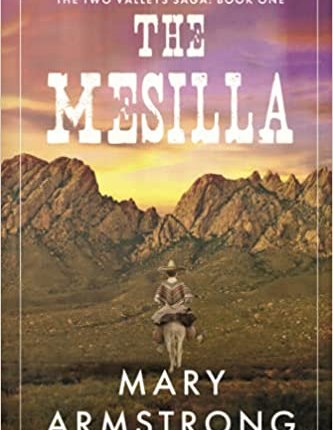
Mary Armstrong’s novel The Mesilla provides a fictional account of some of the events in Fountain’s career prior to his disappearance. This story, the first in Armstrong’s Two Valleys Saga series, centers around Fountain’s defense of Bronco Sue, a woman who was accused of killing her husband, one of a series of men she’d cohabitated with. The courtroom scenes alone are worth the price of this book.
Armstrong has clearly done her homework. The novel is packed with information and anecdotes about New Mexico’s Mesilla and Tularosa Valleys in the late 1800s, which she feeds seamlessly into the story line. If you’re interested in the history of these areas or are just looking for a well-written historical novel, I recommend The Mesilla.
What picture comes to your mind when you hear the words “Santa Fe Trail”? American merchants with wagons full of merchandise heading west and returning with money in their pockets, right? Well, there’s more to that story, and Susan Calafate Boyle’s book Los Capitalistashelps to provide that additional information.
So they did. By 1840, Hispanos were major participants in the trade along the Santa Fe Trail, with extensive trade and financing relationships as far east as New York, London, and Paris. Los Capitalistasexplains those relationships and the types of merchandise New Mexican merchants conveyed back and forth and, in the process, expands our understanding of New Mexico.
The ricos of New Mexico saw pretty early on that hauling merchandising over the Trail could work both ways. After all, they were already taking wool, woven goods, and other items to Chihuahua, Sonora, and other points south. Extending their freighting operations east was the next logical step.
Los Capitalistasis written in a clear, matter-of-face style that conveys a great deal of information and provides a glimpse of New Mexico that most of us haven’t seen before, and is an important book for understanding the history of the Southwest as well as an enjoyable read. I recommend it!
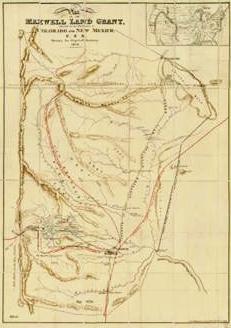
Mid-April 1871 was a busy time for the newly-formed Maxwell Land Grant Company. Lucien and Luz Maxwell had received their cash for the grant, moved out of the house at Cimarron, and were busy spending their money. Lucien had used a good chunk of it to set up the First National Bank in Santa Fe. He’d also bought land at Fort Sumner. While Luz turned the former the officers quarters into a home, he bought racehorses.
However, the Company wasn’t having an easy time establishing their control over the former Beaubien-Miranda Land Grant’s vast acreage. There’d been an initial dust-up in late 1870, when the Elizabethtown miners rioted against the new owners and the Governor had to send soldiers in to squelch them. But that wasn’t the end of it. In early April 1871, the Cimarron Squatters Club organized a mass protest and fundraising meeting in front of the county courthouse.
The Company apparently decided to demonstrate a little force in response. They sent a group of employees into the Ute Creek placer mines and took over. That strategy didn’t work out too well—the miners disarmed the Company’s men and held them hostage.
Again, the Governor got involved. This time he came himself, forced the miners to free the prisoners, ordered them to abstain from further violence, and then got the Army to station soldiers from Fort Union in the area to enforce the peace.
The soldiers’ presence does seem to have calmed the boiling pot for a little while. But it was bound to boil over again—the Company was enforcing rent payments Maxwell had never bothered to collect and also kicking people off range and farmland Maxwell had allowed them to use.
Maxwell Land Grant Map, circa 1870
Whether the Company was within their rights isn’t clear. Things got even murkier in late January 1873, when the U.S. Department of Interior ordered much of the Grant’s acreage to be treated as public lands. This brought more settlers (the Company called them “squatters”) into the area and, with them, more unrest.
With the newcomers came Methodist Episcopal missionary Rev. Franklin J. Tolby. Tolby sided with the settlers and miners and didn’t hesitate to speak his mind. In mid-September 1875 he was ambushed and killed on the canyon road between Elizabethtown and Cimarron, and the Colfax County War was on in earnest.
The conflict didn’t end until April 18, 1887, when the U.S. Supreme Court confirmed the Company’s right to almost two million acres. Even then, the violence didn’t come to an immediate halt. However, even the most ardent settlers didn’t have any legal arguments left in their arsenal and the Colfax County War gradually faded away.
Once again, money and political power had prevailed in the fight for control of New Mexico’s lands.
Sources: David L. Caffey, Chasing The Santa Fe Ring, Albuquerque: University of New Mexico Press, 2014; Harriet Freiberger, Lucien Maxwell,Villain or Visionary, Santa Fe: Sunstone Press, 1999; Larry Murphy, Out in God’s Country: A History of Colfax County, New Mexico, Springer, NM: 1969; Lawrence R. Murphy, Philmont: A history of New Mexico’s Cimarron Country, Albuquerque: University of New Mexico Press, 1972; Moreno Valley Writers Guild, Lure, Lore and Legends of the Moreno Valley, Angel Fire, NM: Columbine Books, 1997; Stephen Zimmer, For Good or Bad, The People of the Cimarron Country, Santa Fe: Sunstone Press, 1999.
On Monday, April 5, 1880, after almost 30 years of waiting, the New Mexico and Southern Pacific railroad, a subsidiary of Atchison, Topeka And Santa Fe, arrived in Albuquerque, New Mexico.
The Territory’s first hope for a railroad that connected it to both coasts had been in 1853, when a survey was completed from Albuquerque toward Arizona and California. But then the nation got caught up in the conflict that would lead to the Civil War and nothing happened.
After the war, all eyes were on the transcontinental rail link which lay to the north, along the 32nd parallel. When that final spike was pounded into place at Ogden, Utah in 1869, the next logical place to build was on or near the southern border. Surely now it was New Mexico’s turn.
In the early 70s, it looked like that turn had come. Various rail lines built steadily west across Kansas and Colorado.
Then came the financial Panic of 1873. Once again, everything ground to a halt. Ranchers and farmers in New Mexico must have fumed as Texans loaded cattle and Californians boxed up grapes and pears and sent them east by rail while New Mexico still received its mail via stagecoach and had to use Santa Fe Trail freight wagons for anything larger.
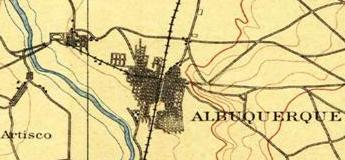
Albuquerque in 1889. Source: U.S. Library of Congress.
But then the great day finally arrived and a train chugged into Albuquerque. The new track was positioned over a mile east of the town plaza. This resulted in a flurry of real estate, commercial, and other activity. Albuquerque took on the characteristics of a boomtown, with brawls, thefts, and shootings and the inevitable ad hoc vigilante groups to try to keep them under control.
Was the arrival of the railroad a good thing? I suspect not everyone thought so.
Sources: David L. Caffey, Chasing The Santa Fe Ring, Albuquerque: University of New Mexico Press, 2014; Lawrence A. Johnson, Over The Counter And On The Shelf, Country Storekeeping in America, 1620-1920, Rutland, VT: Charles E. Tuttle Co., 1961; Morris F. Taylor, First Mail West, stagecoach lines on the Santa Fé trail, Albuquerque: University of New Mexico Press, 2000.







 Fiction and Fact From Old New Mexico