Watch this video for information about the town of Estancia and the press that published Jack Thorpe’s seminal 1908 book Songs of the Cowboys. It also shows how a platen press worked! I really enjoyed this one.
Category: New Mexico Territory
Buffalo Soldiers in New Mexico
Because it’s Memorial Day, I’m sharing this video about the Buffalo Soldiers in New Mexico. Don’t know what a Buffalo Soldier was? Watch the video! Note: All opinions expressed in this presentation are those of the speaker. I do not necessarily agree that New Mexico needed to be civilized or that these men were the only reason it finally became a state. But it’s an interesting concept! Tell me what you think!
IMPATIENCE
“This gold. They have found it in large quantities?” The lanky teenage boy named Escubal Martinez poked a stick into the logs on the fire, moving them closer together. At the edge of the mountain valley, a coyote yipped. The Martinez clan’s flock of sheep shifted uneasily in the darkness beyond the firelight.
The Prussian-born traveler from Etown grinned. “Ja,” he said. “But it is hard work, the digging for gold.”
Escubal’s uncle Xavier grunted from the other side of the flames, where he was using a knife to carefully smooth out an uncomfortable bump on the grip of his walking staff. “Borregas y carneros.” He nodded at the boy. “That is wealth.”
Escubal scowled at the fire.
The traveler looked puzzled. “Carner?” he asked. “Meat is wealth?”
“No, Borregas y carneros,” Escubal said.”Ewes and rams.” He gestured impatiently toward the flock.
Xavier moved his staff in the firelight and ran his fingertips gently over the wood. “Carne y ropa,” he said meditatively. “Meat and clothes.”
“Ja,” the Prussian answered. “You are correct.”
Escubal scowled at the fire and the traveler smiled sympathetically. It was not easy to be young and impatient.
The boy poked at the fire again. It flared briefly, lighting the night, and the flock moved restlessly, waiting for morning.
from Valley of the Eagles
Saloons in Old New Mexico
I thought I’d do something different this month and share some video about a historical even instead of a written piece. In this particular case, there are several events reenacted in this Colores presentation about saloons in Old New Mexico, including speeches by Benito Juarez and the Clay Allison-Pancho Griego gunfight in Cimarron. Enjoy!
BOOK REVIEW: Company of Cowards
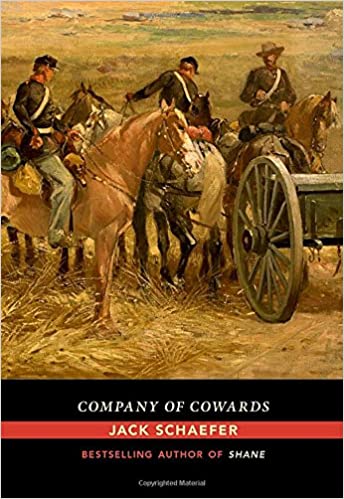
University of New Mexico Press (July 11, 2017)
Jack Schaefer is probably best known for his novel, Shane. However, he wrote a number of other books, as well as a history of New Mexico for young people. One of these is Company of Cowards, a historical novel based on an event which may or may not have occurred.
The story’s premise is that eight Union officers who’ve been court-martialed for cowardice are not sent home in disgrace but are instead assigned to a separate military unit set up just for them, Company Q. Whether or not there really was such a unit is a riddle for the historians. Schaeffer’s take on the idea and his exploration of how such a group of men might become a cohesive fighting group and in the process learn to respect themselves again, makes for a fascinating story.
On this website, I only review books that are primarily set in New Mexico prior to statehood in 1912. Company of Cowards meets my criteria because, though Schaeffer’s Company Q is established in the East, the men in it end up at New Mexico’s Fort Union and participate in the 1864 Battle of Adobe Walls. Schaefer’s version of that battle highlights the bravery of the fictional Company Q as well as the military skills of their non-fictional commander Christopher Carson.
Company of Cowards is a well-written book that explores how a man might fail and yet not be a failure. While Company Q serves as the primary focus of this exploration, the events at Adobe Walls also provide an opportunity to consider whether this battle—technically a defeat because Carson’s forces retreated— should actually be characterized in that way.
I recommend this book for several reasons. First, it is a fine exploration of the difficulty or breaking free of the labels others place on us. Second, it’s a wryly humorous look at the Civil War and the decision-making process in any military unit. Third, Schaefer’s loving characterization of New Mexico and careful depiction of the battle of Adobe Walls will be appreciated by anyone who is interested in New Mexico and its history.
Company of Cowards is definitely worth a read!
A GOOD ARRANGEMENT
As the man on the ridge watched, the herd of elk below suddenly broke and pounded across the icy stream toward the cover of the trees. Three wolves, two grays and a black, chased after them, then slowed and sat, watching them go. A young bull elk with a limp had lagged behind the herd, and the wolves appeared to be studying him. A raven cawed overhead.
The man smiled. The wolves had identified his target for him. He reached to lift the bow from his back. It was a good arrangement, he mused as he slipped down from the ridge and began circling to get downwind of the straggling bull. When he had finished with the elk, the wolves and ravens would attack the remains. “We will all eat well tonight,” he murmured. Which was good, because the elk herd would move more swiftly tomorrow, without the lagging one to slow them.
from Valley of the Eagles
Billy The Kid Escapes!
On Thursday, April 28, 1881 William Henry Bonney, better known as Billy the Kid, escaped from the county jail in Lincoln, New Mexico.
Billy was 22 and loved reading books, singing, and dancing. He was fluent in the Spanish language and skillful with a rope, horse, and gun. He was a hard worker and not much of a drinker. He didn’t use tobacco either.
But Billy did have two problems: He was small for his age and he had a hair-trigger temper. Also, like most of us, he didn’t appreciate being made fun of. In August 1877, while he was working as a cowboy in Arizona, a bully taunted the Kid one time too many. Bonney shot and he didn’t miss.
When the man died, Billy fled to New Mexico. By November, he was in the Lincoln area. By early the following year, he had signed on at John Tunstall’s ranch. The rest is history.
Three years later, at the tail-end of the Lincoln County War, Bonney was in jail in the town of Lincoln, waiting to be hung for the murder of Sheriff William Brady. Then he saw his chance and took it. He got away, killing Deputies J.W. Bell and R. Olinger in the process.
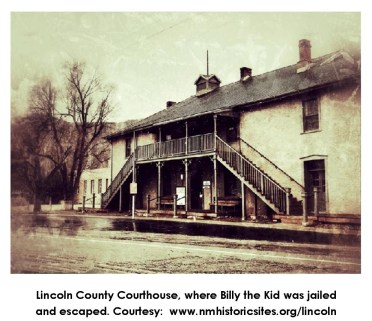
Given that he now had the murder of a Sheriff and two Deputies hanging over him, Billy’s friends thought he should head south to Mexico. Instead, he went north to Fort Sumner. There, sheltered by friends and associates, he kept a low profile.
But it wasn’t low enough. Word of the Kid’s whereabouts got out and Sheriff Pat Garrett started nosing around, making inquiries. One night, Garrett was visiting at the Maxwell ranch just outside town when Billy, not knowing he was there, wandered into the room.
Within a few seconds, William Henry Bonney was dead. It was Thursday, July 14, 1881, just eleven weeks since his escape from the Lincoln County jail.
Billy the Kid should have listened to his friends.
Sources: Don Bullis, New Mexico, A Biographical Dictionary, Vol. I, Rio Grande books, Los Ranchos de Albuquerque, 2007; Howard R. Lamar, The Reader’s Encyclopedia of the American West, Harper & Row, New York, 1977; Ruben Salaz Marquez, New Mexico, a brief multi-history, Cosmic House, Albuquerque, 1999; David Grant Noble, Pueblos, Villages, Forts and Trails, University of New Mexico press, Albuquerque, 1994.
BOOK REVIEW: Glorieta

ISBN: 979-8604997840
Among the battles of the Civil War, the one at New Mexico’s Glorieta Pass doesn’t get much attention. In the broader scheme of the war, it was a minor conflict. But Glorieta was important for the Confederacy. Although they won the battle, they lost their supply train and were forced to return south, away from Colorado and its gold and silver fields.
Glorieta, Jennifer Bohnhoff’s fictional treatment of the battle, is the second in her trilogy about the Civil War in New Mexico. In Glorieta, we are re-introduced to rebel Jemmy Martin, a character in Valverde, the first book, and meet a new one, the Irish teenager Cian Lochlann from Colorado. Between the two of them, we see the conflict from both the Confederate and Union perspectives.
Bohnhoff also introduces us to some historical characters. One of these, Major John F. Chivington, I expected to dislike. I knew about his actions years later at Sand Creek. For that reason, I didn’t understand why anyone would follow the man anywhere for any reason whatsoever. Bohnhoff’s Glorieta helped me see Chivington’s charisma while she also acknowledges the negative aspects of his character.
The Rebels Along The Rio Grande series is written for Middle Graders. That being said, I found this second volume to be an enjoyable and informative read. I recommend Glorieta to anyone who’s interested in the Civil War in New Mexico, young and old alike.
FIRST DIVORCE
Augusta Meinert stood firmly in the center of the makeshift courtroom, her eyes on the judge. At thirty-seven, she was still attractive, though the stubborn tilt to her chin said she didn’t often take “no” for an answer.
Judge Watts studied her. “You understand what divorce means?” He spoke slowly, as if unsure her English could withstand the strain of the concept.
Augusta’s chin went up. “I understand no longer the bastard takes the money I earn.” A ripple of suppressed laughter ran through the onlookers behind her. She turned and glared, and the men fell silent.
“You will be a marked woman,” Judge Watts warned. “This isn’t Germany.”
She frowned. “In Germany, he takes my money, and I can do nothing.” She smiled suddenly, her eyes twinkling. “It is why I like America.”
The Judge nodded and gaveled the rough wooden planks of the table before him. “The first divorce in Colfax County, New Mexico Territory, is hereby declared final,” he announced.
from Valley of the Eagles
NOTE: This tale, like most of the other stories in Valley of the Eagles, is based on an actual event. In this case, Augusta Meinert’s petition for divorce was the first heard in newly formed Colfax County in the Spring 1869 court session in Elizabethtown, New Mexico. For more details, see the footnote in the book.
New Mexico Delegate Sees Lincoln Shot!
By mid-April 1865 Jose Francisco Perea had finished his term as New Mexico Territory’s Congressional delegate. The Civil War was over and he must have been looking forward to returning home again to a quieter life.
But Perea had one more Washington DC event to experience. On Friday, April 14, 1685, he attended the Ford’s Theater production of Our American Cousin.
His seat was near President Lincoln’s box.
Perea, who had been educated at a Jesuit college in St. Louis, would have known the meaning of the words John Wilkes Booth yelled as he leapt to the theater stage from Lincon’s box. “Sic temper tyrannis!” meant “Thus always for tyrants!”
It wasn’t the first time Perea had witnessed a death as the result of rebellion. As a seven-year-old in Santa Fe, he’d watched four men who’d led a revolt against the Mexican government suffer the ultimate punishment on a cold January 1837 morning.
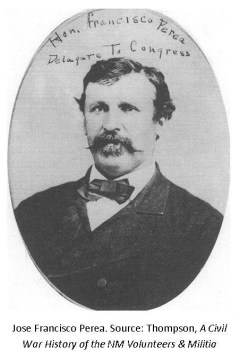
Now he watched as a doctor rushed to Lincoln’s side and gravely shook his head. It was only a matter of time. Booth’s shot was clearly mortal.
Perea himself would live another 48 years, dying in May 1913. Until then, he would busy himself with his business interests, the post office and hotel in Jemez Springs, and his home in Albuquerque. But he would never forget that January morning in 1837 or that rainy night in April 1865.
Sources: W.H.H. Allison, Old Santa Fe Magazine, Vol. II, Ralph Emerson Twitchell, Ed., Old Santa Fe Press, Santa Fe; John W. Kirshon, Ed., Chronicling America, Chronicle Publications, Mt. Kisco, 1987; Jerry D. Thompson, A Civil War HIstory of the New Mexico Volunteers & Militia, UNM Press, Albuquerque, 2015.
 Fiction and Fact From Old New Mexico