LEONIDAS AND GEORGE, PART 2 OF 2

George was getting nervous. “Let’s get ourselves off this main track,” he said. “These cattle are making our trail a wee bit too readable.”

Leonidas nodded. “We can head up Ute Creek,” he suggested. “Maybe offer them for sale at Baldy Camp instead of driving them clear to Etown.”

The longhorns moved gladly into the Ute Creek grasslands, but then stalled. The forage was long and green, and they saw no reason to go on. George whooped and waved his hat at them half-heartedly. He was losing enthusiasm for the whole venture. His pony wasn’t really a cowhorse and didn’t care for close proximity to longhorns. And he liked Leonidas, but the big Canadian hadn’t adapted to herding as easily as he’d hoped. He sighed. Etown placer mining, and now this. He should just head on back to Ireland.

Leonidas rode up beside him. “How much farther?” he asked.

~ ~ ~ ~

Tom Stockton pushed back his hat and wiped his forehead with his shirt sleeve. Even the rippling sound of the nearby Cimarron river did nothing to relieve the heat.

Chuck, Finis, and the others reined in on either side of him. They all stared at the hoof marks on the rocky dirt road heading into Cimarron canyon.

“They ain’t even tryin’ to cover their tracks or keep those cattle where it won’t show,” Finis said with disgust. “Looks like only two men who don’t know what in hell they’re doin’.”

“Greenhorns,” Chuck agreed. He spat into the dust. “Feel kinda sorry for ’em.”

“That’s seventy head of my cattle they’re doing such a damn poor job of herding,” Stockton said grimly. “Greenhorns or not, they’re rustlin’.” He resettled his hat. “Let’s get this over with.” He spurred his horse into a steady trot. The others followed briskly behind.

~ ~ ~ ~

The two younger men didn’t stand a chance against Tom Stockton and his five riders. They were covered by guns before they even knew they were surrounded. Leonidas felt his stomach tighten.

“Round ’em up,” Stockton said, his voice icy. He gestured at the cattle with his head as his Colt focused on Van Valser’s chest.

“Aye, that’s just what we’ve been adoin’,” George Cunningham said, his Irish brogue thickening. “We were just rounding them up for you, gatherin’ ’em for a quick swing on down to your Clifton House—”

“Wrong direction, son,” Chuck said. Cunnningham fell silent.

“Get moving,” Stockton ordered.

Leonidas and George obeyed. As the other men spread out around the cattle with them, Leonidas felt a surge of relief at the lack of gunfire. Stockton was a big man in the County. Maybe he’d just turn them over to the Sheriff in Cimarron.

~ ~ ~ ~

As they entered the east end of the canyon, George Cunningham’s hopes revived. Tom Stockton had his longhorns back, and he and his men were paying more attention to the cattle than to Cunningham and Van Valser. There’d been no move to string them up.

The farmlands east of Cimarron Canyon were almost within sight. George began looking carefully at the sandstone and juniper on either side of the road. It might just be possible to make a dash for it. He glanced around. Van Valser was behind him. George slowed his pony a little to angle closer, letting the cattle ease by.

But Stockton had seen him examining the landscape, and suddenly Chuck and Finis were riding toward George and Leonidas. There was a sudden blast of gunfire. Cunningham’s pony reared, Leonidas crumpled in his saddle, and everything went black.

“Trying to escape,” Tom Stockton growled. “The damn fools.”

Copyright ©2015 Loretta Miles Tollefson

The French in New Mexico: A Talk

I was disappointed that I wasn’t able to catch Francois-Marie Patorni’s recent talk about his book The French in New Mexico at the Santa Fe Public Library. And then I discovered it had been recorded and put up online! I hope you enjoy this as much as I did.

LEONIDAS AND GEORGE, PART 1 OF 2

“Where’d you be gettin’ a name like Leonidas?” the young Irishman asked the tall young man next to him at the Etown bar.

The big Canadian looked at him. “My mother had scholarly ambitions beyond her station,” he said. He lifted a fist. “And my father made sure I could defend myself.”

“I’d not be denying you the right to the name.” George Cunningham grinned. “An’ I’m thinking your father trained you good and well.”

“The trouble is, they didn’t have the money for proper scholarship,” Leonidas Van Valser told him. “That’s why I’m here.”

“Get enough gold, you won’t be havin’ to worry ’bout scholarship,” Cunningham observed.

“I intend to pan enough gold to go to school properly,” Van Valser explained. “I’m only twenty-five. There’s still time.”

“You’ve got ambitions,” Cunningham said. “’Tis a good thing in a man.”

The two grinned at each other companionably.

~ ~ ~ ~

George Cunningham was small, even for an Irishman, with a perpetually restless face. His Canadian friend Leonidas Van Valser was the steady one, until Etown’s gold placer mines wore down even his perseverance.  

“There must be an easier way to make a living,” Leonidas said one night in Herberger’s saloon, examining his bandaged hand. He’d had a run-in that morning with some unstable sandstone.

“Somewhere else, is what I’m thinkin’,” Cunningham said. “Anywhere but these water-forsaken rock-bound hillsides.”

Van Valser nodded gloomily. “I think you’ve finally convinced me, George. But I don’t know what to do about it.”

“It’s cattle I’m thinkin’ of.”

“Neither of us have cattle.”

“There’s plenty o’ cattle running through these hills with nary a brand mark t’ be seen.”

“That’s rustling,” Leonidas said.

“Not if you don’t get yourself caught.” Cunningham bent toward him.

Van Valser studied his friend’s face. “I’m listening,” he said.

~ ~ ~ ~

“Do you know anything about cattle?” Leonidas asked as he studied the longhorns in the clearing below.

“Aye, I was in Texas for a while after the war,” Cunningham said. “Though my size was agin me, I do admit.” The little Irishman grinned at his friend. “But you’ve got the leverage to bring those yearlings onto their sides smooth as whisky.” He hefted the rope in his hand. “I rope ’em, you flip ’em, then we brand and sell ’em to the first Etown slaughterhouse we reach.”

“It’s certainly worth a try,” Leonidas agreed. “Beef’s selling at a good price and the slaughterhouses aren’t too careful about ownership, from what I hear.” He looked at the herd. “Who do they actually belong to?”

Cunningham shrugged. “Some Texan turned ’em loose on grass that don’t belong to him. To my mind, we’re just helpin’ the Maxwell Company even the score.”

~ ~ ~ ~

“You git off my property!” The woman was thin as a garter snake, with the eyes of a rattler. She glared at the two dusty young men down the cold steel of a rifle barrel. “And git your hands up!”

Van Valser and Cunningham did as she said, their horses shifting beneath them.

“We do apologize, ma’am,” Cunningham said. “We were hoping for a wee bit of water from your well. Drivin’ cattle is hard work on an uncommonly warm day as it is.”

She studied them. Her mouth twitched as she looked at Van Valser, whose face was streaked with dusty sweat. She lowered her rifle and gestured toward the well. “Help yourself,” she said. “But only to the water. Not my cattle or anythin’ else. Then git on outta here ’for you get caught.”

“Yes, ma’am,” they said in unison.

“Godforsaken young idiots,” she muttered, watching them dismount.

. . . . to be continued

Travelin’ Man

Old One Eyed Pete had been in the Pecos wilderness all winter, him and the mule, avoiding Apaches and harvesting beaver. The weather had been dry and mild for the most part, the resulting pelts poor to middling. But it had been a peaceful season over all and he was almost sorry when the first cottonwood buds started greening the trees.

He headed downslope then, and out onto the edge of the eastern plains. He worked his way north along the base of the foothills, taking his time, moving from one greening meadow to the next, letting the mule feed, killing an antelope or small deer when he needed meat and skirting the few settlements he sighted.

He was in no hurry for human company just yet. The beaver plews weren’t going to fetch much, no matter when he got them to market. He could take his time. But as he neared the Cimarron River, the usual dust-filled spring winds picked up and the mule objected vociferously to plodding through clouds of grit. Old Pete chuckled in sympathy. Conditions like these almost made a man think four walls and a roof might not be such a bad thing.

Pete squinted his good eye at the Cimarron. The river wasn’t quite as unruly as it usually was this time of year. He studied it for a long moment, then decided to follow the stream to its source and head on west from there to Taos.

By the end of the day, he was well inside the Cimarron’s canyon. He made camp at the base of a long sky-scraping cliff of jagged rock. The setting sun glinted like gold on its crest. Pete grunted. Maybe sights like this were what gave the Spanish the idea that this land held cities of gold. As far as Old Pete was concerned, with the sunlight on them like that, those towering cliffs were prettier than any mere gold.

He shook his head at mankind’s general greed and foolishness, and hobbled the mule. Then he swept leaf litter from the flat top of a knee-high granite boulder and built a small fire. He heated water and added a quarter of his remaining coffee. As it steeped, he arranged small heaps of river rock alongside the fire, then cut and trimmed a handful of green willow branches. He sliced thin strips of meat from the remaining antelope haunch and wove the strips onto the sticks, then wedged them between the rocks to angle the meat over the flames.

Old Pete sat back on his heels and reached for the coffee. The brownish liquid wasn’t very tasty, but it was hot. He sipped at it while he waited for the meat to sizzle.

He squinted his good eye up at the cliffs, contemplating their grandeur again, then gazed toward the west. The sky was a clear, bright blue above the mountains up canyon. The mountains’ bulk blocked the setting sun and the resulting shadows turned the slopes facing Pete into a solid black mass, making the sky above them even brighter. As he ate, blue in the west became more and more luminous, then paled, darkened, and finally gave way to stars.

When he’d finished his meal, Old Pete rolled himself into his blanket and slept. He kept his rifle beside him, not because he felt in any danger but because it was the thing a man did when he was alone in the wilderness, a habit he’d formed long ago.

The next morning, man and mule moseyed on up the canyon. They didn’t dally, but they didn’t hurry none, neither. The sun glinted on the stream, water striders danced across the water, and fish traced the striders. Old Pete contemplated the long narrow shapes of trout slipping through the shadowed pools and considered stopping to hook one, then decided to wait a mite longer.

He came to a small meadow. A clutch of wild turkeys moved ahead of him, scratching along the base of the streamside willows. Pete grinned at the way the birds pretended not to see him as they stayed just out of reach. They were unusually plump and sleek for this time of year. With so little winter snow, they’d had an easy time of it.

He moved on, like the turkeys, seemingly in no hurry and unaware of his surroundings, but absorbing it all just the same. With the warming weather, the coyote willow beside the river had developed a haze of tiny green leaves that brightened the winter red of its bark. Under the tall green pines, waxy white flowers glowed on sprigs of wild grape-holly. Sunlight filtered through the long needles of the thick barked ponderosas and glinted on the twisted branches of the scrub oaks below, still stubbornly bare.

In the late afternoon, Old Pete stopped in a meadow to water and graze the mule while he gathered wild greens for his supper. He rinsed them in a small creek that fed into the Cimarron, then sat on a downed cottonwood log and nibbled contentedly on a handful of the sweet herbs. This was better than any so-called civilized garden. He’d just as soon stay out here forever, if he didn’t need coffee.

from Old One Eye Pete

Book Review: Following The Royal Road

I already had a book about the Camino Real de Tierra Adentro—the highway from New Mexico to Mexico City that came into being in the late 1500s. I had no business buying Following the Royal Road by Hal Jackson.

But I’m certainly glad I did.

The book I already owned is a good overview of the road’s history, but Following the Royal Road gets into the details that make a historical researcher salivate. It answered questions I ran into while gathering information for No Secret Too Small and also provided details I didn’t know I needed. For example, both battles of New Mexico’s 1837/38 revolt happened on the Camino Real. And El Alamo—where Governor Perez and his officials spent the night of August 8, 1837, is on the route, south of Santa Fe and just north of Los Golondrinos.

One of the things I really like about Following the Royal Road is the detailed maps it provides for each section of the Camino. Also, it traces the road all the way to Taos, a connection most books don’t make. In fact, it lays out the alternate routes people took to get to Taos, depending on the weather, material I used in No Secret Too Small.

But Following the Royal Road isn’t just a map with words. Jackson sprinkles a liberal amount of historical and cultural information throughout the book, so you’ll learn about everything from hornos to the founding of El Paso del Norte and the silver mines of Zacatecas.

And you can actually follow Following the Royal Road. It provides driving instructions from Taos to Mexico City. Whether you want to explore pieces of the Camino Real de Tierra Adentro from your armchair or on the road, I heartily recommend this book as your guide.

NEWS

There was a knothole in the cabin door, in the fourth board from the right. Kenneth stood on tiptoe and peered through it at the men on the horses.

“It’s Clay Allison!” he hissed.

His little sister Elizabeth stood on tiptoe and tried to shoulder Kenneth out the way so she could see for herself. “Are you sure?” she whispered.

Kenneth nodded. “He’s tall and he’s got those black whiskers and he’s ridin’ that big blond horse Papa says is so dangerous.”

Elizabeth bit her lip and shrank back. She hugged herself tightly around her waist. “I’m scared,” she whimpered. “I’ve heard tell that he’s mean.”

“Ah, he’s only mean to those who are mean,” Kenneth scoffed. But he didn’t open the door. His mother had instructed him to stay inside if anyone came while she and his father were gone. As far as Kenneth was concerned, ‘anyone’ included the gunslinger Clay Allison. If that’s who it was. He wasn’t at all certain, now that he thought about it. He’d never seen the man close up. But he sure wasn’t gonna tell Elizabeth that.

The knothole suddenly went black and there was a thud on the wooden door that shook Kenneth in his boots. “What are we going to do?” Elizabeth gasped.

Kenneth put his hand over her mouth. “Hush!” he hissed. “He’ll hear you!”

Boots scuffed on the porch, as if whoever it was had walked away and then come back. “I believe you two young uns ought to open this door,” a man’s deep voice said. “Your Mama says you won’t be wantin’ too, but I’ve got important news for ya’ll.”

The children looked at each other. Kenneth shook his head.

“But he’ll break the door down!” Elizabeth hissed. “And if he has to do that, he’ll be really mad! And then he’ll be extra mean!”

Kenneth’s lower lip jutted out and he shook his head again. Elizabeth had seen that look before and she knew it was no use arguing with him. She sank to the floor in a heap and tried not to cry.

There was a long silence. Booted feet paced the porch. Then they stopped outside the door again. The man coughed. The children looked at each other apprehensively.

“All right,” the man said. “I guess I’ll just have to tell you my news through the door. Your Mama’s been laid up at your Aunt Ginny’s house and she says you’re to stay here until your Pa comes for you. That’ll more than likely not be till tomorrow. She says to have your chores done and your things ready, because your Pa’s gonna be taking you back to Ginny’s house so’s you can meet your new baby brother.” There was a short pause. “Or sister. Your Mama doesn’t  know yet just which it’ll be.”

The children stared at each other, then Kenneth moved to the door and looked through the knothole again. “Really and truly?” he asked.

“Really and truly,” Clay Allison said.

from Old One Eye Pete

Manuel Armijo Marches Into Santa Fe

On Thursday, September 14, 1837, former New Mexico governor Manuel Armijo and his combined troops, about 1000 men, marched into Santa Fe to begin the push against the rebels who’d captured the city in early August.

The rebels had already left town. They’d installed Jose Angel Gonzales as governor and returned to their homes in Santa Cruz de la Canada, Chimayo, Truchas, and Taos. After all, it was the harvest season. They had wheat and other crops to harvest in preparation for the coming winter.

In Santa Fe, Manuel Armijo faced a similar lack of resources at the governmental level, but he was apparently less uncomfortable requisitioning what he needed.  This included seizing three large wagons to carry  provisions and also soliciting contributions from American merchants Jesse Sutton, John Scully, Luis and Antonio Robidoux, and David Waldo as well as New Mexico’s ricos, especially those who lived south of Santa Fe.

Money even came from Padre Antonio Jose Martinez in Taos. Martinez was probably feeling particularly anxious that the rebels be quelled. Even though he’d returned to Taos earlier in the month at the rebels’ request and come to terms with them, they still weren’t happy.

Not only did they want him to perform marriages, baptisms, and burials for alms, rather than the customary fees, they also wanted their dead buried inside the church. Martinez refused, saying he didn’t have the authority to do so and warning that anyone who undertook such a burial faced excommunication.

Sept 14 illustration.wheat

Nothing he said made a difference. The rebels seized the Los Ranchos de Taos chapel and buried a corpse by the chancel steps. When the Padre remonstrated, they gave him a document saying they took full responsibility.

By doing this, the rebels denied the priest’s authority in this and other areas of their lives.  While Manuel Armijo, in Santa Fe, was preparing physically for the coming altercation, the rebels in Taos were preparing mentally, establishing themselves and their comrades as the arbiters of their temporal and spiritual destinies.

They would need that self-assurance in the weeks to come.

Sources: Fray Angelico Chavez, But Time And Chance, The Story of Padre Martinez of Taos, 1793-1867, Santa Fe: Sunstone Press, 1981; Paul Kraemer, An Alternative View of New Mexico’s 1837 Rebellion, Los Alamos Historical Society, 2009; Janet Lecompte, Rebellion in Rio Arriba, 1837, Albuquerque: UNM Press, 1985; David J. Weber, The Mexican Frontier, 1821-1846, Albuquerque: UNM Press, 1982.

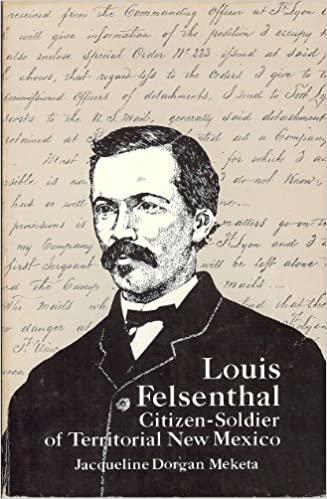
Book Review: Louis Felsenthal, Citizen-Soldier of Territorial New Mexico

Meketa.Louis Felsenthal.Cover
UNM Press, 1982
ISBN-13: 978-0826306043

Most of the people prominent in New Mexico history have had at least one book written about them (Kit Carson, Padre Martinez, Bishop Lamy, and Thomas Catron, to name a few). However, there aren’t many books about people who played minor roles in New Mexico’s history. That’s why Jacqueline Dorgan Meketa’s biography of Louis Felsenthal is so valuable.

Louis Felsenthal, Citizen-Soldier of Territorial New Mexico tells the story of a young Prussian Jew who arrived in Santa Fe in 1858 with high hopes. He had a gift for language and law, and was extremely interested in New Mexico’s history. When the Civil War broke out, he joined the Army and saw action at Valverde. He stayed in the military after the war and led patrols along the Santa Fe Trail that ensured the safety of the mail as well as stage passengers.

But Louis Felsenthal did not become famous. His passion for preserving New Mexico’s archives led him into conflict with the politicians of the day, and the effects of a stroke caused some of his fellow Anglos to believe he had an alcohol problem. As a result, he was denied the Veterans assistance to which he was entitled. He died in poverty and obscurity.

In some ways, this is a sad tale of a talented young man who didn’t achieve fame and fortune. But in other ways, Louis Felsenthal’s story is a heartening one. He’s one of many Anglos who came to New Mexico looking for adventure and fortune and instead fell in love with the land and its history, and did his best to protect it and to preserve its historical record. He may not be famous now, but he contributed to the society of his day and to posterity to the best of his abilities.

For this reason, and for its discussion of New Mexico in the second half of the 1800s, I recommend Louis Felsenthal, Citizen-Soldier of Territorial New Mexico.

MAXWELL BEFORE THE BAR

Lucien Bonaparte Maxwell sits on one of the mismatched chairs in Elizabethtown’s makeshift Colfax County courtroom and studies the man behind the judge’s table. He’s sat at such tables himself, though he doubts he ever looked so uncomfortable. Joseph Palen looks out of place here in this rough mining town and angry that it has the audacity to call itself a county seat. He apparently disapproves of nuevomexico, too, for that matter.

Maxwell feels the impulse to laugh, but instead lifts his right foot to his left knee and watches the crowd gather. Most of the men nod to him politely, touching their foreheads in a kind of salute, and he nods back. They’re good people. Know what they want, have no pretense about them. He grins at Old Pete, who’s still wearing his hat, even inside the courtroom.

Beside him, the old attorney Theodore Wheaton mutters, “Here we go,” and Judge Palen gavels the room to attention.

“Apparently, Mr. Maxwell has deigned to honor us with his presence this morning,” Palen says, glaring at Lucien.

Maxwell resists the impulse to straighten his spine and put both feet on the floor. “I believe you wanted to see me,” he says coolly.

Judge Palen’s lips tighten. “You have an interest in a number of cases before this court.”

Maxwell nods and tilts his head toward the old lawyer beside him. “Mr. Wheaton is my designated attorney,” he says. “I believe that releases me from the need to be present.” He adjusts his right foot higher on his left knee.

“You have also been indicted on a serious charge.” Palen leans forward. “That indictment requires your attendance.”

“The probate court issue?” Maxwell lifts a shoulder. “We have an excellent probate court clerk. As you’ll see from his records, there was no need to hold formal court.”

Palen’s lips thin. “You committed to appearing on the first day of this session in regard to the indictment against you. It is now the fourth day.”

“I was unexpectedly detained.”

Palen stares at him for a long moment, then turns to the court clerk. “Let the record show that Mr. Maxwell has appeared and apologized for his failure to appear, and that we are satisfied no contempt was intended.”

Maxwell’s jaw tightens, then he nods slightly and pulls his right foot more firmly onto his knee. If that’s the way the man wants to play it, he can adjust.

~ ~ ~ ~

“Things are changing, Mr. Maxwell.” Judge Joseph Palen sets his whisky glass on the saloon table and looks around the room. “In another year or so, these ragged placer miners will be replaced by businessmen with laborers to do the rough work.”

Maxwell nods, following his gaze. “And many of these men will be laborers, instead of independent men with claims of their own,” he says ruefully.

“Claims so poorly worked they bring in barely enough to keep body and soul together.” Palen flicks a speck of dust from the sleeve of his dark broadcloth suit.

“That’s all that matters, I suppose.” Maxwell grimaces. “Efficiency.”

“It’s a large territory, and its resources are going to waste.”

“So they tell me,” Maxwell says. He shakes his head, puts his glass on the table, and reaches for his battered black hat. “I’ve been here a long time, Mr. Palen, and I happen to like nuevomexico’s lack of efficiency. So do most of the men in this room, I expect. Though none of us are averse to making a penny or two.” He stands, towering over the table. “Good day to you, Judge.” A mischievous smile flashes across his face. “And good luck.”[1]

from Old One Eye Pete

[1] This story is based on events that occurred during the Spring 1870 First Judicial District Court session in Elizabethtown, the Colfax County seat. Lucien Maxwell, as Colfax County Probate Judge, was indicted for not holding court, but the charges were dismissed. At the time, Maxwell and his wife were in the final stages of selling the Beaubien/Miranda Land Grant (aka the Maxwell Land Grant) to a consortium of English investors. Judge Joseph Palen was newly appointed to his position as Justice for the First District Court of New Mexico. He would go on to become an important member of the notorious Santa Fe Ring, which sought to monetize the agricultural and other assets of New Mexico Territory.

Estancia’s Press

Watch this video for information about the town of Estancia and the press that published Jack Thorpe’s seminal 1908 book Songs of the Cowboys. It also shows how a platen press worked! I really enjoyed this one.