OBSESSIONS

OBSESSIONS

“Did you know the Maxwell Land Grant Company is evicting people who’ve been farming here for decades?” the Reverend Franklin Tolby demands.

At the other end of the small pine table, Mary Tolby moves a raised biscuit from the chipped ceramic platter to her plate. “That’s terrible,” she says. “These biscuits are quite good this time. I think I’ve finally become used to that stove. Rachel, eat your peas or there’ll be no dessert.”

Her husband picks absently at his food. “It’s a moral outrage,” he says. “The Company has no right.”

Mary looks anxiously at his pale face. Since they arrived in Cimarron, Franklin has been on horseback constantly, west to Elizabethtown, south to Fort Union and beyond, yet his cheeks show no evidence of windburn or sun.

“I’ve made strawberry pie for desert,” she says. “An Indian girl came by selling berries. They’re very sweet. The result should be quite tasty.”

Franklin’s eyes focus on her for a split second, then his head snaps up, as if he’s listening to something outside the house. “And the Indians,” he says. “With this much land, there’s room for them also.” He pauses for a long moment, fork in the air, then says, “Excuse me,” drops his frayed linen napkin onto the table, and hurries from the room.

Mary can hear him scrabbling through the papers on his desk as he prepares to write down whatever has just come to him. She sighs and reaches to cover the food on his half-empty plate with a clean napkin. “Rachel, eat your peas,” she says absently.

~ ~ ~ ~

The tiny Elizabethtown church reeks with the late June stench of unwashed miners, but Dr. Robert Longwill presses through the door anyway. He nods at Old One Eye Pete, who’s standing to one side, his battered hat clasped politely in his hands.

Then the doctor focuses on the front of the room. He can just see the top of Reverend Tolby’s head. On Cimarron’s dusty streets, the little man’s carefully groomed handlebar mustache has often given Longwill the urge to laugh, but here in Etown the miners and old trappers aren’t snickering.

Tolby’s voice fills the room. “The Maxwell Land Grant Company has no right to the land on which your mines and farmlands rest,” he says flatly. “You work the land and bring forth value from it. They sit in their offices and collect the rewards of your God-driven labor. Let us be done with such greed! Let us return to the scriptural truth that a man must work by the sweat of his brow and reap the labor of his hands!”

Dr. Longwill eases out the church door and down the hillside, toward the livery stable where he left his horse. “That preacher’s been here less than six months, and already he’s an expert on the Grant and the miners’ and farmers’ rights,” he mutters bitterly. Which wouldn’t be a problem, if no one were listening to him.

~ ~ ~ ~

Mary Tolby frowns at the potatoes she’s peeling, then out the kitchen window at the dusty Cimarron sky. It seems as if a grit-filled wind has blown every day of the eighteen months since she and Franklin arrived here to begin his Methodist Episcopal mission work. Mary sighs, washes her hands, and lifts the towel that shelters her rising bread dough. It’s taking longer than usual to double its size.

But then, Franklin is taking longer than usual to return from his Sunday services at Elizabethtown. He’s usually back before Tuesday noon, following his meeting with the church board and various other discussions on Monday.

Mary frowns and looks out the window again. There’s so much dust in the air, she can hardly see the sun. Franklin’s undoubtedly talking with someone in Etown or Ute Park about the Maxwell Land Grant Company and its wholesale eviction of the miners and small farmers who were here before the corporation purchased the grant.

She shakes her head and returns to her work. She very much doubts that her husband is speaking with anyone about the state of their soul. Not that many people in Colfax County seem to care about God or religion. Land and water are all that matter. That and gold. How she longs sometimes for Indiana!

~ ~ ~ ~

Two days before, the man had hovered outside Etown’s tiny Protestant church just long enough to confirm that Franklin Tolby was preaching there. He couldn’t stay longer than a few minutes. The air sucked out of his lungs at the thought of Tolby’s teachings, so contrary to Holy Church. But he’d been there long enough to confirm that the heretic minister will be traveling down canyon this Tuesday morning, as he always does after a Sunday in Elizabethtown.

The man waits now, rifle tucked to his chest, in the shadow of the big ponderosa at the mouth of Clear Creek. How pleasant it will be to stop the minister’s preaching.

The men who are paying him to silence Tolby have other reasons for desiring his death, reasons of power and money and land. But the waiting man cares nothing for these things, although the gold they’ve given him will be useful enough. He can leave the grant now, take his family someplace where americanos have not yet stolen the land from those who know how to do something useful with it, those whose fathers tilled it before them.

He turns his head, listening. Someone is coming. A man singing a raucous heretical hymn. Tolby, most certainly. The minister will stop at Clear Creek as usual, to water his horse and drink from the hollowed-out wooden trough placed there for the refreshment of travelers.

His back will be to the big ponderosa that shields the man with the gun. But there is no dishonor in shooting a heretic in the back. A man who will steal one’s very soul if he can, destroy the very fabric of one’s Catholic life. The rider in his clay-brown coat dismounts and the gunman eases into position. He holds his breath as his finger touches the trigger, squeezing so gently and slowly that Tolby drops to the ground before the shooter registers the sound of the bullet’s discharge, sees the neat hole it makes in the shabby brown coat.

from Old One Eye Pete
Book Review: Los Capitalistas

Book Review: Los Capitalistas
UNM Press, 1997, ISBN: 0-8263-2235-2


What picture comes to your mind when you hear the words “Santa Fe Trail”? American merchants with wagons full of merchandise heading west and returning with money in their pockets, right? Well, there’s more to that story, and Susan Calafate Boyle’s book Los Capitalistas helps to provide that additional information.

So they did. By 1840, Hispanos were major participants in the trade along the Santa Fe Trail, with extensive trade and financing relationships as far east as New York, London, and Paris. Los Capitalistas explains those relationships and the types of merchandise New Mexican merchants conveyed back and forth and, in the process, expands our understanding of New Mexico. 

The ricos of New Mexico saw pretty early on that hauling merchandising over the Trail could work both ways. After all, they were already taking wool, woven goods, and other items to Chihuahua, Sonora, and other points south. Extending their freighting operations east was the next logical step.

Los Capitalistas is written in a clear, matter-of-face style that conveys a great deal of information and provides a glimpse of New Mexico that most of us haven’t seen before, and is an important book for understanding the history of the Southwest as well as an enjoyable read. I recommend it!

Maxwell Land Grant = Trouble

Maxwell Land Grant = Trouble

Mid-April 1871 was a busy time for the newly-formed Maxwell Land Grant Company. Lucien and Luz Maxwell had received their cash for the grant, moved out of the house at Cimarron, and were busy spending their money. Lucien had used a good chunk of it to set up the First National Bank in Santa Fe. He’d also bought land at Fort Sumner. While Luz turned the former the officers quarters into a home, he bought racehorses.

However, the Company wasn’t having an easy time establishing their control over the former Beaubien-Miranda Land Grant’s vast acreage. There’d been an initial dust-up in late 1870, when the Elizabethtown miners rioted against the new owners and the Governor had to send soldiers in to squelch them. But that wasn’t the end of it. In early April 1871, the Cimarron Squatters Club organized a mass protest and fundraising meeting in front of the county courthouse. 

The Company apparently decided to demonstrate a little force in response. They sent a group of employees into the Ute Creek placer mines and took over. That strategy didn’t work out too well—the miners disarmed the Company’s men and held them hostage.

Again, the Governor got involved. This time he came himself, forced the miners to free the prisoners, ordered them to abstain from further violence, and then got the Army to station soldiers from Fort Union in the area to enforce the peace.

The soldiers’ presence does seem to have calmed the boiling pot for a little while. But it was bound to boil over again—the Company was enforcing rent payments Maxwell had never bothered to collect and also kicking people off range and farmland Maxwell had allowed them to use.

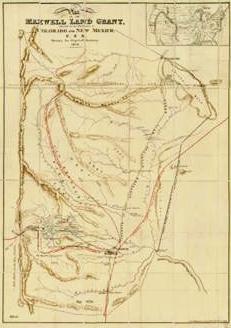
Maxwell Land Grant Map, circa 1870

Whether the Company was within their rights isn’t clear. Things got even murkier in late January 1873, when the U.S. Department of Interior ordered much of the Grant’s acreage to be treated as public lands. This brought more settlers (the Company called them “squatters”) into the area and, with them, more unrest. 

With the newcomers came Methodist Episcopal missionary Rev. Franklin J. Tolby. Tolby sided with the settlers and miners and didn’t hesitate to speak his mind. In mid-September 1875 he was ambushed and killed on the canyon road between Elizabethtown and Cimarron, and the Colfax County War was on in earnest.

The conflict didn’t end until April 18, 1887, when the U.S. Supreme Court confirmed the Company’s right to almost two million acres. Even then, the violence didn’t come to an immediate halt. However, even the most ardent settlers didn’t have any legal arguments left in their arsenal and the Colfax County War gradually faded away.

Once again, money and political power had prevailed in the fight for control of New Mexico’s lands.

Sources: David L. Caffey, Chasing The Santa Fe Ring, Albuquerque: University of New Mexico Press, 2014; Harriet Freiberger, Lucien Maxwell,Villain or Visionary, Santa Fe: Sunstone Press, 1999; Larry Murphy, Out in God’s Country: A History of Colfax County, New Mexico, Springer, NM: 1969; Lawrence R. Murphy, Philmont: A history of New Mexico’s Cimarron Country, Albuquerque: University of New Mexico Press, 1972; Moreno Valley Writers Guild, Lure, Lore and Legends of the Moreno Valley, Angel Fire, NM: Columbine Books, 1997; Stephen Zimmer, For Good or Bad, The People of the Cimarron Country, Santa Fe: Sunstone Press, 1999.

THE FOURTH TIME

THE FOURTH TIME

She could be incandescently angry and Gerald’s trip to Santa Fe and back had taken a week longer than he’d told her it would, so he braced himself as he opened the cabin door. But Suzanna barely raised her head from the rocking chair by the fire. She wasn’t rocking. Her shawl was clutched to her chest, her face drawn and gray under the smooth, creamy-brown skin. She glanced at Gerald, then turned her face back to the flames, her cheeks tracked with tears.

Gerald’s stomach clenched. “What is it?” he asked. “The children?”

Suzanna shook her head without looking at him. “The children are fine,” she said dully. She moved a hand from the shawl and placed it on her belly. The tears started again and she looked up at him bleakly. “This is the fourth time,” she said. “There will—” She closed her eyes and shook her head. “There will be no third child,” she choked, and he crossed the room, knelt beside her, and wordlessly took her into his arms.

from Valley of the Eagles

Short Line Rail in New Mexico

Railroad Finally Reaches Albuquerque!!!!

Railroad Finally Reaches Albuquerque!!!!

On Monday, April 5, 1880, after almost 30 years of waiting, the New Mexico and Southern Pacific railroad, a subsidiary of Atchison, Topeka And Santa Fe, arrived in Albuquerque, New Mexico.

The Territory’s first hope for a railroad that connected it to both coasts had been in 1853, when a survey was completed from Albuquerque toward Arizona and California. But then the nation got caught up in the conflict that would lead to the Civil War and nothing happened.

After the war, all eyes were on the transcontinental rail link which lay to the north, along the 32nd parallel. When that final spike was pounded into place at Ogden, Utah in 1869, the next logical place to build was on or near the southern border. Surely now it was New Mexico’s turn.

In the early 70s, it looked like that turn had come. Various rail lines built steadily west across Kansas and Colorado.

Then came the financial Panic of 1873. Once again, everything ground to a halt. Ranchers and farmers in New Mexico must have fumed as Texans loaded cattle and Californians boxed up grapes and pears and sent them east by rail while New Mexico still received its mail via stagecoach and had to use Santa Fe Trail freight wagons for anything larger.

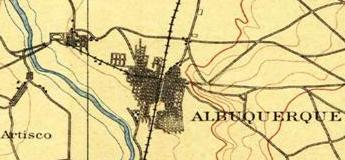
Albuquerque in 1889. Source: U.S. Library of Congress.

But then the great day finally arrived and a train chugged into Albuquerque. The new track was positioned over a mile east of the town plaza. This resulted in a flurry of real estate, commercial, and other activity. Albuquerque took on the characteristics of a boomtown, with brawls, thefts, and shootings and the inevitable ad hoc vigilante groups to try to keep them under control.

Was the arrival of the railroad a good thing? I suspect not everyone thought so.

Sources: David L. Caffey, Chasing The Santa Fe Ring, Albuquerque: University of New Mexico Press, 2014; Lawrence A. Johnson, Over The Counter And On The Shelf, Country Storekeeping in America, 1620-1920, Rutland, VT: Charles E. Tuttle Co., 1961; Morris F. Taylor, First Mail West, stagecoach lines on the Santa Fé trail, Albuquerque: University of New Mexico Press, 2000.

Josefa Jaramillo is Born in New Mexico!

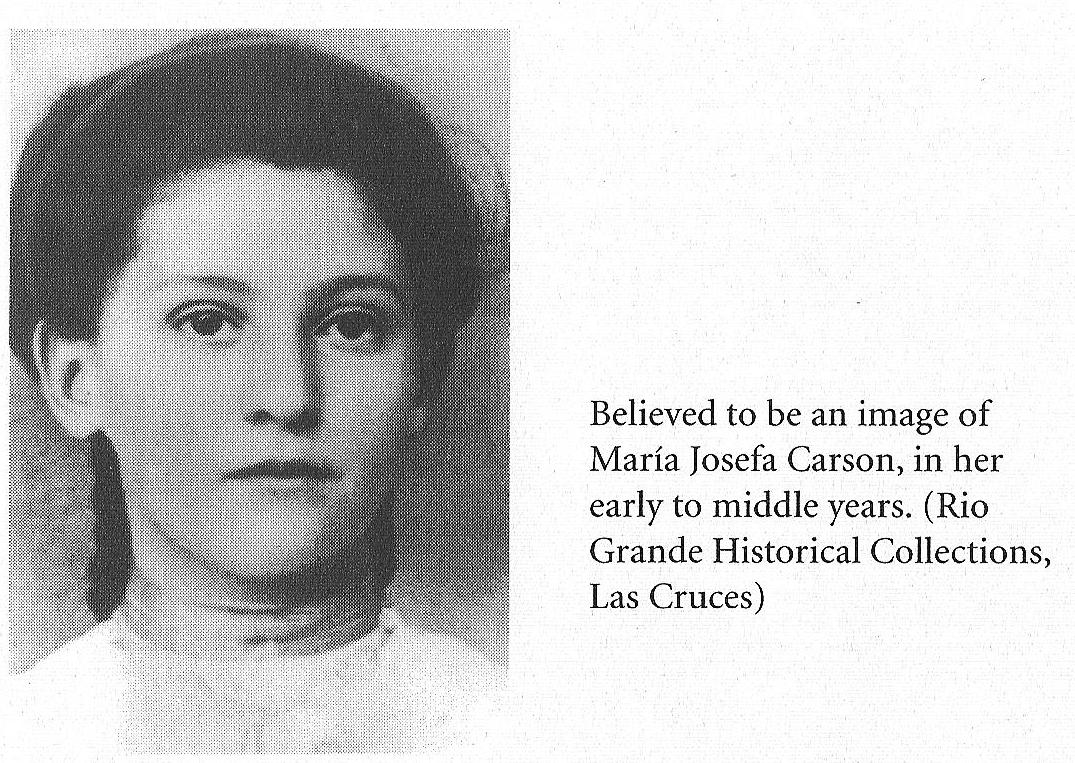
On Thursday, March 27, 1828 in Portrero, New Mexico, María Josefa Jaramillo was born to Francisco Esteban Jaramillo and María Apolonia Vigil in Portrero, New Mexico. Her parents moved to Taos before the end of the year, María Josefa and her older siblings, including three sisters, in tow.

Josefa, called “Josefita” by her family, and her older sister Ignacia would grow up to ally themselves with two prominent americanos—Christopher “Kit” Carson and Charles Bent. In the early 1830s, the now-widowed Ignacia entered into a common-law marriage with American merchant Charles Bent. About ten years later, on February 6, 1843, Josefa married newly-converted Catholic Christopher “Kit” Carson, exactly seven weeks before her fifteenth birthday.

Source: Kit Carson and His Three Wives, Marc Simmons

Four years later in mid-January, while Kit was away and Josefa was staying with Ignacia and Charles in Taos, the Jaramillo girls’ brother and Bent were killed by an angry mob. The nineteen-year-old testified at the trial of the accused men.  Refined in dress and manners, she had a heart-breaking beauty, one observer said, that “would lead a man with the glance of the eye, to risk his life for a smile.”

After that, Josefa’s life settled down a little, though it seems to have never been truly calm. Carson was gone for long stretches of time: trapping and hunting, and serving as a scout for John C. Fremont, as a courier during the Mexican war, as a military officer during the Civil War, and as commander of the troops that forced the Mescalero Apaches and Navajos onto the Bosque Redondo reservation in 1863-64. In the meantime, Josefa moved from Taos to Rayado to Bent’s Fort and back again, then followed Carson to Fort Garland and finally Boggsville, Colorado.

But Carson and the woman he called “Chepita” and “Little Jo” seem to have had a loving relationship. They had eight children, the last one born just ten days before her death in April 1868. Carson followed her a month later. They are buried side by side in a small cemetery in Taos, ending their journey together in the town where it began.

Sources: Don Bullis, New Mexico Biographical Dictionary, 1540-1980, Vol. I, Los Ranchos de Albuquerque: Rio Grande Books, 2007; Lewis H. Garrard, Wah-to-yah and the Taos Trail, Norman: University of Oklahoma Press, 1955; Leroy R. Hafen, Ed., Fur Traders of the Far Southwest, Logan: Utah State University Press, 1997; Howard R. Lamar, Reader’s Encyclopedia of the American West, New York: Harper & Row, 1977; Marc Simmons, Kit Carson and His Three Wives, Albuquerque: University of New Mexico Press, 2003

THICKER’N SNOT

“It’s s’posed to be August, dadburn it.” Julius Fairfield looked gloomily out the door of the long, narrow log cabin that served as the Quartz Mill & Lode Mining Company barracks outside of Elizabethtown. “This fog is thicker’n snot.”

In one of the iron beds lining the walls behind him, somebody sneezed. “And there’s the snot for ye,” Edward Kelly, the company’s lone Irishman, chortled as he added more wood to the pot belly stove halfway down the room.

A door opened at the far end and the chief engineer came out. He ignored the men in the beds as he walked down the room to peer over Fairfield’s shoulder. “That fog’ll lift shortly,” he said. He clapped Fairfield on the back. “Be thankful it’s not rain.”

“That was yesterday’s gift to us all,” Fairfield said gloomily. He shook his head. “And here I thought New Mexico Territory’d be drier than New York.” He grinned and glanced at the engineer. “When’d you say payday was?”

Behind them, Kelly began to sing a song praising Ireland and its green hills, and a chorus of voices yowled at him to be still. The engineer chuckled and turned. “That’s enough now!” he said.

from Valley of the Eagles

Thomas Catron is Named U.S. Attorney for New Mexico!!!

In early March 1872, Thomas B. Catron was named U.S. Attorney for New Mexico Territory, replacing his good friend Stephen Elkins, who’d just been elected New Mexico’s delegate to Congress. Catron had come to the Territory in 1866 at Elkins’ urging. He used his appointment to become a powerhouse in New Mexico politics and the center of what became known as the Santa Fe Ring, a group of men who sought to keep New Mexico’s political and financial power firmly in their own hands.

Catron and Elkins were business as well as law partners. They focused their efforts on anything that would increase their wealth, including banking, mining, and land speculation. Elkins left the Territory in 1877 and moved to West Virginia, but Catron stayed and continued his business and political activities. He served as Santa Fe’s mayor, president of the New Mexico Bar Association, and—perhaps most importantly—kingpin of New Mexico’s Republican party.

Source: Thomas Benton Catron and His Era by Victor Westphall

These positions and his control of the Santa Fe Ring enabled Catron to amass huge landholdings, many of them fraudulently. By the end of the 1800s, he reportedly owned around two million acres in New Mexico land and had a financial interest in another four million, much of it former Spanish and Mexican land grants.

It seems fitting that Catron County, one of New Mexico’s largest counties in terms of area but smallest in terms of population, is named after Catron. I suspect he was one of those people who didn’t tolerate others well unless they could benefit him in some way, so he needed a certain amount of elbow room. Naming a county for him that contains plenty of acreage but not many people seems appropriate.

Sources: Don Bullis, New Mexico: A Biographical Dictionary, 1540-1980, Vol. 1. Los Ranchos de Albuquerque: Rio Grande Book, 2007; Howard R. Lamar, Ed. The Reader’s Encyclopedia of the American West, New York: Harper and Row, 1977; Hal Stratton and Paul Farley, Office of the Attorney General, State of New Mexico, History, Powers & Responsibilities, 1846-1990. Santa Fe: State of New Mexico, 1990; Victor Westphall, Thomas Benton Catron and his era, Tucson: University of Arizona Press, 1973.

WELL-FOUNDED PESSIMISM

The dark-skinned young woman and the old Ute man sat with the quietness of old friends on the cabin porch, out of the bright mountain sun.

Stands Alone gazed at the green-black slopes lining the opposite side of the long grassy valley. “My people have no other options,” he said bleakly.

Alma tucked a wayward black curl behind her right ear. “Surely there is somewhere you can go to live your lives in peace.”

The old man shook his head. “Wherever we go, the whites follow and take the little we possess.”

“Not all of us.”

A small smile crossed his seamed face. “You, my friend, are not white. Your people have also known sorrow and theft.”

The young woman raised an eyebrow, but could not contradict. There was slavery in her veins, if not her experience, though, with enough face powder, she could pass for a deeply tanned white woman. Only the pale splotches on her cheeks, where the pigmentation wasn’t consistent, gave her away. Her French/Navajo/American mother had applied various potions in her attempt to even out the child’s skin tone, but nothing had worked and after her mother’s death, the teenage girl had stopped trying.

 “You and your people could hunt here,” Alma said, gesturing toward the valley. “After all, it was your land before my parents arrived.”

“It was,” Stands Alone agreed. “And the hunting rights are still ours. Your father and I made an agreement that allowed him his pastures.” His gaze moved toward the north end of the valley, where another cabin was under construction behind a screen of small tree-covered hills. “But still others will come,” the old man said. “And they will not ask permission.”

Alma nodded, silent before the Ute’s well-founded pessimism. Since the American takeover in 1846, eastern settlers had moved steadily into New Mexico territory. Eventually, they would find even this protected valley, which she now shared with only her brother, the former nuevomexicano mountain man Ramón who acted as their cook and handyman, and the occasional band of Indian hunters or herders from Taos.

“It is not for myself that I dread this move the American government is forcing upon us,” Stands Alone said. “But the land to which they send us is unfamiliar, and the young men are angry and uncontrollable. They talk of war against all who have built houses on our land. I fear even for you.”

Alma frowned. “We have always lived in peace with both the Ute and the Apache,” she said. “We have endeavored not to encroach on the hunting grounds or to frighten off the elk and the deer.”

The old man chuckled. “I recall that your mother was not happy about that.”

Alma grinned. “She was bound to grow corn up here, even if it killed her and all the beasts who wanted to eat it.”

“A determined woman,” he said. “May her spirit rest.”

Alma nodded somberly, then turned back to the subject at hand. “If the young men come, my brother and I will treat them with respect.”

“May they respond with respect,” he said prayerfully.

“We will remain vigilant,” she told him. “The rifles will be ready, if need be.” She shook her head, dark eyes somber. “Although I pray it will not come to that.”

“Your brother will protect you,” the old man said, reassuring himself as much as her. “And Ramón.”

But when the young men came three days later, neither Andrew nor Ramón were at hand.

Ramón had headed north after three stray cows and Andrew was in a side canyon checking his rabbit snares. So the house was quiet when Alma looked up from her book to see a Ute man with a red stripe running down one side of his face peering through the small panes of window glass at the front of the cabin.

A spasm of fear clutched at Alma’s belly and her mother’s exasperated voice echoed in her memory: “It’s dangerous for a woman in this god forsaken valley!” Then the rich voice of her father’s father reminded her: “People are like dogs. They’ll sense your fear if you let yourself feel it.”

Alma took a deep breath, steadying herself. Then she stood, crossed the room, lifted the always-loaded shotgun from the wall, and swung the cabin door firmly open.

Ten young braves stood in the yard, their faces striped with the Utes’ signature red war paint, chests bared for battle.

“Hello,” Alma said, the shotgun under her arm. “How are you all today?” The words seemed inadequate, but she thought the tone was firm enough. She knew most of them: the grandson of Stands Alone, two of the grandson’s cousins, and several others whose faces she recognized. At the back of the group, toward the long low adobe and timber barn, was Running Wolf, who as a boy had taught Alma’s brother how to set the snares he was now checking.

 “We are not well,” the grandson of Stands Alone said. “We are unhappy.”

“I am sorry to hear that,” Alma said calmly.

“You whites have come in and now we have no game.” This was a man Alma didn’t know. A broad stripe of red ran down each cheek, flattening the planes of his cheekbones.

A young boy came running from the barn, eyes bright with excitement. “There are no men here,” he told the broadly-painted one breathlessly. “And there are cattle!”

The man nodded, his eyes on Alma’s shotgun.

One of the grandson’s cousins chuckled and shifted a hatchet from his left hand to his right. “The woman has a good shape,” he observed.

“We will have her and then we will burn the house and take the cattle,” the broadly-striped one announced. He took a step forward and raised his voice. “Then we will feast!”

Alma’s stomach tightened and she lifted the shotgun, sighting on the man’s chest. “But you will not have me and you will not feast!” she said sharply. “You will be dead!”

An irritated growl swept across the yard. At the corner of her eye, Alma saw the cousin easing around the corner of the cabin, toward the lean-to kitchen’s door. Alma forced her gaze to remain on the broadly-painted man’s bare chest, her shotgun barrel steady.

“I would not touch her,” a disgusted voice said from the back of the crowd. Running Wolf? She didn’t move her eyes. “Those spots on her face are the sign of disease. Smallpox or something worse.”

The broadly-painted one peered sharply into Alma’s face and she nodded. “That’s right!” Alma said, meeting his eyes defiantly. “I will shoot you and you will die quickly.” She raised her voice. “But if these others are loco enough to have me, they will suffer for a long time before they die.” She chuckled grimly. “I will take all of you with me! And you will die a painful and lingering death of disease, not of battle!”

A confused murmur passed over the yard. Alma held the shotgun muzzle steady on the broadly-painted one’s chest. There was a long silence, then the other cousin jerked his head toward the barn. “We will take cattle instead,” he pronounced. “The cattle are not diseased.”

“Two fat cows to feed us and our children.” Running Wolf moved slightly forward. His eyes swept the cluster of warriors, then turned toward the barn. “We will all feast this night!”

The warriors swung to face the barn and Alma eased backward into the house. She shoved the door closed, then leaned against it, heart pounding her ribs, fingers cramped painfully on the gunstock. Then she crept to the kitchen, assured herself that the door was indeed barred, and slipped back into the front room. She sank into her mother’s old rocking chair and placed the shotgun gently on the floor beside her. Only when she heard Ramón and Andrew on the porch did she lift her hands from her face, now splotchy with tears.

from Old One Eye Pete