The Lights of Cimarron: Book Review

The Lights of Cimarron cover
Five Star Publishing, April 2019
ISBN-13: 978-1432851187

It’s always a treat to discover that a book I’m reading and enjoying is part of a series, so I was delighted to discover that the characters in Jim Jones’ The Lights of Cimarron are featured in other books as well.

Set in Cimarron, New Mexico in the 1870s, The Lights of Cimarron features Tommy Stallings, a very young sheriff who has the makings of a great man. He’s fallible, a little insecure, and he has a great mentor who’s a legend among sheriffs and a wife who doesn’t take him too seriously.

Tommy has challenges, though. For one thing, Colfax County officials want him to relocate to the new county seat in Springer, away from Cimarron where his wife is a teacher. So there are marital issues.

More ominously, there’s a gang of rustlers at work in the County and they’re doing more than stealing stock. They’re killing people, women and children as well as men, and leaving mutilated bodies in their wake.

But Tommy’s been charged with taking a bribe, a charge a local mayor seems more concerned with than murder. The accusation is keeping Tommy from finding and dealing with the rustlers. In fact, the mayor seems to be using it to block the rusting investigation. Can Tommy clear his name and get the rustlers too?

In my opinion, the test of a good series is whether the books in that series can stand alone as separate stories. This one does. It’s a pleasure to read and left me wanting to know more about the characters and what will become of them in the future. I’m looking forward to locating and reading the Jared Delaney series, of which The Lights of Cimarron is a spin-off.

If you’re looking for a light-hearted Western with interesting characters and which is part of a series, I definitely recommend The Lights of Cimarron!

Two Robidoux Brothers Become Mexican Citizens

On Friday, July 17, 1829, Antoine and Louis Robidoux of Missouri became naturalized citizens of Mexico, thus beginning a long and somewhat fruitful association.

Antoine and Louis were two of six brothers, all of them involved in one aspect or another of the Rocky Mountain fur trade. Becoming Mexican citizens made good business sense, because trapping licenses for non-citizens were at times non-existent.

Antoine, who was 35 years old in 1829, had been in New Mexico since 1822. He’d spent the previous two years trapping and trading with the Sioux and his application for citizenship may have been prompted by the fact that he’d married a New Mexican woman in 1828 and it was time to settle down. Or he may have wanted to get involved in local politics. Antoine’s citizenship made him eligible to be elected 1st alcalde and regidor (councilman) of Santa Fe in late 1830 and three years later to serve as 3rd alcalde of Santa Fe and a member of the Santa Fe Commission for forming election districts.


He was also busy making money. During the 1830s, Antoine purchased a mine in the Santa Fe area. He also built Fort Uinta (aka Fort Robidoux) and Fort Uncompahgre in what is now Colorado and used them as a base for trade with the Indians and the trappers in the area.

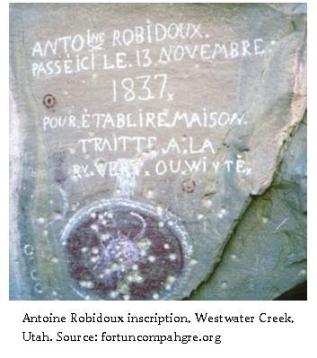
July 17 illustration.Antoine-Robidoux inscription

However, in 1844, both forts were attacked by Utes and a number of men were killed and women captured. These events seem to have curbed Antoine’s enthusiasm for the frontier life. He left for Missouri shortly thereafter.

But he came back. Eschewing his Mexican citizenship, Antoine served with Col. Stephen Watts Kearny as an interpreter during the 1846 U.S. advance on New Mexico and remained with him during the California campaign which followed. After the war, Antoine returned to Missouri, where he died in 1860.

Louis Robidoux, on the other hand, seems to have remained loyal to his Mexican citizenship. Much of his early career mirrored Antoine’s. He arrived in New Mexico about the same time (probably 1823), married a New Mexican woman (Guadalupe Garcia in 1834), and participated in Santa Fe politics, where he served as first alcalde in 1839. He also participated in various moneymaking schemes, including operating a grist mill and iron works in Santa Fe.

July 17 illustration.Louis Robidoux

And he also left New Mexico. But instead of heading back to Missouri, Louis went to California, a move reportedly bankrolled by a $30,000 win in a Santa Fe card game. He arrived in California with a group of Mexican traders in 1843 and remained there until his death in 1868.

He settled in what would become San Bernardino County, where he set up a large livestock operation and planted orchards, wine vineyards, and a grist mill. He was also involved in politics, becoming the first San Bernardino County Supervisor. The City of Rubidoux, the Louis Robidoux Library, various streets, and Mount Rubidoux are all named after him.

Leroy R. Hafen, Fur Traders and Trappers of the Far Southwest, Logan: Utah State University Press, 1997; David J. Weber, The Taos trappers, the fur trade in the far Southwest, 1540-1846, Norman: University of Oklahoma Press, 1971.

Chasing the Santa Fe Ring: Book Review

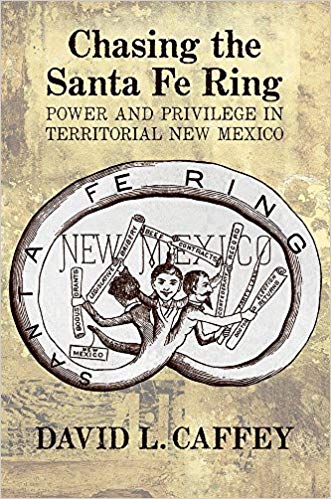
Chasing the Santa Fe Ring cover
by David L. Caffey
University of New Mexico Press, 2014
ISBN: 978-0-8263-1947-0

In New Mexico, the words “Santa Fe Ring” convey the same concept as the words “Tammany Hall” in New York. The Ring is synonymous with collusion by a few to suppress the many, the use of political power for private ends, and the accumulation of wealth by unsavory means.

In Chasing the Santa Fe Ring, David L. Caffey describes the beginnings, height, and end of the Ring and the people involved in it. The major figures he discusses include, of course, Thomas Catron, Governor Samuel Beach Axtell, Stephen Benton Elkins, and William Breeden. But there were a number of less well-known figures that had links to the ring—Colfax County men like physician Robert Longwill and attorney Melvin W. Mills and Santa Fe merchants like Lehman Spiegelberg and Abraham Staab. Caffey places the activities of these men in context and also provides a helpful summary of their activities in the back matter.

One of the pleasures of reading this book is learning about the connections between the Ring and the various events in New Mexico Territory that tend to be treated as stand-alone eruptions—for example, the Lincoln County War and the Colfax County War. Chasing the Santa Fe Ring is actually a great way to obtain a comprehensive history of the Territory from the lens of the Ring and its particular chronology of events.

Catron and his allies seem to have had their hands in any and every opportunity that appeared to promise a monetary return. This included something as large as using their legislative power to “open up” the land grants to acquisition by outsiders and as small as arranging for jury members to be paid in script with little or no monetary worth, buying that script up, and then forcing a law through the legislature which increased its value.

But this book isn’t just a record of the wrongs perpetuated by the Santa Fe Ring. It’s also the story of how a few people took action and brought an end to its power. One of those people was Mary Tibble McPherson, a woman who didn’t actually live in New Mexico. But her daughter did. By the time McPherson was finished raising hell, even Washington D.C. was taking notice.

Mary McPherson wasn’t the only person involved in the fight against the Ring. But to find out more, you’ll have to read the book. If you’re interested in New Mexico history in the Territorial period, Chasing the Santa Fe Ring is a great resource. I recommend it!


YOU PROMISED ME GLASS WINDOWS

Suzanna’s eyes narrowed and her lips tightened. “I did not come to this god forsaken valley to live in a cave,” she snapped. The toddler on her hip started fussing but Suzanna only shifted impatiently and continued to glare at her husband on the other side of the room. “You promised me glass windows. You also said you wanted to farm, that you were finished with trapping.”

Gerald gestured at the beaver pelts lying just inside the cabin door. “I was finding the means to buy glass,” he said mildly.

Suzanna turned away. “The money will just go to something else.” Alma fussed again and Suzanna bent to place her on the floor. “The mule will go lame or cougars will take down a couple more calves.”

“Suzanna sweet–”

“Don’t you ‘sweet’ me!” She straightened, hands on her hips. “I will not be sweet-talked out of this! You can’t expect me to live in a cabin with just shutters at the windows, sitting in the dark whenever it rains!”

“We have lamps.”

“It’s not the same and you know it!”

Alma had toddled to her father. She clung to his leg, looking up at him. “Papa stay home?” she asked. “Mama ang’y.” She shook her dark curly head. “Me don’ like Mama ang’y.”

Gerald and Suzanna stared at each other for a long moment. Then Gerald scooped Alma into his arms and Suzanna threw her hands in the air helplessly and crossed the room. She leaned her head against his shoulder. “I had no idea when you would return,” she said into his sleeve.

 Copyright © 2016 Loretta Miles Tollefson

President Keeps His Word!

On Thursday, June 16, 1910, the United States Congress finally agreed to allow New Mexico to become a State, ending a quest that had begun 62 years before.

The delay was partly New Mexico’s fault. In their first bid for statehood in 1848, New Mexico’s citizens had stipulated that they enter the Union as a free (non-slave) state. That requirement guaranteed that the slave-holding states would oppose New Mexico’s entry.

But a little opposition never has kept New Mexico from trying again. There were at least three other attempts to gain Congressional approval—in 1850, 1875, and 1902.

When Congress approved a process in 1906 for a combined state of New Mexico/Arizona, it looked like success was in sight. New Mexico voted for the proposal. However, Arizona voters rejected the plan.

Then in 1908, William Howard Taft became President. During the campaign, he’d pledged to make New Mexico a state. He kept his word. His Republican-controlled House and Senate approved legislation that initiated the formal process for Statehood and Taft signed it into law on Saturday, June 18, 1910.

A year and a half later, those formalities were completed and, on Saturday, January 6, 1912, President William H. Taft signed the formal proclamation that approved New Mexico’s entry into the Union. New Mexico was finally a state.

So the next time someone tells you that Presidents never keep their campaign promises, remember President Taft and the case of New Mexico statehood.

Sources: Thomas C. Donnelly, The Government of New Mexico. UNM Press: Albuquerque, 1953; David V. Holtby, Forty-Seventh Star, New Mexico’s struggle for statehood. University of Oklahoma press: Norman, 2012; Marc Simmons, New Mexico, an interpretive history, UNM Press, Albuquerque, 1988


BUZZARD BRAINS

“He ain’t got the brains God gave a buzzard,” the old man grumbled. He picked up his mattock and glared at the black-hatted figure retreating down the bottom of Humbug Gulch toward Elizabethtown. Then he looked uphill, toward Baldy Peak. “Idiot can’t even figure out there’s a storm up there and this gully likely t’wash out in another half hour.” He sniffed disdainfully and went back to work, breaking rock on the gully’s southern lip, searching for the gold that was bound to be there if a man worked the stones long enough.

The young man in the black bowler hat chewed thoughtfully on his lower lip as he trudged down the center of the gulch through the gravel and broken rock. He’d offered every dollar he had for the claim, but the miner clearly wasn’t interested in selling. He shook his head. There must be other options.

Halfway down the gulch, he paused to catch his breath and gaze at the mountain above. That dark cloud spoke rain. Given the southeast position of the cloud and the angle of the gulch, it was unlikely that particular cloudburst would wet this particular gully. However, just to be on the safe side, he moved halfway up the gully’s north slope before he continued his downward trek.

The sun was glaringly bright on the dry rocks. The young man sat down on a large sandstone boulder and took off his hat. He brushed at the dust on the black felt and shook his head. He needed to find something lighter weight and less apt to show dust. He’d keep wearing this in the meantime, though. If nothing else, it protected him from sunstroke. He glanced down at the shadowed side of his rocky seat and grinned. Like this boulder was protecting that bit of grass, growing here among the pitiless rocks where no plant had a right to be.

The young man’s eyes narrowed and he leaned forward. He shaded the clump of grass with his hat and peered down at it and the rocks around it. Then he straightened abruptly, glanced up the gully where the miner had gone back to work, and slid off the boulder. He crouched beside the big rock and gently pried a piece of broken quartz from the ground. He turned it slowly back and forth, examining every facet and seam.

Five minutes later, the young man sat back on his heels and turned the rock again, just to be certain. Then he picked up a stick and poked around a bit in the ground beside the boulder. He nodded thoughtfully, then stood and looked carefully at the gulch’s rocky slopes for any sign of possession. But this piece of land clearly hadn’t been claimed. Apparently, no one had thought there was gold this far down Humbug Gulch.

The young man chuckled, tucked the piece of quartz into his pocket, clapped his dusty black hat on his head, and headed into Elizabethtown to file the necessary paperwork for his claim.

from Old One Eye Pete

First Hispanic Named New Mexico Governor!

On Wednesday, June 2, 1897 President William McKinley appointed 37-year-old Miguel Antonio Otero II as Territorial Governor of New Mexico.

Otero’s appointment was the beginning of a new approach to politics in New Mexico, one not dominated by the Santa Fe Ring. Although “Gilly,” as he was known to his friends, had been close to Thomas Catron, the Ring’s head, he now began cultivating a younger generation of men, Democrats and Republicans alike. Together, they formed what would become known as the Otero wing of New Mexico’s Republican Party and would align themselves with progressives such as Theodore Roosevelt of New York.

Perhaps because of his progressive views and his past work recruiting New Mexicans for Roosevelt’s Rough Rider regiment, Otero was reappointed Governor in 1902. He served until January 22, 1906, a total of eight years and seven months in office. This made him the longest-serving New Mexico territorial governor and a one of only nine men who, between 1787 and 1912, served as a U.S. territorial governor for eight or more years. Just five served longer than Otero.

June 2 illustration.Miguel Otero

More importantly for New Mexico, Otero was the first Hispanic Governor during the Territorial period. While Juan Bautista Vigil y Alarid acted as governor at the beginning of the 1846 U.S. occupation, New Mexico was still under military rule at that time. It would not be organized as a United States Territory until 1851.

During the Territorial Period (1851-1912), Miguel Otero II was New Mexico’s only Hispanic Governor. To this day, he is the only New Mexico governor—appointed or elected—with more than eight consecutive years of service. Although Bruce King (1971-1974, 1979-1982, 1991-1994) served more years than any other Governor, those terms were not consecutive.

Ironically, Otero, with his New Mexico roots, was not, however, the first New Mexican governor to be born here. That honor goes to Ezequiel Cabaza de Baca, the first Hispanic elected Governor after statehood. Although Otero’s father was born in Valencia County, Gillie Otero himself was born in St. Louis, Missouri.

Sources: Don Bullis, New Mexico, A Biographical Dictionary, 1540-1980, Volume 1. Rio Grande Books: Los Ranchos, 2007; David L. Caffey, Chasing the Santa Fe Ring. University of New Mexico press: Albuquerque, 2014; Thomas C. Donnelly, The Government of New Mexico. UNM Press: Albuquerque, 1953; David V. Holtby, Forty-Seventh Star, New Mexico’s struggle for statehood. University of Oklahoma press: Norman, 2012; Ralph E. Twitchell, The Leading Facts of New Mexican History, Vol. II. The Torch Press: Cedar Rapids. 1912

INDECISION

Billy Dupre pulled his ivory-handled Colt pistol from its holster and laid it beside him on the granite boulder. He looked at the revolver thoughtfully, then twisted away to gaze at the valley below. The morning light was just beginning to turn the tops of the western mountains a pinkish-orange. He sighed and shook his head.

“You backin’ and fillin’ again?” a sleepy voice asked from the other side of the burnt-out fire.

Billy glanced around. “I can’t help it, Johnny,” he said. “I just can’t get to makin’ up my mind to killin’ a man just cuz I’m paid to do it. A man who never did nothin’ to me or mine. Someone I don’t even know.”

“You were in the army, same as me,” Johnny Kemp said. “You did it then, didn’t ya?”

“That was war. This is different.”

“And you’re from Missouri, same as me,” Kemp persisted. “Weren’t there no bushwhackers where you come from?”

“Yep, and I shot my share. But that was defendin’ my family and my home, same as when I joined up.” Billy looked toward the sunlit mountain peaks. “Not that it did me much good. By the time I got back, my ma was dead, my pa was half-crazy, and that Sally Ann–” He stood abruptly and nudged at the ashes in the fire ring with his booted toe. “There’s no embers left. You got a match?”

“That girl done and gone, didn’t she?” Johnny sat up and reached for his knapsack. “That Sally Ann?”

“It’s all done and gone.” Billy turned and began moving around the edge of the campsite, collecting small pieces of downed aspen branches. “All of it’s right done and gone.”

“So you should be wrathful enough to shoot just about any varmint that crosses your path.” Kemp stood, stretched, and began buckling his pants. “Cuz there’s no one left back there and no one here neither.” He grinned. “No one ’sides me.” He crossed to the boulder and hefted the Colt, then flipped it expertly, feeling the balance of the thing. “Nice gun,” he said.

“No, you can’t have it,” Billy said. He dropped an armload of wood beside the fire ring.

Kemp grinned, put the pistol back on the rock, and crossed to the firewood. “So what’re you gonna do if you don’t go to shootin’ for pay?” He crouched down, took out his knife, and began shaving bark into a small pile. “You gonna go back to laborin’ at one of those Etown sawmills? Become a mine flunky?”

“I might.” Billy went back to the big rock. He stared down at the valley as he reholstered the pistol. “We had us a farm in Missouri,” he said thoughtfully.

Johnny Kemp rocked back on his heels. An incredulous grin split his face. “You gonna be a farmer? A bug-ridden land-rich cash-poor dirt grubber?”

Billy Dupre stared at the sunlight touching the grasses below and glinting off the small streams that meandered across the valley toward the canyon of the Cimarron. “I might,” he said. “I just might.”

from Old One Eye Pete

Over The Trail to Mexico: Book Review


Over The Santa Fe Trail to Mexico cover
Joy L. Poole, editor
ISBN: 9780806157511
University of Oklahoma press, 2017

Early in the summer 1825, yet another young man joined a wagon train headed over the Santa Fe Trail to New Mexico.

This particular traveler’s name was Doctor Rowland Willard. Dr. Willard’s diary during his time on the Trail and afterwards in New Mexico, Chihuahua, and Durango has now been published with detailed notes and provides a fascinating look at life in Mexico in the second half of the 1820s.

As a medical doctor, Doctor Willard’s perspective was slightly different from other Americans on the Trail and in Mexico. However, in some ways it was very much the same — he was there to make money.

He spent less than six months in New Mexico and did not find there the financial success he was looking for. However, he did find it in Chihuahua. He returned to the States in 1828 with $7000 in cash.

Willard’s diary has actually been published before. Excerpts were included in the Western Travel Review in 1829 and two years later the entire diary was added as an appendix to The Personal Narrative of James Ohio Pattie. The physical diary disappeared into Willard family archives and didn’t resurface until  2005, when it began its journey to publication as Over The Santa Fe Trail To Mexico, the travel diaries and autobiography of Doctor Rowland Willard

This edition provides not only the diary but also Joy L. Poole’s extensive notes and Willard’s autobiography, published here for the first time. This book is worth its price for Poole’s notes alone, which provide the context for fully appreciating Willard’s experiences and observations.

If you’re a student of the Santa Fe trail or of New Mexico history in the late 1820s, Over the Santa Fe Trail to Mexico  will be a valuable addition to your library. If you’re simply looking for a good read about old New Mexico— or old Mexico— I would definitely recommend it.

New Mexico’s First Protestant Church

On Saturday, May 21, 1853, Baptist missionaries in Santa Fe began construction of the first Protestant church in New Mexico, located on the corner of what is now Grant and Griffin Street. The Reverend Henry W. Reed and the Reverend L. Smith officiated.

May 21 illustration

Henry Reed had arrived in Santa Fe in Summer 1846 and opened a school. Smith arrived several years later. They seem to have been focused on converting New Mexicans to Protestantism rather than serving the Anglo population. In 1851, Reade reported to his constituency back East that he’d been in Taos to share information about his Baptist school curriculum with Padre Martinez and had attended the Catholic services there. He disapprovingly described the mass as “not above a whisper and in Latin.”

The Baptist church services in Santa Fe were apparently in Spanish and English. At the cornerstone-laying ceremony on May 21, Reverend Smith spoke in Spanish and Reverend Read in English. This bilinqual approach doesn’t seem to have been enough to attract a large congregation. The adobe brick building was sold to the Presbyterians in 1866, at the end of the Civil War.

The Presbyterians eventually pulled the adobe building down and replaced it in 1882 with a brick structure. That building was replaced in 1939 with a Pueblo Revival building designed by John Gaw Meem, which is still in use today.

Sources: Thomas Harwood, The History of New Mexico Spanish and English Missions of the Methodist Episcopal Church, 1850 to 1910, Vol. I. Albuquerque: El Abogado Press, 1908; E. A. Mares, ed., Padre Martinez: New Perspectives From Taos, Taos: Millicent Rogers Museum, 1988; Ralph Emerson Twitchell, The Leading Facts of New Mexican History, Vol. II. Cedar Rapids: The Torch Press, 1912.