IMPATIENCE

“This gold. They have found it in large quantities?” The lanky teenage boy named Escubal Martinez poked a stick into the logs on the fire, moving them closer together. At the edge of the mountain valley, a coyote yipped. The Martinez clan’s flock of sheep shifted uneasily in the darkness beyond the firelight.

The Prussian-born traveler from Etown grinned. “Ja,” he said. “But it is hard work, the digging for gold.”

Escubal’s uncle Xavier grunted from the other side of the flames, where he was using a knife to carefully smooth out an uncomfortable bump on the grip of his walking staff. “Borregas y carneros.” He nodded at the boy. “That is wealth.”

Escubal scowled at the fire.

The traveler looked puzzled. “Carner?” he asked. “Meat is wealth?”

“No, Borregas y carneros,” Escubal said.”Ewes and rams.” He gestured impatiently toward the flock.

Xavier moved his staff in the firelight and ran his fingertips gently over the wood. “Carne y ropa,” he said meditatively. “Meat and clothes.”

Ja,” the Prussian answered. “You are correct.”

Escubal scowled at the fire and the traveler smiled sympathetically. It was not easy to be young and impatient.

The boy poked at the fire again. It flared briefly, lighting the night, and the flock moved restlessly, waiting for morning.
from Moreno Valley Sketches II

ELEGANCE IN ETOWN

The men in Seligman’s Mercantile watched silently as the young woman in the trailing pale blue silk skirts swept out of the store.

“She’s a lardy dardy little thing, isn’t she now?” Charles Idle, the expatriate Englishman, asked. He shook his head and stretched his feet closer to the wood stove. “That dress and hat.”

Joseph Kinsinger spat a stream of tobacco toward the empty lard can by the stove. “Those silks ain’t gonna last long in this mud. And the wind’l take that hat.”

His brother Peter grinned. “You’re just worried Desi’s gonna see her and want a getup just like it,” he said.

“I wonder where’s she’s staying,” Idle said thoughtfully. “Hey Jim, where’d she say to deliver that sterling brush and comb set?”

The clerk hesitated, then shrugged. It would be all over town soon enough anyway. “The Moreno Hotel,” he said.

There was a short silence, then Idle said, “Well, I guess I’d better go see how my mine’s doing this morning,” and rose from his chair.

“I’ll bet,” Peter said sardonically, but Idle only smiled and went out.

from Moreno Valley Sketches, II

OLD BILL – 6 of 6

He had found it.

Old Bill stood on the rocky mountain ridge, hat in hand, and peered into the long green valley below. This was the larger section Three Hands had spoken of, sure as shootin’. Meandering streams glinted in the autumn light and the clouds overhead betokened more rain.

Old Bill laughed aloud, replaced his hat, and scrambled down from the rocks. His credit-bought beaver traps rattled slightly as the new mule carefully followed him down the mountainside. There’d be beaver here, he could feel it in his bones. If not in the valley itself, then surely in the streams flowing out of it through the mountains to the east.

“C’mon mule,” he said. “We’re gonna ’cuperate my losses and make us our fortune. All we gotta do is stay outta the way of  the Injuns and the Mexicans chasin’ ’em.” He chuckled. “Not to mention catamount an’ bear.”

from Moreno Valley Sketches

OLD BILL – 4 of 6

Well, he’d got hisself away from the Ute war party, but with only his rifle, one beaver trap, and the clothes on his back. As he headed west into the foothills, Old Bill considered his situation. He was moving into the snow, not away from it, and the cold was devilish fierce. The wind howled into his face, bringing dampness with it. No one but a fool would head into this storm, toward the peaks, ’stead of down. He hoped the Utes would think so, anyways.

He gripped his rifle, resettled the trap looped over his shoulder, and lowered his head, battered hat tilted against the wind. And he’d thought he’d been cold before he entered that valley. He began to climb steadily, careful to conserve his energy, his long legs eating the mountainside.

When he finally stopped to rest, he could see nothing below but blowing whiteness.

from Moreno Valley Sketches


OLD BILL – 3 of 6

At dusk, Old Bill wrapped himself in a buffalo robe and lay quiet against the skin wall of the Ute lodge. This weren’t no hunting party, if he savvied correct. They were layin’ in wait for somethin’ and it weren’t other Injuns, to his thinking. He wasn’t exactly a captive, but Three Hands had made it clear he should stay in camp.

He’d been wandering these parts long enough to have picked up a smattering of Ute lingo. What he’d overheard made him think there were Mexican soldiers headed thisaway. From Taos, mebbe, though it was a darn fool time of year to be comin’ from that direction.

He studied his situation. He didn’t blame the Utes for their plans. It was their country, after all. Theirs and the Taos Injuns. But he didn’t want to be caught in the middle of it neither. He eased out of the robe.

from Moreno Valley Sketches

OLD BILL – 2 of 6

He entered the Ute camp warily, one hand on the mules’ lead rope, his rifle in the other. A man rose and came forward. Old Bill snorted a laugh. “Three Hands!” he said. “I done found you!”

The man studied him. “You searched for me?”

“Well, not ’xactly. But I sure am glad t’ find you.”

Three Hands nodded. “You are cold.”

“Warmer now than I was,” Old Bill said. “This is quite a little valley you have here.”

“Not so little.” Three Hands gestured to the south. “More below.”

“Sure am glad I stumbled in,” Old Bill said. “I was nigh to freezin’ comin’ over Bobcat Pass.”

The other man looked at the mules. “You trap?”

“I was, but the beavers are iced in nasty hard this winter. Can’t get at ’em.”

“The signs say the cold will continue.”

“That how come you’re here?”

Three Hands smiled noncommitally.

from Moreno Valley Sketches

Etown’s Moreno Hotel Opens With Elegant Dinner

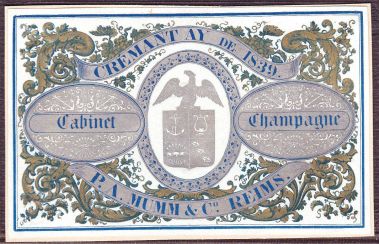
On Wednesday, July 1, 1868, the newly constructed Moreno Hotel opened in Elizabethtown, New Mexico with a dinner for 83 guests, and Etown congratulated itself on its prosperity. The hotel was a living symbol of how far the town had come since its gold-mine camp beginnings early the previous year. This inaugural dinner was served on “the finest china in the territory” and accompanied by bottles of Mumm’s Dry Imperial Champagne. The hotel was nicely located on 3rd Street between Broadway and Washington and would have had a fine view of Baldy Mountain on the eastern side of the valley as well as the various gold mining claims on the Moreno Creek in the valley directly below the town.

July 1 illustration.Mumm champagne label

It’s not clear who owned the Moreno when it opened, but two months later, it passed into the hands of Augusta Forbes, a German-born woman who, when she divorced her runaway husband the following spring, was granted the right to revert to her maiden name of Augusta Meinert as well ownership of the hotel and “all the personal property, household, and kitchen furniture now on the premises.”

Meinert operated the hotel for about four and a half years. She remarried in late December 1872 and formally handed off the Moreno to her new husband, Chancy Storey a month later. She seems to have retired from active involvement in running the business at that point, because she’s listed as a housewife in the June 1880 census while Chancy is listed as a hotel keeper, presumably of the enterprise that had such an elegant beginning twelve years before.

Sources: Colfax County Real Estate records, 1868-1888; U.S. Census Data, Colfax County, New Mexico Territory, 1870 and 1880.

OLD BILL – 1 of 6

Old Bill and the two mules had been stumbling south, half-blinded by snow, for three days. When he came over the top of the rise and looked into the valley below, he passed his hand over his face. He must be hallucinating.

He looked again. Sure enough, that was a valley below. The snow was thinner there. A herd of elk had worked large patches clear. The wolves patrolling in the snow beyond the herd were breaking through, snow almost to their hocks.

He studied the layout. Elk, snow melt for water. Bound to be Injuns. He passed his hand over his face again, warming his eyes, and looked again. Sure enough, smoke rose near the hills at the valley’s southern end.

He was coming in peace with little more than the mules and his clothes. They’d feed him, sure. Had probably already seen him. “C’mon, you mules,” he said.

from Moreno Valley Sketches


Colfax County Serial Killer’s Wife Bears Him a Son

On June 24, 1869 a baby boy was born to Charles and Gregoria Kennedy, presumably at their cabin at the foot of Palo Flechado Pass on the road between Taos and Elizabethtown. Baptized in September that year at Our Lady of Guadalupe church in Taos, he was the only living child of Charles (age 31) and Gregoria (age 17) when the U.S. census taker arrived at the cabin the following summer. Charles Kennedy would become known in New Mexico Territory as the serial killer whose wife turned him in after he killed their child. Following a hung jury in Elizabethtown in Fall 1870, a mob led by Colfax County rancher and gunslinger Clay Allison would spring Kennedy from jail and see that justice was done anyway—at the end of a rope.

June 24 illustration.Christening record
Samuel Kennedy (Canady) Christening Record

Legend has it that Allison then took a butcher knife to Kennedy’s neck, severing his neck and presenting it to hotelkeeper Henri Lambert for display outside his establishment as a warning for all evildoers in Colfax County. It is also said that before he died Kennedy confessed to killing twenty-one men. Without the birth and subsequent death of that little boy, many more men might have died at his father’s hands.

If you’re interested in a fictional account of these events, please consider ordering my novel The Pain and the Sorrow, which will be released by Sunstone Press in early August.


Sources: New Mexico, Births and Christenings, 1726-1918; Howard Bryan, Wildest of the Wild West, Clear Light Publishers, 1988; Southwest Sentinel, Silver City, NM, November 24, 1885.

SLICK

The rain was behind him and gaining fast.

Timothy looked back, down the valley, and kicked at the mule, but it was hot and the mule had been going for a long time. Its pace quickened for a few yards, then dropped back into an easy trot.

The boy groaned and looked back again. His mother had told him to take his slicker, but he’d been in a hurry. “C’mon Boss,” he begged, but the mule just flicked its ears and jogged onward.

Somehow, they made it to the barn before the clouds reached them. Timothy turned the mule into the stall and made a dash for the house. The first raindrops bit into the dust as he reached the steps.

His mother opened the door. “Get wet?” she asked meaningfully.

He grinned at her. “Dry as a bone!” he said.

from Moreno Valley Sketches II