Condemnation Process Begins for Future Eagle Nest Lake

In April 1909, the Cimarron Valley Land Company filed a lawsuit to condemn land that was destined to lie under what is now known as Eagle Nest Lake in northern New Mexico’s Rocky Mountains. The land in question seems to have belonged entirely to widow Mary Gallagher and her eight children, the youngest of whom was 16.

Mary’s husband John had purchased the property with proceeds from his 1870’s gold mining days in the Elizabethtown area at the northern end of the valley. He was a committed farmer: he’d constructed canals from both Willow and Cieneguilla Creek to irrigate his crops.

When the Cimarron Valley Land Company in Springer requested a State permit to construct a dam at Eagle’s Nest that would back up water onto her and other landowners’ property, Mary Gallagher took action. In January 1908, she filed a formal protest against the proposal. However, the State Engineer approved the permit in early July and the Company began negotiating with the three property owners affected.

April 27 illustration.Eagle Nest Dam location prior to construction.Office of State Engineer
Eagle Nest Dam location prior to construction. Source: New Mexico Office of State Engineer

But Mary Gallagher held out. Eventually, the Cimarron Valley Land Company realized that only a condemnation suit was likely to dislodge her. So they went to court in April 1909. And that’s when the real delays began. Initially, there was no Judge in the County to take up the matter. Even when that issue was resolved, the proceedings moved at glacial speed. There were appeals, demands for a jury trial, a commission established to determine the value of the property, and so forth. In fact, the process took so long that it didn’t formally end until after Mary’s death in 1916. Work on the dam and its related reservoir began the following spring, after her children had been paid off.

Oddly enough, in April 1915 the Company had requested an extension of the State permit, citing “unprecedented financial conditions” which made the Company “unable to procure the necessary funds.” The application for extension didn’t mention the land condemnation suit. Perhaps the Cimarron Valley Land Company was a little embarrassed by the fact that a little old widow lady (Mary was about 62 at the time) was blocking their progress so effectively. It must have seemed simpler to blame the delay on the international crisis of World War I.


Sources: Sept. 1, 1909 Charles Springer letter to NM Territorial Engineer Vernon S. Sullivan; Sept. 16, 1909 Charles A. Spiess affidavit; Jan 27, 1908 letter from Mary Gallagher to NM Territorial Engineer Vernon S. Sullivan; Jan. 31, 1908 protest from Gallagher family to NM Territorial Engineer Vernon S. Sullivan; March 30, 1915 application for extension of time for construction, NM Territorial Engineer Permit # 71.

Apache Canyon

There was a reason it was called Apache Canyon and Old Pete proceeded cautiously, aware that there’d been a recent outbreak of hostilities between the Jicarillas and the locals. Somebody had gotten twitchy-brained and shot off their gun without thinkin’ twice and now the whole Sangre de Cristos was on edge. Didn’t matter that he’d had no part in the original quarrel.

However, Pete hadn’t seen a soul in three days, and he was beginning to think he was gonna get to Taos in one piece after all, if the damn half-grown dog taggin’ him would quit wanderin’ off then comin’ back, widening the scent trail with his idiot nosin’ around. Pete scowled as the puppy reappeared, this time from a thicket of scrub oak, dead leaves rattling on the ground. The dog went into a half-crouch as it came closer. It was holding something in its mouth, its curly black tail drooping anxiously.

“What ya got there?” Pete asked. He squatted and held out his hand and the dog released the item into his palm. “Shit!” Pete said, dropping it. Then he leaned closer and sniffed. It really was shit. Human, too. Fresh enough to still stink. He rose, studying the slopes on either side, turning to examine the pass behind him. So much for bein’ alone.

“Thankee pup,” he muttered. “I think.”

Copyright © 2016 Loretta Miles Tollefson


Calling the Jury, Elizabethtown, New Mexico Territory

Judge Palen flattened his palms against the rough wooden table that served as the Court bench and scowled at Sheriff Calhoun. “Are you telling me that you called twenty-one men for jury duty and only seven showed up?”

Calhoun was a big man, but he fingered the broad-brimmed hat in his hands like a schoolboy. “Yes, sir.”

“Well, go get fourteen more.”

The Sheriff nodded, turned, and crossed the creaking wooden floor.

Palen turned his attention to his seven potential jury members. “All right,” he said. “Now how many of you are going to have good excuses for not fulfilling your civic duty?”

Three of them sheepishly raised their hands. Palen nodded to his court clerk to begin taking their excuses and closed his eyes. And he’d thought this appointment as Chief Justice of New Mexico Territory and Judge of its First Judicial District was a logical step up from postmaster of Hudson, New York. He suppressed a sigh. How he missed the broad sweep of the river, the bustle of the town’s port. He grimaced and opened his eyes. Only four jurymen left. Damn this town, anyway. The whole of New Mexico Territory, for that matter.

from Moreno Valley Sketches II


New Mexico Territory’s Chief Justice is Fooled Again

Friday, April 1 was the first day of the Spring 1870 Court session in Colfax County, New Mexico Territory, and Judge Joseph G. Palen must have thought someone had pulled an April Fool’s joke on him. At the end of the 1869 Fall session, he’d made three local men responsible for selecting jurors for the Spring term, but it hadn’t done much good. Only six of the identified grand jury members had showed up, so the Judge ordered Sheriff Andrew J. Calhoun to bring in 15 more potential jurors. Which he did but eleven of them had excuses. The 57-year-old Harvard-educated Judge Palen must have wished he’d never accepted President Ulysses S. Grant’s offer to promote him from Hudson, New York postmaster to Chief Justice of the New Mexico Territorial Court and therefore Judge of the Territory’s First District, which included Colfax County.

April 1 illustration.1870 court transcript.resized

Something similar had happened at the beginning of the Fall 1869 session, Judge Palen’s first in Colfax County, and he’d thought he’d solved the problem by giving E.B. Dennison, Benjamin F. Houx, and John Sutton the task of ensuring there’d be enough jurors for the Spring Session. But even their fellow citizens couldn’t corral the miners and ranchers of Colfax County to do their civic duty.

Late that day, the Sheriff finally brought in enough men to fill out the grand jury panel, none of them with reasons strong enough excuse them from the task. However, Palen still had no petit jury members. It was the morning of Tuesday, April 5 before he had both panels in place. Which wouldn’t have been too much of a problem, except that the court session was scheduled to end on Saturday, April 9. There wasn’t much time to address the over 70 separate actions that came before the court during the week-long Spring 1870 session.

Sources: Chasing the Santa Fe Ring, David L. Caffey, UNM Press, 2014; Colfax County District Court Civil and Criminal Record 1, 1869-1871, Serial No. 14400; The Leading Facts of New Mexico History Vol. II, Ralph E. Twitchell, Sunstone Press, 2007.


Future St. James Hotel Owner Marries Virginia Belle

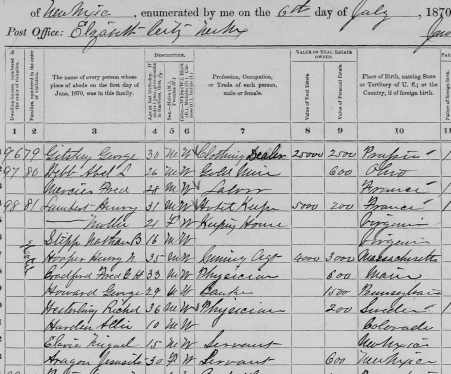
On March 28, 1868, former Fifth Army Corps cook Frenchman Henri Lambert married Anna E. “Molly” Stepp of Petersburg, Virginia, where Henri had been operating a restaurant following his service in the Union Army. Shortly after their marriage, Henry and Mary made their way to Denver by train and then south by wagon to Elizabethtown, where they arrived in May, 1868. Here, Henry worked as a placer miner until Fall set in, when he opened the first of the two hotels he would own in Colfax County. In the fall of 1871, the Lamberts moved to Cimarron, where Henri opened the saloon which would form the first story and basis of today’s St. James Hotel. Although Henri and Mary never had children, they did share their Elizabethtown home with her younger brother Nathan and in the mid 1870’s adopted a New Mexican boy named Jacob. Another brother, William, died September 1, 1881, less than two months before Mary’s death on October 28.

lambert-census-1870
1870 Elizabethtown, NM Census Record for the Lambert hotel and its occupants

Sources: http://genealogytrails.com/newmex/colfax/biographies.htm#lambert March 2015; Ralph E. Twitchell, The Leading Facts of New Mexico History, Torch Press, Cedar Rapid, Iowa, 1911. p. 212; 1870 and 1880 Colfax County Census data; George B. Anderson, History of New Mexico, Its Resources and People, Pacific State Publishing Co., New York, 1907.  p. 696-697; https://www.findagrave.com/.

Wild Knowledge

He wasn’t a man to pay much attention to girl children, but this one was different. She didn’t seem interested in cooking or clothes. More likely, she’d be in the canyon, fishing the Cimarron River. Her brother was the dreamy one, the one watching the fish swim ’stead of trying to catch ’em.

So the man was surprised when she came around the curve of the path and stopped to watch him cook the wild carrot root. He’d cut off the flowers and was slicing the root into the pot on the fire.

“Good eatin’,” he told her. “Back home, they say these make your eyes strong.”

She frowned. “Not that,” she said, shaking her head.

He was hungry. He lifted the last piece to his mouth.

“No!” she said sharply.

He raised an eyebrow at her and lowered his hand.

“That isn’t carrot,” she said. “It’s poison hemlock.”

from Moreno Valley Sketches

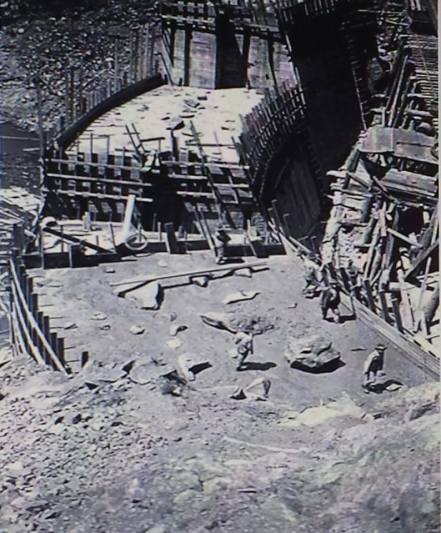
Eagle Nest Dam Finally Begins Construction

11188151_948738271824312_43356579046834581_n
Eagle Nest dam early in the construction process. Source: NM State Engineer’s Office.

On the brink of what would become known as World War I, in March 1917, construction on the Eagle Nest dam and reservoir at the head of the Cimarron Canyon had finally gotten  underway. The project had been held up for nine years while the Cimarron Valley Land Company, under the leadership of Charles Springer, fought to acquire the land that would be flooded by the impounded waters. Long-time Moreno Valley property owner Mary Gallagher had fought valiantly against the project, but when she died in 1916, her eight children seem to have quickly capitulated to the company’s demands. The deeds for the condemned lands were handed over on January 17, 1917, and work commenced. Even with the shortages in material, equipment, supplies, and laborers as a result of the war in Europe, construction proceeded rapidly and the dam was 90 percent complete by mid-December that year.

gallagher-protest-letter-cropped
Mary Gallagher’s 1907 letter protesting the dam and reservoir. Source: Office of the NM State Engineer

Sources: Charles Springer affidavit dated Jan. 29, 1921; Gallagher protest letter dated January 31, 1908.


Corn Damage, 3 of 3

Suzanna looked doubtfully at the tall, thick-bodied tan dog facing her. The man at Mora had generously loaned Gerald one of his three English mastiffs to test the theory that it would keep the deer from her cornfield.

“His name is Duke,” Gerald said, stroking the black-muzzled head. The dog’s tail wagged slowly as it studied Suzanna with sleepy brown eyes.

“He seems very docile,” she said.

“They were bred to hunt and are said to be very protective.” Gerald shrugged. “I guess we’ll just have to see.”

She nodded and watched as Gerald and the dog headed toward the cornfield, their own two mixed-breed dogs romping alongside. The mastiff majestically ignored the other dogs and Suzanna’s lips twitched. Then she shook her head and went back inside.

The barking began at daylight the next morning: high yips from their own dogs and a deeper, more solid sound. Suzanna rose and went to the window. The mongrels were at the edge of the corn patch, dancing around each other. As she watched, Duke appeared at a steady trot, circling the field.

Suzanna grabbed her shawl and went out onto the cabin porch, where she could see the entire patch. There were no deer in the corn. Duke circled the field again, stopping occasionally to mark its boundary, lift his head toward the hills above, and bark menacingly. There were deer on the hillside, moving steadily upward.

Suzanna turned toward the house. Gerald was standing in the doorway, watching her.

“How long will it take a puppy to grow to Duke’s size?” she asked, and he chuckled triumphantly.

from Moreno Valley Sketches II

Moreno Valley’s Serial Killer Gets Married

kennedy-cortez-marriage-record

On Thursday, February 28, 1867, Charles Kennedy married Gregoria Cortes at the Nuestra Senora de Guadalupe Church in Taos. Gregoria was the fourteen year old daughter of widower José Cortez of La Cordillera del Rancho, about two miles west of Mora. Charles was the 28 year old son of William and Fanny Canady (aka Kennedy) of Tennessee. Gregoria and Charles settled in the Moreno Valley at the foot of Palo Flechado Pass, on the road from Elizabethtown to Taos. There they kept a way station for travelers, and Charles Kennedy became embroiled in a series of lawsuits: one for selling liquor without a license, another for assaulting an Elizabethtown merchant with a deadly weapon, and still another for embezzling an Elizabethtown laborer’s money and goods. Kennedy was suspected of other nefarious activities, but nothing could be proven. Then, one day in the fall of 1870, his then seventeen year old wife appeared in Etown and denounced Kennedy as a serial killer. The subsequent Elizabethtown trial and lynching would make the Santa Fe, Silver City, and Indianapolis newspapers. The Silver City report said Kennedy claimed just prior to his lynching that he’d killed twenty-one men.

Corn Damage, 2 of 3

“The ears probably wouldn’t have ripened before the first snow, anyway,” Gerald said as he studied the deer-damaged cornfield. Beside him, the hired man Ramon nodded sympathetically.

Suzanna’s eyes narrowed. “You don’t know that,” she said. “And if some had, then I would have saved them to plant next spring.”

Gerald shook his head. “It’ll take years to get a strain that’ll grow at this high altitude.”

Her chin lifted. “Then it will take years. You want to stay in this God forsaken valley, don’t you?”

He continued to study the damage. “I just don’t think a fence is going to keep the deer out,” he said mildly. “They can jump pretty much anything you put in front of ’em.”

“Then what would you suggest? Those mongrel dogs of yours have proven themselves useless.”

Gerald shook his head without looking at her.

“There is a man at Mora who has dogs called masteef,” Ramon said. He held out a hand, waist high, palm down. “They are this big and used for hunting.”

Gerald turned his eyes from the corn. “Do you think he would sell?”

Ramon shrugged. “When we were there last month he showed me puppies.”

“Ramon, you are an angel,” Suzanna said.

“We don’t know that this will work,” Gerald warned.

“It’s certainly worth a try.” She gave Ramon a brilliant smile and he grinned back at her sympathetically.

from Moreno Valley Sketches II