Land Grant Controversy Begins!!!!

On Friday, December 8, 1843, Taos residents Ceran St. Vrain and Cornelio Vigil asked the Governor of New Mexico to grant them the equivalent of 922 square leagues (over four million acres) of land in what is now southern Colorado. The acreage in question included the valleys of the Greenhorn, Huerfano, Apishapa, Cucharas, and Purgatoire Rivers. St. Vrain and Vigil said they intended to use it to “encourage the agriculture of the country to such a degree as to establish its flourishing condition” and to raise cattle and sheep south of the Arkansas River and opposite Bent’s Fort.

They got what they wanted. By January 4 of the following year, they were in possession.

And they did raise cattle and sheep on the land. Between 1844 and 1847, fifteen to sixteen hundred head of cattle grazed there.

But then the Americans showed up. After things settled down following the Mexican-American War, the new government informed the owners of all the land grants in New Mexico that they needed to prove their right to the property in question.

Vigil had died in the Taos revolt in 1847, and by this time the land had been sold to or inherited by various parties, but they were all interested in pursuing title to the grant. On June 4, 1857, thirteen and a half years after Vigil and St. Vrain took possession, the owners presented the required documentation and waited for an answer.

Things went smoothly enough at first. On September 17, Surveyor General William Pelham approved what was now being called the Las Animas grant and recommended that Congress confirm it.

The first sign of trouble was during the review by the House’s Committee on Private Land Claims. The committee was taken aback when they realized the land grant documents didn’t identify the number of acres involved. Instead, it laid out the grant boundaries, which included a spot “one and one-half leagues below the junction of the San Carlos River . . . thence following in a direct line to the south, until it reaches the foot of the first mountain, two leagues west of the Huerfano River…” The committee stalled for a while on this traditional terminology, but eventually did recommend approval.

And then the Bill reached the Senate. Here the boundaries description wasn’t the problem. The grant simply contained too much land to be handed over to private control. The Senate was willing to approve 22 square leagues (97,514.53 acres), but not over four million. Donaciano Vigil and the others protested, but the Civil War broke out right about then and the case was set aside for more pressing concerns.

Dec 8 illustration.Colorado Land Grants

When Congress finally returned to the issue in 1869, it confirmed its original 22 square league decision, but granted the owners the right to choose which part of the land to retain.

However, in the meantime, grant owners had sold parcels to other people, people whose land was now in danger of being considered public domain. There would be further court battles and examinations of evidence until the United States Supreme Court handed down a final ruling on December 3, 1900, almost exactly 57 years after Ceran St. Vrain and Cornelio Vigil first requested the land.

The answer was still “no.” Sometimes it’s just not worth it to keep pressing your case.

Sources: J.J. Bowden, “Las Animas Grant,” New Mexico State Record Center and Archives, accessed via  dev.newmexicohistory.org/ filedetails.php? fileID=25012, 11/4/19; Marc Simmons, Kit Carson and His Three Wives, University of New Mexico Press, Albuquerque, 2003; Ralph E. Twitchell The Leading Facts of New Mexican History, Vol. 2, Cedar Rapids: Torch Press; Victor Westphall, Mercedes Reales, Hispanic Land Grants of the Upper Rio Grand Region, University of New Mexico Press, Albuquerque, 1983.
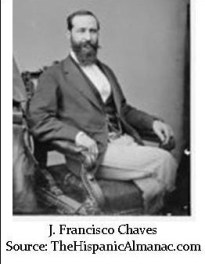
 

Top New Mexico Republican Murdered!!!!

Early on Sunday morning, November 27, 1904, news reached Santa Fe that J. Francisco Chaves was dead. Chaves had been eating dinner at a friend’s house at Pino’s Wells in Torrance County when a lone gunman shot through the window of the room he was in, then escaped on horseback.

The murder was shocking both because of its Wild West nature and because of the victim’s status in New Mexico. Born at Los Padillas in what is now Valencia County, the 71-year-old Chaves was considered the father of the Territory’s Republican party. He was a veteran of the battle of Valverde and subsequently commander at Fort Wingate. The was followed by service as Territorial Delegate to Congress from 1865 to 1871 and also as New Mexico’s Superintendent of Public Instruction. By 1904, he’d served in the Territorial Legislature for almost 30 years and was a longtime friend and political ally of Governor Miguel Otero.

Nov 27 illustration.Chaves

But political power had apparently given Chaves a sense that he wasn’t obliged to abide by other men’s rules. He was a strong supporter of the idea that New Mexico should be made a state as soon as possible and had been working hard at the territorial and national levels to make that happen. When Bernard Rodey, New Mexico’s delegate to Congress, came out in opposition to immediate statehood, Chaves was furious.
But he didn’t confront Rodey, who was up for reelection. Instead, he publicly supported Rodey’s candidacy, while quietly arranging for another man to get the Republican nomination to the position.

Chaves’s candidate would win that election and proceed to Congress, but Chaves wouldn’t live to see his success. He was dead by then, killed in a way that contributed to the idea that New Mexico Territory was still a violent frontier and not ready yet for statehood.

The behavior of the new Delegate didn’t help matters. Within seven weeks of his arrival in Washington, D.C., scandal engulfed him, raising further questions about New Mexico’s right to become a full-fledged state. It would be another eight years before the cloud lifted and New Mexico achieved Chaves’ desire. One has to wonder if Statehood would have happened sooner if Chaves hadn’t tried to hurry it along.

Sources: David V. Holtby, Forty-Seventh Star, New Mexico’s Struggle For Statehood, University of Oklahoma Press, Norman, 2012.; Frank H. H. Roberts and Ralph E. Twitchell, History and Civics of New Mexico, Robert O. Law Company, Chicago, 1914; Jerry D. Thompson, A Civil War History of the New Mexico Volunteers and Militia, University of New Mexico Press, Albuquerque, 2015; Ralph E. Twitchell, The Leading FActs of New mexican History Vol. III, The Torch Press, Cedar Rapids, 1917.

First Legal Americans Arrive in Santa Fe

When William Becknell and his companions reached Santa Fe, New Mexico on Wednesday, November 16, 1821, they experienced a very different reception then they would have received a year before.

In the fall of 1820, Becknell could have easily faced jail time for entering New Mexico. But by November 1821, Mexico had completed its break from Spain and the new government welcomed the Americans it had previously shunned. Travelers from the eastern part of the continent were no longer illegal aliens and subject to arrest at any time. Instead, they and their goods were welcomed.

Becknell had about 17 men with him. Their original intent had been to trade with the Indians and catch “wild animals of every description.” However, trading in Santa Fe was a lot easier. Becknell disposed of his goods and started back to Missouri for more. Most of the men with him liked New Mexico so much that they decided to stay and spend the winter trapping.

Nov. 16 illlustration.Santa Fe Trail map.1826.cropped

Becknell may have left many of his men behind, but he returned to Missouri with someone who hadn’t made the outgoing trip with him. David Kirker, a member of the John McKnight and Thomas James party, which had followed Becknell across the plains but were going to Mexico to retrieve members of a previous expedition, was sent back to Missouri with Becknell. Kirker had put his party in danger by surrendering himself and his weapons to a threatening Comanche war party instead of standing up to them. The men he was with wanted nothing more to do with him.

David did not return to New Mexico, but his cousin James Kirker must have been inspired by what he heard about it. He arrived a few years later and would eventually become a byword in New Mexico and Chihuahua for a trouble-making American.

Becknell’s appearance in Santa Fe that November day was definitely the beginning of a more complex relationship with New Mexico’s neighbor to the east than had been possible in the past.

Sources: Robert Glass Cleland, Alfred A. Knopf, New York, 1950; Leroy R. Hafen, Fur Trappers and Traders of the Far Southwest, Utah State University Press, Logan, 1997; Marc Simmons, New Mexico, An Interpretive History, University of New Mexico Press, Albuquerque, 1988; David J. Weber, The Taos Trappers, University of Oklahoma Press, Norman, 1971.

Mail Escort Survives October Snow

Captain Louis Felsenthal and the men of New Mexico’s Fort Union’s Company C were out in the field in September and October 1864, escorting mail-and-passenger stagecoaches between Fort Lyon and Fort Union. This should have been pleasant enough duty on the Plains in the fall of the year—the heat reduced, plenty of grass for the mules pulling the supply wagons, golden trees lining the rivers that crossed the open prairie.

But the duty wasn’t pleasant. The weather that fall was unusually cold. By October 20, Felsenthal and his men were experiencing snowstorms every few days. They hadn’t expected these kinds of conditions and didn’t have winter clothing with them. They must have been glad when their two-month rotation ended and they could head back to Fort Union.

They were en route to the Fort, on the north side of Raton Pass, when they were caught in the worst snowstorm they’d seen to date. The company and its animals struggled up and over the Pass, then down to Red River Station, where they sheltered as snow continued to fall all that night and through the next morning.

At that point, the snow on level ground was over a foot and a half deep. And still coming down. It fell steadily snow for two more days until Felsenthal, worried about the lack of forage for the mules, decided to break for Fort Union.

Oct 29 post illustration.Felsenthal

Four days later, after marching through snow that reached to their waists, men, wagons, and mules arrived at Lucien B. Maxwell’s ranch in what is today’s Cimarron). By the time they got there, many of the men had frostbitten feet and most of them were snow blind from the glare of the sun on the snow. But they’d all made it.

One reason Felsenthal and his men survived their trek is that a herd of cattle destined for Fort Union was also marooned by the storm at Red River Station. As a result, the Captain was able to buy 378 pounds of beef to feed his men, giving them the fuel they needed for their coming journey.

They were also fortunate to reach Red River Station when they did. The storm that closed in after Company C arrived there extended north and east across the Colorado plains, creating deep drifts on the stage route between Bent’s Old Fort and Denver and making the divide between the Arkansas and the Platte Rivers particularly treacherous.

You can just never tell what the weather’s going to do on the Western Plains.

Sources: Jacqueline Dorgan McKenna, Louis Felsenthal, Citizen Soldier of Territorial New Mexico, Albuquerque: University of New Mexico Press, 1982; Morris F. Taylor, First Mail West, stagecoach lines on the santa fe trail, Albuquerque: University of New Mexico Press, 1971.

Mormon Battalion Reaches Las Vegas

In early October 1846, the 500-member Mormon Battalion of Volunteers of the U.S. Army of the West marched through Las Vegas, New Mexico. They were on their way to California from Council Bluffs, Iowa, where they’d volunteered to fight in the Mexican-American conflict.

Their service had two conditions. First, each man would receive his $42 uniform allowance in advance but would wear his civilian clothing on the march. This enabled the men to donate most of their clothing money to the Church to buy wagons, animals, and other necessities for the coming move to what is now Utah. Second, the Battalion members would serve twelve months and no longer.

These men hadn’t volunteered because they supported the war against Mexico. Their leaders had asked them to join up. The Latter Day Saints needed Federal government agreement to cross what was rapidly becoming U.S. Territory and settle around the Great Salt Lake.

The LDS leadership also hoped that the Volunteers, the only single-religion battalion in U.S. military history, would help change public perception of the Church and its members by demonstrating their loyalty to the United States.

The Mormon Battalion was divided into two groups which traveled several days apart, but they were all in Santa Fe by mid-October 1846, where they met their new Captain, Philip St. George Cooke.

Oct 3 post illustration.Cooke

They were now about 45 percent through their 2,000 mile trek. Mountain man Jean Baptiste Charbonneau, the child born to Sacagawea during the 1805 Lewis and Clark Expedition, would guide them the rest of the way. Charbonneau, Cooke, and the men of the Mormon Battalion would create Cooke’s Wagon Road, a route used after American annexation to transport goods and people to California.

They arrived in California in January 1847, shortly after Mexican capitulation to John Fremont, and therefore didn’t see battle. But they completed other useful tasks and fulfilled their full twelve month contract. After their service expired, some of the Battalion members stayed in California. A few of them were working at Sutter’s Mill when gold was discovered there on January 24, 1848.

As a result, not only did the Church receive much of the $30,000 the volunteers had earned during their military service, it also received $17,000 in contributions from the first fruits of what would become the 1849 California Gold Rush. Those funds were instrumental in getting the LDS congregation through the winter, providing the means for their epic journey to the Great Salt Lake area, and helping to establish them there.

Sources: en.wikipedia.org/wiki/Mormon_Battalion Accessed 9/4/19; Paul J. Horgan, Great River, the Rio Grande in North American History, Connecticut: Wesleyan UP, 1984;  John W. Kirshon, Ed., Chronicle of America, Mt. Kisko: Chronicle Press, circa 1989; Benjamin M. Read, Illustrated History Of New Mexico, Santa Fe, 1912;  Ralph E. Twitchell The Leading Facts of New Mexican History, Vol. 2, Cedar Rapids: Torch Press;  www.mormonbattalion.com Accessed 9/4/19.


Santa Fe Trail Mail Contractor Changes!

Throughout the month of September, 1855, the Santa Fe Weekly Gazette informed its readers that the U.S. mail contract had recently been transferred to Hockaday and Hall and was providing mail and passenger transport to and from Independence, Missouri for a mere $125 per passenger.

Packages and extra baggage could also be sent via the Hockaday and Hall coaches, at a cost of 25 cents per pound, although there was a minimum charge of $1.00 and the contractors could not be held responsible for anything worth more than $50.

These rates remained the same two years later, even when service increased to twice monthly. This may have been because, no matter how often the mail left Santa Fe, it took about the same length of time to travel  to or from its destination. Round trip to St. Louis was still about three months and delivery from the Atlantic seaboard to Santa Fe remained around six weeks. Letters and packages continuing from Santa Fe on to El Paso were transferred to George H. Gidding’s service south and could take an additional week to ten days.

Sept 22 illustration

Interestingly, the front page items about the new contractors and their service are not set off in a box or with any other markings to indicate that they’re advertisements. They’re treated like news items. Repeating news items—the same language shows up in every September 1855 issue of the Gazette.

While news of the mail was critical to the functioning of business and politics in New Mexico Territory, the decision to promote its service and fees in this way may have been the result of other factors. The Hockaday and Hall agent in Santa Fe just happened to be W. W. H. Davis, the newspaper’s editor.

Sources:  Santa Fe Weekly Gazette, September 1, 8, 15, 22, 29, 1855; Morris F. Taylor, First Mail West, stagecoach lines on the santa fe trail, Albuquerque: UNM Press, 1971.

The Excitement of Politics—Some Things Never Change

On Saturday, September 15, 1855, the political atmosphere of New Mexico was so tense that a group of political operatives took it upon themselves to steal the Rio Arriba County poll books at gunpoint. The poll books in question contained the county records of the recent election for New Mexico’s territorial delegate to Congress. The two candidates for the post were Jose Manuel Gallegos and Miguel Antonio Otero.

In Rio Arriba County, a Gallegos stronghold, Probate Court Clerk Ellis T. Clark was responsible for getting the vote results to Santa Fe. He stashed the records in his saddlebags and, accompanied by Territorial Attorney General Theodore Wheaton, headed south.

About 25 miles north of Santa Fe, near Pojoaque Creek, Wheaton and Clark happened to meet five men from Otero’s party. The meeting seemed innocent enough. According to the Santa Fe Weekly Gazette account of the incident, the two groups  “halted and passed the usual compliments, the former not suspecting the object of the latter.” During the ensuing conversation, one of Otero’s partisans asked Clark if he had the poll books and he said he did. The men continued to chat.

Then suddenly the mood changed. As their companions pulled out six shooters, two of Otero’s friends grabbed Clark’s and Wheaton’s arms and demanded the voting records. Then one of them pilfered  Clark’s saddle-bags and grabbed the books.

The thieves didn’t take off immediately. They paused long enough to explain that they planned to hold the records hostage until the votes for Otero’s home county, Valencia, were tallied. They’d heard that there were plans afoot to “disappear” the Valencia poll books and hand Gallegos the election. If Valencia’s votes were “lost”, the records for Rio Arriba would also disappear.

Then the five rode off, heading north. Clark and Wheaton continued south. They arrived in Santa Fe around 10 o’clock that night and told the Sheriff what had happened. He, Clark, and a posse immediately headed north after the thieves. A duplicate set of the Rio Arriba poll books were in Clark’s house. They figured the Otero partisans would want to acquire those as well.

Sept 15 illustration

They were right. In fact, when the posse arrived at Clark’s house the next day, they learned that three of the thieves had already been there. They’d tried to bully Clark’s wife into giving them the records and, when she refused, went in search of a lawman who’d force her to do what they wanted. There’s no record of who they found to play that role. When the Otero men returned to the house, the posse was waiting and the thieves were arrested.

They’d actually had good reason to be concerned about the election results. When all the votes were counted,  Gallegos had won by 99 votes. However, Otero contested the results, alleging illegal activities related to the vote, and was ultimately awarded the Delegate seat. He served in that position until 1861, when he lost a re-election bid to John S. Watts.

As for the theft, the Gazette expressed its editorial sorrow “that men, in the excitement of politics, should commit acts their judgment will condemn in their sober moments,” and called for more stringent laws related to election fraud.

Ironically, we’re still expressing the same kind of sorrow and calling for the same kind of laws today. Some things never change.

Sources: Don Bullis, New Mexico, A Biographical Dictionary, 1540-1980, Vol. 1. Los Ranchos de Albuquerque: Rio Grande books, 2007; Santa Fe Weekly Gazette, September 22, 1855, page 2.

Future Governor Trades on Camino Real

On Monday, August 27, 1827 American traders Henry Connelly, Alphonso Wetmore, and James Erwin Glenn received written permission to travel El Camino Real de Tierra Adentro from Santa Fe to Chihuahua on a trading venture. Although Wetmore was an established Santa Fe trader at the time, then 27-year-old Henry Connelly would become the most well-known of the three men on this expedition, with the most influence on New Mexico.

A medical doctor, Connelly settled in Chihuahua at the end of his 1827 trip, and engaged in the mercantile trade there. However, he didn’t abandon his Santa Fe connections or his links to the United States. When General Stephen Watts Kearny’s army invaded New Mexico in 1846, Connelly had been in Mexico almost 20 years and had influential friends in Santa Fe.

Aug 27 post illustration.Connelly

In fact, Connelly’s connections may have been critical to the success of Kearny’s mission. He is believed to have been Governor Manuel Armijo’s agent during the negotiations that resulted in the bloodless handoff of New Mexico to the U.S.

By 1849, Connelly’s heart was definitely in New Mexico as opposed to Chihuahua. That year, he married Dolores Perea de Chavez of Peralta and subsequently became officially involved in New Mexico Territorial politics. In 1851, he became a member of the Territorial Council. Ten years later, President Abraham Lincoln named him Governor of New Mexico Territory.

Connelly was ill during much of his tenure as governor and actually left the Territory in Fall 1862 to try to recover. He returned in May 1863 and finally retired in mid-July 1866. He died less than a month later, in mid-August 1866, almost exactly 39 years after he first ventured south on the Camino Real.

 Sources: Don Bullis, New Mexico, a Biographical Dictionary, 1540-1980, Los Ranchos de Albuquerque: Rio Grande Books, 2007; Julie L. Pool, editor, Over the Santa Fe Trail to Mexico, the travel diaries and autobiography of Doctor Rowland Willard. Norman: University of Oklahoma Press, 2015; Jerry D. Thompson, A Civil War History of the New Mexico Volunteers and Militia, Albuqerque: UNM Press, 2015; Ralph Emerson Twitchell, The Leading Facts of New Mexico History, Vol. II, The Torch Press: Cedar Rapids, 1912; web.archive.org/web/20120406161610/http://www.newmexicohistory.org/filedetails.php?fileID=23527

Spanish Soldiers Killed on the Plains!

On Sunday, August 14, 1720 Santa Fe Presidio Garrison Lieutenant Pedro de Villasur died on the Platte River during an altercation with Pawnee Indians. Villasur was the leader of a force of Spanish soldiers, Pueblo Indian militia, and several citizens who’d set out that spring on an expedition to the Platte River in what is today’s Nebraska. The expedition was following up on reports that large numbers of Frenchmen were trading with the Pawnee, a tribe which dominated the central plains. This made Mexican officials nervous. Not only did Spanish mercantile policy forbid foreigners from trading within her empire, but the traders from French Louisiana could be providing the Plains Indians with arms and ammunition that could then be used against New Mexico’s settlements.

To find out what was going on, Villasur and his men were dispatched on a fact-finding mission. the reached the plains east of what is today Colorado’s Front Range in mid-August. When they found a large village of Pawnee, Villasur sent a note in to ask for a parlay.

It’s unclear whether there were any Frenchmen in the village to translate the note, which was in French, but the Pawnee didn’t waste any time responding to it. They attacked the next morning.

Villasur was among the first to fall and among the forty-five who died. The few expedition members who survived the battle carried the news back to Santa Fe and seem to have provided the details subsequently recorded in a unique artwork, one of two painted hides  that eventually came into the hands of Jesuit priest Philipp von Segesser von Brunegg.

In 1758 Segesser von Brunegg sent these artifacts to family members in Switzerland. They were eventually sold to the Palace of the Governors Museum in Santa Fe, New Mexico and returned to thecity that Villasur and his men departed from over 300 years ago. They are officially known as the Segesser hides.

There’s documentary evidence of other reposteros, or artwork painted on tanned hides, created in Santa Fe during the 1700s and some scholars believe the Segesser pieces were also produced there. Because of the details in the Segesser II hide, the painting that reflects contemporary accounts of the Villasur debacle, it seems clear that the painting was done by people who were familiar with the events.

Augst 14 post ilustration.Segesser detail

The other fascinating thing about this artwork is the way it combines pictorial elements characteristic of indigenous or folk-art paintings while also reflecting influences from European battle tapestries of the late 1600s and early 1700s. The wide borders on the hide painting contain flower and leaf designs similar to of those works.

If you’d like to know more about these unique historical artifacts and the Villasur expedition, the Segesser  hides are on display in Albuquerque, New Mexico through October 20, 2019 as part of a larger exhibit titled A Past Rediscovered. If you can’t make it to Albuquerque, you can view portions of the hide paintings here.

Sources: Marc Simmons, New Mexico, an Interpretive History, Albuquerque: University of New Mexico Press, 1988; Ruben Salaz Marquez, New Mexico, a brief multi-history, Albuquerque: Cosmic House, 1999; https://www.cabq.gov/culturalservices/albuquerque-museum/exhibitions/a-past-rediscovered

The Quickest Fort in the West

In late July 1851 Fort Union, New Mexico came into being very quickly. There had been nothing at the location at the beginning of the month, but after Colonel Edwin Vose Sumner reached Santa Fe on July 19, it was only a matter of time, and not very much of that.

The search for a new U.S. Army quartermaster depot site east of Santa Fe had already been. The Army needed a convenient point for receiving supplies in bulk from Fort Leavenworth and then distributing them to posts throughout New Mexico.

When Colonel Sumner saw the location chosen for the depot, he realized it was also an excellent spot for a new military post and Department headquarters. Known as Los Pozos (“the pits” or “the potholes”) the site had several spring-fed pools of water, something of a rarity on the plains east of the Sangre de Cristo mountains.

July 29 illustration.Fort Union Plan.1853.Oliva 72

Not only would the new Fort be supplied with water in an otherwise arid land, but the location was near the junction of the Santa Fe Trail Cimarron and Mountain routes, near the trail through Mora to the Rio Grande valley, and also near settlements such as Rayado and Las Vegas, which were being threatened by the Jicarilla Apaches.

Once Sumner made the decision, things moved quickly. By the end of July, the number of civilians employed by the quartermaster department in Santa Fe was reduced to three clerks and one carpenter and moved to the new site along with the soldiers who had been stationed in Santa Fe and in Las Vegas. New Mexico’s Fort Union was born.

Sources: Ruben Cobos, A Dictionary of New Mexico and Southern Colorado Spanish, Santa Fe: Museum of New Mexico Press, 2003; Lawrence R. Murphy, Philmont: a history of New Mexico’s Cimarron country, Albuquerque: University of New Mexico Press, 1972; Leo Olivas, Fort Union and the Frontier Army in the Southwest, Division of History, National Park Service, Southwest Cultural Resources Center, 1993; Marc Simmons, Kit Carson and His Three Wives, Albuquerque: University of New Mexico Press, 2003.