In my new novel No Secret Too Small, Suzanna and the kids spend quite a bit of time riding in a buckboard wagon. Today, I thought I’d explain what a buckboard wagon looks like.
A buckboard is basically a big rectangular wooden box with four sides, no top, and four wheels. It’s called a buckboard because an extra board is added to the wagon box directly in front of the driver’s seat. This protects the driver and passengers from the mule or horse’s hooves in case they buck. The board also acts as a footrest.
Below is a picture of a modern-day buckboard. This seat has a back, unlike the one on the Locke wagon.
Hitching an animal to one of these was not a simple task. Here’s a video of a pony being hitched to a cart. Imagine that animal a good deal bigger and you’ll get the idea.
You can see from this why Suzanna was glad to have help hitching up her mules! I enjoy learning and writing about Old New Mexico, but I have to admit that I’m glad we have more modern transportation available to us!
This book is set in 1837 against the backdrop of what is commonly known as New Mexico’s Chimayó revolt. However, the story is centered on the relationships of the Locke family. I don’t want to give away too much of the plot here, but I will say this: when Suzanna and the children leave the valley, they end up at Chimayó for a while, where Suzanna gets instruction from a master weaver in both spinning and weaving.
My primary source for the weaving scenes in this book was Chimayo Weaving by Helen R. Lucero and Suzanne Baizerman. However, I had trouble visualizing how drop spindle spinning is done. This video of Navajo weaver Clara Sherman came to my rescue. I hope you learn as much from it as I did!
However, Armijo was convinced the insurgency would erupt again. Before he left the capitol for Albuquerque in mid-October, he gave Captain Jose Caballero explicit instructions about what to do if this happened—the imprisoned rebels were to be executed at once.
Early the morning of Wednesday, October 18, it appeared that Armijo’s orders would need to be carried out. Word reached the capitol that the rebels were rallying in the mountains east of Santa Cruz, where the August insurgency had been headquartered. Armijo got the news in Albuquerque about the same time Caballero did in Santa Fe. The next day, he sent a letter north, ordering that the four hostages be executed.
But on Friday, the Captain staged a small rebellion of his own. When he received Armijo’s instructions, he didn’t follow them. Instead, he called a meeting of Presidio officers to consider how to respond. He had several concerns with Armijo’s directive. For one thing, the prisoners had still not been formally tried for their crimes. Also, there was a good chance that following Armijo’s orders would inflame revolutionary sentiment in Santa Fe instead of quelling it. And the garrison wasn’t at full strength. Successfully putting down a full-scale revolt would required reinforcements.
Given all this, Caballero and his officers decided they would obey Armijo’s orders only if and when there was an imminent threat to the city and they had the forces necessary to repel it. The prisoners would be executed only if the rebels attacked. On Sunday, Captain Caballero sent a formal letter south to Armijo, explaining what he was doing and why. Although the missive was in his name, the other men signed it.
Some of the signatures on Captain Caballero’s letter. Source: New Mexico State archives
The governor was not happy when he received this news. Early the next week, he responded with a letter criticizing Caballero’s decision. But he didn’t overturn it. And he sent a troop of active Albuquerque militia north to help in case of attack.
It was all a moot point anyway. The rebel threat dissipated. The men in the Santa Fe jail would live several more months, though Governor Armijo’s orders were eventually implemented. When rebellion burst out again in early 1838, the four prisoners were publicly garroted.
There are still historians who wonder if this action was really necessary. The threat of the executions didn’t stop the rebels from rising or keep the subsequent battle from being any less bloody. But Armijo did get the last word.
Sources: Lansing B. Bloom, “New Mexico Under Mexican Administration,” Old Santa Fe Magazine, Vol. II, Santa Fe: Old Santa Fe Press, 1914-1915; Paul Horgan, Great River: The Rio Grande in North American History, Middleton: Wesleyan University Press, 1984; Janet Lecompte, Rebellion in Rio Arriba, 1837, Albuquerque: UNM Press, 1985; F. Stanley, Giant in Lilliput, The Story of Donaciano Vigil, Pampa, TX: Pampa Print Shop, 1963.
The fall of 1837 was a tense time for the people of Santa Fe. Not only was the capitol invaded by rebels in August, but there was another threat in late September. Then after former Governor Manuel Armijo fended that off, a different kind of incursion began. Refugees started arriving in town.
Most of the newcomers came from down river, following the militia, men who were ordinarily tasked with keeping the settlements there safe. With the militia now in Santa Fe, these villages were susceptible to raids from the First Nation groups New Mexicans called the “wild tribes”—primarily Apache in the south and Navajo in the west.
While the Apache seem to have contented themselves with raiding Chihuahua-bound merchant caravans, the Navajo went after the settlements, venturing as close to Albuquerque as Bernalillo and as far northeast as the Taos Valley. New Mexico’s unrest was a great opportunity for the Navajo warriors to supplement their sheep herds and perhaps pick up a few captives to replace people taken by New Mexicans in earlier raids. In response to the danger, New Mexican families who could afford to do so headed to Santa Fe.
Almost 75 years later, one of those refugees, a boy who turned eight that winter, left behind a record of what the capitol was like during that time. Jose Francisco Perea’s family arrived in early October from Bernalillo. “We found the place full of soldiers, citizens, and a miscellaneous gathering of humanity,” he recalled. The plaza was “crowded with all kinds of vehicles, beginning with the cart that was made entirely of wood . . . to the well-constructed wagon that had brought a consignment of merchandise over the Santa Fe Trail; together with teamsters, camp-cooks, roustabouts, horses, mules, burros, pigs and goats. Some were about their camp-fires, preparing their food, while others were feeding and caring for their animals. Near the northeast corner of the plaza, which was then surrounded on its four sides with flat-roofed one-story buildings, with portals (porches) in front of them, were three cottonwood trees of the mountain variety, and opposite the Palace (the capital) stood a flagstaff (pirome), from the top of which was displayed the Mexican flag in all its glory: and the four entrances at the corners of the square were guarded, each with a single cannon of small caliber.”
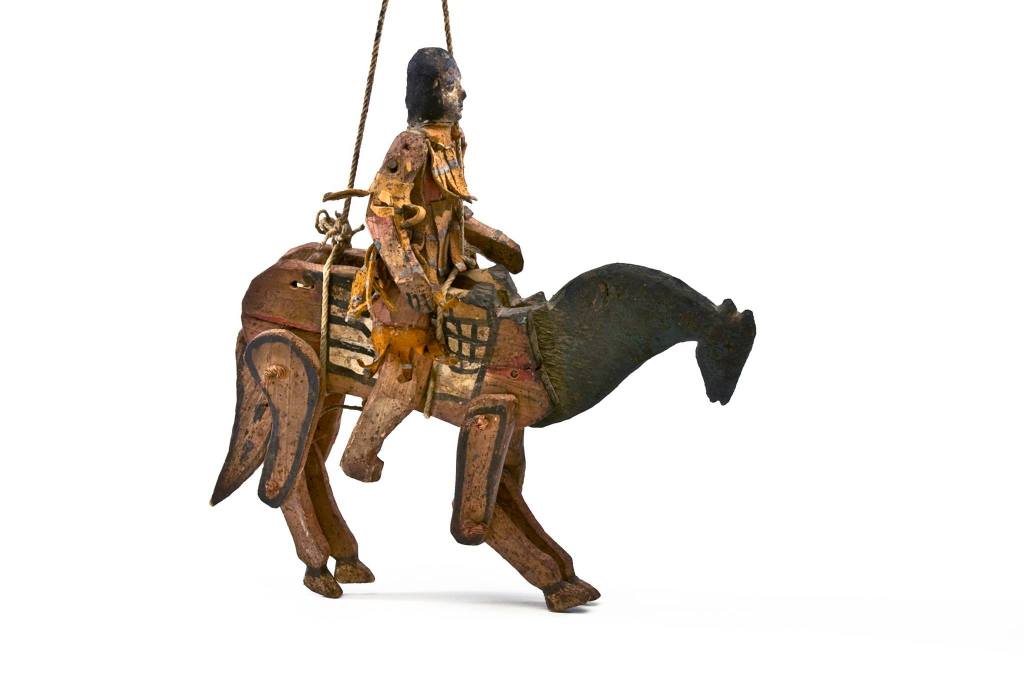
What seems to have fascinated him even more was the entertainment available. “Dancing was much indulged in,” he reported. “Particularly during Sunday nights and evenings following marriages, baptisms, and feast days. Theatricals, principally rudely constructed after the writings of Cervantes (Don Quixote de la Mancha) and Gil Blas, were occasionally played. . . Some of these were played with figures and images hung on strings, to be moved about when required.”
A marionette from Old New Mexico. Source: New Mexico History Museum
He also apparently peaked into establishments “where wine and other liquors were sold by the drink” and gambling occurred. These games of chance included Spanish monte, three-card monte, roulette, and dice. For boys Francisco’s age, there were outside games such as pitarria, played on smooth ground inside a marked square with short sticks of two colors, and quoit pitching at pegs driven into the ground. When he tired of games, he could watch dancers from the nearby pueblos perform on the plaza.
It was all quite an education for the young Perea, one supplemented by three months of classroom experience. Some time in January 1838, he and his younger brother began attending a school run by a Captain Sena and his wife. This ended when the Perea family returned to Bernalillo in late April, but his Santa Fe adventures were only the beginning of Jose Francisco Perea’s experience of the world beyond his family’s hacienda. As an adult, he would return to Santa Fe to sit on the New Mexico Territorial Council. During the Civil War, he would fight for the Union as a Lieutenant Colonel and would later serve as New Mexico’s Congressional representative in Washington, D.C.
He would also leave behind an evocative glimpse of Santa Fe in the winter of 1837/38, one for which we storytellers are quite thankful.
Sources: W.H.H. Allison as narrated by Col. Francisco Perea, “Santa Fe During the Winter of 1837/38.” Old Santa Fe Magazine, Vol. II, Santa Fe: Old Santa Fe Press, 1914-1915; James F. Brooks, Captives and Cousins: Slavery, Kinship and Community in the Southwest Borderlands, Chapel Hill: U of North Carolina Press, 2002; Janet Lecompte, Rebellion in Rio Arriba, 1837, Albuquerque: UNM Press, 1985; F. Stanley, Giant in Lilliput, The Story of Donaciano Vigil, Pampa, TX: Pampa Print Shop, 1963.
On Monday, September 18, 1837, word reached Santa Fe that the rebels who had been so successful in August were approaching the capital again. The threat of Manuel Armijo’s troops wasn’t enough to keep them away.
And Armijo had a crises of confidence. He who’d been named head of the New Mexico militia by his rico compatriots asked Judge Juan Estevan Pino to take command. When Pino declined, Armijo’s political skills kicked in. He might not know military tactics, but he did know people.
He sent word to the rebels that he wanted to negotiate. Pablo Montoya, now head of the rebels, took the bait. The insurgents camped five miles north of the capitol and negotiations commenced via correspondence.
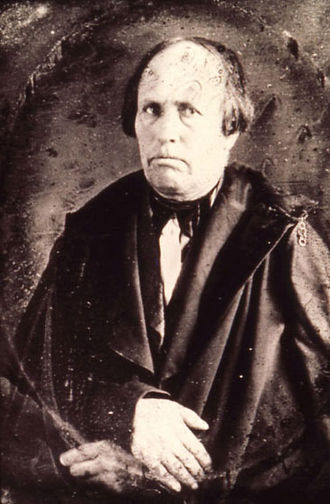
New Mexico Governor Manuel Armijo
Eventually, Armijo invited Montoya to come into town to talk. The talks, though somewhat contentious, were ultimately successful. The rebels agreed to dissolve their organization, turn over four of the initial instigators, and recognize Armijo as New Mexico’s political and military leader.
The negotiations were undoubtedly facilitated by the fact that the rebels were short on guns and ammunition, and—without Jose Angel Gonzales’ presence—military organization and discipline. In addition, not all of them considered Armijo an enemy. He had a track record as a former governor who did what he could for the people of New Mexico, even if it meant bending or judiciously ignoring Mexican law.
The treaty was signed on Thursday, September 21, and the rebels disbanded. The conflict was over. But not really. As part of the deal, Jose Angel Gonzales was released from the Santa Fe jail where he’d been lingering the last couple weeks. He was back in Chimayo with his wife and family by the end of the month.
It was a decision Armijo would live to regret. Rebellion still stirred in northern New Mexico. It wouldn’t break out again in full force until the following January, but it would break out. Armijo’s political and verbal skills delayed the conflict, but they didn’t end it.
Sources: Lansing B. Bloom, “New Mexico Under Mexican Administration,” Old Santa Fe Magazine, Vol. II, Santa Fe: Old Santa Fe Press, 1914-1915; Fray Angelico Chavez, But Time And Chance,The Story of Padre Martinez of Taos, 1793-1867, Santa Fe: Sunstone Press, 1981; Janet Lecompte, Rebellion in Rio Arriba, 1837, Albuquerque: UNM Press, 1985; Rubén Sálaz Márquez, New Mexico, A Brief Multi-History, Albuquerque: Cosmic House, 1999; F. Stanley, Giant in Lilliput, The Story of Donaciano Vigil, Pampa, TX: Pampa Print Shop, 1963.
On Thursday, September 14, 1837, former New Mexico governor Manuel Armijo and his combined troops, about 1000 men, marched into Santa Fe to begin the push against the rebels who’d captured the city in early August.
The rebels had already left town. They’d installed Jose Angel Gonzales as governor and returned to their homes in Santa Cruz de la Canada, Chimayo, Truchas, and Taos. After all, it was the harvest season. They had wheat and other crops to harvest in preparation for the coming winter.
In Santa Fe, Manuel Armijo faced a similar lack of resources at the governmental level, but he was apparently less uncomfortable requisitioning what he needed. This included seizing three large wagons to carry provisions and also soliciting contributions from American merchants Jesse Sutton, John Scully, Luis and Antonio Robidoux, and David Waldo as well as New Mexico’s ricos, especially those who lived south of Santa Fe.
Money even came from Padre Antonio Jose Martinez in Taos. Martinez was probably feeling particularly anxious that the rebels be quelled. Even though he’d returned to Taos earlier in the month at the rebels’ request and come to terms with them, they still weren’t happy.
Not only did they want him to perform marriages, baptisms, and burials for alms, rather than the customary fees, they also wanted their dead buried inside the church. Martinez refused, saying he didn’t have the authority to do so and warning that anyone who undertook such a burial faced excommunication.
Nothing he said made a difference. The rebels seized the Los Ranchos de Taos chapel and buried a corpse by the chancel steps. When the Padre remonstrated, they gave him a document saying they took full responsibility.
By doing this, the rebels denied the priest’s authority in this and other areas of their lives. While Manuel Armijo, in Santa Fe, was preparing physically for the coming altercation, the rebels in Taos were preparing mentally, establishing themselves and their comrades as the arbiters of their temporal and spiritual destinies.
They would need that self-assurance in the weeks to come.
Sources: Fray Angelico Chavez, But Time And Chance,The Story of Padre Martinez of Taos, 1793-1867, Santa Fe: Sunstone Press, 1981; Paul Kraemer, An Alternative View of New Mexico’s 1837 Rebellion, Los Alamos Historical Society, 2009; Janet Lecompte, Rebellion in Rio Arriba, 1837, Albuquerque: UNM Press, 1985; David J. Weber, The Mexican Frontier, 1821-1846, Albuquerque: UNM Press, 1982.
Early the morning of Saturday, September 2, 1837 someone got news to Padre Antonio Jose Martinez in Taos that his life was in danger. Even though the rebels had taken over New Mexico’s government in August, they were still after anyone who hadn’t complained loudly enough about the men they’d killed on their way to power.
In Taos, that included Padre Martinez and his brother Santiago, a local judge appointed by the authorities in Santa Fe. Apparently, Santiago had been appointed by former Governor Albino Perez. His position and his life were now at risk.
As the oldest of the Martinez siblings, Antonio Jose took charge. The brothers fled south to Santa Fe, probably along the rocky but shorter route that skirted the Rio Grande river. It seems to have been a harrowing journey. By the time they reached Santa Fe on Sunday, Padre Martinez was ready to flee all the way south to Durango and the bishop, perhaps even to give up his Taos ministry.
Padre Antonio Jose Martinez
But then his other brother, Jose Maria Martinez, arrived with a message from the rebels. They begged the Padre to return to help restore order in Taos and promised that if he did, they would receive him, and presumably Santiago, well.
So he turned around and headed back, but this time with protection. The rebel-appointed governor, Jose Angel Gonzalez, accompanied him.
Even Gonzales’ presence didn’t smooth the way completely. The rebels had conditions. If Padre Martinez didn’t appear before them and retract his approval of the previous administration, he would still be at risk.
Negotiating with the rebels took time, and Governor Gonzales stayed in Taos several days while they and the Padre reached an agreement: Martinez would disavow his previous allegiances and also promise not to ask for fees for baptisms, marriages, and other church ceremonies.
Then Governor Gonzales headed back to the capital. While he’d been away, the leaders of the counter-revolutionaries had met in Tomé, organized their own men, and issued their own set of ultimatums. Their representatives met Gonzales at the door of the Governor’s palacio and took him into custody. Padre Martinez’ refusal to immediately give in to the Taos rebels’ demands had cost their leader his freedom.
Sources: Fray Angelico Chavez, But Time And Chance,The Story of Padre Martinez of Taos, 1793-1867, Santa Fe: Sunstone Press, 1981; Paul Kraemer, An Alternative View of New Mexico’s 1837 Rebellion, Los Alamos Historical Society, 2009; Janet Lecompte, Rebellion in Rio Arriba, 1837, Albuquerque: UNM Press, 1985; David J. Weber, The Mexican Frontier, 1821-1846, Albuquerque: UNM Press, 1982.
My August 3, 2020 post discussed the 1837 rebellion in New Mexico and described the rebel governor as genízaro Jose Angel Gonzales. Today, I want to discuss what meant by the word “genízaro.”
In New Mexico in the 1830s, the term was technically outlawed. All racial identifiers had been banned in the 1820s, after Mexico gained its independence from Spain. However, the term was still generally used for people whose ancestors originated in one of the Native American tribes in the region, more specifically the “wild tribes” of the Utes, Apaches, Comanches, or Navajos.
My 1960s-era Spanish dictionary tells me “genízaro” means “composed of different species,” or, in Mexico, “half-breed.” According to Ruben Cobos’ dictionary specific to New Mexico, in the 1800s, the term referred to the children of non-European parents of mixed blood, or to a non-Pueblo Indian captive rescued by the Spanish settlers.
This term “rescued” is very telling. It underscores the idea that a child taken from a nomadic tribe, baptized Catholic, and raised by Spanish settlers was both saved from hell and given the chance to be “civilized.” This idea a justification purchasing children from tribes that had stolen them from other tribes, as well as capturing them directly. Thus, a Navajo child could be “rescued” from its Comanche captors but could also be “rescued” by stealing it away from its parents.
The resulting group of people formed a useful work force for the Spanish settlers. As adults, they often set up households of their own. In some cases, they banded together in communities at the margins of the Spanish settlements. Some of these—Abiquiu, Jarales, and Carnué, for examplte—still exist.
In recent years, there’s been a resurgence in interest in these communities and their story. The two links below are to videos with more information about this topic.
This book was released December 1, 2019. You can find it here.
Sources: James F. Brooks, Captives and Cousins, Chapel Hill: University of North Carolina Press, 2002; Cassell’s Spanish Dictionary, New York: Funk & Wagnalls, 1960; Ruben Cobos, A Dictionary of New Mexico and Southern Colorado Spanish, Santa Fe: Museum of New Mexico Press, 2003.
On Thursday, August 3, 1837, rebellion broke out in northern New Mexico.
Trouble had been brewing for over a year, fed by a Governor who was quicker to borrow money than distribute it, new laws restricting the right to vote, and the threat of new taxes. On top of that, Governor Perez was now inserting himself into local affairs. When he slapped the alcalde of Santa Cruz de la Canada in jail for making a decision the Governor didn’t like, something snapped.
A mob freed Alcalde Esquibel and he came out of prison with a plan. The people would set up their own government, one that he felt reflected the original intentions of the Mexican revolution and also asserted the right of New Mexicans not to pay taxes.
When Perez got wind of the rebel’s intents, he marched out of Santa Fe with a coalition of his officials, Presidio troops, militia, and Pueblan warriors. Unfortunately for the Governor, on the morning of Tuesday, August 8, shortly after he and his men stumbled on the rebel troops at the volcanic outcropping known as Black Mesa, most of his militia and warriors switched sides.
A copy of the rebel proclamation, courtesy of the New Mexico State Archives.
The battle took less than an hour. The Governor and his officials fled south. The rebels followed. By nightfall two days later, Perez and his men were dead and the rebels had installed a new Governor, genizaro Jose Angel Gonzales.
There would be push-back from the government loyalists in New Mexico, of course, especially those in the Albuquerque area and farther south. But, for now, the rebels were in charge.
Sources: Lecompte, Janet. Rebellion in Rio Arriba 1837. Albuquerque: University of New Mexico Press, 1985; Simmons, Marc. New Mexico: An Interpretive History. Albuquerque: University of New Mexico Press, 1988; Weigle, Marta, Ed. Telling New Mexico. Santa Fe: Museum of New Mexico Press, 2009
Because it’s Memorial Day, I’m sharing this video about the Buffalo Soldiers in New Mexico. Don’t know what a Buffalo Soldier was? Watch the video! Note: All opinions expressed in this presentation are those of the speaker. I do not necessarily agree that New Mexico needed to be civilized or that these men were the only reason it finally became a state. But it’s an interesting concept! Tell me what you think!





 Fiction and Fact From Old New Mexico