Eagle Nest Dam Finally Begins Construction

11188151_948738271824312_43356579046834581_n
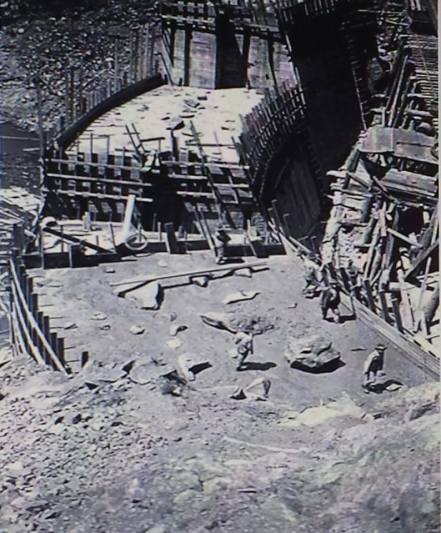
Eagle Nest dam early in the construction process. Source: NM State Engineer’s Office.

On the brink of what would become known as World War I, in March 1917, construction on the Eagle Nest dam and reservoir at the head of the Cimarron Canyon had finally gotten  underway. The project had been held up for nine years while the Cimarron Valley Land Company, under the leadership of Charles Springer, fought to acquire the land that would be flooded by the impounded waters. Long-time Moreno Valley property owner Mary Gallagher had fought valiantly against the project, but when she died in 1916, her eight children seem to have quickly capitulated to the company’s demands. The deeds for the condemned lands were handed over on January 17, 1917, and work commenced. Even with the shortages in material, equipment, supplies, and laborers as a result of the war in Europe, construction proceeded rapidly and the dam was 90 percent complete by mid-December that year.

gallagher-protest-letter-cropped
Mary Gallagher’s 1907 letter protesting the dam and reservoir. Source: Office of the NM State Engineer

Sources: Charles Springer affidavit dated Jan. 29, 1921; Gallagher protest letter dated January 31, 1908.


Future Urraca Ranch Property Sells For $660

In March 1861, Lucien Maxwell and Charles Beaubien sold what is now the Urraca Ranch wealthy Taos merchant Peter Joseph for $660. A Portuguese immigrant, Joseph had trapped and traded with Maxwell and Carson during their mountain man days. Although he died less than a year after the property transfer, in that time Joseph had a ten acre piece of the land (probably along Urraca Creek) surrounded with a board fence so it could be farmed. The eastern border of the Joseph Ranch was the Old Santa Fe Trail between Rayado and Cimarron and its western border was the Cimarron mountains. On the south, it was bounded by the Maxwell/Abreu properties at Rayado, and on the north by the ridge that separated the waters flowing into the Urraca and Cimarroncito creeks.

antonio_joseph
Antonio Joseph. Source: https://en.wikipedia.org/wiki/Antonio_Joseph_(politician)

About five years after Peter Joseph’s death, his sixteen year old son Antonio gained full control of the property. In 1880, he sold the land to speculator Frank R. Sherwin for $8,500, almost thirteen times his father’s original investment. Antonio Joseph went on to become New Mexico Territory’s representative to Congress from 1884 to 1894 and to play an important role in the fight for New Mexico statehood.


Sources: Lawrence R. Murphy, Philmont a history of New Mexico’s Cimarron Country, UNM Press, Albuquerque, p. 135;     1880 Colfax County Census data; David V. Holtby, Forty-Seventh Star, U of Oklahoma Press, Norman, p. 7-15, 286.


Moreno Valley’s Serial Killer Gets Married

kennedy-cortez-marriage-record

On Thursday, February 28, 1867, Charles Kennedy married Gregoria Cortes at the Nuestra Senora de Guadalupe Church in Taos. Gregoria was the fourteen year old daughter of widower José Cortez of La Cordillera del Rancho, about two miles west of Mora. Charles was the 28 year old son of William and Fanny Canady (aka Kennedy) of Tennessee. Gregoria and Charles settled in the Moreno Valley at the foot of Palo Flechado Pass, on the road from Elizabethtown to Taos. There they kept a way station for travelers, and Charles Kennedy became embroiled in a series of lawsuits: one for selling liquor without a license, another for assaulting an Elizabethtown merchant with a deadly weapon, and still another for embezzling an Elizabethtown laborer’s money and goods. Kennedy was suspected of other nefarious activities, but nothing could be proven. Then, one day in the fall of 1870, his then seventeen year old wife appeared in Etown and denounced Kennedy as a serial killer. The subsequent Elizabethtown trial and lynching would make the Santa Fe, Silver City, and Indianapolis newspapers. The Silver City report said Kennedy claimed just prior to his lynching that he’d killed twenty-one men.

Why “Colfax” County?

On January 25, 1869, eighteen months after Elizabethtown, New Mexico was founded in Mora County, New Mexico’s Territorial Legislature cut the County into two pieces and renamed the northern section Colfax County, in honor of the new U.S. Vice President Schuyler Colfax. Elizabethtown became the county seat. Schuyler Colfax had visited northern New Mexico Territory in late 1868, shortly before being sworn in as Ulysses S. Grant’s Vice President. Colfax was a journalist and politician from Indiana and was expected to one day be President.

schuyler-colfax

Unfortunately, the Grant administration scandals ruined those hopes, as well as the hopes of those who thought naming the County after him would be a smart move. When it was created, Colfax County included the entire Maxwell Land Grant, except for 265,000 acres in southern Colorado, and extended to the Texas/Oklahoma border, encompassing what is now Harding and Union County.

Sources: Lure, Lore, and Legends of the Moreno Valley. Angel Fire, NM: Moreno Valley Writers Guild, 1997: 5.  Daniel, Clifton. Chronicle of America. Mount Kisco, NY: Chronicle Publications, 1988: 408.

Virginia City, New Mexico is Born. And Dies.

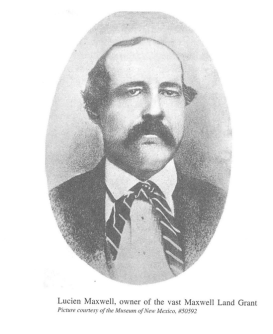
On January 6, 1868 Lucien Bonaparte Maxwell, co-owner of the Maxwell land grant, announced a public auction of 400 lots in Virginia City, a new town six miles east of today’s Elizabethtown. The new town was located along Willow Creek on Baldy Mountain’s southern slopes and  named after Maxwell’s seventeen-year-old daughter, Virginia.

lucien-maxwell

Unfortunately, the town got off to a slow start. Only fifteen houses were in the next two months. Due to poor sales, the town had collapsed by the time Virginia married U.S. Army officer A.S.B Keyes two years later without Maxwell’s permission. What little remains of Virginia City is now on private property.

Sources: Urban, Jack. C.. Lure, Lore, and Legends of the Moreno Valley. Angel Fire, NM: Moreno Valley Writers Guild, 1997: 32.  Murphy, Larry R. Philmont. A History of New Mexico’s Cimarron Country. Albuquerque: UNM Press, 1972: 90. Freiberger, Lucille. Lucien Maxwell: Villain or Visionary. Santa Fe: Sunstone Press, 1999: 103.