Lightning Strikes Missionaries in Cimarron Canyon

Exactly 146 years ago today, on Friday, August 4, 1871, three Methodist missionaries en route to Elizabethtown, New Mexico were struck by lightning and almost killed in Cimarron Canyon. Illinois natives Reverend N. S. Buckner and his 19 year old wife Annette had recently been appointed to take over Rev. Thomas Harwood’s responsibilities in Etown. They were travelling with Harwood, the man would go on to become the Methodist Bishop of New Mexico and co-found what is now the Harwood School in Albuquerque. The Buckners had just been assigned to assist him by taking over in Elizabethtown, where Harwood had dedicated a church building the year before.

The sun was beginning to set when Harwood and the Buckners reached the first section of Cimarron Canyon. Rev. Harwood’s buggy provided protection from the rain, so they weren’t uncomfortable. In fact, they were enjoying the thunderstorm and discussing the properties of electricity, when suddenly, thunder crashed, lightning flashed, and the smell of sulfur filled the air. The buggy itself had been struck and its passengers stunned to immobility. The force of the strike tore two large holes in the ground underneath the wheels, broke the crossbar behind the horses, and knocked the animals themselves off their feet.

Once the Buckners and Harwood were able to move again, they left the horses and walked back towards Cimarron “under the blazing lightnings and almost deafening thunder, muddy, wet and barefoot, . . . three miles to the nearest American house, and thence in wagon to Cimarron City” (Harwood, Vol. I, 129).
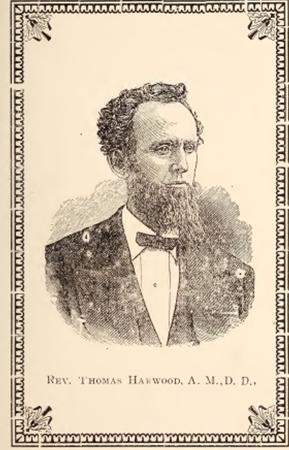
Aug 4 illustration.Thomas Harwood photo

Although they were all still feeling the effects of their lightning experience, the next morning, the little group of  missionaries were back in the canyon, this time on the Saturday stage to Elizabethtown, where the men preached at the morning and evening church services the next day.

It was an inauspicious beginning to the Buckner’s work in New Mexico Territory and things don’t seem to have improved much after that. Elizabethtown was a center of resistance to the Maxwell Land Grant Company’s plan to dispossess the area’s miners, ranchers, and farmers of their land. The town was rife with tension. The Buckners returned to Colorado in 1872. A year and a half later, in January  1874, they were replaced by Rev. Franklin J. Tolby, who lived in Cimarron but held services in Elizabethtown on a regular basis. Tolby himself would not last long. He was gunned down on September 14, 1875 on his way home from the Elizabethtown church, a date that many consider to be the beginning of the Colfax County War.

For fiction based on Reverend Tolby’s life and assassination, and historical information about his death, see my May 24, 2017 post and watch for them throughout September.


Source: Thomas Harwood, History of New Mexico Spanish and English Missions of the Methodist Episcopal Church, Vol. I and II, El Albogado Press, Albuquerque, 1910; Lawrence R. Murphy, Philmont, A History of New Mexico’s Cimarron Country, UNM Press, 1972, Albuquerque; ttps://www.timeanddate.com/calendar/?year=1871&country=1 accessed 7/17/2017

The Month of July and Lucien Bonaparte Maxwell

July is a month fraught with meaning in connection with Lucien Bonaparte Maxwell, the man who controlled almost 2 million acres of New Mexico Territory land in the 1860’s.

Lucien Bonaparte Maxwell died on this day, July 25, in 1875, five years after the sale of what was known as the Maxwell Land Grant to a consortium of London investors was recorded in the Colfax County, New Mexico Territory’s record books. It was his daughter Odile’s sixth birthday.

The Beaubien Miranda land grant had come into Maxwell’s hands through his wife’s inherited portion, their purchase of her Beaubien sibling’s sections, and their acquisition of the remainder from the Miranda heirs. There was still some question about the actual size of the grant when Maxwell died, a question which would be settled by the United States Supreme Court in 1887, when they confirmed it at just under 2 million acres.

A portion of the money from the sale, went to the purchase of the decommissioned Fort Sumner from the Federal  government. Located in the southeastern part of the Territory, Fort Sumner had been the site of the infamous detainment of Navajos and Mescalero Apaches in the 1860’s. Following their return to their homeland, the Fort had little use to the military control of the Native population. Maxwell purchased it in 1870, renovated the buildings, and ranched and raised race horses there until his death in 1875.

July 25 illustration.Maxwell Fort Sumner house.Freiberger
Source: Lucien Maxwell, Villain or Visionary by Harriet Freiberger

Lucien Maxwell’s family continued to live at the old Fort after his death. Six years later, again in July, another death became associated with the site. Billy the Kid was visiting the Maxwell home at Fort Sumner the night that he was shot and killed by Sheriff Pat Garrett.

Sources: Dean K. Boorman, Guns of the Old West, Lyons Press, 2004;  Harriet Freiberger, Lucien Maxwell, Villain or Visionary, Sunstone Press, 1999; Lawrence R. Murphy, Philmont, A history of New Mexico’s Cimarron country, UNM Press, 1972; David G. Noble, Pueblos, Villages, Forts & Trails: A guide to New Mexico’s past, UNM Press, 1994; Stephen Zimmer, For Good or Bad, People of the Cimarron Country Sunstone Press, 1999.

Black Jack Ketchum Plays His Last Hand

On July 16, 1899, bullets began raining down on Black Jack Ketchum’s Turkey Creek Canyon hideout west of Cimarron, New Mexico Territory, and the outlaw began the last hand in his life’s game of cards.

Two years earlier, Ketchum and his gang had barricaded a cave in the upper reaches of the canyon with logs and built a corral nearby for their horses, in case they needed a hideout, which seemed highly likely. Black Jack had been a brutal teenager with a penchant for malicious activities like burning Hispano sheepherders’ camps and he’d grown into an outlaw with a taste for theft, women, and gambling, hence the name “Black Jack.”  In fact, shortly after they’d constructed their Turkey Creek Canyon hideout in 1897, Black Jack and his buddies hit Cimarron’s gambling halls, with Black Jack losing heavily the night before they ventured out to hold up their first Colorado and Southern train near Folsum, New Mexico.

Two years later, Ketchum and his gang robbed another Colorado and Southern train near Folsum, then made a run for Turkey Creek Canyon. But a sheriff’s posse tracked them down and opened fire the morning of July 16. In the ensuing conflict, the sheriff and two posse members were killed, Black Jack’s brother Sam was fatally wounded, and gang member William McGinnis was injured.

Black Jack escaped, but not for long.  He was arrested the following month in Union County, New Mexico. The trial and then the plans for the hanging took a while, but in April 1901, when his hand was truly up.

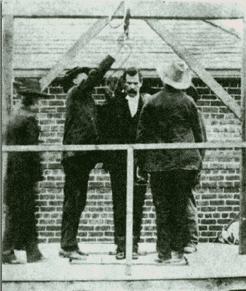
July 16.illustration.Ketchum hanging photo

However, Ketchum’s death didn’t come easily. Today, he’s remembered in New Mexico as the man who lost his head in a hanging. The Clayton, NM executioner didn’t calculate the rope weight and length correctly and Ketchum had been indulging during his prison stay, adding extra pounds. When the trap door opened, his body swung through but his head was cut off by the rope: A truly grisly way to die.

Sources: Stephen Zimmer, For Good or Bad, People of the Cimarron Country, Sunstone Press, 1999;  Stephen Zimmer and Steve Lewis, It Happened in Cimarron Country, Eagle Trail Press, 2013.


Baldy Town Celebrates the 4th of July

On July 4, 1871, up-and-coming lawyer Melvin Whitson Mills delivered the Independence Day oration at Baldy, the center of gold mining activity on the east side of Baldy Mountain north of Ute Park, New Mexico Territory. The celebrations included a parade of 500 people marching to a grove of trees outside town. There, the local newspaper editor read the United States Declaration of Independence and Mills, the young lawyer and would be politician who had so ably defended serial killer Charles Kennedy a year and a half before, delivered a “spread eagle” oration. A formal dance ended the day.

Although there were those who weren’t impressed that Mills had almost succeeded in rescuing Kennedy from the hangman’s noose, he was respected enough in the county to be elected as a delegate to the Republican National Convention in 1873 as well as various other municipal, county, and Territorial positions. Along with his legal practice and his connections to the Santa Fe Ring, these activities gave Mills the financial ability by the end of the decade to construct a handsome three-story mansard-roofed home in Springer which was known throughout the territory for its more than twenty rooms and its maple interior trim. He also owned a large ranch outside in eastern Colfax County, where he raised cattle and planted the fruit trees that can still be seen in what is now Mills Canyon.

July 4 illustration.Mills house

Sources: Bainbridge Bunting, Of Earth and Timbers Made: New Mexico Architecture, UNM Press, 1974; Loretta Miles Tollefson, The Pain and the Sorrow, Sunstone Press, 2017; Victor Westphall, Thomas Benton Catron and his era, U of Arizona Press, 1973.

Etown’s Moreno Hotel Opens With Elegant Dinner

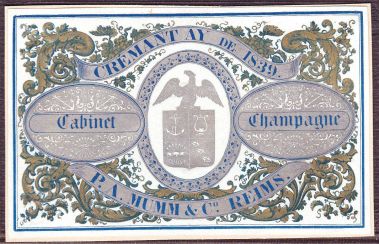
On Wednesday, July 1, 1868, the newly constructed Moreno Hotel opened in Elizabethtown, New Mexico with a dinner for 83 guests, and Etown congratulated itself on its prosperity. The hotel was a living symbol of how far the town had come since its gold-mine camp beginnings early the previous year. This inaugural dinner was served on “the finest china in the territory” and accompanied by bottles of Mumm’s Dry Imperial Champagne. The hotel was nicely located on 3rd Street between Broadway and Washington and would have had a fine view of Baldy Mountain on the eastern side of the valley as well as the various gold mining claims on the Moreno Creek in the valley directly below the town.

July 1 illustration.Mumm champagne label

It’s not clear who owned the Moreno when it opened, but two months later, it passed into the hands of Augusta Forbes, a German-born woman who, when she divorced her runaway husband the following spring, was granted the right to revert to her maiden name of Augusta Meinert as well ownership of the hotel and “all the personal property, household, and kitchen furniture now on the premises.”

Meinert operated the hotel for about four and a half years. She remarried in late December 1872 and formally handed off the Moreno to her new husband, Chancy Storey a month later. She seems to have retired from active involvement in running the business at that point, because she’s listed as a housewife in the June 1880 census while Chancy is listed as a hotel keeper, presumably of the enterprise that had such an elegant beginning twelve years before.

Sources: Colfax County Real Estate records, 1868-1888; U.S. Census Data, Colfax County, New Mexico Territory, 1870 and 1880.

Kit Carson’s Home is Attacked!

On June 26, 1850, while Kit Carson was traveling home from Missouri with trade goods, a band of Native Americans attacked the Carson’s hamlet of Rayado, in the shadow of the Cimarron mountains. Despite the presence of a company of Army dragoons at Rayado, the Indians—no one was sure if they were Ute or Jicarilla Apache—drove off six horses, four mules, and 175 head of cattle valued at over $5000. Two Rayado men were killed: an unarmed Army bugler and a civilian (possibly trapper William New).

The dragoons had been stationed at Rayado in response to the Indian raids against the communities on the eastern mountain slopes and on the Santa Fe Trail on the eastern plains since the middle of 1849. Some of the violence was undoubtedly triggered by events in August 1849, when Jicarilla Apache Chief Chacón took his band to Las Vegas to make peace, but was attacked by an armed party led by Lt. Ambrose E. Burnside, the future Civil War General. Burnside’s men killed fourteen Jicarilla and  captured the daughter of Chief White Wolf, who was then incarcerated in a Las Vegas jail. She was shot and killed during an escape attempt later that year.

June 26 illustration
Source: Fort Union and the Frontier Army of the Southwest by Leo E. Oliva

Following the June attack, the army sent another company of dragoons from Las Vegas and called for citizen volunteers to assist with a campaign against the Indians. The resulting expedition doesn’t seem to have helped much, although people died. Only after Fort Union was constructed in the Spring of 1851 did things settle down a bit.

Rayado had been established in 1848 by Lucien B. Maxwell and Christopher “Kit” Carson on land owned by Maxwell’s father-in-law. The idea seems to have been to raise stock. When the military unit was stationed there, Maxwell took the opportunity to rent out living space to them as well selling them fodder for their animals.


Sources: Howard Bryan, Wildest of the Wild West, Clear Light Publishers, 1988. Leo E. Oliva, Fort Union and the Frontier Army of the Southwest, Southwest Cultural Resources Center, National Park Service, 1993; Marc Simmons, Kit Carson and His Three Wives, UNM Press, 2003.

Colfax County Serial Killer’s Wife Bears Him a Son

On June 24, 1869 a baby boy was born to Charles and Gregoria Kennedy, presumably at their cabin at the foot of Palo Flechado Pass on the road between Taos and Elizabethtown. Baptized in September that year at Our Lady of Guadalupe church in Taos, he was the only living child of Charles (age 31) and Gregoria (age 17) when the U.S. census taker arrived at the cabin the following summer. Charles Kennedy would become known in New Mexico Territory as the serial killer whose wife turned him in after he killed their child. Following a hung jury in Elizabethtown in Fall 1870, a mob led by Colfax County rancher and gunslinger Clay Allison would spring Kennedy from jail and see that justice was done anyway—at the end of a rope.

June 24 illustration.Christening record
Samuel Kennedy (Canady) Christening Record

Legend has it that Allison then took a butcher knife to Kennedy’s neck, severing his neck and presenting it to hotelkeeper Henri Lambert for display outside his establishment as a warning for all evildoers in Colfax County. It is also said that before he died Kennedy confessed to killing twenty-one men. Without the birth and subsequent death of that little boy, many more men might have died at his father’s hands.

If you’re interested in a fictional account of these events, please consider ordering my novel The Pain and the Sorrow, which will be released by Sunstone Press in early August.


Sources: New Mexico, Births and Christenings, 1726-1918; Howard Bryan, Wildest of the Wild West, Clear Light Publishers, 1988; Southwest Sentinel, Silver City, NM, November 24, 1885.

Let The Evictions Begin!!!

In the summer of 1870, the Maxwell Land Grant and Railway Company closed their sale with Lucien B. and Luz Maxwell for the Beaubien-Miranda Land Grant and the Company began moving to take full possession of the land. This move began with sending notices to anyone who hadn’t arranged with Maxwell for formal title to their land, including miners who had paid Maxwell for the privilege of working their mines or farmers who had been providing produce in lieu of cash money. These “squatters” were informed that they must either make arrangements with the Company or leave. When they didn’t the Company initiated ejectment proceedings. Conveniently, Stephen B. Elkins, a member of the Company Board and the company’s attorney, also happened to be New Mexico Territory’s U.S. Attorney General at the time. None of these cases appeared before the court in the Fall 1870 session, so it appears that there was some time provided to the persons in question who had the resources to make the necessary “arrangements.”

The process was not a smooth or a simple one and the Company’s actions reverberated as far as the East Coast. By the summer of 1875, a series of articles had appeared in a New York newspaper criticizing Santa Fe ring members Elkins, Catron, Palen and others. One of the authors was the Reverend Franklin Tolby, who used his pulpit as a platform for preaching against the Land Grant Company’s eviction process and advocating that the government buy at least of a portion of the grant  as a reservation for the local bands of Utes and Arapahos—a solution to the “Indian problem” that Kit Carson and Indian Agent William Frederick Milton Arny  had proposed prior to the sale of the grant. After all, they’d been here first. This, of course, didn’t happen and local settlers would continue to be evicted and tensions would continue to rise throughout the first half of the 1870’s, beginning with a riot in Etown in 1870 and reaching a crescendo in 1875 with Reverend Tolby’s death and the lynching of a (possibly) innocent man. Stay with me as I look at Reverend Tolby’s activities and death, and the resulting lynching, in the months to come….

Sources: David L. Caffey, Chasing the Santa Fe Ring, University of New Mexico Press, 2014; Stephen Zimmer, For Good or Bad, People of the Cimarron Country, Sunstone Press, 1999; Victor Westphall, Thomas B. Catron and His Era, University of Arizona Press, 1973.

Eagle Nest Lake Application Goes to NM Territorial Engineer

150 years ago today, on June 12, 1907, Colfax County rancher and businessman Charles Springer submitted an application to the New Mexico Territorial Engineer to build a dam at the head of the Cimarron River, thereby creating what would become known as Eagle Nest Lake.

June 12.illustration.b

The application called for impounding 113,700 acre feet of what it called “surplus flood waters”  from the Cimarron and its tributaries: Cieneguilla, Moreno, and other creeks in the Cimarron watershed.  The water would be “used for power plants as it goes down Cimarron canyon and for irrigation, for supplying cities and towns and water users generally, . . . for irrigating, mining power and other purposes.”

June 12.illustration

Charles Springer, who had arrived in the Territory in 1878, was brother to Frank Springer, one-time attorney for the Maxwell Land Grant Company. The Springer application to dam the headwaters of the Cimarron was approved in August 1907. Due to a variety of issues, including lack of capital and the need to buy the lands to be flooded from the people who owned them, construction of the impound dam did not get underway until Spring 1917.


Source: Anderson, History of New Mexico Its Resources and People, Pacific States Publishing, 1907; June and August 1907 application for NM State Engineer permit #71


Timber Rail Moves Out From Cimarron

150 years ago this month, in the middle of June 1907, the Cimarron & Northwestern Railroad Company began laying track out of Cimarron, west toward the Ponil timber country, in what is today part of the Valle Vidal Unit of the Carson National Forest.

Work on the tracks had begun earlier that year. The Cimarron & Northwestern was a wholly-owned subsidiary of the Continental Tie and Lumber Company, whose president, T.A. Schomburg was a former Maxwell Land Grant Co. employee. The sole purpose of the Cimarron  & Northwestern line was to get timber out of the canyons of the Ponil. This timber would be turned into railroad ties for freight and passenger rail lines such as the Santa Fe and Colorado & Southern, red spruce mining props for the coal fields in the region, and building lumber.

Mining camps and small sawmills to pre-process the lumber grew up along the rail tracks which moved up the branches of the Ponil. Independent logging crews spread out into the forest and were remarkably efficient considering that they were felling the trees by hand. They could often bring in as many as 100 trees per day. The most effective way of doing this was to clearcut, leaving only diseased or deformed trees and the slash from the felled ones behind.

June 3 illustration.news article

Some of the timber was milled right there in the Ponil. Others were taken to East Cimarron, where it was dried, planed, treated, and packaged before being shipped out. Between the mill, the train staff, and the loggers coming into Cimarron for supplies, the lumber industry was an important boost to the town’s economy.

Even with a slump in lumber prices in the first few years, the project still did well financially, with the Continental Company paying a $6,000 royalty to the Maxwell Company in 1907, $16,000 in 1908, and $87,943 in 1910. For the next ten years, the forest continued to provide wealth to the area, but gradually the supply of usable timber thinned and, almost exactly 23 years after track construction got underway in Cimarron, on June 3, 1930, the company notified the New Mexico Interstate Commerce Commission that they wanted to abandon what was left of the track between Cimarron and the South Ponil. Due to the Depression, demand for timber had dropped sharply and capital wasn’t available for more construction. Even if there’d been a market, much of the land had been sold to private owners and large-operation logging was no longer feasible. The rails that were removed are thought to have been shipped to San Francisco, where they were sold to a Japanese industrialist.

Sources: Lawrence R. Murphy Philmont, A History of New Mexico’s Cimarron Country, UNM Press, 1972; Stephen Zimmer and Steve Lewis, It Happened in Cimarron Country, Eagle Trail Press, 2013.