When New Mexico’s first printing press arrived in Taos in late November 1835, its new owner Padre Antonio José Martinez didn’t waste any time putting it to work. On Friday, November 27, he announced that the press was be available to residents to use to publish “literary contributions.”
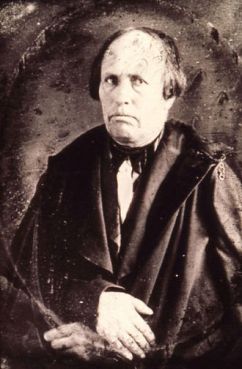
Padre Antonio Jose Martinez circa 1848
The press and its printer, Jesús María Baca of Durango, Mexico, had arrived in Santa Fe in 1832, brought there by Don Antonio Barreriro, a barrister and governmental deputy from Mexico City, apparently at the behest of nuevomexico Legislature’s Secretary, Don Ramón Abreu.
Barreriro used the new press to print a short-lived newspaper El Crepúsculo de la Libertad (The Dawn of Liberty), the first newspaper in New Mexico and possibly the first paper published west of the Mississippi. Abreu may have also used it to publish the first book printed in New Mexico, a spelling primer titled Cuaderno de Ortografía.
Following Barreriro’s return to Mexico, Ramón Abreu sold the printing equipment to Padre Martinez, the priest assigned to Taos’ Our Lady of Guadalupe chapel, who moved it to Taos. Once it and its printer were in place, Martinez put them to work, with output ranging from diligencia matrimonials (the standard forms for pre-nuptial investigations) to religious books. And hopefully Taos residents’ “literary contributions,” as well!
Sources: Fray Angelico Chavez, But Time and Chance, Sunstone Press, Santa Fe, NM 1981; Richard W. Etulain, New Mexican Lives: Profiles and Historical Stories, UNM Press, Albuquerque 2002; Rubén Saláz Márquez, New Mexico A Brief Multi-History, Cosmic House, Albuquerque, 1999.
On Wednesday, November 10, 1875 Manuel Cardenas was shot and killed by an unknown gunman in the short distance between the Colfax County jail and courtroom in Cimarron, New Mexico Territory. Cardenas had been on his way to tell the justice of the peace what he knew about the mid-September death of Methodist missionary Franklin J. Tolby. Because Cardenas died when he did, the mystery of who shot Reverend Tolby, and why, was never solved.
Tolby had been a bur under the Maxwell Land Grant Company’s saddle since he’d arrived in the Territory in early 1874. He pointed out that Congress had thrown the grant land was open to homesteaders and objected strenuously to the Company’s program against the settlers they called “squatters.” Because of Tolby’s status as a minister of the gospel, people listened to him and resisted the Land Gant Company’s enforcers.
When Tolby was killed in the Cimarron canyon in September, many thought Civil War veteran Cruz Vega was responsible. As a result, Vegas was tortured and killed, but before he died, Vega fingered Manuel Cardenas as the man who’d shot Tolby.
Cardenas, in turn, claimed that the now-dead Vega had killed the minister. More importantly, he asserted that three prominent members of the community—men who were believed to be part of the Santa Ring—had ordered the killing. Since members of the Ring had a controlling interest in the Maxwell Land Grant Company, Cardenas’ claim made a lot of sense to many Colfax county residents.
However, Cardenas had yet to make his accusations before the County Court. And he died before he could do so. Since his killer was never identified, questions about Tolby’s killing and its aftermath remain to this day: Who killed Manuel Cardenas and why? Was it a Cruz Vega adherent, revenging the aspersion on his good name? Was it Clay Allison or a member of the vigilante group that killed Cruz Vega, seeking vengeance for Reverend Tolby’s death? Or did the Santa Fe Ring send out a killer to take out their killer before he could officially name names? For that matter, who killed Reverend Tolby? Was it Cruz Vega or Manuel Cardenas? And did members of the Santa Fe Ring really put them up to it? If so, how far did the conspiracy go? The Governor’s office? Unless new evidence shows up now, 142 years later, we’ll never know for sure.
And so the saga of Reverend Tolby’s death ends with more questions raised than answered. This is the stuff that novels are made of!
Sources: Chuck Parsons, Clay Allison, portrait of a shootist, Pioneer Book Publishers, 1983; David L. Caffey, Chasing the Santa Fe Ring, UNM Press, 2014.
Cruz Vega didn’t go quietly to his death. He told the Cimarron, New Mexico Territory mob who lynched him that they were killing the wrong man. He hadn’t shot Methodist missionary Franklin J. Tolby in Cimarron Canyon on September 14, 1875. Manuel Cardenas had.
Vega’s accusation didn’t save him from death, but it did turn attention to Elizabethtown in the mountains west of Cimarron, where Cardenas lived. When word of Vega’s accusation reached the mining town on Saturday, November 6, 1875, Cardenas turned himself in rather than face a lynch mob of his own. Then he proceeded to tell Etown’s Justice of the Peace what some county residents had suspected from the beginning: Santa Fe Ring members were responsible for Tolby’s murder.
The Santa Fe Ring controlled the Maxwell Land Grant Company and they’d badly wanted to silence Reverend Tolby. Tolby inveighed regularly against the Company evictions of people they considered squatters as well as the Company’s other efforts to get maximum value from the land they’d purchased from Luz and Lucien Maxwell five years before. According to Tolby, the grant lands were open to homesteading and, if anything, at least part of it should be returned to the Ute and Apache bands who’d used it before the Anglo invasion.
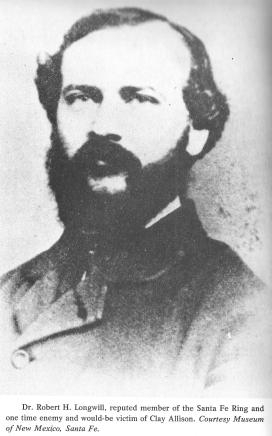
Manuel Cardenas told the Elizabethtown Justice of the Peace that three men associated with the Santa Fe Ring—mail contractor Florencio Donoghue, County probate judge Dr. Robert Longwill, and Attorney Melvin W. Mills—had offered him $500 to kill Tolby. However, according to Cardenas, he turned the job down and the trio hired the now-dead Cruz Vega to shoot Tolby instead.
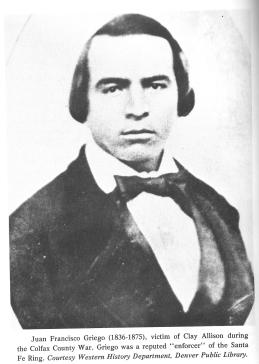
Cardenas’ charges resulted in a flurry of activity. Robert Longwill fled to Santa Fe pursued by a posse led by anti-Grant Company gunman Clay Allison. Since Allison had bested Santa Fe Ring enforcer Juan Francisco “Pancho” Griego in a shootout at Henri Lambert’s Cimarron saloon earlier that week, Longwill was wise to take him seriously.
Source: Clay Allison, Portrait of a Shootist, Chuck Parsons
Melvin Mills was made of sterner stuff. He’d been in Colorado when the charges were made and he returned to Cimarron, indignantly insisting on his innocence. Mills must have arrived back in town around the same time the cavalry detachment from Fort Union showed up on Monday, November 8. The horse soldiers had been dispatched to Cimarron to maintain civil order, sent out at the request of Territorial Governor Samuel Axtell, who just happened to also be a member of the Santa Fe Ring.
With Longwill safely in Santa Fe, Cardenas and Donaghue in jail, and Mills released for lack of evidence, it seemed reasonable to assume that things had quieted down and would remain so. A hearing date to address Cardenas’ evidence was set for Wednesday, Nov. 10. But there was going to be a least one more death before it was all over. Can you guess who? . . . . Stay tuned.
Sources: David L. Caffey, Chasing the Santa Fe Ring, UNM Press, 2014; Chuck Parsons, Clay Allison, portrait of a shootist, Pioneer Book Publishers, 1983
Monday, November 1, 1875 in Cimarron, New Mexico should have been a quiet day after an eventful weekend. Cruz Vega, the man thought to have murdered Methodist missionary Reverend Franklin J. Tolby in September, was dead and buried. Now the County could get back to ranching and mining. But Vega’s confession at his Saturday, October 30 lynching had not put the matter to rest.
Vega confessed merely to being involved in the plot to kill Reverend Tolby. He said Manuel Cardenas was the actual shooter. So there was still that to deal with.
Then there was the matter of how Vega had died. Following the telegraph-pole lynching that produced his accusation against Cardenas, Vega was shot and killed. When his battered body was found the next day, his friends and relatives were upset, to say the least. Their thoughts turned almost immediately to revenge. In fact, before the funeral was over, Civil War veteran Juan Francisco “Pancho” Griego vowed vengeance on the men who’d tortured and killed his friend.
There’s no concrete evidence that gunslinger R. Clay Allison was part of the Vega lynch mob, but the fact that Griego confronted him about it implies that Allison either participated in the lynching or was concerned for the welfare of those who had.
At any rate, Griego and Allison met late Monday, November 1 at Henri Lambert’s saloon in Cimarron (today’s St. James Hotel) and Griego didn’t make it out alive. According to Lambert, who’d been born in France, “Pancho try to pull the pistol. Mr. Allison smarter.” When Pancho fell, Lambert ordered everybody out and closed up shop. It was a smart thing to do. Allison and his friends spent the night “hoorahing” the town and probably would have caused more damage to Lambert’s place besides the blood-stained saloon floor if he hadn’t closed down when he did.
But Tolby’s killer still needed to be dealt with and there were still strong suspicions that the Santa Fe Ring was somehow behind it all. Certainly, the bloodshed hadn’t ended. There would be more in the coming days. Stay tuned . . . .
Source: Clay Allison, Portrait of a Shootist, Chuck Parsons
Sources: Las Vegas Gazette, November 14, 1875. Chuck Parsons, Clay Allison, Portrait of a Shootist, Pioneer Book Publishers, 1983.
On the night of Saturday, October 30, 1875 New Mexico Territory rancher William Low joined Mexican-born Cruz Vega beside a campfire about a mile and a half north of Cimarron. Low had hired Vega to watch his cornfields that Halloween weekend. But when a group of masked men led by Methodist missionary Oscar P. McMains showed up that night, Low wasn’t surprised. Reverend McMains had asked him to hire Vega to watch that particular cornfield. He wanted him within easy reach of the Poñil River stage road and the telegraph line that ran it.
McMains and his men had a sinister use for those telegraph poles. They suspected Vega of murdering McMain’s fellow missionary, the Reverend Franklin J. Tolby the month before, and they intended to extract a confession from him.
Las Vegas Gazette, Nov. 14, 1875
According to William Low, “One of them says, halloo boys, and he walked up toward Cruz with a lariat and put it around his neck, and says, come on, and they took him into the road and we along with him. We went up I judge about 500 yards among the timber, along the telegraph line: there was a party of men. It was pretty dark. These four or five men took him to a telegraph pole of their own accord: none of the parties said a word . . . One of the four or five men climbed the telegraph pole and put the rope over the wire and they raised him up, on their own accord, and after a few seconds let him down again.” After Vega recovered enough to talk, McMains interrogated him.
This process was repeated until McMains got all the information he was looking for. Then the Reverend returned to the Poñil River ranch where he and Low were staying the night and left Vega to the mercy of the now-drunken mob. McMains said later that he thought they were too drunk to do Vega any real damage. But shortly after McMains reached the ranch house, he and Low heard gunshots. “My God!” McMains exclaimed. “I fear these are the shots that kill Cruz Vega.”
And he was right. Vega’s body was found the next morning near the base of the telegraph pole. A clump of hair from his bashed-in head lay nearby and rope burns circled his neck.
Ironically, the information McMains gathered that night acquitted Vega of Tolby’s murder. Although Vega admitted that he’d witnessed the killing, he identified Manual Cardenas of Elizabethtown as the shooter. So the murderer was still at large. The saga of Reverend Tolby’s murder wasn’t quite over, and more deaths would ensue before it was. . . . Stay tuned.
Sources: Las Vegas Gazette, Nov. 14, 1875. Las Vegas Gazette, August 25, 1877.
In Fall 1875, when Rev. Oscar P. McMains took over for the murdered Rev. Franklin J. Tolby, he provided more than ministerial services. He also played detective, and went to work hunting for Tolby’s killer. Colfax County’s collective finger pointed at Cruz Vega, a Civil War veteran who’d run the mail right past the spot in Cimarron Canyon where Tolby had died September 14th. But Vega hadn’t reported seeing Tolby’s body, which many locals deemed mighty suspicious.
Rev. McMains wanted badly to talk with Vega, but he was having trouble locating him. When he did find him, he was going to have another problem: McMains didn’t speak Spanish, the Mexican-born Vega’s native (and apparently only) language.
Source: NM Conference United Methodist History Journal, Nov. 2011
McMains first attempted to locate Vega through Isaiah Rinehart, the rancher that Territorial Governor Samuel Axtell would appoint Colfax County Sheriff the following spring. While Rinehart believed that Vega knew something about Tolby’s death, he declined to get involved: a logical stance for someone who wanted to stay in good standing with the Santa Fe Ring-enmeshed Governor. After all, the Ring was suspected of ordering Reverend Tolby’s execution.
But Reverend McMains was not a man to bow to the mighty or those connected to them, and he didn’t give up. Sometime in the period between October 21 and October 26, he convinced local miner and rancher William Lowe to help him “find” Cruz Vega in Lowe’s Ponil Creek cornfields north of Cimarron. Lowe agreed to hire Vega to watch his fields over the Halloween weekend and McMains arranged to be there with a translator on Saturday, October 30. What happened that night was a story worthy of Halloween. Stay tuned. . .
Sources: David L. Caffey, Chasing the Santa Fe Ring, UNM Press, 2014; Las Vegas Gazette, August 25, 1877; Chuck Parsons, Clay Allison, Portrait of a Shootist, Pioneer Book Publishers, 1983. Will Steinsiek, “O.P. McMains, The Agitator” in New Mexico Conference United Methodist History Journal, Nov. 2011.
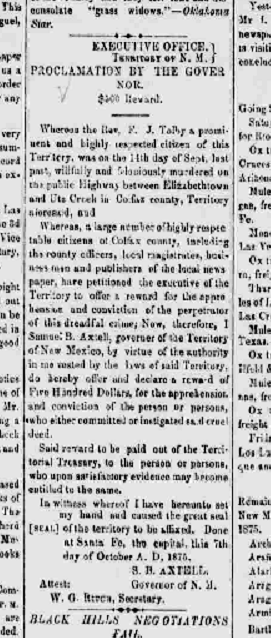
On Thursday, October 7, 1875, three weeks after Reverend Franklin J. Tolby’s body was found shot in the back in Cimarron Canyon, New Mexico’s Territorial Governor Samuel B. Axtell announced a $500 reward for the apprehension and conviction of Tolby’s murderer. The proclamation, published in the Friday, October 8 Las Vegas Gazette, seems to indicate that the Governor felt pressured to offer the reward. “A large number of highly reputable citizens of Colfax County, including the county officers, local magistrates, local business owners, and publishers of the local newspapers” had petitioned the governor to issue the proclamation.
The Governor’s apparent lack of enthusiasm lends supports to a local theory that members of the Santa Fe Ring were behind Tolby’s murder. The Governor was thought to be, at the very least, a tool of the Ring, which included Thomas B. Catron, Colfax County Probate Judge Dr. R. H. Longwill, and others, and would play a role in the Lincoln County War in the late 1870’s.
Whether the reward offer had anything to do with what happened in Colfax County in the following weeks isn’t known. What is known is that local attempts to identify Tolby’s murderer would lead to more deaths, one of them far more violent than a mere shot in the back. Stay tuned . . .
Sources: Las Vegas Gazette, October 8, 1875; David L. Caffey, Chasing the Santa Fe Ring¸ UNM Press, 2014.
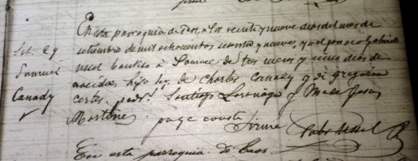
On this day in 1869, (Wednesday, September 29), three month old Samuel Kennedy was christened in Our Lady of Guadalupe Church in Don Fernando de Taos. He hadn’t been baptized sooner because he’d been born 25 miles east of town, at the foot of Taos Pass (today’s Palo Flechado Pass). It wasn’t a simple matter to get to Taos from what is now the Angel Fire area in those days.
Within a year, Samuel would be dead and his father about to die as a result. His father, Charles Kennedy (sometimes spelled Canady), had spent the last three years murdering and robbing men who visited the Palo Flechado cabin and Samuel’s teenage mother, Maria Gregoria, had kept silent. But in a fit of rage in late September 1870, Charles Kennedy killed his fifteen-month-old son and Samuel’s grieving mother finally took action. She fled twelve miles north to Elizabethtown to report her husband’s nefarious activities.
Justice was a little confused, but in the end it was served—at the hands of a lynch mob. Legend says Kennedy’s severed head ended up on a pike outside a local restaurant and saloon as a grisly reminder that even on the New Mexico Territory frontier, the death of a child would not go unrevenged.
For a fictional account of the Kennedy story, see my recently-published novel The Pain and The Sorrow (Sunstone Press).
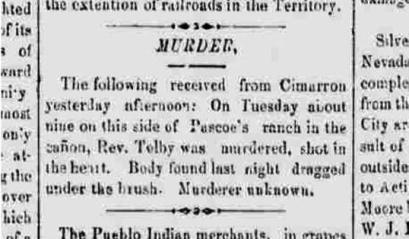
On Thursday, September 16, 1875, 142 years ago today, the body of Methodist missionary Franklin J. Tolby was found lying beside the Cimarron Canyon road near the mouth of Clear Creek, shot in the back. He’d been there two days, killed while returning from church services at Elizabethtown. His horse was tethered nearby and none of Tolby’s goods were missing. It was clearly a case of assassination and many people believed they knew why he was killed. But who did it and who’d ordered the killing? Those were the burning questions that some people believe were never answered.
Tolby had begun preaching vehemently against the Maxwell Land Grant & Railway Company almost as soon as he’d arrived in Colfax County in early 1874. The Company had bought the Beaubien-Miranda Grant from Lucien B. Maxwell and his wife four years before. The fact that the Grant boundaries were disputed wasn’t going to stop them from maximizing their profits from every bit of its roughly 1.9 million acres. They would use whatever means necessary to keep anyone they deemed a squatter off the Grant, even people the Maxwells had work/share agreements with prior to the sale.
Source: Las Vegas Gazette, Sept. 18, 1875
The 33 year old Reverend Tolby preached that the farmers and ranchers were more in the right than the Grant people. After all, the U.S. Department of the Interior had ordered the grant land to be treated as public, which made it available to homesteaders.
In addition, Tolby advocated that part of the grant be set aside a reservation for the bands of Utes and Arapahoes who traditionally hunted there. And he said so quite strongly.
Tolby became increasingly annoying to the Company, whose board of directors included Dr. Robert Longwill (Colfax County Probate Judge), Stephen B. Elkins (New Mexico Territorial delegate to Congress), and Thomas B. Catron (U.S. Attorney for New Mexico Territory), all members of the Santa Fe Ring and working hard to extract as much money as possible from the Territory in general and the former Maxwell Grant in particular.
Any of these men and their associates, including Cimarron Attorney Melvin W. Mills and its part-time Justice of the Peace (who was Mills’ office clerk) had reason to wish Tolby dead. After all, the Reverend was interfering with their business interests! But consensus among the anti-Grant folks in the County was that none of the Ring men were likely to dirty their hands with the actual deed itself. In fact, many suspected substitute mail carrier Cruz Vega of killing Tolby. After all, Vega’s Tuesday, September 14 mail route took him through the Cimarron Canyon, but he hadn’t reported seeing a body. This seemed mighty suspicious. Clearly, he knew something.
But Vega spoke only Spanish, which was a problem for the primarily English-speaking men who suspected him. They couldn’t find out what he knew. And they weren’t getting much help from the County’s Spanish-speaking population.
But there was another stubborn Methodist minister in Cimarron, and this one would prove to be even more tenacious than his predecessor. Rev. Tolby’s assistant Rev. Oscar P. McMains was now in charge, and he was hell bent on finding out what Vega knew. It would take six weeks before that confrontation occurred, and when it did it would create even more havoc. Stay tuned . . .
Sources: David L. Caffey, Chasing the Santa Fe Ring, UNM Press, 2014; Moreno Valley Writers Guild, Lure, Lore and Legends of the Moreno Valley, Columbine Books 1997; Chuck Parsons, Clay Allison, Portrait of a Shootist, Pioneer Book Publishers, 1983; Stephen Zimmer, For Good or Bad, People of the Cimarron Country, Stephen Zimmer, Sunstone Press, 1999.
On Sunday, August 25, 1867, the miners of New Mexico Territory’s Willow Creek Mining District organized themselves for the second time that year. They’d done a rush job in June. With miners pouring onto the slopes of Baldy Mountain, there hadn’t been time for organizing and mining too. But it didn’t look like things were going to settle down any time soon: There were up to 7,000 miners in the region, and activity everywhere. On Willow Creek alone, over 350 placer claims would be staked between 1867 and 1868, from high up Baldy Mountain almost to the edge of what is now Eagle Nest Lake. With the staking of claims came the potential for conflict. The only answer was to take the time to reorganize, and Sunday seemed as good a day as any.
The new Willow Creek rules allowed four claims per miner. A man could file a ravine claim (200 feet along the bottom and from bank to bank); a hill claim (200 feet along the stream by 300 feet toward the ridge), a flat claim ( 300 feet by 300 feet); and a quartz or lode claim (300 feet along the lode, with no specified width). In addition, a man who discovered a new creek, hill, flat, or load claim could also file one extra claim of any of the four types. To be considered “alive,” a claim had to be worked one day in every ten and at least once within the 15 days after it was recorded.
The Willow Creek Mining District lay on the south slopes of Baldy Mountain, much of it within the boundaries of the 20th century town of Eagle Nest, NM. The District was bounded on the east and north by the ridges that extended south from Baldy, and on the west by a divide that separated the creek’s drainage from Anniseta Gulch, which ran west in the direction of Moreno Creek and Elizabethtown.
While it never produced much lode gold, the Willow Creek District yielded well to placer operations. In fact, at one point, the main channel of Willow Creek was the highest producing creek bottom along the south and west slopes of Baldy Mountain, topping both Humbug Gulch and Grouse Gulch (see the table below). In addition, a Willow Creek side canyon called Last Chance Gulch and an area at the head of this gulch called Last Chance Flats, were both rich in gold. As a result, the District’s placers brought in 40% of the area’s placer gold in 1868 and 1869 and remained just behind Grouse Gulch’s placer production throughout the next decade.
The high levels of gold from Willow Creek may explain why there were at least twenty miners involved in an 1869 court fight over placer claims and water rights on the creek. The battle was not resolved until Spring 1870, when Lucien Maxwell intervened, purchased all the water rights in question, and then proceeded to lease them back to just a handful of individuals. Even though Maxwell was in the process of selling the land grant, he was keeping the Willow Creek Mining District water rights—perhaps its most lasting wealth—firmly in his own hands.
Sources: R. F. Pettit, Jr. “History of mining in Colfax County, New Mexico,” Taos-Raton-Spanish Peaks Country (New Mexico and Colorado), Northrop, S. A. & Read, C. B., eds., New Mexico Geological Society 17th Annual Fall Field Conference Guidebook, 128 p., 1966; R. F. Pettit, Jr., Mineral Resources in Colfax County, NM, NMBM&MR Open-File Report 15, 1946; Colfax County New Mexico real estate records.



 Fiction and Fact From Old New Mexico