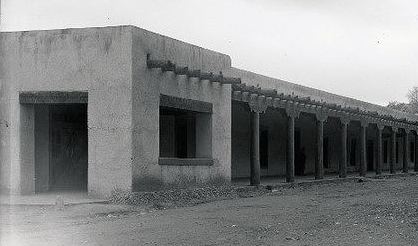
Contested Space: The Military Chapel of Santa Fe

Contested Space: The Military Chapel of Santa Fe

In a recent post about the Santa Fe plaza, I included a set of maps. If you look closely, you’ll notice that even the oldest of them identifies a small building on the south side of the square as the “military chapel.”

More properly called the Military Chapel of Our Lady of Light, and commonly referred to as La Castrense, this building was centered in the buildings on the south side of the Plaza and faced the Governor’s Palace on the north. The word Castrense means “belonging to the military profession,” so its nickname was appropriate, because the little church was built specifically for use by the members of the Santa Fe garrison. 

The original chapel was completed in 1717 and then rebuilt and rededicated in 1761. The reconstruction was funded by Governor Francisco Antonio Marin del Valle and his wife, Dona Maria Ignacia Martinez de Ugarte. This power couple also donated a new altar piece, or reredo, which was carved from large pieces of limestone quarried north of Santa Fe near Pojoaque. Said to be the largest and most ambitious piece of artistic work ever attempted in New Mexico to that point, the piece filled the entire altar end of the building. 
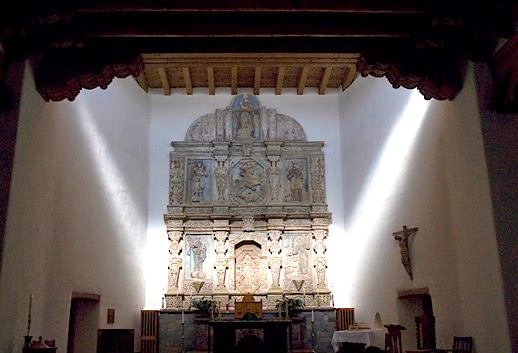
La Castrense altar piece today, courtesy El Cristo Rey Catholic Church, Santa Fe

The chapel received further decorations around 1813, when Pedro Bautista Pino, New Mexico’s representative to the Spanish Cadiz, returned from Europe with two marble bas-reliefs which were mounted on the outside wall above the door from the plaza. Colonel Francisco Perea remembered years later that one of them represented “Santa Gertrudes wrapped in the coils of a large serpent, while the other, I believe, represented the mother of Jesus, Nuestra Senora de la Luz (Our Lady of Light), recuing a human being from Satan.”

The military troops stationed in Santa Fe attended services in the chapel monthly as well as on special occasions. During Governor Manuel Armijo’s first two administrations, he and the full garrison attended regularly, with the officers in full uniform.  However, it seems unlikely that they continued to do so during his third term (July 1845 to August 1846) as the roof had fallen in. At least, that’s what Lt. James W. Abert reported in early October 1846. He also said the building contained “some handsome carved work behind the altar,” and that at least one of the bas-reliefs still remained over the door, the one that showed Our Lady of Light.  

Abert had entered Santa Fe in the Fall of 1846 with the occupying U.S. army. Five and a half years later, in Spring 1851, newly appointed Chief Justice Grafton Baker, needed a place to hold his court and decided to use La Castrense.

The building, apparently repaired by this time, was set up with the necessary furniture and the grand jury was called. Unfortunately for Judge Baker, the grand jury members included Santa Fe native and former Mexican soldier, Donaciano Vigil. Vigil and his wife had been married in the chapel, and his father and an infant son were buried there. As former provisional governor under the U.S. rule, he had enough political clout to risk protesting the use of the chapel for civil purposes and enough connections in the city to rally public opinion behind him.

Baker threatened to hold court anyway and to have Vigil arrested, but when a crowd began to assemble outside and the commanding officer of the American troops rallied behind Vigil, the Judge gave way. He ordered the court moved across the plaza to the Governor’s palace. The men responsible for shifting the furniture didn’t have to actually remove it from the building. The crowd had already dumped most of it in the plaza.

The building doesn’t seem to have been immediately converted back to being a chapel. According to the 1891 Silver City Enterprise, in the 1850s, it was instead used to store  captured cannons, including the Lone Star of Texas which had come into New Mexico in 1841 with the ill-fated Texas Santa Fe Expedition.

The guns must not have stayed there for long, because in 1859 Bishop Lamy exchanged the building for $2000 and  land in the vicinity of the Parish church. The money went to repairs for  church and the land became the site of St. Michael’s College and the Loreto Chapel.

La Castrense itself was demolished by its new owner, but not until the altar piece was preserved and carefully removed. It is now in El Cristo Rey, which offers a brochure about the reredos on its website. It’s nice to know that, even though the building itself had to give way to “progress,” at least some of its contents were preserved and still survive.

© Loretta Miles Tollefson July 2025

Sources: James W. Abert, Western America in 1846-47; https://www.cristoreyparish.org/; Roland F. Dickey, New Mexico Village Arts; Francois-Marie Patorni, The French in New Mexico; Colonel Francisco Perea in Allison, “Santa Fe in 1837-1838”, Old Santa Fe Magazine, Vol. II; Silver City Enterprise, Oct. 9, 1891; Marc Simmons, Spanish Government in New Mexico; Francis Stanley, Giant in Lilliput; Maurilio Vigil and Helene Boudreau, Donaciano Vigil.

Not As Simple As They Look

Not As Simple As They Look

If you’ve been fortunate enough to tour an adobe home here in New Mexico, you may have noticed the corner fireplaces which are a signature element in these houses.

Often built in a corner, the traditional fireplace, or fogón, had a low hearth, between six and eight inches high. The structure was usually roughly a quarter round with a narrow opening of about twenty inches. The firebox was relatively shallow. In fact, the wood was usually placed upright and leaned against the back of the space, instead of flat on the hearth.

Corner fireplace. Source: Bainbridge Bunting, Early Architecture in New Mexico

If one fireplace couldn’t warm the room sufficiently or wasn’t large enough to cook a meal for the entire family, there were several options. One was to build another cooking area in the opposite corner. Another was to build a larger bell-shaped one, up to four feet, four inches wide, that could accommodate more wood. A third alternative, especially useful when there was more than one cook, was to construct a double-arched bell-shaped structure.

Double arched fireplace. Source: Bainbridge Bunting, Of Earth and Timber Made

In every case, the arched opening was constructed using two large specially shaped adobe bricks. The chimney was usually a rectangular cuboid roughly 10 x 10 inches in diameter and made of thin adobe bricks set on edge with their ends fit into channels cut into the supporting walls

Not all adobe fireplaces were placed in the corner of a room. If a heat source was needed elsewhere, a “spur” of adobe would be extended out from the wall in the desired location and then a fireplace was constructed in the resulting corner.

As the Americans began to pour into New Mexico after 1846, they began remaking the traditional adobe houses to meet their Eastern expectations. This included encasing the adobe fireplaces with wooden chimney breasts and mantel shelves.

Source: Bainbridge Bunting, Early Architecture in New Mexico

Personally, I prefer the older style. All the little indentations in those fake pillars would have just collected dust. And probably soot. Give me the clean lines of traditional adobe anytime!

© Loretta Miles Tollefson

Sources: Bainbridge Bunting, Early Architecture in New Mexico and Of Earth and Timbers Made, New Mexico Architecture.

Damasio Salazar on the Assignment From Hell

Damasio Salazar on the Assignment From Hell

Mexican militia captain Damasio Salazar hadn’t been particularly pleased about his assignment to take the final batch of Santa Fe Texas Expedition prisoners south to El Paso del Norte. However, the past four days hadn’t been too bad. The prisoners had complained, of course, and he’d had a bit of trouble locating enough food for them, but the communities between San Miguel del Bado and Valencia had been surprisingly generous, especially the pueblos north of Albuquerque.


But now, on Monday, October 21, 1841, trouble had really started. First, he woke to a dead prisoner. Felix Ernest had been weak to begin with. And no wonder. He’d been with the Texans who had been out the longest and starved the most. The poor scurvy-ridden devils had ended up eating lizards, snakes, and boiled horse hide. Ernest hadn’t been actually ill, as far as Salazar knew. He was just too weak to wake up.


The Captain acted quickly to prevent other prisoners from dying on him by immediately requisitioning a cart from the Valencia alcalde and loading the weakest men onto it. But the dilapidated thing was so overwhelmed with riders that it fell apart a mile down the road.


This disaster precipitated another problem. A Texan who’d been riding, a man named McAllister, was so lame he couldn’t walk any further. When one of the more stupid of Salazar’s guards threatened to shoot him, the Texan yelled at him to do just that, and the idiot took him at his word.


Now Salazar had two dead prisoners to account for when he reached El Paso. He couldn’t very well carry the bodies with him. He’d had to resort to cutting off the men’s ears as proof they hadn’t run away.


He must have been thankful when he and his column finally reached the day’s destination, a grove of cottonwoods on the east bank of the Rio Grande south of Belen. The captain ordered one of the nineteen Texan cattle slaughtered. Maybe the meat would put some strength into the men and get them through what was to come. There were only a few more towns where he could acquire rations. Then, he and his prisoners would face the Jornada del Muerto.


By his calculations, they would be crossing right at the end of October. He needed to get 187 men, their guards, and the animals across a 90 mile stretch of wasteland notorious for a lack of water, especially this time of year. It was at least a three-day journey across a land of sand, rocky outcroppings, and an occasional stunted cactus. There was a reason it was called the journey at death.


The place lived up to its name. Three more men died crossing the Jornada. Salazar took their ears as well, and presented them to the Presidio commandant at El Paso del Norte. Although the Texan prisoners, particularly American newsman George Kendall, were appalled by what they saw as his savagery, the Captain was actually following orders —and precedent. The use of ears to account for dead enemies had been instituted by the man he presented them to in early November 1841.


Salazar did face a court-martial however, in response to questions Kendall raised about the Texan cattle left grazing outside El Paso. Once he’d been cleared of wrongdoing, the Captain returned to New Mexico. He would live out his days there, although he did have a brush with Anglo retribution in December 1846, when he was accused of participating in a conspiracy against American occupation.


There was no evidence that he’d been involved in those aborted plans and Salazar was allowed to go home in peace. Whether or not he was still haunted by the memories of the 1841 march south to El Paso is another question entirely.

How to Build a Fire

Since fire was a central element in my post of June 23rd, this seemed like a fitting video to accompany it.

Albino Pérez Arrives in New Mexico!

Albino Pérez Arrives in New Mexico!

Newly appointed Governor Albino Pérez arrived in New Mexico in May 1835 to general relief. The previous governor, Francisco Sarracino, was generally viewed as inept and Pérez was a breath of energetic fresh air. He brought funds for the Presidio troops and immediately set out on a tour that included visits to outlying communities as well as a successful action against the Navajo, who’d been picking off sheep and other prizes. When Pérez returned to Santa Fe, he gave an inaugural address in which he praised New Mexicans’ peaceful habits, love of order, and obedience to justice, among other virtues.

However, the longer Pérez was in office, the more complicated things became. The money he’d brought was spent and more was needed. Sarracino, now New Mexican Treasurer, was accused of embezzling funds. The Navajo were active again and another campaign was necessary. And Pérez’s idea of paying for it with forced loans from the region’s ricos was not met with universal acclaim.

The Governor’s Palace in Santa Fe. Courtesy: NM History Museum

Then New Mexico’s exemption from the national sales tax expired. The governing council asked Pérez to forward a petition for its renewal to Mexico City, but he didn’t do so right away. Instead, he started talking about how to collect the tax.

This didn’t go well with the populace. In fact, it may have been the spark that ignited  what is popularly known as the Chimayó revolt, the rebellion that resulted in Pérez’s death in early August 1837. The good feeling surrounding Pérez’s arrival had disappeared completely by the time he lost his life and his head on the road outside the village of Agua Fría south of Santa Fe.

Which is a good reminder that no matter how an official begins their term, it’s what they do afterwards—and how their time in the sun ends—that people are most likely to remember.

Sources: Lansing B. Bloom, “New Mexico Under Mexican Administration,” Old Santa Fe Magazine, Vol. 2. Santa Fe: Old Santa Fe Press, 1914-1915; Janet Lecompte, Rebellion in Río Arriba 1837, Albuquerque: University of New Mexico Press, 1985; Read, Benjamin M. Illustrated History of New Mexico, Santa Fe: New Mexican Printing Company, 1912; Joseph P. Sanchez, “It happened in Old Santa Fe, The Death of Governor Albino Pérez, 1835-1837,” All Trails Lead to Santa Fe, Santa Fe: Sunstone Press, 2010; F. Stanley, Giant in Lilliput, the Story of Donaciano Vigil, Pampa, TX: Pampa Press Shop, 1963.

A Furry Conflict in New Mexico

On Wednesday, May 16, 1827, a man named Ignacio Sandoval showed up in Santa Fe, New Mexico with important information for Governor Antonio Narbona. Sandoval had just returned from a trapping expedition led by an American named Ewing Young. Young, who didn’t have a permit to trap, had come back with thirteen packs of furs—probably mostly beaver—and hidden them south of Santa Fe at the Peña Blanca home of Luis María Cabeza de Baca.

Narbona, in one of his last official acts as governor, sent men to confiscate the furs. Cabeza de Baca, trying to protect them, died as a result.  Manuel Armijo, who took over as Governor on May 21, promptly issued an order for Ewing Young’s arrest in connection with the illegally obtained furs.

Young escaped incarceration for the time being, but the pelts remained confiscated. Well, most of them did. Some of them belonged to another American, Milton Sublette.

Beaver pelt

In July, Young and two other Americans obtained permission to clean the furs, which they worried had become damaged in storage. They and the local alcalde were busy shaking them out and taking inventory when Sublette appeared, grabbed a pack, threw it over his shoulder, and took off for the nearby home of Cristobal Torres.

The local authorities converged on the house, but it was too late. Sublette and his pelts had disappeared. Armijo blamed Young and called him into his office for explanations. When he threatened to incarcerate the American, Young walked out. Armijo had him arrested, threw him in jail, then released him when Young claimed a debilitating fever.  But Armijo didn’t release the furs. Legally, they were now government property. They would eventually be sold, though at a fraction of what their original value.

So once again, a conflict between the Mexican administration and the Americans in New Mexico ended in a standoff, with no one the clear winner. I find this a fascinating story because it highlights the conflicts and complexities of American-Mexican interactions twenty years before the 1847 revolt at Taos, which stunned the Americans with its ferocity.

They weren’t looking at the larger picture. The kind of high-handedness and disregard for local customs Young and Sublette displayed were common among the American trappers during the Mexican period.  The 1827 incident, among many others, appears to me to be directly linked to the events of early 1847, when the newly appointed American governor and former trapper and merchant Charles Bent was killed.

Retribution, no matter how long it takes, is still retribution.

Source: David J. Weber, The Taos Trappers, Norman: University of Oklahoma Press, 1971.

The French in New Mexico: A Talk

I was disappointed that I wasn’t able to catch Francois-Marie Patorni’s recent talk about his book The French in New Mexico at the Santa Fe Public Library. And then I discovered it had been recorded and put up online! I hope you enjoy this as much as I did.

Book Review: Following The Royal Road

I already had a book about the Camino Real de Tierra Adentro—the highway from New Mexico to Mexico City that came into being in the late 1500s. I had no business buying Following the Royal Road by Hal Jackson.

But I’m certainly glad I did.

The book I already owned is a good overview of the road’s history, but Following the Royal Road gets into the details that make a historical researcher salivate. It answered questions I ran into while gathering information for No Secret Too Small and also provided details I didn’t know I needed. For example, both battles of New Mexico’s 1837/38 revolt happened on the Camino Real. And El Alamo—where Governor Perez and his officials spent the night of August 8, 1837, is on the route, south of Santa Fe and just north of Los Golondrinos.

One of the things I really like about Following the Royal Road is the detailed maps it provides for each section of the Camino. Also, it traces the road all the way to Taos, a connection most books don’t make. In fact, it lays out the alternate routes people took to get to Taos, depending on the weather, material I used in No Secret Too Small.

But Following the Royal Road isn’t just a map with words. Jackson sprinkles a liberal amount of historical and cultural information throughout the book, so you’ll learn about everything from hornos to the founding of El Paso del Norte and the silver mines of Zacatecas.

And you can actually follow Following the Royal Road. It provides driving instructions from Taos to Mexico City. Whether you want to explore pieces of the Camino Real de Tierra Adentro from your armchair or on the road, I heartily recommend this book as your guide.

Another Rebellion in Santa Fe!

To the casual observer, New Mexico in early October 1837 may have looked like a peaceful place. The August 1837 rebellion had been quelled, four of its leaders were in jail in Santa Fe, and former Governor Manuel Armijo was firmly in control.

However, Armijo was convinced the insurgency would erupt again. Before he left the capitol for Albuquerque in mid-October, he gave Captain Jose Caballero explicit instructions about what to do if this happened—the imprisoned rebels were to be executed at once.

Early the morning of Wednesday, October 18, it appeared that Armijo’s orders would need to be carried out. Word reached the capitol that the rebels were rallying in the mountains east of Santa Cruz, where the August insurgency had been headquartered.  Armijo got the news in Albuquerque about the same time Caballero did in Santa Fe. The next day, he sent a letter north, ordering that the four hostages be executed.

But on Friday, the Captain staged a small rebellion of his own. When he received Armijo’s instructions, he didn’t follow them. Instead, he called a meeting of Presidio officers to consider how to respond. He had several concerns with Armijo’s directive. For one thing, the prisoners had still not been formally tried for their crimes. Also, there was a good chance that following Armijo’s orders would inflame revolutionary sentiment in Santa Fe instead of quelling it. And the garrison wasn’t at full strength. Successfully putting down a full-scale revolt would required reinforcements.  

Given all this, Caballero and his officers decided they would obey Armijo’s orders only if and when there was an imminent threat to the city and they had the forces necessary to repel it. The prisoners would be executed only if the rebels attacked.  On Sunday, Captain Caballero sent a formal letter south to Armijo, explaining what he was doing and why.  Although the missive was in his name, the other men signed it.

Some of the signatures on Captain Caballero’s letter. Source: New Mexico State archives

The governor was not happy when he received this news. Early the next week, he responded with a letter criticizing Caballero’s decision. But he didn’t overturn it. And he sent a troop of active Albuquerque militia north to help in case of attack.

It was all a moot point anyway. The rebel threat dissipated. The men in the Santa Fe jail would live several more months, though Governor Armijo’s orders were eventually implemented. When rebellion burst out again in early 1838, the four prisoners were publicly garroted.

There are still historians who wonder if this action was really necessary. The threat of the executions didn’t stop the rebels from rising or keep the subsequent battle from being any less bloody.  But Armijo did get the last word.

Sources: Lansing B. Bloom, “New Mexico Under Mexican Administration,” Old Santa Fe Magazine, Vol. II, Santa Fe: Old Santa Fe Press, 1914-1915; Paul Horgan, Great River: The Rio Grande in North American History, Middleton: Wesleyan University Press, 1984; Janet Lecompte, Rebellion in Rio Arriba, 1837, Albuquerque: UNM Press, 1985; F. Stanley, Giant in Lilliput, The Story of Donaciano Vigil, Pampa, TX: Pampa Print Shop, 1963.

Refugees in Santa Fe!

The fall of 1837 was a tense time for the people of Santa Fe. Not only was the capitol invaded by rebels in August, but there was another threat in late September. Then after former Governor Manuel Armijo fended that off, a different kind of incursion began. Refugees started arriving in town.

Most of the newcomers came from down river, following the militia, men who were ordinarily tasked with keeping the settlements there safe. With the militia now in Santa Fe, these villages were susceptible to raids from the First Nation groups New Mexicans called the “wild tribes”—primarily Apache in the south and Navajo in the west­.

While the Apache seem to have contented themselves with raiding Chihuahua-bound merchant caravans, the Navajo went after the settlements, venturing as close to Albuquerque as Bernalillo and as far northeast as the Taos Valley. New Mexico’s unrest was a great opportunity for the Navajo warriors to supplement their sheep herds and perhaps pick up a few captives to replace people taken by New Mexicans in earlier raids. In response to the danger, New Mexican families who could afford to do so headed to Santa Fe.

Almost 75 years later, one of those refugees, a boy who turned eight that winter, left behind a record of what the capitol was like during that time. Jose Francisco Perea’s family arrived in early October from Bernalillo. “We found the place full of soldiers, citizens, and a miscellaneous gathering of humanity,” he recalled. The plaza was “crowded with all kinds of vehicles, beginning with the cart that was made entirely of wood . . . to the well-constructed wagon that had brought a consignment of merchandise over the Santa Fe Trail; together with teamsters, camp-cooks, roustabouts, horses, mules, burros, pigs and goats. Some were about their camp-fires, preparing their food, while others were feeding and caring for their animals. Near the northeast corner of the plaza, which was then surrounded on its four sides with flat-roofed one-story buildings, with portals (porches) in front of them, were three cottonwood trees of the mountain variety, and opposite the Palace (the capital) stood a flagstaff (pirome), from the top of which was displayed the Mexican flag in all its glory: and the four entrances at the corners of the square were guarded, each with a single cannon of small caliber.”

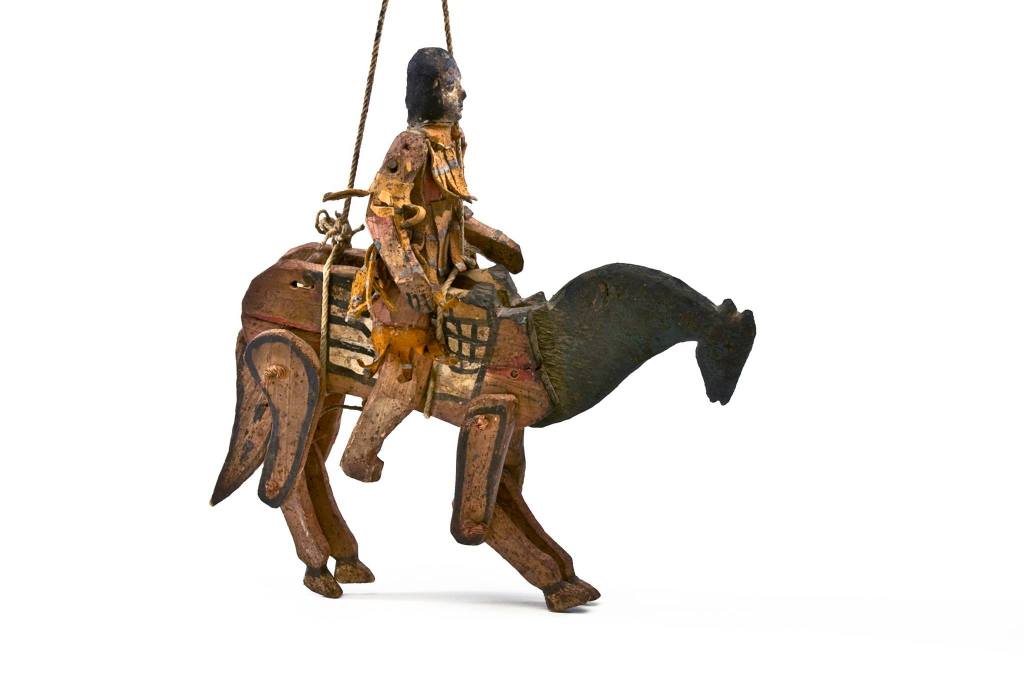
What seems to have fascinated him even more was the entertainment available. “Dancing was much indulged in,” he reported. “Particularly during Sunday nights and evenings following marriages, baptisms, and feast days. Theatricals, principally rudely constructed  after the writings of Cervantes (Don Quixote de la Mancha) and Gil Blas, were occasionally played. . . Some of these were played with figures and images hung on strings, to be moved about when required.”

A marionette from Old New Mexico. Source: New Mexico History Museum

He also apparently peaked into establishments “where wine and other liquors were sold by the drink” and gambling occurred. These games of chance included Spanish monte, three-card monte, roulette, and dice. For boys Francisco’s age, there were outside games such as pitarria, played on smooth ground inside a marked square with short sticks of two colors, and quoit pitching at pegs driven into the ground. When he tired of games, he could watch dancers from the nearby pueblos perform on the plaza.

It was all quite an education for the young Perea, one supplemented by three months of classroom experience. Some time in January 1838, he and his younger brother began attending a school run by a Captain Sena and his wife. This ended when the Perea family returned to Bernalillo in late April, but his Santa Fe adventures were only the beginning of Jose Francisco Perea’s experience of the world beyond his family’s hacienda. As an adult, he would return to Santa Fe to sit on the New Mexico Territorial Council. During the Civil War, he would fight for the Union as a Lieutenant Colonel and would later serve as New Mexico’s Congressional representative in Washington, D.C.

He would also leave behind an evocative glimpse of Santa Fe in the winter of 1837/38, one for which we storytellers are quite thankful.     

Sources: W.H.H. Allison as narrated by Col. Francisco Perea, “Santa Fe During the Winter of 1837/38.” Old Santa Fe Magazine, Vol. II, Santa Fe: Old Santa Fe Press, 1914-1915; James F. Brooks, Captives and Cousins: Slavery, Kinship and Community in the Southwest Borderlands, Chapel Hill: U of North Carolina Press, 2002; Janet Lecompte, Rebellion in Rio Arriba, 1837, Albuquerque: UNM Press, 1985; F. Stanley, Giant in Lilliput, The Story of Donaciano Vigil, Pampa, TX: Pampa Print Shop, 1963.