Lightning Strikes Missionaries in Cimarron Canyon

Exactly 146 years ago today, on Friday, August 4, 1871, three Methodist missionaries en route to Elizabethtown, New Mexico were struck by lightning and almost killed in Cimarron Canyon. Illinois natives Reverend N. S. Buckner and his 19 year old wife Annette had recently been appointed to take over Rev. Thomas Harwood’s responsibilities in Etown. They were travelling with Harwood, the man would go on to become the Methodist Bishop of New Mexico and co-found what is now the Harwood School in Albuquerque. The Buckners had just been assigned to assist him by taking over in Elizabethtown, where Harwood had dedicated a church building the year before.

The sun was beginning to set when Harwood and the Buckners reached the first section of Cimarron Canyon. Rev. Harwood’s buggy provided protection from the rain, so they weren’t uncomfortable. In fact, they were enjoying the thunderstorm and discussing the properties of electricity, when suddenly, thunder crashed, lightning flashed, and the smell of sulfur filled the air. The buggy itself had been struck and its passengers stunned to immobility. The force of the strike tore two large holes in the ground underneath the wheels, broke the crossbar behind the horses, and knocked the animals themselves off their feet.

Once the Buckners and Harwood were able to move again, they left the horses and walked back towards Cimarron “under the blazing lightnings and almost deafening thunder, muddy, wet and barefoot, . . . three miles to the nearest American house, and thence in wagon to Cimarron City” (Harwood, Vol. I, 129).
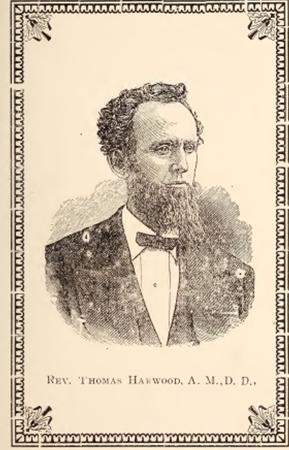
Aug 4 illustration.Thomas Harwood photo

Although they were all still feeling the effects of their lightning experience, the next morning, the little group of  missionaries were back in the canyon, this time on the Saturday stage to Elizabethtown, where the men preached at the morning and evening church services the next day.

It was an inauspicious beginning to the Buckner’s work in New Mexico Territory and things don’t seem to have improved much after that. Elizabethtown was a center of resistance to the Maxwell Land Grant Company’s plan to dispossess the area’s miners, ranchers, and farmers of their land. The town was rife with tension. The Buckners returned to Colorado in 1872. A year and a half later, in January  1874, they were replaced by Rev. Franklin J. Tolby, who lived in Cimarron but held services in Elizabethtown on a regular basis. Tolby himself would not last long. He was gunned down on September 14, 1875 on his way home from the Elizabethtown church, a date that many consider to be the beginning of the Colfax County War.

For fiction based on Reverend Tolby’s life and assassination, and historical information about his death, see my May 24, 2017 post and watch for them throughout September.


Source: Thomas Harwood, History of New Mexico Spanish and English Missions of the Methodist Episcopal Church, Vol. I and II, El Albogado Press, Albuquerque, 1910; Lawrence R. Murphy, Philmont, A History of New Mexico’s Cimarron Country, UNM Press, 1972, Albuquerque; ttps://www.timeanddate.com/calendar/?year=1871&country=1 accessed 7/17/2017
Black Jack Ketchum Plays His Last Hand

On July 16, 1899, bullets began raining down on Black Jack Ketchum’s Turkey Creek Canyon hideout west of Cimarron, New Mexico Territory, and the outlaw began the last hand in his life’s game of cards.

Two years earlier, Ketchum and his gang had barricaded a cave in the upper reaches of the canyon with logs and built a corral nearby for their horses, in case they needed a hideout, which seemed highly likely. Black Jack had been a brutal teenager with a penchant for malicious activities like burning Hispano sheepherders’ camps and he’d grown into an outlaw with a taste for theft, women, and gambling, hence the name “Black Jack.”  In fact, shortly after they’d constructed their Turkey Creek Canyon hideout in 1897, Black Jack and his buddies hit Cimarron’s gambling halls, with Black Jack losing heavily the night before they ventured out to hold up their first Colorado and Southern train near Folsum, New Mexico.

Two years later, Ketchum and his gang robbed another Colorado and Southern train near Folsum, then made a run for Turkey Creek Canyon. But a sheriff’s posse tracked them down and opened fire the morning of July 16. In the ensuing conflict, the sheriff and two posse members were killed, Black Jack’s brother Sam was fatally wounded, and gang member William McGinnis was injured.

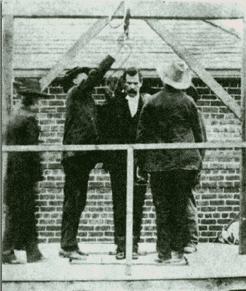
Black Jack escaped, but not for long.  He was arrested the following month in Union County, New Mexico. The trial and then the plans for the hanging took a while, but in April 1901, when his hand was truly up.

July 16.illustration.Ketchum hanging photo

However, Ketchum’s death didn’t come easily. Today, he’s remembered in New Mexico as the man who lost his head in a hanging. The Clayton, NM executioner didn’t calculate the rope weight and length correctly and Ketchum had been indulging during his prison stay, adding extra pounds. When the trap door opened, his body swung through but his head was cut off by the rope: A truly grisly way to die.

Sources: Stephen Zimmer, For Good or Bad, People of the Cimarron Country, Sunstone Press, 1999;  Stephen Zimmer and Steve Lewis, It Happened in Cimarron Country, Eagle Trail Press, 2013.


Baldy Town Celebrates the 4th of July

On July 4, 1871, up-and-coming lawyer Melvin Whitson Mills delivered the Independence Day oration at Baldy, the center of gold mining activity on the east side of Baldy Mountain north of Ute Park, New Mexico Territory. The celebrations included a parade of 500 people marching to a grove of trees outside town. There, the local newspaper editor read the United States Declaration of Independence and Mills, the young lawyer and would be politician who had so ably defended serial killer Charles Kennedy a year and a half before, delivered a “spread eagle” oration. A formal dance ended the day.

Although there were those who weren’t impressed that Mills had almost succeeded in rescuing Kennedy from the hangman’s noose, he was respected enough in the county to be elected as a delegate to the Republican National Convention in 1873 as well as various other municipal, county, and Territorial positions. Along with his legal practice and his connections to the Santa Fe Ring, these activities gave Mills the financial ability by the end of the decade to construct a handsome three-story mansard-roofed home in Springer which was known throughout the territory for its more than twenty rooms and its maple interior trim. He also owned a large ranch outside in eastern Colfax County, where he raised cattle and planted the fruit trees that can still be seen in what is now Mills Canyon.

July 4 illustration.Mills house

Sources: Bainbridge Bunting, Of Earth and Timbers Made: New Mexico Architecture, UNM Press, 1974; Loretta Miles Tollefson, The Pain and the Sorrow, Sunstone Press, 2017; Victor Westphall, Thomas Benton Catron and his era, U of Arizona Press, 1973.

Eagle Nest Lake Application Goes to NM Territorial Engineer

150 years ago today, on June 12, 1907, Colfax County rancher and businessman Charles Springer submitted an application to the New Mexico Territorial Engineer to build a dam at the head of the Cimarron River, thereby creating what would become known as Eagle Nest Lake.

June 12.illustration.b

The application called for impounding 113,700 acre feet of what it called “surplus flood waters”  from the Cimarron and its tributaries: Cieneguilla, Moreno, and other creeks in the Cimarron watershed.  The water would be “used for power plants as it goes down Cimarron canyon and for irrigation, for supplying cities and towns and water users generally, . . . for irrigating, mining power and other purposes.”

June 12.illustration

Charles Springer, who had arrived in the Territory in 1878, was brother to Frank Springer, one-time attorney for the Maxwell Land Grant Company. The Springer application to dam the headwaters of the Cimarron was approved in August 1907. Due to a variety of issues, including lack of capital and the need to buy the lands to be flooded from the people who owned them, construction of the impound dam did not get underway until Spring 1917.


Source: Anderson, History of New Mexico Its Resources and People, Pacific States Publishing, 1907; June and August 1907 application for NM State Engineer permit #71


Half-Grown Pup

The half-grown pup had followed Old Pete and the mule from the Ute Indian encampment down-canyon. It was a gangly thing, large for an Indian dog, with dirt-matted curly black hair. Pete looked at it in disgust as it half-crouched at his feet.

“Damned if the thing ain’t smilin’,” Pete muttered. He poked the dog’s side with his foot. “You a doe or a buck?” The animal rolled over obligingly, paws in the air. “Buck.” Pete toed it again. “Well, you won’t last long, I expect. Be runnin’ off to the first camp with a bitch in heat.” He turned and twitched the mule’s lead rope. “Giddup.”

They trailed the Cimarron River up-canyon through the afternoon and settled into camp under an overhanging sandstone boulder as the light began to fade. It was still early: the sunlight went sooner as the canyon walls narrowed. But Old Pete was in no particular hurry and the pup was acting a mite tired.

“Gonna hafta keep up,” Pete told it as he cut pieces of venison off the haunch he’d traded from the Utes. The dog slunk toward the fire and Pete tossed it a scrap. “Too small fer my roaster anyway,” he muttered as he skewered a larger chunk onto a sharpened willow stick and lifted it over the flames.

Copyright © 2016 Loretta Miles Tollefson

Wild Knowledge

He wasn’t a man to pay much attention to girl children, but this one was different. She didn’t seem interested in cooking or clothes. More likely, she’d be in the canyon, fishing the Cimarron River. Her brother was the dreamy one, the one watching the fish swim ’stead of trying to catch ’em.

So the man was surprised when she came around the curve of the path and stopped to watch him cook the wild carrot root. He’d cut off the flowers and was slicing the root into the pot on the fire.

“Good eatin’,” he told her. “Back home, they say these make your eyes strong.”

She frowned. “Not that,” she said, shaking her head.

He was hungry. He lifted the last piece to his mouth.

“No!” she said sharply.

He raised an eyebrow at her and lowered his hand.

“That isn’t carrot,” she said. “It’s poison hemlock.”

from Moreno Valley Sketches

Eagle Nest Dam Finally Begins Construction

11188151_948738271824312_43356579046834581_n
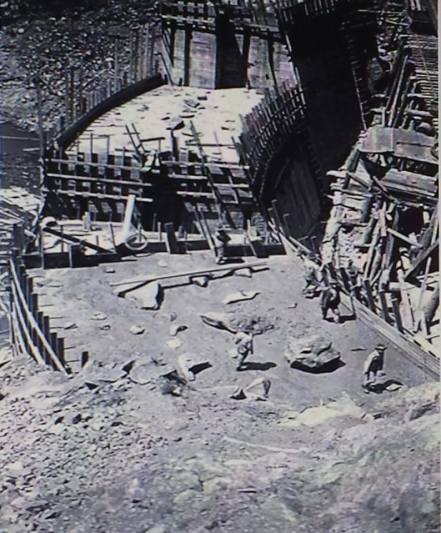
Eagle Nest dam early in the construction process. Source: NM State Engineer’s Office.

On the brink of what would become known as World War I, in March 1917, construction on the Eagle Nest dam and reservoir at the head of the Cimarron Canyon had finally gotten  underway. The project had been held up for nine years while the Cimarron Valley Land Company, under the leadership of Charles Springer, fought to acquire the land that would be flooded by the impounded waters. Long-time Moreno Valley property owner Mary Gallagher had fought valiantly against the project, but when she died in 1916, her eight children seem to have quickly capitulated to the company’s demands. The deeds for the condemned lands were handed over on January 17, 1917, and work commenced. Even with the shortages in material, equipment, supplies, and laborers as a result of the war in Europe, construction proceeded rapidly and the dam was 90 percent complete by mid-December that year.

gallagher-protest-letter-cropped
Mary Gallagher’s 1907 letter protesting the dam and reservoir. Source: Office of the NM State Engineer

Sources: Charles Springer affidavit dated Jan. 29, 1921; Gallagher protest letter dated January 31, 1908.


Lucky

As they watched, a wild turkey hen stepped onto the frozen riverbed. She walked carefully up the ice-covered stream, stopping occasionally to peck at a fallen leaf or twig.

Finally, she disappeared into the coyote willow at the river’s edge. Carla let out a long breath and sat back against the Model T’s battered seat. She put her bare hands to her neck to warm them, and looked at her mother. “We’re really lucky,” she said.

“Why do you say that?” Eileen poured thin tea from the thermos into their single mug. She held it for a moment, warming her hands, then handed it to Carla.

“We see wild turkeys on a frozen river in January.” Carla sipped the tea carefully. “Not many people have that.”

Eileen looked out the cracked windshield, up at the bare cottonwoods etched against clear turquoise sky. “Not many do,” she agreed. “Not many do.”

from Moreno Valley Sketches II