NOT JUST ANY MAN – CHAPTER 1

NOT JUST ANY MAN – CHAPTER 1

The following material is an extract from NOT JUST ANY MAN, A Novel of Old New Mexico, Copyright © 2018 Loretta Miles Tollefson. Published by Palo Flechado Press, Santa Fe, NM

A Note about Spanish Terms: This novel is set in northern New Mexico and reflects as much as possible the local dialect at that time. Even today, Northern New Mexico Spanish is a unique combination of late 1500s Spanish, indigenous words from the First Peoples of the region and of Mexico, and terms that filtered in with the French and American trappers and traders. I’ve tried to represent the resulting mixture as faithfully as possible. My primary source of information was Rubén Cobos’ excellent work, A Dictionary of New Mexico and Southern Colorado Spanish (University of New Mexico Press, 2003). Any errors in spelling, usage, or definition are solely my responsibility.

CHAPTER 1

When Gerald tops the low rise and sees the mule-drawn wagons strung out along a rutted track across the prairie, it takes him a moment to adjust. After five days walking westward, he is still absorbing the healing beauty of the wind bending the grass, the bulk of buffalo in the distance. The sweep of the land has been a balm to his eyes. So the eight mule-drawn wagons jolting along the rutted trail below are a bit of a shock.

A loose collection of mules and horses meander to one side. Gerald stops, considering. Approaching the train is the sensible thing to do. It’s pure luck that he hasn’t encountered any Indians so far. But he isn’t quite ready to give up the silent grassland, regardless of the risk to his light brown skin.

Then a long-haired man with a wind-reddened face canters a chestnut-colored horse out from the wagon train. A firearm is braced in the crook of his right arm. Gerald moves toward him, down the slope.

The man on the chestnut reins in at a safe distance, rifle still in a position to be easily lifted and fired. Gerald stops walking and lifts his hands away from his sides, palms out.

“Ya’ll stranded?” the man calls.

Gerald takes off his hat, runs his hand through his curly black hair, and shakes his head. “Headed west.”

The man turns his head and spits. “Lose yer ride?”

“I figure my feet are more dependable.”

The man snorts. “And slower.”

“They also give me a lower profile, out of Indian sight.”

The other man nods begrudgingly, then jerks his head toward the caravan. “Wagon master says come on in, he’ll trade ya for a mount ’n some food.”

“Where are you headed?” Gerald asks.

“Santa Fe, where else?”

“I’m hoping to reach Don Fernando de Taos.”

“Same thing, pretty much. North o’ Santa Fe a couple o’ days.” The man jerks his head toward the wagon train again. “Young’s got a mercantile there.”

“Young?”

“The train master. Ewing Young. He’s been merchanting, bringin’ in goods from Missouri, selling ’em, then goin’ back fer more.” The chestnut stirs restlessly. “Come on in an’ he’ll tell ya himself.”

If he refuses, they’ll suspect him of trouble and who knows where that will lead? Gerald nods and follows the horseman toward the wagons.

As he gets closer, a tall powerfully built man wearing fringed buckskins and a broad-brimmed felt hat walks out from the lead wagon. In his early thirties, the man’s air of command is enhanced by intelligent brown eyes under a high forehead, a hawkish nose, and a mouth that looks as if it rarely smiles.

“Well now, it’s not often we find someone walkin’ the trail,” he says in a Tennessee drawl. He looks steadily into Gerald’s face.

“A horse seemed like an unnecessary expense and more than likely to make me a target,” Gerald says.

“It’s a slow way to travel, though,” the other man observes.

Gerald glances toward the wagon trundling past at the pace of a slow-walking mule. The way it lurches over the rutted track says it’s heavy with goods. “If I had what you’re carrying, it would be,” he says.

The man sticks out his hand. “I’m Ewing Young, owner of this outfit.” He jerks a thumb toward the rider who’d met Gerald on the hill. “This here’s Charlie Westin, my scout.”

Gerald nods at the scout and reaches to shake Ewing Young’s hand. “I’m Gerald Locke Jr., hoping to one day own an outfit.” He grins, gray eyes crinkling in his square brown face. “Though not a wagon outfit.”

Young chuckles. “Well, out here just about anything’s possible.” The last of the wagons trundles past and he gestures at it. “Come along to camp and we’ll talk about how you can get started on that.”

Gerald falls into step with the older man, cursing himself for a fool. He doesn’t need to tell his intentions to everyone he meets. It comes from not speaking to another living being in the last five days, he thinks ruefully. Solitude makes a man too quick to speech. How often has his father repeated, “Words can be a burden”? He’d do well to heed that idea. Especially until he knows the character of the men he’s fallen in with.

So when the small train stops that night, Gerald says nothing of joining his father or of his desire for land. That he’s from Missouri and going west to try his fortune are all that Young needs to know.

It seems to be all he wants to know. The men with him are silent, clearly playing subordinate roles, and the wagon master does the talking, mostly about himself and the part his merchandise is playing in opening up the Santa Fe trade.

“It’s slow goin’ though,” he says. “Now, trappin’s a way to make yourself some real money. But it’s a risky business. You’ve got to throw in with the right men and steer clear of the Mexican officials as much as you can.” He grimaces and shakes his head. “The Mexican government’s as changeable as the weather when it comes to what’s allowed and what’s not.” He takes a sip from his tin cup of coffee. “The best way to do it, is to find a seasoned man to work with. Someone who can show you the ropes and knows whose hands to grease.”

Gerald raises an eyebrow. “New Mexico sounds like it’s not much different from Missouri.”

Young chuckles and looks into the fire. “Oh, it’s different all right. For one thing, the women are more forgiving. And the houses the people live in are like nothin’ you’ve ever seen. But government’s government no matter where you go, so the main thing is to steer clear of it as much as possible. That’s why I like Taos. It’s a good stretch from the official center of things. And it’s within strikin’ distance of good fur country. Trappers bring in the furs and I trade for ’em. Do a little trapping myself, for that matter.” He swings his head, eyes on Gerald’s face. “But Charlie says you’re headin’ there, not Santa Fe. Where’d you learn about Taos, anyhow?”

Gerald shrugs. “I don’t rightly know,” he lies. “Someone passing through, I suppose.”

And that’s all it takes. Young gives him a sharp look, then nods as if he approves. “We could use another man on the remuda,” he says.

Gerald feels something like hope stir in his chest. Could it be this easy?

But then he turns his head and catches the flat contemptuous gaze of a big man with long, matted dirty-blond hair, who’s leaning against a nearby wagon bed. He knows. In spite of Gerald’s light skin that could pass for a tanned white man, and the red highlights in his wavy black hair, he knows.

Rebellion stirs. Gerald’s eyes tighten and he looks deliberately at Ewing Young. “Remuda?” he asks.

Young gestures toward the herd of mules and horses grazing beside the wide, dusty track that breaks across the prairie. “What in New Mexico they call the extra mounts we’ve brought along as spares. I could do with another herder. Not much in wages, but bread and board and a mount.”

Gerald’s lips twitch as he remembers the Missouri farmer who refused his back wages and predicted he’d be back within a month. He looks into Ewing Young’s eyes. “I can do that,” he says.

As he unrolls his bedding that night, Gerald shakes his head. His father’s letter said a man isn’t judged by his color out here. Is it possible that it’s not even noticed? Then he tamps down the tingle of hope. Some men do notice and judge. The dirty-haired blond man with the narrow blue eyes certainly seems to suspect something. Can somehow tell that, along with the Irish and Cherokee blood in Gerald’s veins, there’s blackness in there, too.

Gerald scowls. Somehow, that piece of his heritage outweighs everything else. But not, apparently, for everyone, he reminds himself. And Young is the boss, not the man with the sneer. He’ll just have to wait and see. To work for a man who accepts him as just any other man would be a new experience in itself.

The work is simple enough: keep the loose horses and mules alongside the wagon train, spell a teamster when it’s needed, brush down whatever mount he’s ridden that day. The days are long and, when sundown comes, no one’s in much of a mood for talk.

There’s also guard duty. Each man takes a shift every three nights, watching to make sure the animals don’t stray, or that interested coyotes or wolves don’t get too close. No one speaks of the possibility of human interest in the resting animals, but there’s always that danger, as well.

But it’s another week before there’s any sign of other humans on the prairie. Young’s merchandise train bumps steadily along the dusty Santa Fe Trail, the grass beside it growing ever more golden-brown as the autumn heat bakes the ground, the loose herd wandering a little farther off trail each day as they search for tender shoots in the occasional water seep. Gerald follows their wanderings on his plodding horse, both of them half-asleep in the warm fall sun.

Enoch Jones, the man who’d scowled when Gerald and Young were negotiating Gerald’s pay, is also with the remuda, but he’s made a point of steering clear of Gerald, so Gerald’s lost his edge of concern about the big man. He’s stretching himself sleepily, trying to stay awake, when there’s a sudden hail from the head wagon.

Gerald looks up to see Ewing Young half-standing on the wagon seat. He’s leaning out from the wagon and rotating his arms over his head, signaling the herders to move the remuda closer to the train. Charlie’s on his horse beside the wagon, his head turned to focus on a low ridge to the south.

As the spare animals move closer to the train, Young swings onto a horse and rides out to meet the herders, the scout behind him.

“Charlie tells me we’re goin’ to have company shortly,” Young says. “We’ll make a halt up on that rise ahead.” He gestures toward the loose animals. “When we do, I want all these hobbled or staked close by so they can’t be run off.”

“Comanche?” someone asks.

Young shakes his head. “Pawnee. They should be friendly. They don’t look painted up and he didn’t see any war shields.” He turns to gaze at the ridge to the south. A line of men on ponies is strung out along its top, facing the train. They could be trees, they’re so still. Young turns back to his men. “Go cautious, though. No gun waving. No heroics.”

Enoch Jones growls “Coward,” and there’s a low mutter from the men at the back of the group.

His mount moves restlessly, but Young just turns to his scout. “Charlie, why don’t you go see what they want. Raise both hands comin’ back if they’re lookin’ to trade.”

The scout’s face tightens, but he nods and turns the chestnut’s head. They all watch silently as he trots toward the waiting Indians. When he reaches sign-language distance, half a dozen yards below the ridge, there’s a long tense moment. Charlie moves his hands, then one of the Pawnee moves his. Finally, Charlie turns and begins to trot back, both hands up and waving.

The tension goes out of the group. The herders scatter to gather the remuda and follow the wagons up the trail. When the train stops, the teamsters leave their mules in their traces but the herders vault from their mounts to hobble or stake out the spares. When Gerald’s finished his work, he heads for the train, where the teamsters are pulling boxes of goods from the wagon beds.

Young moves along the little train, confirming what should be displayed and what left covered. “No liquor,” he says as he passes the third wagon. “Move those jugs farther back and cover up that barrel. We don’t need them to know we’ve got all that on board.”

“Too good for ’em anyway,” a teamster chuckles. “Let ’em go t’ Taos for some lightning.”

Young grins. “Make sure it’s well covered,” he says.

Gerald watches in fascination as the Pawnee canter toward the train. Their ponies are full of energy and seem to respond to the slightest touch. The men have no hair on their faces at all, whiskers or eyebrows. Gerald tries not to stare. The sides of their heads are also shaved, leaving a mop of hair and feathers on top. This has been stiffened with something that glints red in the sun, and arranged so it curves up and out over the men’s foreheads like the prow of a ship. Ridges of hair run from this puff toward the back of the warriors’ heads, then hang down their backs in a kind of braided tail. Silver and brass earrings dangle from the Pawnees’ ears.

The Indians vault off their horses and stalk alongside the wagons, looking imperiously at the goods Young’s men have pulled from the boxes. The cloth shirts the warriors are wearing with their buckskin leggings say the Pawnee have traded before. The shirts are weighted down with necklaces of shells and beads.

But it won’t do to stare. After all, Gerald’s seen Indians before, in the Missouri settlements. They aren’t a brand new phenomenon. But they seem different out here, somehow. More at home.

Certainly more confident. A tall young man strides up to Gerald and reaches toward the tooled leather scabbard at Gerald’s waist and the carved wooden handle of the knife protruding from it. Gerald starts to flinch away, then catches himself and forces himself still. He raises his eyebrows and stares inquiringly into the man’s face. The Pawnee points his index fingers into the air, then begins crossing his hands and swinging them up and back, in a kind of arch.

“He’s wantin’ to trade for yer knife,” Charlie says from behind him.

As Gerald turns toward Charlie, the Indian reaches out and pulls Gerald’s knife from its sheath. Gerald’s hand clamps instinctively on the man’s wrist. “Leave it alone!” he snaps.

“Easy now,” Charlie cautions. “Ya hafta agree it’s a right purty thing.”

Gerald turns to the Pawnee and holds out his hand. The man lays the knife in Gerald’s palm. The ten inch double-edged steel blade gleams in the prairie sun. The knife guard is well balanced and solid, the finely carved maple handle cool to the touch. Gerald’s fingers curve around it protectively.

“My father made this for me,” Gerald says. He looks at Charlie. “I won’t trade it.”

Charlie nods and turns to the Pawnee. His hands gesture rapidly and the man looks again at the knife, then into Gerald’s face. He nods, looks at Charlie, moves his own hands in a few fluid gestures, then turns and is gone.

“This talking with the hands is hard to get used to,” Gerald says. “What did you say?”

“That it was made by yer father fer you only, an’ its medicine would be bad fer anyone who takes it away from ya.”

Gerald grins. “He swallowed that?”

“He said it’s good for a man to own such a thing from his ancestors and yer a wise man to protect it.”

“Thanks Charlie. I appreciate it.” Gerald looks down at the knife again, then slips it back into its sheath. He grins. “Guess I’d better try to learn some sign language.”

It’s another eight days before they see more Indians. They’re Kiowa this time, and they also want to trade. Ewing Young agrees and again orders his men to cover the liquor in the third wagon and place a guard on it. “That bourbon isn’t intended for the likes of them,” he says, turning away. He looks at Charlie. “In fact, let’s put all the trade goods up front by the lead wagon.”

But the Kiowa don’t seem at all interested in the third wagon. The older men cluster around the trade goods while the younger men wander freely along the rest of the wagons, stopping now and then to chat in sign language with a teamster or herder, or standing to gaze at the hobbled horses and mules nearby.

Gerald hasn’t been assigned guard duty, but he happens to be passing the fourth wagon when the shoving starts. Enoch Jones staggers to one side and his spine scrapes against the wagon wheel. He comes up in a crouch, long bone-handled knife at the ready. Steel flashes in the hand of the long-haired teenage Kiowa who pushed him, and the men standing guard on the liquor wagon, Charlie included, form a silent circle around the combatants.

Gerald glances toward the third wagon. A younger Indian, no more than a boy, is climbing over the tailgate, his yellow-painted leather moccasins braced on the rim of the big wheels as he leans to push the wagon’s canvas cover to one side.

“Hah!” Gerald shouts. Startled, the youngster looks toward him. Gerald laughs. “Good try!” He waves his hands as he walks toward the wagon, shooing the boy away. The boy looks toward the combatants, shrugs, pushes his long black hair away from his face, and hops down. The wagon guards turn to look. They grin sheepishly, then move back into position.

The teenager who’d pushed Jones glances toward them, then tosses his knife into the dirt and lifts his empty palms toward Jones. He grins mischievously, his silver earrings flashing in the sunlight. Jones scowls in confusion.

“We’ve been had,” one of the guards tells him. “Bloody devils were tryin’ to distract us to get at the liquor.”

“Bastards!” Jones growls. He lunges toward the Kiowa boy, but the Indian dances backwards, swoops down to retrieve his knife, then flashes Jones another smile and turns on his heel to trot toward the men clustered around the lead wagon.

“It’s just a couple of kids,” Gerald says.

Jones glares at him and opens his mouth, but then Charlie says, “They’ll be trying the mules an’ horses next,” and Jones sticks his knife back into his belt and heads off toward the remuda.

That night, Ewing Young settles beside Gerald as they drink the last round of coffee by the fire. “Good work there today,” Young says. “Kept a battle from starting.”

“Would it have gone that far?” Gerald asks in surprise.

“You never can tell. How’d you know what they were up to?”

“I guess I’ve learned to watch out for the unexpected.”

Young grins. “Even Charlie got caught by that one. And here I thought you were a green hand.”

“When it comes to the wilderness, I am,” Gerald says. “But when it comes to people, I’ve got more experience than I would prefer.”

Young studies him, a question in his eyes, but Gerald turns his face to the fire. Once again, he’s said more than he should have. But it doesn’t seem to matter to Young, who nods thoughtfully, then rises to name the men who’ll take the first watch.

Copyright © 2018 Loretta Miles Tollefson

Southwest Proverbial Rolling Stones

Southwest Proverbial Rolling Stones

I’m fascinated by Southwestern proverbs, also known as refranes or dichos. In fact, I’m so fascinated that my monthly newsletter always includes one, with a translation.

My primary source for that content is Refranes: Southwest Spanish Proverbs, collected and translated by Rubén Cobos. As I was perusing Refranes for this month’s inspiration, I noticed that Cobos included five proverbs for the concept that’s generally expressed in English as “a rolling stone gathers no moss.”

That English expression dates back to sixteenth century translations of Roman author Publius Syrus. It’s generally interpreted as advice to stay in one place. If you don’t, you’re never going to accumulate “green,” meaning dollars.

Here are the proverbs that Rubén Cobos collected, along with the translations he provided:

Piedra movediza el musgo no la cobija: A moving rock allows no moss. (#1368)
Piedra movediza no cría enlame: A moving rock allows no slime. (#1369) Piedra movediza no cría mojo: A rolling rock allows no rust. (#1370)
Piedra movediza nunca mojo la cobija: A moving stone never gets rusty. (#1371)
Piedra que rueda no cría mojo: A rock that rolls doesn’t get rusty. (#1372)

I was puzzled by the fact that only one of these refranes (#1368) actually includes the word “musgo,” or “moss.” The rest of them talk about slime (elame) and rust (mojo).

When I went to the dictionary to confirm Cobos’ translations, I became even more puzzled. The most up-to-date one, The American Heritage Spanish Dictionary), says “mojo” means “gravy” or “juice,” and doesn’t even include an entry for “enlame.” My older (1960) copy of Cassell’s Spanish-English Dictionary doesn’t include a definition for either word, although it does have an entry for “enlamar,” which it defines as “to cover with slime.” This word is also in an even older source (Velasquez’s Pronouncing Dictionary, originally published in 1852), which says it is “applied to inundations.”

Interestingly, Velasquez also says “mojo” is from “remojo,” which means the act of steeping or soaking. So, my older resources do indicate both words have to do with liquid, some of it not very tasty. I suppose you could make the link between these definitions and moss. After all, moss grows in wet conditions. But it seemed odd. Those wet conditions are unpleasant. And could produce other things besides moss. Illness, for example.

At this point, I remembered that I owned another book by Mr. Cobos, his Dictionary of New Mexico and Southern Colorado Spanish. When I pulled it out, I discovered that, in early to mid-nineteenth century New Mexico, “mojo” meant “rust, mold, or mildew.” Perhaps reflecting what happens when things are left steeping in liquid too long? “Enlame” meant “scum, slime; a kind of moss.” So there was the link between scum and moss. Not a very salubrious one, but still a link.

As a result of all this research, I began to wonder if Publius Syrus actually meant that a rolling stone should keep on rolling and not stick around to be loaded down with moss. Or rust, mold, or mildew.

Which reminded me that I originally thought the rolling stone proverb meant “stay home, don’t go adventuring, etc.” And led me to ponder whether a closer look at old proverbs can give us more than interesting images and turns of phrase. Perhaps they can also help us examine what we think we’ve been taught.

This particular set of refranes certainly implies that being a metaphorical rolling stone may be a good thing, at least in terms of our world view. Perhaps keeping ourselves open to new perspectives, not letting ourselves stew in what we think we know, can reduce the possibility of metaphorical moss, rust, mold, slime, or mildew sticking to us.

Even if we consider ourselves a cut above the rocks around us, we still might want to think about examining what we think we know. Because, as refrane #750 (“fierro movedizo no cría mojo”) points out, a moving piece of iron doesn’t get rusty, either.

The Call of the Cranes

The Call of the Cranes

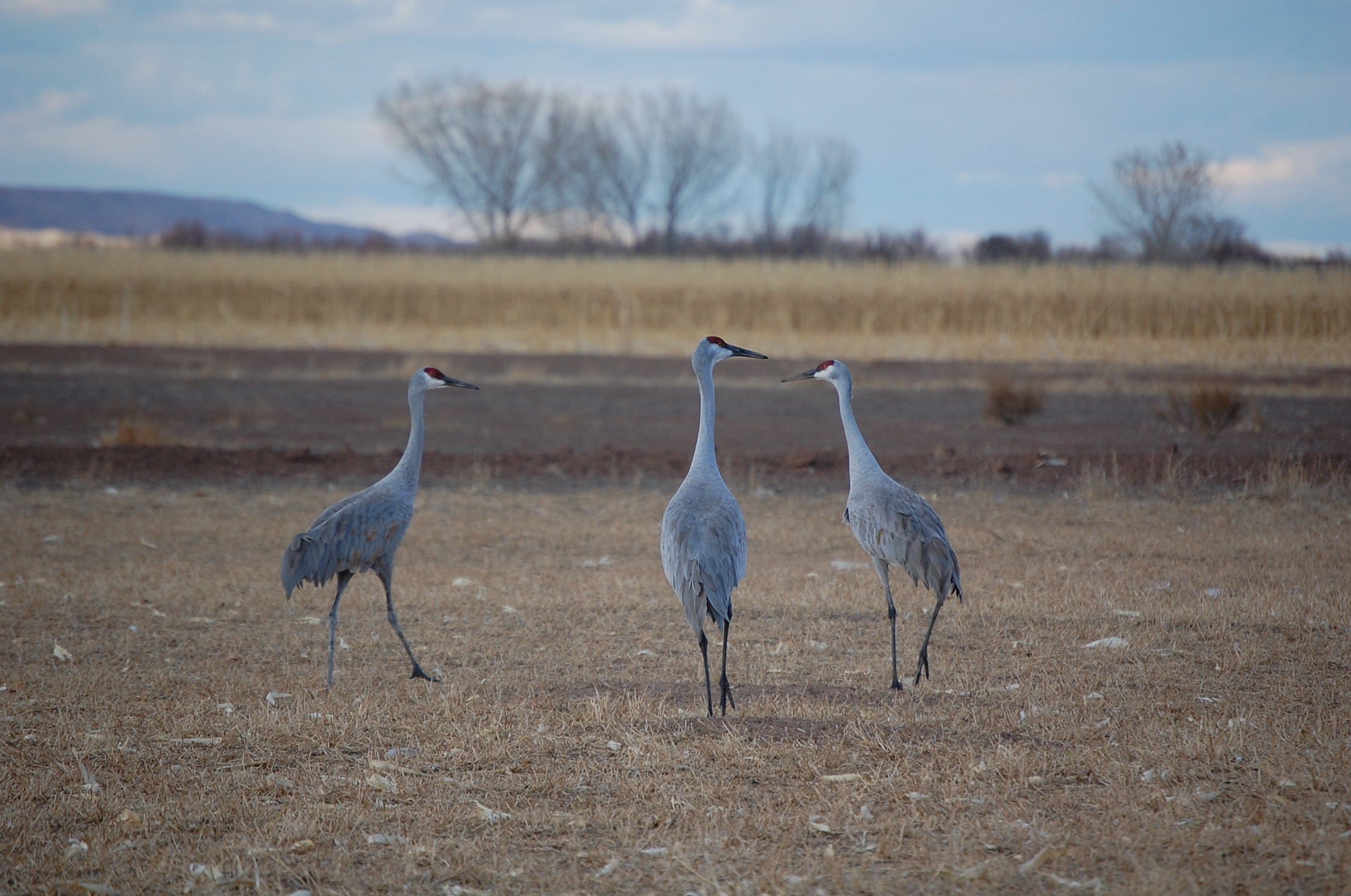
I haven’t seen any sandhill cranes in the Santa Fe area yet this year, but recently I ran across a section of Lt. James W Abert’s 1846-47 New Mexico travel diary which definitely evoked them:

Tuesday, October 13: [outside Bernalillo] “… we are now surrounded by cranes that keep up a great whooping all night. Their cry bears some resemblance to that of the red[headed] woodpecker.” The following day, the roadside ponds near Alameda “were covered with cranes, geese, and ducks. All these birds are quite tame and suffered us to approach very close (Abert, 44).”

Not close enough to be killed, though. In fact, whenever Abert or one of his companions appeared with a gun, the birds slipped out of range.

If you’ve had a chance to read The Texian Prisoners, you’ll notice that the men under Damasio Salazar also encounter sandhill cranes, first at Pecos Pueblo and then later along the Rio Grande. The birds, grazing in the stubble of harvested corn and wheat, stay well out of reach. When a horseman canters across the fields, they and the snow geese with them rise in great waves, their cries filling the air.

I have responded viscerally to the call of the cranes since I first heard it here in New Mexico. Abert’s observation that the sound resembled that of the redheaded woodpecker prompted more research. While the woodpecker’s actual call doesn’t seem to have much similarity to the sandhill’s, the sound of its drumming actually does.

Listen for yourself: Here’s the woodpecker drumming (at :31) and here’s the sandhill crane (choose the Garrett McDonald one). Isn’t the similarity amazing?

There’s an important difference to my ear though. The woodpecker is boring a hole in something. The cranes are talking, calling across the sky as they fly overhead through the long shadows of a New Mexico sunset.

How the Texian prisoners must have envied their freedom.

Note: the attached crane images were taken by me at two of my favorite birding places in New Mexico, the Bernardo Waterfowl Area of the Ladd S. Gordon complex south of Belen and the Bosque del Apache National Wildlife Refuge.

New Year, New Book!

New Year, New Book!

I’m pleased to announce that my novel The Texian Prisoners will be published in March next year and that the ebook is now available for pre-order!

In Fall 1841, a band of roughly 300 Texans straggled out of the Staked Plains into New Mexico. They had intended to claim everything east of the Rio Grande for Texas. Instead, they were captured and sent south to El Paso del Norte, then on to Mexico City. The largest group of prisoners, which included journalist George Wilkins Kendall, was escorted to El Paso by Captain Damasio Salazar. Five prisoners died on that trek. Kendall would later write a book describing the experience, a book which accused Salazar of food deprivation, mutilation, and murder, and fed the glowing coals that would become the Mexican-American War.

But what really happened on the way to El Paso? The Texian Prisoners tells the story through the eyes of Kendall’s friend George Van Ness, a lawyer burdened with the ability to see his enemy’s point of view, and asks us to consider the possibility that Kendall’s report was not unbiased.

A historically accurate retelling of Larry McMurtry’s Dead Man’s Walk, this fictional memoir will make you question everything you thought you knew about Texas, New Mexico, and the boundary between them.

Available for pre-order from Amazon.com and other ebook retailers.

BOOK REVIEW: Letters and Notes on the Texan Santa Fe Expedition, 1841-1842

In June this year, I posted something very rare for me: a less-than-positive book review. The review was of a book that serves as a primary source for most historical research about the ill-fated 1841 Texan Santa Fe Expedition. I had a number of issues with that text. However, during my own work on the Expedition, I was pleased to discover primary source that I can recommend wholeheartedly: Letters and Notes on the Texan Santa Fe Expedition, 1841-1842 by Thomas Falconer.


Falconer was one of the few British members of the Expedition. A trained barrister with a strong interest in the natural sciences, he traveled to Texas to explore emigrating there and was almost immediately invited by President Lamar to accompany the Expedition as a scientific observer.
Kendall describes Falconer as a “gentleman of high literary and scientific attainments [with] mild and agreeable manners,” who was “extremely sociable and companionable” (Kendall, I, 26-27), rather careless of his appearance, but well equipped with “a number of books and scientific instruments” (Kendall, I, 43).


Falconer’s books, instruments, and notes were, unfortunately, confiscated when the Texans finally reached New Mexico. However, his memory and interest in his surroundings stood him in good stead. After he was released from prison in Mexico City, he went to New Orleans, where he developed a report for Kendall’s newspaper, the New Orleans Picayune. This and his “Notes of a Journey Through Texas and New Mexico,” published in the British Journal of the Royal Geographical Society in 1844, form the core of Letters and Notes.


This book is valuable for several reasons. First, it provides an antidote to Kendall’s more excitable, and not altogether trustworthy, version of events in New Mexico in 1841; second, it gives us valuable information about the geography and plants of the region during the early 1840s; and third, it provides an outsider’s view of the Texans and their foibles, as well as insight into the sort of information about the North American continent that the English found useful.


Falconer’s other books, one about the Oregon question, and another about the discovery of the Mississippi, are also fascinating reads, but if you’re interested in the history of New Mexico, particularly the 1841 Texan Santa Fe Expedition, I highly recommend his Letters and Notes.

Sources: Thomas Falconer, Letters and Notes on the Texan Santa Fe Expedition, 1841-1842, New York: Dauber and Pine, 1930; George Wilkins Kendall, A Narrative of the Texan Santa Fe Expedition, Vol. II, Harper and Brothers: New York, 1847.

Texan Prisoners Reach El Paso!

Texan Prisoners Reach El Paso!

When the last of the men from the Texas Santa Fe Expedition reached El Paso del Norte (today’s Juarez) in early November 1841, they must have felt as if they’d come out of hell into paradise.


They had traveled roughly 1000 miles from Austin, Texas to New Mexico, starving a good deal of the way, then about 500 more, as prisoners, from eastern New Mexico to the Rio Grande, then south, a route that included the desert-like Jornada del Muerto, or Journey of the Dead Man. They had endured unbearable heat on the plains and snow and icy winds on the Jornada. Now, though they were still prisoners, life had become much easier.


The very weather had changed. George Wilkins Kendall noticed it the night before they arrived, when, he says, “the evening air was of a most wooing temperature mild and bland” (Kendall, II, 23). As the Texans reached the outskirts of El Paso, they saw that the very plant life was different. The valley, irrigated by a canal from the Rio Grande, boasted abundant wheat, onions up to four pounds in weight, fruit trees, and extensive vineyards (Timmons, 195).


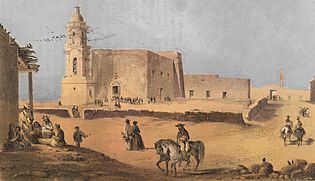
Even Kendall, who spent almost all his time in Mexico complaining, liked El Paso del Norte. Although his report doesn’t mention its famous building, the mission of Guadalupe de los Mansos, he does rhapsodize about the city’s “delightful situation in a quiet and secluded valley, its rippling artificial brooks, its shady streets, its teeming and luxurious vineyards, its dry, pure air and mild climate, and, above all, its kind and hospitable inhabitants” (Kendall, II, 42).

The Guadalupe Mission was painted in 1850 by A. de Vauducourt.
Source: es.wikipedia.org/wiki/Misión_de_Guadalupe_de_los_Mansos_en_el_Paso_del_río_del_Norte Accessed 10/17/23


Part of the reason Kendall was so impressed by the hospitality was that he was one of several Texans hosted by Presidio Commander José María Elías González. And hosted lavishly. Kendall reports the afternoon hot chocolate, the evening wine in glasses the size of New England tumblers, the tasty blood puddings, and other details of the table with great glee.
But the party couldn’t go on forever. The Texan prisoners were on the road again on Tuesday, November 9, heading to Chihuahua en route to Mexico City, where life would again become difficult. The idyll of El Paso was over, and prison and the whims of President Santa Anna, who the Texans had humiliated at San Jacinto, waited ahead.

Partial Sources: Ruben Cobos, A Dictionary of New Mexico & Southern Colorado Spanish, Santa Fe: Museum of New Mexico Press; George Wilkins Kendall, A Narrative of the Texan Santa Fe Expedition, Vol. II, Harper and Brothers: New York, 1847; W.H. Timmons, El Paso, A Borderlands History, El Paso: Texas Western Press, 2004.

Damasio Salazar on the Assignment From Hell

Damasio Salazar on the Assignment From Hell

Mexican militia captain Damasio Salazar hadn’t been particularly pleased about his assignment to take the final batch of Santa Fe Texas Expedition prisoners south to El Paso del Norte. However, the past four days hadn’t been too bad. The prisoners had complained, of course, and he’d had a bit of trouble locating enough food for them, but the communities between San Miguel del Bado and Valencia had been surprisingly generous, especially the pueblos north of Albuquerque.


But now, on Monday, October 21, 1841, trouble had really started. First, he woke to a dead prisoner. Felix Ernest had been weak to begin with. And no wonder. He’d been with the Texans who had been out the longest and starved the most. The poor scurvy-ridden devils had ended up eating lizards, snakes, and boiled horse hide. Ernest hadn’t been actually ill, as far as Salazar knew. He was just too weak to wake up.


The Captain acted quickly to prevent other prisoners from dying on him by immediately requisitioning a cart from the Valencia alcalde and loading the weakest men onto it. But the dilapidated thing was so overwhelmed with riders that it fell apart a mile down the road.


This disaster precipitated another problem. A Texan who’d been riding, a man named McAllister, was so lame he couldn’t walk any further. When one of the more stupid of Salazar’s guards threatened to shoot him, the Texan yelled at him to do just that, and the idiot took him at his word.


Now Salazar had two dead prisoners to account for when he reached El Paso. He couldn’t very well carry the bodies with him. He’d had to resort to cutting off the men’s ears as proof they hadn’t run away.


He must have been thankful when he and his column finally reached the day’s destination, a grove of cottonwoods on the east bank of the Rio Grande south of Belen. The captain ordered one of the nineteen Texan cattle slaughtered. Maybe the meat would put some strength into the men and get them through what was to come. There were only a few more towns where he could acquire rations. Then, he and his prisoners would face the Jornada del Muerto.


By his calculations, they would be crossing right at the end of October. He needed to get 187 men, their guards, and the animals across a 90 mile stretch of wasteland notorious for a lack of water, especially this time of year. It was at least a three-day journey across a land of sand, rocky outcroppings, and an occasional stunted cactus. There was a reason it was called the journey at death.


The place lived up to its name. Three more men died crossing the Jornada. Salazar took their ears as well, and presented them to the Presidio commandant at El Paso del Norte. Although the Texan prisoners, particularly American newsman George Kendall, were appalled by what they saw as his savagery, the Captain was actually following orders —and precedent. The use of ears to account for dead enemies had been instituted by the man he presented them to in early November 1841.


Salazar did face a court-martial however, in response to questions Kendall raised about the Texan cattle left grazing outside El Paso. Once he’d been cleared of wrongdoing, the Captain returned to New Mexico. He would live out his days there, although he did have a brush with Anglo retribution in December 1846, when he was accused of participating in a conspiracy against American occupation.


There was no evidence that he’d been involved in those aborted plans and Salazar was allowed to go home in peace. Whether or not he was still haunted by the memories of the 1841 march south to El Paso is another question entirely.

Book Review: When Cimarron Meant Wild

David Caffey’s recent book When Cimarron Meant Wild fills an important gap in the historiography of northeast New Mexico, specifically Colfax County, a.k.a. Cimarron Country. There are a number of books available about different aspects of the county and the personalities that made it legendary in its time, but up to this point, none of them have tied everything together, as Caffey’s does.

The County is inextricably linked to what became known as the Lucien B. Maxwell Land Grant. But When Cimarron Meant Wild begins long before the grant was established in the 1840s and reminds us that the land was home to indigenous populations well prior to either Spanish or American occupation.

Caffey also explains how these peoples—the Jicarilla Apache and Moache Ute—continued to play a role in the area well into the mid-19th century. Most of the material about Colfax County I’ve seen up to this point has very little to say about the original peoples, their rights to the land, and how they were gradually pushed off of it. I was impressed with the way When Cimarron Meant Wild addresses this issue.

The book also does an excellent job of describing Lucien Maxwell’s rather relaxed approach to exploiting the area’s resources, both agricultural and mineral. The difference between his strategy and that of the British corporation he and his wife sold out to in 1870 is an excellent study in contrasts. The Corporation was intent on wringing every penny out of their new possession, previous arrangements be damned. This shift in attitude created the environment that erupted into what became known as the Colfax County War, a conflict Caffey estimates resulted in 52 deaths over the next 11 years.

When Cimarron Meant Wild builds on Caffey’s previous work on New Mexico’s Santa Fe Ring and details the way the British corporation worked with Ring members, most notably Thomas B. Catron and Thomas Elkins, to eliminate the small-holders and miners who they felt were blocking the way to greater profits. The violence that resulted is documented here in detail but never sinks to a mere record of facts. Quite the opposite. The book’s organization and narrative flow is so masterful that it reads like a novel.

When Cimarron Meant Wild contains the best description I have yet read of the Colfax County War. Caffey not only provides an excellent retelling of both small and large events, he also gives us snapshots of the personalities involved without sentimentality or condemnation something I as a fiction writer find especially compelling.

This book is readable, historically accurate, and fills in important gaps for those of us who know a little about the area and want to learn more. If you aren’t familiar with northeast New Mexico’s or the Maxwell Land Grant’s fascinating history, When Cimarron Meant Wild is definitely the place to start learning about it. I highly recommend this book!

BOOK REVIEW: FATHER STANLEY

BOOK REVIEW: FATHER STANLEY

Instead of doing a typical book review this time, I’ve chosen to write about one of my favorite New Mexico authors, the man who wrote under the pseudonym Fr. Stanley. Born in New York in 1908, Stanley Louis Crocchiola was ordained at age 30 in the Franciscan Order of Atonement. He had contracted tuberculosis by this time, so his superiors sent him to Hereford, Texas where they assumed the arid climate would help him heal. Ironically, he arrived there in February 1939 during a black dust storm. He survived that, though, and in 1940 was transferred to Santa Fe, New Mexico. The dry climate does seem to have suited him. He lived to be 87.


He used that time to learn about the history of the various communities he served in New Mexico and, in 1948, began chronicling their history. The resulting books, published under the pseudonym Fr. Stanley, are a charming mixture of stories told by old-timers, newspaper clippings, and on-the-ground observations. Many of them are printed on folded-over 8.5 x 11 paper stapled in the cross-section, or saddle-stitched, a kind of historical chapbook.


Fr. Stanley’s books often have the same simple cover design–a bright yellow background containing a red zia symbol and typeface. At least for the New Mexico books, the titles are also often nearly identical. The four I own are The Stanley (New Mexico) Story, The Elizabethtown (New Mexico) Story, The San Miguel del Bado (New Mexico) Story, and The Miami (New Mexico) Story.


Father Stanley wrote and published over 170 books, the majority in this simple format, though some, like The Duke City: The Story of Albuquerque, New Mexico and The Civil War in New Mexico were published in hardback. They are all a great resource for discovering the details of New Mexican life in the late 19th and early 20th centuries–everything from the types of apples grown in Miami to the names of the men on the Elizabethtown baseball team.

This interest in the minutiae of life is the defining characteristic of Father Stanley’s books and makes them well worth reading because they give us an almost newspaper-like glimpse into a bygone world. The only trouble is, they’re no longer currently being published. If you want a copy of The Bethel (New Mexico) Story, The Texico (New Mexico) Story, The Causey (New Mexico) Story, The Grant That Maxwell Bought, The Magdalena (New Mexico) Story, The Abo (New Mexico) Story, The Golden (New Mexico) Story, or any of the others, you’re going to have to find a secondhand bookseller.


I encourage you to do so, even at the risk of driving up prices on the many Stanley books that I still don’t have in my collection. For sheer joy in New Mexico history, in all its details, I recommend Father Stanley’s work!

Fever and the Texas Expedition to Santa Fe

Fever and the Texas Expedition to Santa Fe

Subscribe to continue reading

Subscribe to get access to the rest of this post and other subscriber-only content.