NOT MY FATHER’S HOUSE – Chapter 3

CHAPTER 3

A month goes by before Suzanna sees another man who isn’t her husband. This one is tall and thin, clothed in black, and walking up the trail from Taos beside a well-rounded woman whose head is shrouded in a voluminous shawl. They each lead a donkey, a wooden bench perched precariously above bulging packsaddles. Half a dozen cattle splay out on the trail behind them, raising lazy spurts of dust when they aren’t straying into the grass and patches of purple flowers that lie beside the path. A thin young man walks behind the cows, waving a long switch at them when they wander too far off-track.

Suzanna stands in her corn patch below the cabin and gazes at the little caravan, puzzled. Then joy lights her face. It’s her father. And Encarnación. Ramón will be so glad! She makes a face at the raccoon tracks in the dirt at her feet and trots up the hills toward the house.

But Ramón has already spotted the travelers. He’s watching them from the cabin porch, a basket of eggs in each hand. He smiles at Suzanna as she reaches the steps. “It is Gregorio Garcia with the cattle,” he says. “And your father with the mules.” His eyes brighten as his smile broadens. “And la Encarnación.” He glances down at the eggs, his mind clearly on the evening meal. “It is well that el señor went hunting this morning.”

Suzanna nods, then follows him into the cabin and begins straightening the books on the table by the set of four panes of thick mica that form the single window. In the kitchen, Ramón whistles tunelessly. She chuckles at his gladness. Though she has to wonder whether the figure trailing behind the cattle actually is Gregorio Garcia. How can Ramón possibly have recognized him?

But the young man really is Gregorio, as dark eyed and lanky as ever. He drives the reluctant cows into the rough wooden corral at the edge of the hilltop and swings the gate shut behind them just as Gerald and his horse trot in from the hills, a deer carcass slung over the back of the trailing mule. Gregorio follows Gerald into the open-sided shed behind the barn and helps with the butchering while Suzanna and Encarnación supervise the unloading of her father’s pack animals.

The two carved and brightly painted benches come off first, followed by Suzanna’s big wooden spinning wheel on its stand, three bags crammed with wool, containers of dried maíz, chile, and ground wheat flour, and two rhubarb plants that have been carefully swaddled in straw, then wrapped in rough cotton.

“Rheum rhabarbarum for medicinal or other uses,” Jeremiah Peabody says with a small smile as he strokes his black chin beard.

“Thank you for bringing it,” Suzanna says. “It should do nicely up here. I had such a time keeping it alive in Don Fernando. The heat was almost too much for it.”

Encarnación turns to Ramón. “For medicine or other uses,” she says. “It is also called pie plant.” She tilts her head, her eyes crinkling. “But perhaps you prefer las natillas.”

“Ah, Chonita, I prefer anything that you prefer to make,” Ramón says and she rewards him with a brilliant smile. “Come, let me show you the kitchen and how I have arranged it,” he says. “It does not seem quite as it should be.”

As Encarnación sweeps before him into the cabin, Suzanna turns to her father. “He certainly knows how to please her,” she says, smiling.

He looks down at her. “And you?” He glances toward the barn, then peers into her face. “Does your life here please you?”

She looks down at the ground, blushing, knowing that he really wants to ask if her husband pleases her, then looks up. “Yes,” she says shyly.

A shadow crosses his face and she puts her hand on his arm. “It is not my father’s house,” she says. “And I do miss you, papa.” She wrinkles her nose. “And the mountains are closer than I would prefer.” Then she looks into his eyes. “But my life here is as pleasing as it can be without being in Taos and near you.”

He smiles ruefully and gives a little nod as he turns to look out over the valley. “The mountains are very near, but the view is delightful.” He tilts his head toward the corn patch at the bottom of the hill. “And I see you’ve already planted a garden.” He smiles at her slyly. “Your husband is a very smart man.”

“It’s a source of food,” Suzanna says defensively. Then she laughs. “And it keeps me occupied. I have peas and spinach and squash and potatoes and maíz, all of which are doing quite nicely, now that the monsoon rains have begun. And as long as I can keep the pernicious raccoons away from them. Though the corn seems slow to develop. We had no rain in June, and it didn’t get a good start.” She tucks her left hand into her father’s elbow. “But come and let me show it all to you.”

Her right hand brushes her belly as she leads him down the hill. How will she find a way to tell him? She feels an unexpected shyness toward the man to whom she’s always been able to say almost anything.

But there’s no need for her to speak. Immediately after the evening meal, Encarnación rises and begins clearing the table. Suzanna stands to help her but the other woman waves her back into her chair beside her father. “Women in your condition should not carry heavy dishes,” Encarnación says gaily.

Suzanna reddens as her father’s head swivels toward her. Ramón and Gerald, at the other end of the table, both chuckle. Gregorio looks at her with wide eyes.

“Chonita!” Suzanna protests. She slides a glance toward her father and covers her face with her hands. Then she glares at Ramón. “Did you tell her?”

Encarnación laughs and reaches for the serving platter. “There was no need to tell me. I have eyes. A woman sees such things before a man does.”

Suzanna looks helplessly at her father. “I was going to tell you this evening.” She gives Encarnación a mock glare and glances away from Gregorio’s embarrassed face. “In private.”

“It may come from a private matter, but there’s nothing very private about a child, as you will see!” Encarnación chortles as she turns toward the sink.

“There’s no keeping her quiet, when she wishes to speak,” Ramón says as he rises and follows her, his hands full of plates.

Suzanna, Gerald, and Jeremiah exchange bemused glances. Jeremiah chuckles and shakes his head. He turns to Suzanna. “I am delighted, of course. When do you expect to be confined?”

“As nearly as I can tell, at the end of the year,” Suzanna says.

“We may give you a grandchild as a Christmas gift,” Gerald adds.

Jeremiah’s thin face works under his beard. There’s a long silence, then the unemotional New Englander lifts his palms and stares down at them. He reaches blindly for Suzanna’s hand and turns to Gerald, tears welling in his eyes. “You have made me quite happy,” he says simply. Then he releases Suzanna’s hand, gives it a sharp pat, rises, and leaves the kitchen.

As the door to the porch thuds closed behind her father, Suzanna looks at Gerald. “He is quite speechless. I have never known words to fail him.”

Gerald chuckles. “His baby has grown up and is about to become a mother. I’m sure it will be a shock to us when it happens.”

She laughs in sudden delight. “It is something miraculous, isn’t it?”

He pushes back his chair, moves to stand behind her, and bends to kiss her the top of her head. Encarnación turns from the sink and flaps her wet hands at them. “Go, go,” she says, beaming. “The kitchen is not a place for such activity.”

When Suzanna wakes the next morning, Gerald’s side of their attic pallet is already empty. Encarnación moves around the room below, shaking out blankets and pushing furniture back into place. Suzanna smiles drowsily. It will be good when the other woman is here permanently. She’s missed Chonita’s bustling energy.

Then the image of the man on the ridge rises unbidden in her mind. Suzanna frowns. Should she tell Encarnación what she saw? If Enoch Jones is still alive, Encarnación certainly has a right to know. After all, the dirty-haired mountain man harassed her, too.

Suzanna gives herself a little shake. Jones is dead. Gerald killed him. The man she saw on the ridge was simply someone passing through, someone built like Jones. Those hunched and strangely massive shoulders, that angry bull-like tilt of the head. Or perhaps she simply imagined the whole thing. Ramón didn’t see anything and he has exceptional eyesight. He knew Gregorio was Gregorio when the young man was still well down the valley and behind a haze of dust kicked up by half a dozen cattle.

And, if she tells Encarnación that she thinks she saw Jones, her father is certain to hear of it. And then he will worry. Besides, Jones is dead. Gerald killed him. Well, knifed him in the chest, a wound that would kill most men. Though after Jones fled into the wilderness, the searching trappers never did find his body, never actually confirmed he was dead.

Suzanna closes her eyes, fighting the bile in her throat. Her hand wanders to her belly and she takes a deep breath. Worrying about such things is bad for the child. She will think about pleasant things and not let her imagination run away with her.

In the room below, Encarnación throws open the door to the porch. A broom swishes vigorously across the plank floor. Suzanna chuckles and sits up. At this rate, Chonita will be white-washing the rafters before the day is half over. Suzanna stretches, lifts herself from the sleeping pallet, pulls on her clothes, twists her hair into its usual loose bun at the nape of her neck, and heads to the ladder.

Their visitors stay a week, her father walking the land with Gerald and Ramón, Encarnación organizing the kitchen for maximum efficiency, Gregorio hoeing the corn patch and devising ways to stave off raccoon depredations. Then they head back down the valley to Palo Flechado Pass and on to Taos.

Suzanna watches them disappear over the first long rise that bisects the valley, then turns back to the cabin. The men are in the barn, harnessing the mules for a wood cutting trip up the slope behind the cabin. She gazes around the empty cabin. It’s so quiet without Encarnación’s bustling, her father sitting by the fire holding a book, Gregorio in the corner mending mule harness. So empty.

She takes a deep breath, gives herself a little shake, and heads out to her corn patch to see whether the rascally raccoons have succeeded in breaching Gregorio’s barrier of brush.

You’ve just read the third chapter of the forthcoming novel Not My Father’s House by Loretta Miles Tollefson. You can order it now from your favorite bookstore or online retailer, including Amazon, Barnes and Noble, or Books2Read.

NOT MY FATHER’S HOUSE – Chapter 2


CHAPTER 2

The man on the ridge grunts in satisfaction and tucks the spyglass into his pocket. It’s her, all right. With some greaser. Word in Arroyo Hondo was she married that bastard Locke, but that ain’t him. Must be that Mex named Chavez that used to work for her pa. The big man snorts and shoves his dirty-blond hair away from his face. The greaser and Locke, too, probably. Take two men to keep her the way she thinks she needs.

He steps backward down the slope, no longer sky lit on the grassy ridge. Don’t want her gettin’ too good a look. Just enough to make the little bitch wonder. ’Cuz he’s dead. Killed by that interferin’ bastard Locke. Left to be tore apart by the Gila Apaches and the wolves after them. He’s just a pile of bleached bones, somewhere west of the Zuni villages.

The big man chuckles sardonically. Ain’t he?

You’ve just read the second chapter of the forthcoming novel Not My Father’s House by Loretta Miles Tollefson. You can order it now from your favorite bookstore or online retailer, including Amazon, Barnes and Noble, or Books2Read.

NOT MY FATHER’S HOUSE – Chapter 1

CHAPTER 1

There’s a man standing on the grassy ridge south of the cabin, and it isn’t her husband.

At the bottom of the cabin steps, Suzanna sets her bucket of water on the ground, pushes a tendril of black hair from her forehead, and cups her hands around her eyes to block the sun. The figure at the top of the rise seems to be staring straight at her. A flash of light blinks near its head, then again.

Suzanna squints, trying to make out details. A man’s figure, bulky and dark against the sunlit sky. Dread clutches her chest, but she shakes her head against it. Enoch Jones is dead in the Salt River wilderness. Gerald killed him, much to her guilty relief. Yet she still shivers in the bright July sunshine.

She leans down for the water bucket and carries it onto the porch and into the cabin. Ramón is in the lean-to that serves as the kitchen, shelling the new peas she’d brought in an hour before.

Suzanna puts the bucket on the rough wooden counter beside him and forces her voice to sound calm. “Someone’s on the ridge to the south.”

Ramón looks up. “Señor Gerald?”

Suzanna shakes her head. Ramón’s eyes tighten. He drops the pea pods in his hands back into the bowl and moves into the cabin’s main room. Suzanna follows him as he lifts the shotgun from its place beside the heavy wooden door and steps onto the porch.

He turns to scan the ridge on the far side of the marsh below the cabin. The rise is empty of everything except long green grass. A single cow grazes at its base.

“That cow, she has escaped again,” he says absently.

“I saw a man.” Suzanna’s right hand slips to her belly. “He just stood there, watching.”

Ramón nods. His eyes move from the slope to the marsh that lies between the ridge and the hill where the cabin is located. “And there was nothing else? No horse? No pack mule?”

“He was alone. Just standing there. Watching.”

“It wasn’t el señor?”

Suzanna’s lips tighten. “I know what my husband looks like, even from that distance. It wasn’t Gerald.”

“It may have been a passing hunter who was puzzled to see a house here, so far into the Sangres.”

Her jaw clenches. Then she closes her eyes. He’s simply trying to relieve her anxiety. She turns to face him. “I’m sorry, Ramón. I didn’t intend to speak so sharply. It’s just—” She waves a hand. “We’re so isolated here. And now, with the child coming—”

He nods and gives her a sympathetic look. “It is many leagues to Don Fernando de Taos. And you have not seen your father in a long time.”

“And you have not seen your beloved,” Suzanna says contritely. “At least I have mine with me here.”

He gives her a small smile and looks toward the mountains on the valley’s western edge as if he can see through them to the village of Taos and its spreading farmlands. “Encarnación will be here in due time. We will be married when she has found someone to care for your father.” He grins at Suzanna mischievously. “Mí Chonita has very high standards.”

Suzanna laughs. “She certainly does.” In the bottom of the valley below, movement catches her eye. “There’s Gerald now. Is that a deer on the mule?”

Ramón studies the man and laden beast who are moving up the track that threads the center of the valley. “I think it is an elk,” he says. “A small one.” He hands her the shotgun. “If you will return this to its place, I will see to the arrangements for the butchering.”

Suzanna takes the gun. “I’ll finish cleaning the peas,” she says. “Then what should I do with them?”

He’s already at the bottom of the steps. He turns toward her. “They will need to be cooked very quickly.” He pauses, then shakes his head slightly. “Place them in water and leave them. I’ll attend to them later.”

“Because you don’t want me to ruin the first good crop we’ve had,” she says drily.

He chuckles and turns to head across the yard to the adobe-and-timber barn. Suzanna smiles ruefully. Her legendary lack of cooking skills is one of the reasons Ramón is with her and Gerald in this remote valley. While she doesn’t like admitting her weaknesses, she’s glad of his ability in the kitchen. And his company. Between the two men, she’s rarely left at the cabin by herself.

But there are still times when loneliness creeps in on her. When she longs for another woman to talk to, other people. Ramón, still just a boy when he became her godfather, is very dear to her, and she has Gerald and her garden. But it would be nice to have other people nearby.

Though not people who remind her of Enoch Jones. She glances toward the ridge south of the cabin. A red-tail hawk circles above it, alone in the empty sky.

Her shoulders tighten. Whatever possessed her to agree to move here, a bride just turned sixteen, so far from her father and Taos?

The hawk calls, a piercing cry to the clouds. Suzanna’s shoulders tighten again, but she remains on the porch, gun still in her hands, gazing at the green expanse below.

She knows the answer to her question: She loves a man who loves this valley.

And she must admit that it is pretty. Majestic, even. Even now, with rain clouds gathering in the hills behind the cabin and more massing over the stone-topped Sangre de Cristo peaks to the west. They’ll meet in the middle of the valley soon. She grimaces. Probably before Gerald turns off the track below toward the cabin.

She agreed to live here, she reminds herself. Gerald was clear from the beginning that this was where he wanted to settle. And that it was a good three or four day mountain journey east of Taos. But now that she’s here, it seems much farther than that. And the valley seems so foreign, so closed in, so restricted, somehow.

She swallows the sudden acid in her throat. She could have fought him, insisted that they live closer to Taos. But Gerald studies this land with such deep satisfaction in his gray eyes, the same look of wonder and joy he gave her the day she said she’d marry him.

Suzanna smiles, thinking of his creamy brown profile, the wavy black hair, the square forehead, the intelligent eagerness in his look, the strong hands that know just how to touch her, and feels herself soften once again. She can’t resist either him or his desires. She blushes and glances around the yard self-consciously, glad that Ramón is nowhere in sight. Would he know, just by looking at her, what she’s thinking? She takes a deep, steadying breath and tucks a stray black curl behind one ear.

In the valley below, Gerald suddenly lifts his head and looks toward the cabin. Even from here, she can see his face brighten when he realizes she’s on the porch. He lifts an arm, acknowledging her, and her heart lurches again. She waves back at him and watches until he and the mule make the turn toward the cabin. Then she moves into the house, returns the gun to its place by the door, and crosses to the kitchen and the abandoned peas.

As her thumb systematically presses into the end of each pod and scoops the small spring-green spheres from their shells, Suzanna’s mind wanders to the low row of brush the men have placed around her garden. This morning, the leaves on her squash plants had been ragged on the edges, as if something had been nibbling at them. And some of the pea plants had looked like someone had pruned them. Both clear signs of rabbit encroachment. She’s going to have to shore up the fence if she expects to gather more peas this spring.

Or corn, for that matter. She’d also spotted raccoon handprints in the soil between her carefully planted rows of maíz. She grimaces. Those furry gray, stripe-tailed beasts Ramón calls mapaches are as large as a mid-size dog and twice as bulky. And notorious both for their rapacity and their love of corn. The fact that they’re already sniffing around, when the slim green plants haven’t yet even begun to develop ears, is not a good sign.

Suzanna’s hands move quickly over the peas, hurrying to finish up. Gerald will be here soon. And whoever she saw on the ridge this morning isn’t as important as her husband or her plants. If she hurries, she’ll have time to work on the garden fence before the men finish with the elk.

Besides, Ramón is probably right. It was just some passing stranger, surprised to spot a cabin where there’d been only elk the last time he crossed the valley to the Cimarron and the Eastern plains beyond.

Yet, despite her resolution to focus on her garden and not her fears, Suzanna finds herself telling Gerald about the stranger late that afternoon. They’re perched on their favorite boulder on the slope above the cabin, side by side on the sun-warmed rock, gazing out over the valley. “There was something about him that reminded me of Enoch Jones,” she says, trying not to shudder.

Gerald nods, his eyes somber. He puts an arm around her shoulders. “But Jones is dead somewhere in the wilderness northwest of the Gila mountains.” He pauses. “I knifed him, remember?”

“I know,” Suzanna says. “I still feel ashamed at the relief I felt when I learned what had happened.” She leans into the warmth of his arm and shoulder. “And I suppose I should be thankful to the man, lout that he was. After all, if he hadn’t accosted me that day in Taos, you wouldn’t have come to my rescue and we might never have met.” She turns her head to smile at him, then sobers. “I never thought I’d be glad for a man’s death. But he was such a shadow on my life. Such an ongoing threat.” She gazes out over the valley. “Jones was just an ugly man, inside and out. It’s hard to imagine how anyone could be so evil-minded. I suppose he was just bone-bad from the beginning.”

“Oh, I don’t know.” Gerald looks south, studying the ridge where the stranger had appeared, then looks beyond it and west, toward Palo Flechado Pass. “Things happen to a man and change him. Get inside his skin. Sometimes the memories and the bad feelings about them just won’t let go.”

“Or things don’t happen to a man. And that also creates bad memories,” Suzanna says wryly, remembering a story Encarnación once told her of Jones, of his inability to perform as a man. But she certainly isn’t going to explain what she means. Not even to her husband.

Gerald gives her a quizzical look, then lifts a shoulder. “It may be that some people are so confused inside that nothing can heal them.” He pulls her closer. “But Jones isn’t a danger to anyone now, so there’s no need to worry.” His hand drifts lower, to her belly. “We should be celebrating, instead.” Suzanna chuckles and snuggles closer to him, watching contentedly as the setting light brightens the western peaks.

You’ve just read the first chapter of the forthcoming novel Not My Father’s House by Loretta Miles Tollefson. You can order it now from your favorite bookstore or online retailer, including Amazon, Barnes and Noble, or Books2Read.
The Excitement of Politics—Some Things Never Change

On Saturday, September 15, 1855, the political atmosphere of New Mexico was so tense that a group of political operatives took it upon themselves to steal the Rio Arriba County poll books at gunpoint. The poll books in question contained the county records of the recent election for New Mexico’s territorial delegate to Congress. The two candidates for the post were Jose Manuel Gallegos and Miguel Antonio Otero.

In Rio Arriba County, a Gallegos stronghold, Probate Court Clerk Ellis T. Clark was responsible for getting the vote results to Santa Fe. He stashed the records in his saddlebags and, accompanied by Territorial Attorney General Theodore Wheaton, headed south.

About 25 miles north of Santa Fe, near Pojoaque Creek, Wheaton and Clark happened to meet five men from Otero’s party. The meeting seemed innocent enough. According to the Santa Fe Weekly Gazette account of the incident, the two groups  “halted and passed the usual compliments, the former not suspecting the object of the latter.” During the ensuing conversation, one of Otero’s partisans asked Clark if he had the poll books and he said he did. The men continued to chat.

Then suddenly the mood changed. As their companions pulled out six shooters, two of Otero’s friends grabbed Clark’s and Wheaton’s arms and demanded the voting records. Then one of them pilfered  Clark’s saddle-bags and grabbed the books.

The thieves didn’t take off immediately. They paused long enough to explain that they planned to hold the records hostage until the votes for Otero’s home county, Valencia, were tallied. They’d heard that there were plans afoot to “disappear” the Valencia poll books and hand Gallegos the election. If Valencia’s votes were “lost”, the records for Rio Arriba would also disappear.

Then the five rode off, heading north. Clark and Wheaton continued south. They arrived in Santa Fe around 10 o’clock that night and told the Sheriff what had happened. He, Clark, and a posse immediately headed north after the thieves. A duplicate set of the Rio Arriba poll books were in Clark’s house. They figured the Otero partisans would want to acquire those as well.

Sept 15 illustration

They were right. In fact, when the posse arrived at Clark’s house the next day, they learned that three of the thieves had already been there. They’d tried to bully Clark’s wife into giving them the records and, when she refused, went in search of a lawman who’d force her to do what they wanted. There’s no record of who they found to play that role. When the Otero men returned to the house, the posse was waiting and the thieves were arrested.

They’d actually had good reason to be concerned about the election results. When all the votes were counted,  Gallegos had won by 99 votes. However, Otero contested the results, alleging illegal activities related to the vote, and was ultimately awarded the Delegate seat. He served in that position until 1861, when he lost a re-election bid to John S. Watts.

As for the theft, the Gazette expressed its editorial sorrow “that men, in the excitement of politics, should commit acts their judgment will condemn in their sober moments,” and called for more stringent laws related to election fraud.

Ironically, we’re still expressing the same kind of sorrow and calling for the same kind of laws today. Some things never change.

Sources: Don Bullis, New Mexico, A Biographical Dictionary, 1540-1980, Vol. 1. Los Ranchos de Albuquerque: Rio Grande books, 2007; Santa Fe Weekly Gazette, September 22, 1855, page 2.

DRY PICKINS

When Gerald and Old Pete reached the top of the rise, they paused to survey the long green valley that stretched north toward Baldy Peak and Touch Me Not Mountain. Below them, a cluster of bison browsed steadily.

“What’re buffalo doin’ clear up here?” Old Pete muttered as he unslung his rifle from his shoulder and checked the primer. “Must be dry pickins east o’ Cimarron to send this bunch so far up-mountain.”

“We can’t eat a whole buffalo or take the time to jerk it,” Gerald objected.

“No, but the robe’ll warm ya,” Old Pete said. He took careful aim at a yearling bull who’d been paying more attention to the rich grass than to his companions and had strayed to one side. The sound of the gun sent the small herd thundering up the valley, but the young male buckled to his knees as his head swung mutely toward the men on the hill.

Old Pete grunted in satisfaction, lowered the flintlock, and grinned at Gerald. “Or that girl you’ve been acourtin’.”

Copyright © 2016 Loretta Miles Tollefson

Future Governor Trades on Camino Real

On Monday, August 27, 1827 American traders Henry Connelly, Alphonso Wetmore, and James Erwin Glenn received written permission to travel El Camino Real de Tierra Adentro from Santa Fe to Chihuahua on a trading venture. Although Wetmore was an established Santa Fe trader at the time, then 27-year-old Henry Connelly would become the most well-known of the three men on this expedition, with the most influence on New Mexico.

A medical doctor, Connelly settled in Chihuahua at the end of his 1827 trip, and engaged in the mercantile trade there. However, he didn’t abandon his Santa Fe connections or his links to the United States. When General Stephen Watts Kearny’s army invaded New Mexico in 1846, Connelly had been in Mexico almost 20 years and had influential friends in Santa Fe.

Aug 27 post illustration.Connelly

In fact, Connelly’s connections may have been critical to the success of Kearny’s mission. He is believed to have been Governor Manuel Armijo’s agent during the negotiations that resulted in the bloodless handoff of New Mexico to the U.S.

By 1849, Connelly’s heart was definitely in New Mexico as opposed to Chihuahua. That year, he married Dolores Perea de Chavez of Peralta and subsequently became officially involved in New Mexico Territorial politics. In 1851, he became a member of the Territorial Council. Ten years later, President Abraham Lincoln named him Governor of New Mexico Territory.

Connelly was ill during much of his tenure as governor and actually left the Territory in Fall 1862 to try to recover. He returned in May 1863 and finally retired in mid-July 1866. He died less than a month later, in mid-August 1866, almost exactly 39 years after he first ventured south on the Camino Real.

 Sources: Don Bullis, New Mexico, a Biographical Dictionary, 1540-1980, Los Ranchos de Albuquerque: Rio Grande Books, 2007; Julie L. Pool, editor, Over the Santa Fe Trail to Mexico, the travel diaries and autobiography of Doctor Rowland Willard. Norman: University of Oklahoma Press, 2015; Jerry D. Thompson, A Civil War History of the New Mexico Volunteers and Militia, Albuqerque: UNM Press, 2015; Ralph Emerson Twitchell, The Leading Facts of New Mexico History, Vol. II, The Torch Press: Cedar Rapids, 1912; web.archive.org/web/20120406161610/http://www.newmexicohistory.org/filedetails.php?fileID=23527

PRODUCTIVE REVENGE

Placido Sandoval slammed the pick mattock into the rocks at his feet in a blind fury. “This Prussian, this not truly Americano, how dare he speak to me in such a way? As if I were dirt, less than nothing?” he fumed. “Mi familia has lived in this country for generations. I am of the conquistadors, the flower of España, while he is of the peasants in his country. I heard him bragging of it, how he has raised himself above his ascendientes.” He smashed the wide edge of his mattock against the largest of the rocks. A chip flew off, ricocheting into the face of the man working beside him.

“¡A redo vaya!” the other laborer said. “The devil! Be careful!”

Placido Sandoval swung the pick again, just as sharply, and his companion stopped his own work to turn away. “It does no good to be angry,” he said over his shoulder.

Placido glared at him. “It is good for my soul,” he growled. He slammed the pick against the nearest rock. Three large pieces broke free and tumbled farther down the stone-filled gully. “I will not be beaten by such as he. I will not be cowed.”

“You there!” Edward Bergmann, the mining supervisor, called from the bank above them. “You Mexicans!”

The two men paused and looked up. The Prussian’s finger pointed accusingly at Sandoval, his fierce black eyes indignant. “Did I not tell you to go slowly, to be more methodical in your approach? I’ll fine you again if you don’t stop flailing around!”

“I’ll flail you!” Placido muttered as he and his companion returned to their work. But his mattock chopped more sullenly now, reflecting the pattern Bergmann had set for it. Suddenly, gold glinted from the ground. Placido glanced up at the bank. Bergmann had disappeared. Placido bent swiftly and pocketed the chip of rock and ore.

Placido’s companion chuckled as he continued to swing his own tool. “That’s a more productive approach,” he said approvingly. He glanced toward the bank. “Though more dangerous if you are caught.”

Placido Sandoval grunted an unwilling acknowledgement as he continued on with his work, chopping at stones.

from Valley of the Eagles

Sabino’s Map: Book Review

Sabinos Map cover
Sabino’s Map, Life in Chimayó’s Old Plaza
by Don J. Usner
Museum of New Mexico Press, Santa Fe, 1995
ISBN 0-89013-289-5

Sabino’s Map is, I suspect, something of a rarity. It combines interviews with aging locals with an anthropologist’s research skills and fine eye for detail. That’s a difficult balance to achieve, but Don J. Usner does an excellent job arriving at and maintaining the necessary equilibrium.

This book is clearly the result of a labor of love, but it is also a very useful book for anyone who wants to know more about the history of the northern New Mexico village of Chimayo, its people, and its landscape.

Usner, who is related by birth to a good number of the people interviewed for this book, provides an extensive history of Chimayo which begins long prior to the first Spanish settlements.

The book is titled Sabino’s Map because in the 1950s a man named Sabino Trujillo hand-drew a detailed map of Chimayó’s Plaza del Cerro as it existed during his boyhood in the early 20th century. Sabino’s map identified each house on the plaza, who owned it at the time, the location of the acequias, where horses were pastured, where trees were located (or not), and a host of other detail. This detail forms the basis for and triggered the oral histories that provide much of the detail in the book.

This much detail, along with extensive interviews with people with plenty of stories to tell, could easily overwhelm a community narrative, but Usner does an excellent job of sifting through a wealth of knowledge and story to give us the nuggets that help the reader see what it might have been like to live in the Plaza del Cerro or its surrounding homes and farms in the late 1800’s and early 20th century.

Sabino’s Map is a beautifully researched and written produced book.

AN AUGUST MORNING

The old woman woke to a crisp but balmy August day, the kind that can only be experienced in the Sangre de Cristo mountains. She smiled as she threw back the cabin’s shutters. Sunlight and fresh air flooded in. The sky was a clear blue. In the west, a small white cloud lifted off the tip of Wheeler Peak.  She heard the whispery flutter of wings and a juvenile blue bird settled on the porch rail opposite the window. The bird tilted its head back and opened its beak, then looked around with a puzzled air. Where was its mother? A juvenile sparrow flew in and settled a few feet away. It pecked at the rail, looking for bugs, then gave up and flew off. The young blue bird chirped helplessly, but still its mother didn’t come.

The old woman chuckled and the bird startled and flew off. The woman took a deep breath of fresh air. There was work to be done in the cabin, but still she stood there, soaking in the light. “You would think I had never seen an August morning before,” she said to herself. “Yo contento como una niña con zapatos nuevos. I am as happy as a child with a new pair of shoes.”

She chuckled again and turned into the cabin, hurrying to complete her morning chores so she could go outside and play in the sunshine.

from Valley of the Eagles


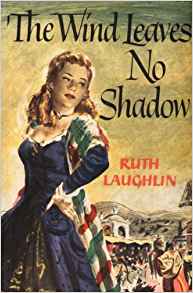
The Wind Leaves No Shadow: Book Review

The Wind Leaves No Shadow cover
by Ruth Laughlin
Caxton Printers, 1951
ISBN-13: 978-0870040832

Doña Tules Barceló was one of New Mexico’s most colorful 19th century characters, and The Wind Leaves No Shadow is, as far as I know, the only fictional or non-fictional treatment of her life.

From humble origins, which Ruth Laughlin imagines effectively, Doña Tules became owner of a Santa Fe gambling establishment where political opponents could meet to arrange accommodations that worked for everyone involved. She also acted as a kind of informal bank, lending money to key actors at critical junctures in New Mexico’s history. Because her gambling house gave her access to information not available everywhere, she was a valuable resource for both the Mexican and the American officials. She is said to have provided information in late 1846 to Governor Bent’s administration about the incipient rebellion against the U.S. occupation, the one that would result in his death a couple months later.

Not much is known about Doña Tules’ life, and Laughlin uses this fact to her advantage, weaving a story that places her in Santa Fe by the mid-1820’s and keeps her there until her death in 1852. The result is a story that not only imagines Doña Tules’ life but also provides the opportunity for an inside look at events (the 1837 Tax Revolt, the 1846 U.S. invasion, the 1847 death of Charles Bent) and people (the fur trappers, the ricos, the Santa Fe merchants, the priests) in Santa Fe during this period.

The Wind Leaves No Shadow was originally published in 1951 and reflects the historical information available to the author at the time as well as the prejudices that period. Although I didn’t always agree with Laughlin’s interpretation of historical events, she does a really great job of incorporating them into an effective story line. I was also uncomfortable with her insistence on Doña Tules’ white skin, red hair, and green eyes. In Laughlin’s interpretation, her coloring sounds more Irish than Spanish. In spite of these caveats, I believe this is still a useful book. If you’d like to get some idea of the life and trials of New Mexico’s famous lady gambler might have been like, or you’d like a fictional interpretation of New Mexico’s history in the 1820-1850 time frame, I recommend this book.