Houses Made of Mud

Houses Made of Mud

In my March 5 post, I mentioned that one of the things that nineteenth century Americans disparaged when they first arrived in New Mexico was what they called “mud houses.” Newspaper correspondent Matt Field wasn’t the only person to describe Santa Fe as a “mud built city” of one-story buildings that reminded him “of an assemblage of mole hills.”

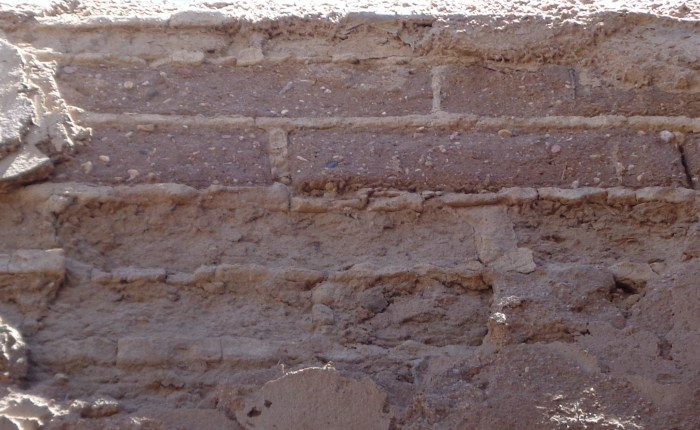
Technically, Field was right. The buildings, even the churches, were in fact built of a mixture of earth and water. These carefully formed bricks had evolved from the indigenous practice of puddled mud construction and by the 1800s were created by packing a stiff, dough-like mud into a rectangular wooden frame that was then lifted away from the resulting block. Two days later, the brick was dry enough to be turned on end and a week later, hard enough to be stacked and cured for another month. To speed up the drying process, adobe makers in the upper Rio Grande region often added straw.

Adobe bricks were used to construct one-story buildings but, with proper buttressing, the walls could be extended higher. Field noted that the Santa Fe parish church was built “as high and quite as large as any of our [U.S.] ordinary size meeting houses.”

He also noted that the adobe walls were strong and durable. In fact, they were so strong and durable that the Fort the invading Americans constructed on the hill overlooking the church in the Fall of 1846 was made of double walls of adobe bricks with a core of rubble between them.  

Diagram of Fort Marcy, constructed Fall 1846. Source: Fort Marcy Park interpretive signage.

Early the following year, the Americans got a taste of just how resilient adobe walls could be. After the January 1847 Taos uprising, the U.S. Army hauled four mounted howitzers and a six-pound cannon north to deal with the rebellion. The insurrectos had retreated to the mission church at Taos Pueblo, but the American artillery made little headway against its adobe walls.  Lt. Richard Smith Elliott reported later that the walls were so thick, the cannon balls would not go through them.

In fact, the artillery crews made little headway against the pueblo church until they positioned the smallest cannon closer to it and began using grapeshot in a spot already damaged by an axe-wielding soldier. Only then were the attackers able to enter the church.

Not even adobe could withstand the fury and tenacity of Americans with newly acquired land to protect.

© Loretta Miles Tollefson

Sources: Bainbridge Bunting, Early Architecture in New Mexico; Stella M. Drumm, Down The Santa Fe Trail and Into Mexico, Diary of Susan Shelby Magoffin 1846-1847; Mark L. Gardner and Marc Simmons, eds., The Mexican War Correspondence of Richard Smith Elliott; Michael McNierny, ed., Taos 1847, The Revolt in Contemporary Accounts; Clyde and Mae Reed Porter, Matt Field on the Santa Fe Trail.

An Unhappy Country – The Countdown Begins!

An Unhappy Country – The Countdown Begins!

The thirty-day countdown to publication of my novel An Unhappy Country has begun!

It’s August 1846. The U.S. army has taken Santa Fe without firing a shot. The Mexican American War is over in New Mexico. Or is it?

Two days after the Army arrives, seventeen-year-old Jessie Milbank and her friends stumble on a man with a knife in his back in the Santa Fe plaza. Then someone close to Jessie’s friend Juanita is murdered. When an insurrection is suppressed in December, Jessie begins to wonder if the three events are linked. 

Were the murdered men part of a conspiracy to throw out the invaders? And were they the only ones hoping for a fight? After revolt does finally break out and the Americans suppress it at the battle of Taos Pueblo, yet another man is murdered. Will the reasons for his death provide clues to the earlier ones?

Early readers are raving about Jessie, the book’s insight into these little-known events, and the beautiful writing in this novel.

You can pre-order the e-book now for only $.99. It’s available at all e-reader outlets , including Amazon and BarnesandNoble. The paperback is available for pre-order at BarnesandNoble, as well.

Chintz and Coffee in New Mexico

Chintz and Coffee in New Mexico

The Americans in Santa Fe before the U.S. invasion in 1846 were almost all merchants. These men brought a range of goods into New Mexico. Fabric, from calico to cashmere. Butcher and other types of knives. Ready-made clothes, including neckties. And also apothecary scales, snuff, turpentine, canned oysters, champagne, claret, and chintz mugs.

Chintz mugs were not made of fabric, as the term “chintz” would imply, but of china. That these pieces of fragile tableware made it from Missouri to New Mexico is a testament to the shippers’ packing ability. The cups were decorated with an all-over flower pattern copied from 18th century fabric designs. Entire dish sets were and are still being made using these patterns, though only the mugs seemed to have made it to New Mexico in the mid1800s.

Chintz mug. Image courtesy of Replacements.org

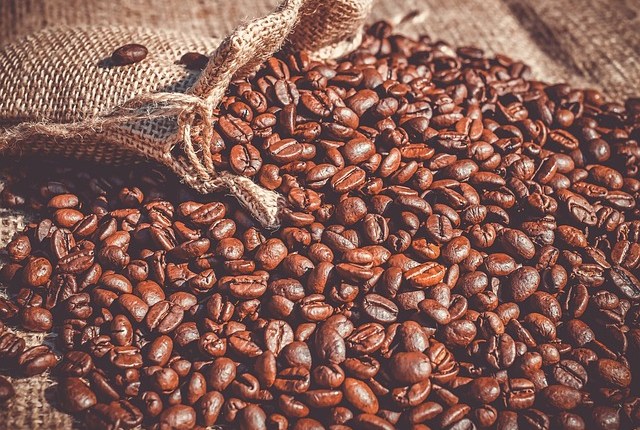
The mugs were undoubtedly used to drink the coffee which was also imported. Although a luxury item in the eastern United States, the beverage seems to have been considered by New Mexico’s Anglo travelers to be an essential, regardless of the cost. And it was expensive: 50 cents a pound in 1846, at a time when a typical male wage earner brought in $2 to $5 a month.

The coffee would have travelled in bean form, probably green beans, as they can be stored up to twelve months in comparison to about thirty days for roasted beans. So purchasers had to roast and grind the beans themselves. Lewis Garrard provided a vivid description of how this was done in on the road.

AWe selected two flat stones from the [water] channel at hand, twenty-five to thirty inches in diameter, which we placed on the fire ’til heated; then one was taken off, the coffee [beans] poured on, and stirred with a stick. The stones served alternately as they became cool. When the coffee was sufficiently burned, a piece of skin was laid on the ground, and a clean stone, a foot in diameter, rested on the knees of the grinder, with one edge on the skin. A smaller stone, held in the hand, reduced the grains between it and the larger one to powder by a rotary motion.@

The resulting grind was poured into boiling milk, where it sank to the bottom of the pan. When the grounds resurfaced, the coffee was ready. “How we feasted!” Garrard reported. “It was splendid!”

It’s unlikely Garrard and his friends drank from chintz mugs that night. They were still on their way to New Mexico. Any china would have been safely packed away. But I’m willing to bet that coffee served in chintz mugs accompanied the September 1846 oyster and champagne supper James Magoffin served his brother and sister-in-law to celebrate their safe arrival in Santa Fe.

Life in New Mexico in 1846-1847 could be quite civilized, for those who could afford it.

© Loretta Miles Tollefson

Sources: David C. Beyreis, Blood in the Borderlands, Conflict, Kindship, and the Bent Family, 1821-1920; Stella M. Drumm, ed., Down the Santa Fe Trail and Into Mexico, Diary of Susan Shelby Magoffin, 1846-1847; Lewis H. Garrard, Wah-to-yah and the Taos Trail; http://www.antiquesandteacups.com/collections/chintz, accessed 2/14/25

Scandalous Smoking Women

Scandalous Smoking Women

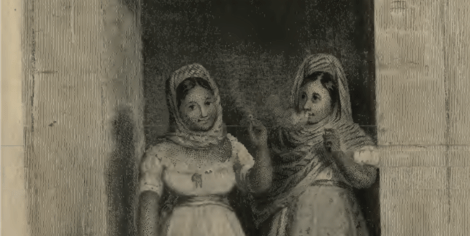
American visitors to 1800s New Mexico found much that was strange to them. “Mud” (adobe) houses, low-impact agriculture, and the clothing styles all gave Anglos something to feel superior about. New Mexican women’s smoking habits were something else entirely. Scandalous, repulsive, and, at least for one young American, titillating.

Seventeen-year-old Lewis Garrard, while decrying the custom, also admitted that smoking enhanced “the charm of the Mexican señoritas, who, with neatly rolled-up shucks [cigarettes] between coral lips,” smiled winningly, “their magically brilliant eyes … searching one’s very soul.” And they offered the treats to him! “These cigarillos they present with such a grace, and so expressive an eye, so musical a tongue, and so handsome a face” that it was impossible to refuse.

New Mexican women smoking. Source: G.W. Kendall, Narrative of the Texan Santa Fe Expedition, Vol. II

What exactly is a cigarillo? Susan Magoffin described them as “a delicate cigar made with a very little tobacco rolled in a corn shuck or bit of paper.” Needless to say, she didn’t try them herself. After all, she was a proper American woman.

The personal production of individual cigarillos was common in the Mexican states of Chihuahua, Sonora, and New Mexico at the time, although elsewhere in the country they were manufactured commercially. The commercial ones always rolled in paper, while New Mexico cigarillos were often made with pre-cut pieces of corn husk, or shuck.

The tobacco used for the New Mexican cigarettes wasn’t necessarily imported, either. They were often made with wild tobacco, or punche. If that wasn’t available, mullein (punchon) was substituted, though the two tasted quite different from each other, with punche being preferred.

The tobacco or its substitute was dried and shredded and carried in a small pouch or silver box. The corn husks or papers for rolling were kept separate, with women often carrying theirs in embroidered cloth cases.

Preparation of the corn shucks consisted of scraping the large pieces smooth, then cutting them into sections roughly three by one and a half inches. When a smoker wanted a cigarette, they (she!) pulled out a piece, moistened it with their mouth, sprinkled tobacco on one end, then rolled it up, pinching the ends to hold the contents.

This process in itself must have been erotic for the teenage Garrard. No wonder he found the cigarillos New Mexican women offered him so irresistible, threatening to draw him into “the giddy vortex of dissipation!”

© Loretta Miles Tollefson

Sources: Stella M. Drumm, ed., Down the Santa Fe Trail and Into Mexico, Diary of Susan Shelby Magoffin, 1846-1847;  Marc L. Gardner and Marc Simmons eds, The Mexican War Correspondence of Richard Smith Elliott; Lewis H. Garrard, Wah-to-Yah and the Taos Trail; Albin O. Korte, Tobacco Tales, La Herencia, Summer 2005; Michael Moore, Los Remedios, Traditional Herbal Remedies of the Southwest.