Albino Pérez Arrives in New Mexico!

Albino Pérez Arrives in New Mexico!

Newly appointed Governor Albino Pérez arrived in New Mexico in May 1835 to general relief. The previous governor, Francisco Sarracino, was generally viewed as inept and Pérez was a breath of energetic fresh air. He brought funds for the Presidio troops and immediately set out on a tour that included visits to outlying communities as well as a successful action against the Navajo, who’d been picking off sheep and other prizes. When Pérez returned to Santa Fe, he gave an inaugural address in which he praised New Mexicans’ peaceful habits, love of order, and obedience to justice, among other virtues.

However, the longer Pérez was in office, the more complicated things became. The money he’d brought was spent and more was needed. Sarracino, now New Mexican Treasurer, was accused of embezzling funds. The Navajo were active again and another campaign was necessary. And Pérez’s idea of paying for it with forced loans from the region’s ricos was not met with universal acclaim.
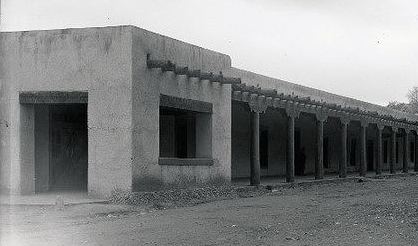
The Governor’s Palace in Santa Fe. Courtesy: NM History Museum

Then New Mexico’s exemption from the national sales tax expired. The governing council asked Pérez to forward a petition for its renewal to Mexico City, but he didn’t do so right away. Instead, he started talking about how to collect the tax.

This didn’t go well with the populace. In fact, it may have been the spark that ignited  what is popularly known as the Chimayó revolt, the rebellion that resulted in Pérez’s death in early August 1837. The good feeling surrounding Pérez’s arrival had disappeared completely by the time he lost his life and his head on the road outside the village of Agua Fría south of Santa Fe.

Which is a good reminder that no matter how an official begins their term, it’s what they do afterwards—and how their time in the sun ends—that people are most likely to remember.

Sources: Lansing B. Bloom, “New Mexico Under Mexican Administration,” Old Santa Fe Magazine, Vol. 2. Santa Fe: Old Santa Fe Press, 1914-1915; Janet Lecompte, Rebellion in Río Arriba 1837, Albuquerque: University of New Mexico Press, 1985; Read, Benjamin M. Illustrated History of New Mexico, Santa Fe: New Mexican Printing Company, 1912; Joseph P. Sanchez, “It happened in Old Santa Fe, The Death of Governor Albino Pérez, 1835-1837,” All Trails Lead to Santa Fe, Santa Fe: Sunstone Press, 2010; F. Stanley, Giant in Lilliput, the Story of Donaciano Vigil, Pampa, TX: Pampa Press Shop, 1963.

WATER OF LIFE

“Now what’re you gettin’ yourself all fired up for?” the matted-haired trapper demanded. “I’m your pa and I can do I want.” He lifted the pottery jug from the wooden table with both hands. “I been feelin’ a mite poorly since I come in from the mountains and this here’s a right good anti-fogmatic.”

“Aquardiente,” the girl said contemptuously. “Your so-called water of life.” She pushed her long black hair away from her face. “Water of hell!”

“Ah, now girlie.” He grasped the jug’s narrow neck with one hand and reached for her arm with the other.

She slapped at him. “I’m not your girlie any longer. Don’t you touch me!”

His eyes narrowed. “I’m still your pappy,” he said. “Just ’cuz I been gone five months don’t mean you can be disrespectin’ me.”

She sniffed and turned away.

He gulped down a swig of the liquor. “Where’s your ma, anyways?”

“She went to the merchant’s to settle her bill.”

“Don’t want me to know how much she spent while I was gone, huh? What new piece of fooferaw have the two of you took a cotton to now?”

The girl whirled. “You mean the cotton for your shirts? The white wheat flour she saved for your biscuits while we spent the entire winter eating cheap corn tortillas?”

The jug thudded onto the table. “What’s eatin’ you girl, that you think you can chaw on me so right catawamptiously? It ain’t fitten!” He surged from the chair, his hand raised. “I’m thinkin’ you need a rememberance of who’s head o’ this household!”

Her lower lip curled. “That’s right. Beat me. Just give me an excuse to leave. That’s everything I could wish for.”

He dropped his hand. “And why would you leave, girl?” He peered at her. “You find a young man to spark you while I was gone?”

She lifted her chin. “I don’t need a man.”

He threw back his head. “Hah! And what else you gonna go and do?” Then his face changed. “You ain’t gone and done something you’ll regret, have you now?”

Her lips twitched with amusement. “You might regret it,” she said. “I won’t be of much use to you.”

He moved toward her. “What the tarnation have you gone and done?”

“You’ll know when I’m ready to tell you.”

As he grabbed her arm, the door opened.

“Be careful of her, por favor!” the girl’s mother said as she entered. “She has been accepted into the convent in Santa Fe, to serve as a helper! Our child is a matter of grace to us now!”

The mountain man stared at his wife, then his daughter. He turned to the table. “Women!” he muttered as he lifted his jug.

from Old One Eye Pete

A Furry Conflict in New Mexico

On Wednesday, May 16, 1827, a man named Ignacio Sandoval showed up in Santa Fe, New Mexico with important information for Governor Antonio Narbona. Sandoval had just returned from a trapping expedition led by an American named Ewing Young. Young, who didn’t have a permit to trap, had come back with thirteen packs of furs—probably mostly beaver—and hidden them south of Santa Fe at the Peña Blanca home of Luis María Cabeza de Baca.

Narbona, in one of his last official acts as governor, sent men to confiscate the furs. Cabeza de Baca, trying to protect them, died as a result.  Manuel Armijo, who took over as Governor on May 21, promptly issued an order for Ewing Young’s arrest in connection with the illegally obtained furs.

Young escaped incarceration for the time being, but the pelts remained confiscated. Well, most of them did. Some of them belonged to another American, Milton Sublette.

Beaver pelt

In July, Young and two other Americans obtained permission to clean the furs, which they worried had become damaged in storage. They and the local alcalde were busy shaking them out and taking inventory when Sublette appeared, grabbed a pack, threw it over his shoulder, and took off for the nearby home of Cristobal Torres.

The local authorities converged on the house, but it was too late. Sublette and his pelts had disappeared. Armijo blamed Young and called him into his office for explanations. When he threatened to incarcerate the American, Young walked out. Armijo had him arrested, threw him in jail, then released him when Young claimed a debilitating fever.  But Armijo didn’t release the furs. Legally, they were now government property. They would eventually be sold, though at a fraction of what their original value.

So once again, a conflict between the Mexican administration and the Americans in New Mexico ended in a standoff, with no one the clear winner. I find this a fascinating story because it highlights the conflicts and complexities of American-Mexican interactions twenty years before the 1847 revolt at Taos, which stunned the Americans with its ferocity.

They weren’t looking at the larger picture. The kind of high-handedness and disregard for local customs Young and Sublette displayed were common among the American trappers during the Mexican period.  The 1827 incident, among many others, appears to me to be directly linked to the events of early 1847, when the newly appointed American governor and former trapper and merchant Charles Bent was killed.

Retribution, no matter how long it takes, is still retribution.

Source: David J. Weber, The Taos Trappers, Norman: University of Oklahoma Press, 1971.

SLICK

The rain was behind him and gaining fast.

Timothy looked back, down the valley, and kicked at the mule, but it was hot and the mule had been going for a long time. Its pace quickened for a few yards, then dropped back into an easy trot.

The boy groaned and looked back again. His mother had told him to take his slicker, but he’d been in a hurry. “C’mon Boss,” he begged, but the mule just flicked its ears and jogged onward.

Somehow, they made it to the barn before the clouds reached them. Timothy turned the mule into the stall and made a dash for the house. The first raindrops bit into the dust as he reached the steps.

His mother opened the door. “Get wet?” she asked meaningfully.

He grinned at her. “Dry as a bone!” he said.

from Valley of the Eagles

Book Review: The Mesilla

Book Review: The Mesilla

If you recognize the name Albert Fountain, you’ll almost certainly associate him with his disappearance in the New Mexico desert in 1896 along with his eight-year-old son. And that’s probably almost everything you know about the man.

But Fountain’s disappearance happened as the result of events that took place well before that early February day. In fact, he’d been a polarizing figure in southern New Mexico for a number of years. He’d defended Billy the Kid in court and made other decisions that brought attention to himself—and not necessarily in a good way.

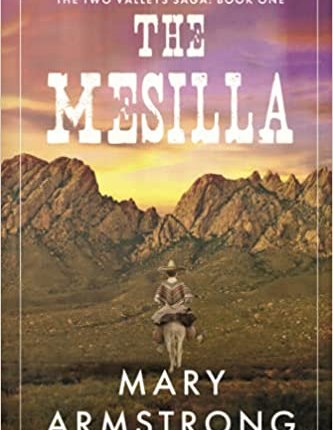
Mary Armstrong’s novel The Mesilla provides a fictional account of some of the events in Fountain’s career prior to his disappearance. This story, the first in Armstrong’s Two Valleys Saga series, centers around Fountain’s defense of Bronco Sue, a woman who was accused of killing her husband, one of a series of men she’d cohabitated with. The courtroom scenes alone are worth the price of this book.

Armstrong has clearly done her homework. The novel is packed with information and anecdotes about New Mexico’s Mesilla and Tularosa Valleys in the late 1800s, which she feeds seamlessly into the story line. If you’re interested in the history of these areas or are just looking for a well-written historical novel, I recommend The Mesilla.  

Ten Americans Killed At Wagon Mound, New Mexico Territory!

Ten Americans Killed At Wagon Mound, New Mexico Territory!

In early May 1850, three men headed across the plains toward Santa Fe with the U.S. mail. Seven other men had joined them for safety’s sake. It wasn’t enough. Around May 7, a band of Jicarilla Apache and Mouache Ute led by a man named White Wolf struck near Wagon Mound.  When the ensuing running fight was over, the entire party of Americans lay dead on the greening grass. The bodies were found by other travellers on Sunday, May 19.

The number of men killed made this incident even worse than the one the previous October when Mrs. White died, and her slave woman and daughter were captured. At a glance, it appeared that the Apache and Utes had gone on a senseless killing spree.  

But there was a reason for these deaths. In August 1849, a band of Jicarilla had visited Las Vegas, New Mexico to discuss a possible peace treaty. Not much discussion seems to have taken place. Instead, the Jicarillas were attacked by armed men who killed fourteen of them and captured White Wolf’s daughter.

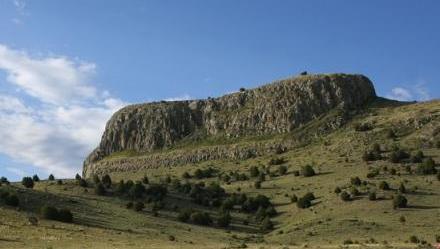
Wagon Mound, New Mexico. Courtesy: Cultural Atlas of New Mexico

After the White party deaths two months later, White Wolf’s daughter was pulled out of jail and taken along on a mission to find the survivors. The idea was to use her as an interpreter/negotiator as well as a bargaining chip. En route, she decided to take matters into her own hands and escape. In the process, she shot two men and did her best to stampede the group’s mules herd but was herself shot and killed.

So no one should have been at all surprised that the mail carriers and their companions died at the hands of White Wolf and his fellow warriors. What else had the men of Las Vegas expected?

Sources: Howard Bryan, Wildest of the Wild West, Santa Fe: Clear Light Publishing, 1988; Leo E. Oliva, Fort Union and the Frontier Army in the Southwest, Southwest Cultural Resources Center, National Park Service, Santa Fe, 1993; Morris F. Taylor, First Mail West, Albuquerque: UNM Press, 2000.