Top New Mexico Republican Murdered!!!!

Early on Sunday morning, November 27, 1904, news reached Santa Fe that J. Francisco Chaves was dead. Chaves had been eating dinner at a friend’s house at Pino’s Wells in Torrance County when a lone gunman shot through the window of the room he was in, then escaped on horseback.

The murder was shocking both because of its Wild West nature and because of the victim’s status in New Mexico. Born at Los Padillas in what is now Valencia County, the 71-year-old Chaves was considered the father of the Territory’s Republican party. He was a veteran of the battle of Valverde and subsequently commander at Fort Wingate. The was followed by service as Territorial Delegate to Congress from 1865 to 1871 and also as New Mexico’s Superintendent of Public Instruction. By 1904, he’d served in the Territorial Legislature for almost 30 years and was a longtime friend and political ally of Governor Miguel Otero.
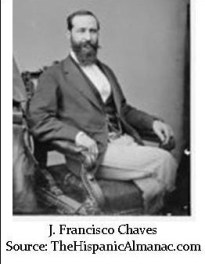
Nov 27 illustration.Chaves

But political power had apparently given Chaves a sense that he wasn’t obliged to abide by other men’s rules. He was a strong supporter of the idea that New Mexico should be made a state as soon as possible and had been working hard at the territorial and national levels to make that happen. When Bernard Rodey, New Mexico’s delegate to Congress, came out in opposition to immediate statehood, Chaves was furious.
But he didn’t confront Rodey, who was up for reelection. Instead, he publicly supported Rodey’s candidacy, while quietly arranging for another man to get the Republican nomination to the position.

Chaves’s candidate would win that election and proceed to Congress, but Chaves wouldn’t live to see his success. He was dead by then, killed in a way that contributed to the idea that New Mexico Territory was still a violent frontier and not ready yet for statehood.

The behavior of the new Delegate didn’t help matters. Within seven weeks of his arrival in Washington, D.C., scandal engulfed him, raising further questions about New Mexico’s right to become a full-fledged state. It would be another eight years before the cloud lifted and New Mexico achieved Chaves’ desire. One has to wonder if Statehood would have happened sooner if Chaves hadn’t tried to hurry it along.

Sources: David V. Holtby, Forty-Seventh Star, New Mexico’s Struggle For Statehood, University of Oklahoma Press, Norman, 2012.; Frank H. H. Roberts and Ralph E. Twitchell, History and Civics of New Mexico, Robert O. Law Company, Chicago, 1914; Jerry D. Thompson, A Civil War History of the New Mexico Volunteers and Militia, University of New Mexico Press, Albuquerque, 2015; Ralph E. Twitchell, The Leading FActs of New mexican History Vol. III, The Torch Press, Cedar Rapids, 1917.
WINTER STOP, MORENO VALLEY

There was no grass visible, covered as it was by three feet of snow. Clouds obscured Aqua Fria Peak, meaning there’d be more snow in the night. The lower branches of the aspens had clearly felt the teeth of hungry deer and elk. There’d no doubt be wolves shadowing their flanks.

Old Pete cut branches for the two pack mules and created a feeding pile. They came eagerly to investigate.

What they left would clearly indicate the passing of a stranger, but he didn’t expect anyone was watching for him, anyhow. And by midday tomorrow the pile would be just another white-mounded windfall.

He added wood to the fire and pulled the buffalo robe tighter around his shoulders. He wished he had some coffee or Taos lightning. The snow-melt water was hot enough to warm him, but something with a kick in it would feel mighty handy right about now.


First Legal Americans Arrive in Santa Fe

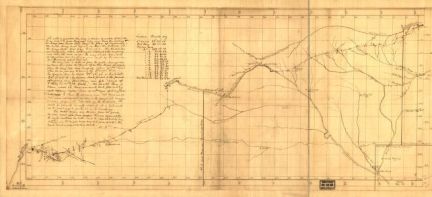
When William Becknell and his companions reached Santa Fe, New Mexico on Wednesday, November 16, 1821, they experienced a very different reception then they would have received a year before.

In the fall of 1820, Becknell could have easily faced jail time for entering New Mexico. But by November 1821, Mexico had completed its break from Spain and the new government welcomed the Americans it had previously shunned. Travelers from the eastern part of the continent were no longer illegal aliens and subject to arrest at any time. Instead, they and their goods were welcomed.

Becknell had about 17 men with him. Their original intent had been to trade with the Indians and catch “wild animals of every description.” However, trading in Santa Fe was a lot easier. Becknell disposed of his goods and started back to Missouri for more. Most of the men with him liked New Mexico so much that they decided to stay and spend the winter trapping.

Nov. 16 illlustration.Santa Fe Trail map.1826.cropped

Becknell may have left many of his men behind, but he returned to Missouri with someone who hadn’t made the outgoing trip with him. David Kirker, a member of the John McKnight and Thomas James party, which had followed Becknell across the plains but were going to Mexico to retrieve members of a previous expedition, was sent back to Missouri with Becknell. Kirker had put his party in danger by surrendering himself and his weapons to a threatening Comanche war party instead of standing up to them. The men he was with wanted nothing more to do with him.

David did not return to New Mexico, but his cousin James Kirker must have been inspired by what he heard about it. He arrived a few years later and would eventually become a byword in New Mexico and Chihuahua for a trouble-making American.

Becknell’s appearance in Santa Fe that November day was definitely the beginning of a more complex relationship with New Mexico’s neighbor to the east than had been possible in the past.

Sources: Robert Glass Cleland, Alfred A. Knopf, New York, 1950; Leroy R. Hafen, Fur Trappers and Traders of the Far Southwest, Utah State University Press, Logan, 1997; Marc Simmons, New Mexico, An Interpretive History, University of New Mexico Press, Albuquerque, 1988; David J. Weber, The Taos Trappers, University of Oklahoma Press, Norman, 1971.

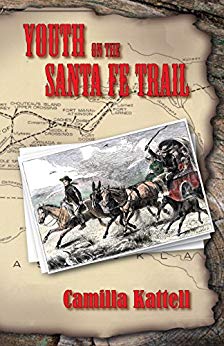
Book Review: Youth on the Santa Fe Trail


Kattell.Youth On The Santa Fe Trail cover
Youth on the Santa Fe Trail
by Camilla Kattell
Light Horse Publishing, November 2015
ISBN-13: 978-0996675406

We tend to forget just how young many of the travelers on the Santa Fe Trail were. I suppose this is because we associate the Trail with merchant caravans more than we do with family settler groups.

In Youth On The Santa Fe Trail, Camilla Kattell reminds us that some of the most famous voices from that famous road were not yet twenty when they travelled it. In addition to Christopher “Kit” Carson, these young people included the soon-to-be mountain man Richens Lacey Wootton, future authors Francis Parkman, Jr. and Hector Lewis Garrard, diarist Susan Shelby Magoffin, and—youngest of them all at age seven—Marian Sloan Russell.

One of the things I especially appreciate about this book is that Kattell includes information about travelers I was unfamiliar with, including James Ross Larkin, an early health seeker on the Trail, sportsman William B. Napton, and New Mexico native José Librado Gurulé.

But Youth on the Santa Fe Trail does more than provide a concise biography of these travelers. It also provides context for their particular story and, in doing so, helps us to understand their world. For example, Kattell’s portrayal of Susan Shelby Magoffin helped me to see this young woman in a way I hadn’t before.

When I read the Magoffin diary a number of years ago, I was frustrated by what I saw as her very narrow view of the world. Youth on the Santa Fe Trail reminded me that Magoffin’s strict, rather puritanical, upbringing would naturally make her look askance at women smoking cigarettes and church hymns set to apparent dance tunes. What I saw as a narrow mindedness can also be viewed as a difference in cultures which Magoffin was doing her best to assimilate. Kattell expanded my view of this young woman’s perspective.

While Youth On The Santa Fe Trail is about the youth who traversed the Santa Fe Trail, it is certainly not only for young readers. It will give you a new appreciation for the Trail’s travelers, the impact they had on both their destination, and the way their experiences on the trail shaped that impact. I recommend it for anyone interested in the history of the Trail and of New Mexico.


THE TIRED DOG

The red-bearded man in the tattered coat and a dirty blue bandana for a hat squatted in the middle of the adobe casita’s single room and scooped the thick stew into his mouth with his fingers, grunting with pleasure. The woman placed a small wooden plate piled high with tortillas beside him. The man sucked his fingers clean, then grabbed a tortilla and used it to shovel more food into his mouth.

The two children perched on the adobe banco in the corner stared silently at the strange americano until their mother motioned at them to go outside. She replenished the man’s stew, then followed them.

“Come como perro amarrado. He eats like a tired dog,” the girl said. She wrinkled her nose. “So rapidly and with no manners.”

Her mother turned from the wood pile, her arms full. “He is our guest,” she said reprovingly. “Come, bring more wood for the fire.”

When they reentered the house, the man had finished his meal.

“More?” the woman asked.

He shook his head. “No, but I thankee. That’s the first meal I’ve et in three days.” He cocked an eyebrow at her. “I’m lookin’ for the wife of Juan Leyba, the one that went to Elizabethtown two years ago t’ find work.”

The woman went still, her lips stiff with fear. She licked them nervously. “I am the wife of Juan Leyba, the one who went to that Elizabethtown to labor in the mines there.” She swallowed hard. “He is well?”

“Oh yes, ma’am!” the americano said. “I’m sorry to frighten you ma’am.” He pulled a small leather bag from a pocket and held it out. “This here’s from him. There’s about two ounces o’ gold in it. He says t’ use it t’ buy that land you wanted, or come to him, whichever seems best t’ you.” As she reached for the bag, he looked at the children and grinned. He shoved his hand into another pocket. “An’ he sent these fer the young uns. Gotta little linty in my pocket, but I think they’re all right.” His fingers opened, revealing a collection of hard candies, enough to keep a careful man going for at least a day and a half.

from Valley of the Eagles