DARKER THAN A WOLF’S MOUTH

“No, don’t go out there now,” Maria said. “It is late and there is no moon. El es oscuro como boca de lobo.”

“How d’you know how dark it is inside a wolf’s mouth?” Alvin Little grumbled as he put on his boots. “Leave me be.” He paused again, listening. The sound came again, the rattle of sticks tumbling off the pile of kindling just outside the door. “I spent two hours yesterday cuttin’ that kindling and I’m damned if someone’s gonna go stealin’ it.”

“El noche es más mala que Judas,” she protested. “It is unsafe.”

He reached for the door latch, then turned to look at her. “More evil than who? Judas, you say? Where d’you get this stuff?”

He stopped on the sill and shook his head as he peered into the darkness. A pale sliver of moon and no starlight. Heavy clouds blanketing the sky. He chuckled. So this was what a wolf’s mouth looked like. He leaned forward and peered at the wood piled alongside the cabin. He could just see the once neatly stacked kindling. Sticks lay haphazardly at the foot of the pile, as if someone had tried to climb it. Alvin scowled and stepped into the yard to gather them up.

A slight scratching sound came from the wooden roof, but Alvin didn’t have time to do more than lift his head before the mountain lion was on top of him, or hear more than Maria’s single scream before the big cat’s teeth found his throat.

from Valley of the Eagles

There’s Always a Way – Fur Trapping Under Mexican Law

On Friday, October 29, 1824, Santa Fe Trail originator William Becknell swerved from the Trail he’d inaugurated three years before and instead got a license from the Mexican government to go trapping. He may have been the first American to do so.

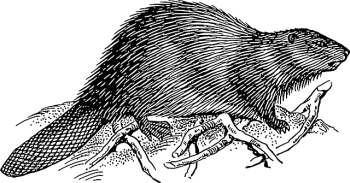
Getting a trapping license that October was complicated. Four months earlier, the Mexican government  had ordered New Mexico’s governor to ban all non-citizens from trapping. Only Mexican nationals were allowed to hunt beaver, although even they needed a license to do so. The process required the applicant to pay a fee, provide information about the number of hunters in the party, the type of hunting to be done and the weapons used, and the length of the planned expedition.

The American trappers got around the new restrictions by asking Mexican citizens to apply for the permits, then allow the Americans to hunt under their licenses. This subfertuge seems to have done with the Governor’s knowledge: Becknell sent Governor Baca a letter to confirm receipt of the permission he’d obtained through Manuel Rada, the priest at Santa Cruz de la Canada.
oct 29 illustration.pixabay

And Becknell wasn’t the only trapper to do this. A year later, Sylvester Pratte and Jean Pierre Cabanné went through customs collector Juan Bautista Vigil y Alarid to get a permit.

However, there was a slight problem with this approach. Different officials read the law differently, and difficulties could develop. For example, in May 1826, the Taos alcalde confiscated the pelts of Sylvestre Pratte and Francois Robidoux, even though they both had permits issued by the Governor. (Robidoux’s had been obtained through Juan Bautista Vigil.) When Pratte and Robidoux protested the seizure, Santa Fe officials ordered the alcalde to return the plews.

But this approach made life uncertain. Additional conflicts occurred the following summer over plews brought in by Ewing Young and his trappers.

And there was another solution to the license problem. A naturalized Mexican citizen could obtain one without a go-between.

This fact seems to have triggered a rash of applications for Mexican citizenship. In 1830 alone, thirteen men (Abraham Ledoux, William Wolfskill, Geronimo Lonte, Pedro Laliberte, Antoine Leroux, Jose Bissonette, Amablo Para, Antonio Blanchilla/Blanchard, Jean Baptiste Trudeau, Luis Ambroise, Carlos Guara, Francisco Siote, Pierre Lesperance, and Paul Anderson) all became Mexican citizens. They joined Richard Campbell, Antoine Robidoux, John Rowland, and Gervais Nolan, who’d already made the switch.

These are the men for whom citizenship records are still extant. Who knows how many other men also decided to live by the old adage, “If you can’t beat ’em, join ’em?”

Sources: Daniel J. Weber, The Taos Trappers, Norman: U of Oklahoma P, 1971

THICKER ‘N SNOT

“It’s s’posed to be August, dadburn it.” Julius Fairfield looked gloomily out the door of the long, narrow log cabin that served as the Quartz Mill & Lode Mining Company barracks outside of Elizabethtown. “This fog is thicker’n snot.”

In one of the iron beds lining the walls behind him, somebody sneezed. “And there’s the snot for ye,” Edward Kelly, the company’s lone Irishman, chortled as he added more wood to the pot belly stove halfway down the room.

A door opened at the far end and the chief engineer came out. He ignored the men in the beds as he walked down the room to peer over Fairfield’s shoulder. “That fog’ll lift shortly,” he said. He clapped Fairfield on the back. “Be thankful it’s not rain.”

“That was yesterday’s gift to us all,” Fairfield said gloomily. He shook his head. “And here I thought New Mexico Territory’d be drier than New York.” He grinned and glanced at the engineer. “When’d you say payday was?”

Behind them, Kelly began to sing a song praising Ireland and its green hills, and a chorus of voices yowled at him to be still. The engineer chuckled and turned. “That’s enough now!” he said.

from The Valley of the Eagles

Santa Fe Trail Survey Reaches Point of Rocks

On  Wednesday, October 19, 1825, George Champlin Sibley’s Santa Fe Trail Survey expedition arrived at Point of Rocks, New Mexico. But they didn’t head to Santa Fe.

Sibley was one of three Commissioners named to head up the United State’s survey of the road between Missouri and Santa Fe that had been inaugurated by William Becknell four years earlier. The survey had two purposes: 1. to facilitate trade with Mexico and 2. to negotiate with the Native American tribes along the Trail for safe passage for future travelers.

George Sibley was the only Commissioner to cross the international boundary into New Mexico. However, when he arrived at Point of Rocks, he didn’t continue south along the Trail to Santa Fe. Instead, arguing that it was too late in the year to travel safely to the capitol, Sibley headed west across the Sangre de Cristos to Taos, where his business associate Paul Baillio was located.

Oct 19 illustration.Sibley photo.Source Noble.272.cropped

Sibley spent the winter of 1825/26 in Taos, where he completed the map of the American portion of the Trail and waited for permission to complete the Mexican portion. Although there’s no evidence he ever travelled the portion between Point of Rocks and Santa Fe, he felt confident enough of that section to note that there was no need to make physical alterations it, since “the open nature of the country” enabled wagon to pass “without the least difficulty … with no other labor than removing a few logs, poles, etc.” (Gregg, 201).

In any event, in 1827, Sibley completed his work and returned to Missouri in 1827, where he and his wife established the Linden Wood School for Girls, which would later become the Linden Wood College, and is today Lindenwood University. In Missouri, he is probably best known for this school. In New Mexico, his name is still more closely associated with the survey of the Santa Fe Trail and the mystery of why he didn’t actually travel the full length of the Trail.

Sources: Kate L. Gregg, ed., The Road to Santa Fe, the journal and diaries of George Champlin Sibley, UNM Press, Albuquerque, 1995; Leroy R. Hafen, ed., Fur Traders and Trappers of the Far Southwest, Logan: Utah State UP, 1997; Daniel J. Weber, The Taos Trappers, Norman: U of Oklahoma P, 1971

THE FOURTH TIME

She could be incandescently angry and Gerald’s trip to Santa Fe and back had taken a week longer than he’d told her it would, so he braced himself as he opened the cabin door. But Suzanna barely raised her head from the rocking chair by the fire. She wasn’t rocking. Her shawl was clutched to her chest, her face drawn and gray under the smooth, creamy-brown skin. She glanced at Gerald, then turned her face back to the flames, her cheeks tracked with tears.

Gerald’s stomach clenched. “What is it?” he asked. “The children?”

Suzanna shook her head without looking at him. “The children are fine,” she said dully. She moved a hand from the shawl and placed it on her belly. The tears started again and she looked up at him bleakly. “This is the fourth time,” she said. “There will—” She closed her eyes and shook her head. “There will be no third child,” she choked, and he crossed the room, knelt beside her, and wordlessly took her into his arms.

from The Valley of the Eagles

Former Taos Trapper Dies in Los Angeles

On Wednesday, October 3, 1866, trapper William Wolfskill died at age 68 in Los Angeles, California, where he’d emigrated from New Mexico.

Born in Kentucky, Wolfskill had arrived in New Mexico as part of William Becknell’s second (1822) Santa Fe Trail expedition and was based in Taos for the next eight years. During that time, Wolfskill trapped on the San Juan, Gila, and Colorado Rivers, and participated in mule and horse trading missions to Missouri.

On one of those missions, in late 1824, Wolfskill joined an expedition to northwest Chihuahua led by a Captain Owens. There, they purchased horses and mules to export to Missouri. Shortly afterward, Owens was killed in an Indian raid. Wolfskill and another man rounded up the mules that had escaped capture, bought more, and took them all to Alabama, where they sold for a nice profit.

Oct 3 illustration.Wolfskill, William, ca.1831_(CHS-1765)
William Wolfskill

But the two men didn’t keep the money for themselves. Instead, Wolfskill took it to Boone’s Lick, Missouri, where he handed over the funds to Captain Owens’ family.

In late September 1830, Wolfskill left New Mexico and never returned. He led a party of about 20 men acrossed the Great Basin into southern California, in the process opening what is today called the “Old Spanish Trail.”

Wolfskill had originally intended to trap beaver in California, but when this turned out to be impractical, he and fellow trapper George Yount turned to hunting sea otter instead. This project seems to have been lucrative, because by 1838, Wolfskill had the funds to join his brother in buying a  4,000-vine Los Angeles vineyard, which would eventually grow to 85,000 vines.

Agriculture must have been more enjoyable than trapping, because three years later, Wolfskill planted the first commercial orange grove in California. These activities formed the basis of a kind of agricultural empire that would introduce the Australian eucalyptus, the soft-shelled almond, the chestnut, and the persimmon to California.

Certainly, by the time he died, Wolfskill had traveled a long way from Kentucky and accomplished a great deal besides trapping furs.

Sources: Leroy R. Hafen, ed., Fur Traders and Trappers of the Far Southwest, Logan: Utah State UP, 1997; Daniel J. Weber, The Taos Trappers, Norman: U of Oklahoma P, 1971.