“Things are changing, Mr. Maxwell.” Judge Joseph Palen set his whisky glass on the saloon table and looked around the room. “In another year or so, these ragged placer miners will be replaced by businessmen with laborers to do the rough work.”
Maxwell nodded, following his gaze. “And many of these men will be laborers, instead of independent men with claims of their own.”
“Claims so poorly worked they bring in barely enough to keep body and soul together.” Palen flicked a speck of dust from the sleeve of his dark broadcloth suit.
“That’s all that matters, I suppose.” Maxwell grimaced. “Efficiency.”
“It’s a large territory, and its resources are going to waste.”
“So they tell me,” Maxwell said. He shook his head, put his glass on the table, and reached for his battered black hat. “I’ve been here a long time, Mr. Palen, and I happen to like Nuevo Mexico’s lack of efficiency. So do most of the men in this room, I expect.” He stood, towering over the table. “Good day to you, Judge.” A mischievous smile flashed across his face. “And good luck.”
Folks in Socorro County called 1862 the “year of the little doves,” but they weren’t talking about birds. They were speaking of locusts. That Spring, an unusually heavy snow pack in the northern mountains that spring caused major floods along the Rio Grande. In Socorro County, the river was more than a mile wide in places. Newly planted corn and wheat fields, peach orchards and vineyards were inundated, and many acequias were destroyed.
Then the “little doves” arrived. By the time the locusts had left, the County was stripped clean and its inhabitants were close to starvation.
Relief was slow in coming, because the Territory was caught up in pushing back the Navajo depredations that had followed hard on the heels of the Confederate invasion. There were also concerns that the Confederates would try again.
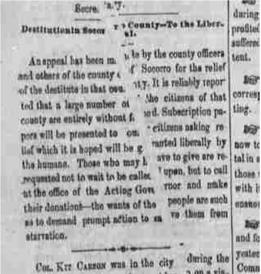
Source: Santa Fe Gazette, May 2, 1863
But help did eventually arrive. In early May, the Santa Fe Gazette printed a plea for help and donations began to pour in. They came from as far north as Arroyo Seco and as far east as Maxwell’s Ranch on the Cimarron. Leading citizens in Taos, Arroyo Seco, Placitas, Cordova, and Espanola contributed $356. Antonio Baca and Francisco Aragon of Arroyo Seco, Francisco Sanchez of Placitas, Pascuel Martinez of Ranchita, Jose Dolores Tafolla of Cordova, Pedro Antonio Vigil of Cordilleras, and Juan Antonio Espinosa and Juan Suaso of San Francisco del Rancho donated 141 fanegas of wheat between them, and Taos’ Fr. Gabriel Ussel raised $82 from his parishioners.
So, while the locusts had destroyed their crops in 1862, “little doves” of help came to Socorro’s rescue in 1863. It was a long time to wait, but help did eventually arrive.
Source: Jerry D. Thompson, A Civil War History of the New Mexico Volunteers & Militia, UNM Press, Albuquerque, 2015. Pages 215-221
Ewing Young had thirteen 90-pound packs of beaver fur in his possession in early May 1827, and he wasn’t interested in having them confiscated. According to the rumors, outgoing Governor Narbona was cracking down on trappers without the proper permissions and incoming Governor Manuel Armijo was likely to be even stricter than Narbona.
So Young did the only sensible thing an American trapper could do. He hid his furs at the Pena Blanca home of his associate Luis Maria Cabeza de Baca.
But he had neglected to realize that some of the men with him might have different ideas about the most sensible approach to government mandates. A member of his trapping party, Ignacio Sandoval, told officials in Santa Fe what Young was up to.
From that point on, things took a turn for the worse. Governor Narbona ordered soldiers to Pena Blanca to confiscate the furs and, in the process, Luis Maria Cabeza de Baca was killed. Then Manuel Armijo became governor on May 20 and signed an order for Young’s arrest for illegal trapping. Young seems to have talked his way out of that predicament and instead got permission to clean the confiscated furs. He and the Santa Fe alcalde were in front of the governor’s long adobe palace, shaking out and inventorying the furs, when another member of Young’s trapping party appeared on the scene. Milton Sublette grabbed a bundle of pelts and made off with them.
When Sublette and the furs disappeared, the governor blamed Ewing Young. He called Young to the palace and threatened him with jail. Young turned on his heel and walked out of Armijo’s office, but he wasn’t free for long. And when the soldiers did catch up with him, he was thrown in the calaboza, where he languished until he became ill and was finally released.
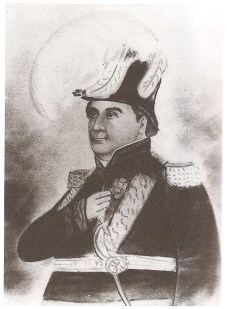
Source: Illustrated History of New Mexico, Reed
But he didn’t get his furs back. Many of them had been badly damaged by rain leaking through the roof of the building where they were stored, so they were sold for about two-thirds what they would have brought in good condition. The total was still a decent amount, about $3500. But it’s not clear who received the resulting funds. After all, the plews were government-confiscated property.
Sources: Carl P. Russell, Firearms, Traps, and Tools of the Mountain Men, Skyhorse Publishing, 2010; David J. Weber, The Taos Trappers, University of Oklahoma Press, 1970.
“You have an interest in a number of cases before this court,” Judge Palen said sharply.
Lucien Maxwell nodded and tilted his head toward the old lawyer beside him. “Mr. Wheaton is my designated attorney.” He raised an eyebrow. “I believe that releases me from the need to be present.” He adjusted his right foot higher on his left knee.
“You have been indicted on a serious charge.” Palen leaned forward. “That indictment requires your attendance.”
“The Probate Court issue?” Maxwell lifted a shoulder. “We have an excellent probate court clerk. As you’ll see from his records, there was no need to hold formal court.”
Palen’s lips thinned. “You committed to appearing on the first day of this session in regard to the indictment against you. It is now the fourth day.”
“I was unexpectedly detained.”
Palen stared at him for a long moment, then turned to the court clerk. “Let the record show that Mr. Maxwell has appeared and apologized for his failure to appear, and that we are satisfied no contempt was intended.”
Maxwell’s jaw tightened, then he nodded slightly and readjusted his right foot on his knee.
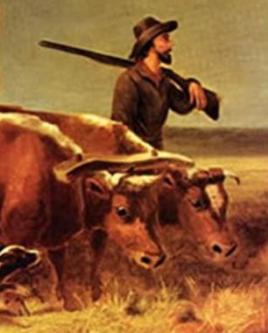
In early May 1868, Hispanic sheep ranchers from across Northeast New Mexico headed east on the Santa Fe Trail from Las Vegas. Five hundred men were taking 200 ox-drawn wagons filled with wool to the Eastern markets. The ranchers had no sacks for theit wool, but that didn’t stop them. They piled their cargo into their wagons, tramped it down, covered it with sheets, and moved out.
The ranchers’ caravan included at least 3200 oxen and over 500 horses and mules. To protect the animals not actually pulling cargo, the wagons traveled in two parallel columns, with the horses and extra oxen between them. About 100 men rode in front to watch for hostile Indians.
The Arkansas River was in flood when they reached it, and the caravan rested on the south bank for three days and waited for the water to subside. The crossing itself took another six days. The wagons full of wool were so heavy that 14 pairs of oxen were needed to get each one safely to the other shore.
Once everyone was across, relays of escorts from the newly established Santa Fe trail military forts accompanied the train to its destination. All in all, it seems to have been a good experience and the ranchers returned to New Mexico with a satisfactory financial outcome.
Their experience was a good deal more positive than Charles Blanchard’s later that year. Blanchard, a French-Canadian who’d settled in Las Vegas a few years before, also hauled loose wool east on the Trail that summer. He and 12 other men took their cargo to Ellsworth, Kansas, the then-terminal end of the Kansas Pacific Railroad. They reached Ellsworth in July and Blanchard sold his wool and traded his ox team and $2000 in cash for 66 mules and 10 wagons.
So far so good. But shortly after Blanchard and his friends headed towards home, they were attacked by Indians, who ran off all the caravan’s animals, including Blanchard’s new mules. The 13 men took refuge at Fort Dodge, where they remained until October, when the trail was deemed to be again safe for traffic.
Clearly, the lesson here for men looking for new wool markets in the late 1860’s was to go early in the Summer, and well armed with vecinos.
Source: Howard Bryan, Wildest of the Wild West, 1988, Clear Light Publishers, Santa Fe
Lucien Bonaparte Maxwell, richest man in northern New Mexico Territory, sat on one of the mismatched chairs in Elizabethtown’s makeshift Colfax County courtroom and studied the man sitting behind the Judge’s table. He’d sat at such tables himself, though he doubted he’d ever looked so uncomfortable. Joseph Palen looked out of place here in this rough mining town and angry that it had the audacity to call itself a county seat. Apparently disapproved of Nuevo Mexico, too, for that matter.
Maxwell felt the impulse to laugh, but instead lifted his right foot to his left knee and watched the crowd gather. Most of the men nodded to him politely, touching their foreheads in a kind of salute, and he nodded back. They were good people, he mused. Knew what they wanted, had no pretense about them.
Beside him, the old attorney Wheaton muttered, “Here we go,” and Judge Palen gaveled the room to attention.
“Apparently, Mr. Maxwell has deigned to honor us with his presence,” Palen said, glaring at Lucien.
Maxwell resisted the impulse to straighten his spine and put both feet on the floor. “I believe you asked to see me,” he said coolly.
 Fiction and Fact From Old New Mexico