CHICKEN FEED

Andrew had pilfered some of the chicken feed and scattered it on the snow for the finches.

Suzanna shook her head as she looked out the window. “That child,” she said.

“What’d he do now?” his father asked. He was sitting near the fire, mending mule harness.

“How did you know it was Andrew I spoke of?”

“You had that tone.” He smiled at her.

A small boy appeared on the ladder from the loft as Suzanna said, “There is chicken feed scattered outside, and the chickens are still penned up against the cold.”

The boy stopped suddenly, then began retreating upward.

“That’s not gonna work, son,” his father said.

“Perhaps next summer you should gather grass seed and set it aside for the birds,” Suzanna said, without turning.

He came to stand beside her. “They’re pretty, aren’t they?”

“And you are incorrigible.” She reached out to ruffle his hair.

from Moreno Valley Sketches I

Willow Creek Mining District Reorganizes

On Sunday, August 25, 1867, the miners of New Mexico Territory’s Willow Creek Mining District  organized themselves for the second time that year. They’d done a rush job in June. With miners pouring onto the slopes of Baldy Mountain, there hadn’t been time for organizing and mining too. But it didn’t look like things were going to settle down any time soon: There were up to 7,000 miners in the region, and activity everywhere. On Willow Creek alone, over 350 placer claims would be staked between 1867 and 1868, from high up Baldy Mountain almost to the edge of what is now Eagle Nest Lake. With the staking of claims came the potential for conflict. The only answer was to take the time to reorganize, and Sunday seemed as good a day as any.

The new Willow Creek rules allowed four claims per miner. A man could file a ravine claim (200 feet along the bottom and from bank to bank); a hill claim (200 feet along the stream by 300 feet toward the ridge), a flat claim ( 300 feet by 300 feet); and a quartz or lode claim (300 feet along the lode, with no specified width). In addition, a man who discovered a new creek, hill, flat, or load claim could also file one extra claim of any of the four types. To be considered “alive,” a claim had to be worked one day in every ten and at least once within the 15 days after it was recorded.

The Willow Creek Mining District lay on the south slopes of Baldy Mountain, much of it within the boundaries of the 20th century town of Eagle Nest, NM. The District was bounded on the east and north by the ridges that extended south from Baldy, and on the west by a divide that separated the creek’s drainage from Anniseta Gulch, which ran west in the direction of Moreno Creek and Elizabethtown.

While it never produced much lode gold, the Willow Creek District yielded well to placer operations. In fact, at one point, the main channel of Willow Creek was the highest producing creek bottom along the south and west slopes of Baldy Mountain, topping both Humbug Gulch and Grouse Gulch (see the table below). In addition, a Willow Creek side canyon called Last Chance Gulch and an area at the head of this gulch called Last Chance Flats, were both rich in gold. As a result, the District’s placers brought in 40% of the area’s placer gold in 1868 and 1869 and remained just behind Grouse Gulch’s placer production throughout the next decade.

Aug. 25 illustration.Value of load and placer mining

The high levels of gold from Willow Creek may explain why there were at least twenty miners involved in an 1869 court fight over placer claims and water rights on the creek. The battle was not resolved until Spring 1870, when Lucien Maxwell intervened, purchased all the water rights in question, and then proceeded to lease them back to just a handful of individuals. Even though Maxwell was in the process of selling the land grant, he was keeping the Willow Creek Mining District water rights—perhaps its most lasting wealth—firmly in his own hands.


Sources: R. F. Pettit, Jr. “History of mining in Colfax County, New Mexico,” Taos-Raton-Spanish Peaks Country (New Mexico and Colorado), Northrop, S. A. & Read, C. B., eds., New Mexico Geological Society 17th Annual Fall Field Conference Guidebook, 128 p., 1966; R. F. Pettit, Jr., Mineral Resources in Colfax County, NM, NMBM&MR Open-File Report 15, 1946; Colfax County New Mexico real estate records.


MOUNTAIN VALLEY COWPUNCHING

Harry nudged the cow pony with his heels and she trotted out to edge the spotted cow and its calf back into the bunch moving downhill toward the creek. While the pony did her work, Harry turned his attention to the trees topping the rise on his left. He’d been through them once already, but he had a suspicion he’d missed something. Then he saw it. A massive black bull rose slowly from a hollow in the ground, gazed at the herd below, then turned and headed into the trees.

Harry sighed. “Collect ’em all,” Gallagher had said. “Even the bastards.”

The cow and calf were now meandering alongside the rest of the herd, which continued its downward trek.

Harry turned his pony’s head toward the rise. The bull was nowhere to be seen. Harry shook his head. Damndest thing, herding cows up here. Too many trees entirely. When he got his month’s pay, he was headin’ to Cimarron, maybe beyond. Out on the plains, where people knew how to ranch. No more mountain valley cowpunching for him.

from Moreno Valley Sketches II

Readers Guide for The Pain and The Sorrow

Those of you who are members of a book club may be interested in knowing that there’s a Readers Guide included in The Pain and The Sorrow. The guide is also available here, so you can take a look at it and decide whether the book might be a good fit for your club. Remember, you can order the book online or from your local bookstore! I hope you’ll consider adding the book to your 2018 line up!

Does My Fiction Matter?

My writing has not been going well the last couple of days. I’ve felt a strange lassitude, as if none of it matters. As if my stories are irrelevant in a world where there’s so much dissension, such a lack of willingness to actually listen to each other’s concerns. Not each other’s words, but our deepest concerns: our fears, rational and irrational, our dreams, our hopes for our children and our world. I began to think, why am I even bothering to write? We’re so busy arguing with each other that no one seems interested in reading, in thinking, in doing much more than reacting to the latest news event.
 
But then I remembered: There have been news events to react to, people doing and saying atrocious things, since the beginning of time (or at least since the beginning of gossip, which I suspect began as soon as we humans had language). My goal for my stories has always been to try to help us see each other more clearly, to understand ourselves and one another and our deepest concerns. Because I believe that we’re all more alike, deep down, than we are different.
 
My fiction is set in the past for two reasons:
1. I am convinced that we humans haven’t really changed all that much over the millennia. People are people, no matter where you go.
2. Sometimes it helps to step into another era to see the fundamentals more clearly, to free up our imaginations past the latest news event to the point where we can see another perspective.
I hope my stories nudge my readers just a little toward looking again at what we think we know, examining our own motivations before we jump to conclusions about those of others.
 
My work is not overtly political. Sometimes I feel guilty about that, as if I’m avoiding a duty. But in another sense, it is deeply political. It is based on the idea that everyone has a story to tell, some knowledge that the rest of us can relate to on a deep level, that we’re all more alike in our pain and fear than we are different. My political stance is that we’d do well to take more time to listen to each other and less time talking.
 
And so I will go on writing what seems like simple entertainment, in the hope that someone, somewhere, will pause long enough to read something I’ve written and really hear what I’m trying to say.

IMPATIENCE

“This gold. They have found it in large quantities?” The lanky teenage boy named Escubal Martinez poked a stick into the logs on the fire, moving them closer together. At the edge of the mountain valley, a coyote yipped. The Martinez clan’s flock of sheep shifted uneasily in the darkness beyond the firelight.

The Prussian-born traveler from Etown grinned. “Ja,” he said. “But it is hard work, the digging for gold.”

Escubal’s uncle Xavier grunted from the other side of the flames, where he was using a knife to carefully smooth out an uncomfortable bump on the grip of his walking staff. “Borregas y carneros.” He nodded at the boy. “That is wealth.”

Escubal scowled at the fire.

The traveler looked puzzled. “Carner?” he asked. “Meat is wealth?”

“No, Borregas y carneros,” Escubal said.”Ewes and rams.” He gestured impatiently toward the flock.

Xavier moved his staff in the firelight and ran his fingertips gently over the wood. “Carne y ropa,” he said meditatively. “Meat and clothes.”

Ja,” the Prussian answered. “You are correct.”

Escubal scowled at the fire and the traveler smiled sympathetically. It was not easy to be young and impatient.

The boy poked at the fire again. It flared briefly, lighting the night, and the flock moved restlessly, waiting for morning.

from Moreno Valley Sketches II

ELEGANCE IN ETOWN

The men in Seligman’s Mercantile watched silently as the young woman in the trailing pale blue silk skirts swept out of the store.

“She’s a lardy dardy little thing, isn’t she now?” Charles Idle, the expatriate Englishman, asked. He shook his head and stretched his feet closer to the wood stove. “That dress and hat.”

Joseph Kinsinger spat a stream of tobacco toward the empty lard can by the stove. “Those silks ain’t gonna last long in this mud. And the wind’l take that hat.”

His brother Peter grinned. “You’re just worried Desi’s gonna see her and want a getup just like it,” he said.

“I wonder where’s she’s staying,” Idle said thoughtfully. “Hey Jim, where’d she say to deliver that sterling brush and comb set?”

The clerk hesitated, then shrugged. It would be all over town soon enough anyway. “The Moreno Hotel,” he said.

There was a short silence, then Idle said, “Well, I guess I’d better go see how my mine’s doing this morning,” and rose from his chair.

“I’ll bet,” Peter said sardonically, but Idle only smiled and went out.

from Moreno Valley Sketches, II

Lightning Strikes Missionaries in Cimarron Canyon

Exactly 146 years ago today, on Friday, August 4, 1871, three Methodist missionaries en route to Elizabethtown, New Mexico were struck by lightning and almost killed in Cimarron Canyon. Illinois natives Reverend N. S. Buckner and his 19 year old wife Annette had recently been appointed to take over Rev. Thomas Harwood’s responsibilities in Etown. They were travelling with Harwood, the man would go on to become the Methodist Bishop of New Mexico and co-found what is now the Harwood School in Albuquerque. The Buckners had just been assigned to assist him by taking over in Elizabethtown, where Harwood had dedicated a church building the year before.

The sun was beginning to set when Harwood and the Buckners reached the first section of Cimarron Canyon. Rev. Harwood’s buggy provided protection from the rain, so they weren’t uncomfortable. In fact, they were enjoying the thunderstorm and discussing the properties of electricity, when suddenly, thunder crashed, lightning flashed, and the smell of sulfur filled the air. The buggy itself had been struck and its passengers stunned to immobility. The force of the strike tore two large holes in the ground underneath the wheels, broke the crossbar behind the horses, and knocked the animals themselves off their feet.

Once the Buckners and Harwood were able to move again, they left the horses and walked back towards Cimarron “under the blazing lightnings and almost deafening thunder, muddy, wet and barefoot, . . . three miles to the nearest American house, and thence in wagon to Cimarron City” (Harwood, Vol. I, 129).
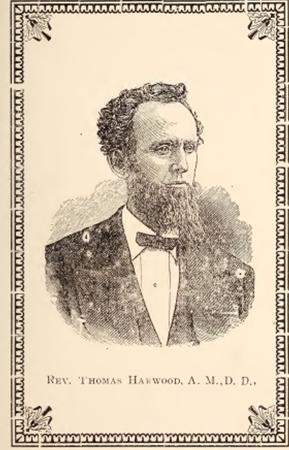
Aug 4 illustration.Thomas Harwood photo

Although they were all still feeling the effects of their lightning experience, the next morning, the little group of  missionaries were back in the canyon, this time on the Saturday stage to Elizabethtown, where the men preached at the morning and evening church services the next day.

It was an inauspicious beginning to the Buckner’s work in New Mexico Territory and things don’t seem to have improved much after that. Elizabethtown was a center of resistance to the Maxwell Land Grant Company’s plan to dispossess the area’s miners, ranchers, and farmers of their land. The town was rife with tension. The Buckners returned to Colorado in 1872. A year and a half later, in January  1874, they were replaced by Rev. Franklin J. Tolby, who lived in Cimarron but held services in Elizabethtown on a regular basis. Tolby himself would not last long. He was gunned down on September 14, 1875 on his way home from the Elizabethtown church, a date that many consider to be the beginning of the Colfax County War.

For fiction based on Reverend Tolby’s life and assassination, and historical information about his death, see my May 24, 2017 post and watch for them throughout September.


Source: Thomas Harwood, History of New Mexico Spanish and English Missions of the Methodist Episcopal Church, Vol. I and II, El Albogado Press, Albuquerque, 1910; Lawrence R. Murphy, Philmont, A History of New Mexico’s Cimarron Country, UNM Press, 1972, Albuquerque; ttps://www.timeanddate.com/calendar/?year=1871&country=1 accessed 7/17/2017

OLD BILL – 6 of 6

He had found it.

Old Bill stood on the rocky mountain ridge, hat in hand, and peered into the long green valley below. This was the larger section Three Hands had spoken of, sure as shootin’. Meandering streams glinted in the autumn light and the clouds overhead betokened more rain.

Old Bill laughed aloud, replaced his hat, and scrambled down from the rocks. His credit-bought beaver traps rattled slightly as the new mule carefully followed him down the mountainside. There’d be beaver here, he could feel it in his bones. If not in the valley itself, then surely in the streams flowing out of it through the mountains to the east.

“C’mon mule,” he said. “We’re gonna ’cuperate my losses and make us our fortune. All we gotta do is stay outta the way of  the Injuns and the Mexicans chasin’ ’em.” He chuckled. “Not to mention catamount an’ bear.”

from Moreno Valley Sketches