
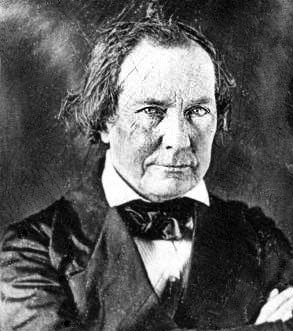
I’ve mentioned George Wilkins Kendall in recent posts and thought I should explain who he was and why I think he’s important to the events that led to the 1846-47 conflict between the United States and Mexico.
A rather handsome man, Kendall had thick, wavy brown hair and loved fashionable clothes. He was also a quick learner who tended to focus only on what he was particularly interested in. At age 16, he announced that he wanted to become a printer and went to work for the Amherst Herald, which was owned by his first cousin and a friend.
When the paper collapsed 12 months later, Kendall went to Boston, where he apprenticed with the Statesman and experienced Boston theater. This sparked an interest in acting that took him to New York City and a position with a wandering theatrical group.
For the next five or six years, Kendall around the U.S., sometimes working in theater, sometimes in print shops or as a reporter. At one point, he even operated a stage coach line in North Carolina. Somewhere along the way, he returned to his first interest and acquired the skills of a journeyman printer. Around the same time, he began to transition into the role of newspaper reporter, writing for the Mobile, Alabama Register; the United States Telegraph and National Intelligencer in Washington City; the True American in New Orleans; and the Sentinel in Greensboro, Alabama. In 1836, he settled in New Orleans and he and a friend prepared to begin printing what is today the Times-Picayune/New Orleans Advocate.

For folks in New Orleans, Kendall’s legacy would appear to be a newspaper that’s been in print since January 1837. However, in the 1840’s, he had a more immediate impact on events at large. The Picayune had published a series of pieces by a reporter named Matt Field. The articles, based on Field’s 1839 trip to New Mexico, were picked up by papers across the country and as far away as London. Field made New Mexico look both wild and accessible at the same time, and the popularity of his pieces seems to have sparked Kendall’s interest in going there himself.
Around the same time, there was a lot of national discussion about whether the Republic of Texas should be invited to join the Union. Kendall, and other who supported annexation, saw it as an opportunity to expand the U.S. as far west as the Rio Grande.
Since its founding, Texas had claimed that its western boundary extended to the river and included Santa Fe. In 1840, Texan President Mirabeau B. Lamar decided to enforce that claim by sending a group of soldiers to New Mexico along with a few merchants, to make it look like a commercial venture.
The Texas Santa Fe Expedition started from Austin in June 1841 and included Kendall, who, unlike his fellow travelers, had a passport from the Mexican vice-consul in New Orleans. As a reporter/publisher, Kendall had developed the habit of carrying a small black notebook, where he recorded ideas, jokes, and “sparks of wit” for future publication. He kept up this practice en route to New Mexico, noting both the good and the bad about the Expedition, its members, and their activities. He was devastated and furious when his notes were confiscated after he and other members were captured by New Mexico militia that Fall.
However, Kendall’s years as a reporter and his time on the stage seem to have stood him in good stead. He remembered in great detail what occurred between his capture, incarceration in Mexico City, and final return to New Orleans in May 1842.
As soon as he reached home, he began writing his memories down. The first installments were published in the Picayune in early June. This and the following chapters were reprinted in newspapers across the country and then into a book, A Narrative of an Expedition Across the Great Southwestern Prairies, from Texas to Santa Fe. The two-volume edition published in 1844 went on to become a best seller, with more than 40,000 copies sold over the next eight years.
The Narrative’s description of Mexico was both inflammatory and racist. Kendall portrayed the Texans as brave risk-taking Anglo adventurers while Damasio Salazar, the man who superintended the first part of the Texans’ journey south to Mexico City, was a “dark-visaged” monster with a vendetta against Americans. In addition, Mexican men in general were shiftless and the Mexican Army in particular was weak and poorly armed.
As the prisoners’ route takes them closer to Mexico City, Kendall begins to provide detail about the condition of the roads and the fortifications in the towns along the way. In fact, the book begins to seem more like a reconnaissance report than a traveler’s narrative. One has the sense Kendall hoped it would serve not only as a rallying cry against the “pernicious” Mexicans, but also as a handbook for an American invasion.
And he appears to have got what he wished for. When the war Mexicans know as “The War of the United States Against Mexico” came in 1846, many of the invading volunteers carried copies of Kendall’s book. After it was over, he published an illustrated book about the conflict, then went to Texas, where he settled in its Hill Country.
He is remembered there for his contributions to Texas sheep ranching. However, I consider the Narrative to be Kendall’s most lasting contribution to history. While many in the United States were already convinced in 1842 that its manifest destiny was to own everything to the Pacific, there was no justification for going to war to get it. But Kendall’s account of what he considered the inhumane treatment of the Texan prisoners gave people the excuse they needed.
He should be remembered for that, not with admiration, but as a caution to ourselves to carefully evaluate what we are told and the possible motivations that might influence that story’s content and message. As a reminder to watch out for the Kendalls in our own midst.


 Fiction and Fact From Old New Mexico