October Sale!

October Sale!

Because October was the month that the prisoners from the 1841 Texan Santa Fe Expedition marched down New Mexico to El Paso, it seems appropriate to put the novel I wrote about that march on sale. So, this month only, the paperback of The Texian Prisoners is 50% off ($8.99) and the ebook is $.99. You can find the Kindle version here and other ebook formats here.

To refresh your memory of what this book is about, here’s the description.

They called themselves “Texians.”

In Fall 1841, a band of roughly 300 men straggled out of the Staked Plains into New Mexico. They had intended to claim everything east of the Rio Grande for Texas. Instead, they were captured and sent south to El Paso del Norte, then on to Mexico City. The largest group of prisoners, which included journalist George Wilkins Kendall, was escorted to El Paso by Captain Damasio Salazar. Five prisoners died on that trek. Kendall would later write a book describing the experience, a book which accused Salazar of food deprivation, mutilation, and murder, and fed the glowing coals that would become the Mexican American War.

But what really happened on the way to El Paso? 
The Texian Prisoners tells the story through the eyes of Kendall’s friend George Van Ness, a lawyer burdened with the ability to see his enemy’s point of view, and asks us to consider the possibility that Kendall’s report was not unbiased.

A historically accurate retelling of Larry McMurtry’s Dead Man’s Walk, this fictional memoir will make you question everything you thought you knew about Texas, New Mexico, and the boundary between them.

BOOK REVIEW: Letters and Notes on the Texan Santa Fe Expedition, 1841-1842

In June this year, I posted something very rare for me: a less-than-positive book review. The review was of a book that serves as a primary source for most historical research about the ill-fated 1841 Texan Santa Fe Expedition. I had a number of issues with that text. However, during my own work on the Expedition, I was pleased to discover primary source that I can recommend wholeheartedly: Letters and Notes on the Texan Santa Fe Expedition, 1841-1842 by Thomas Falconer.


Falconer was one of the few British members of the Expedition. A trained barrister with a strong interest in the natural sciences, he traveled to Texas to explore emigrating there and was almost immediately invited by President Lamar to accompany the Expedition as a scientific observer.
Kendall describes Falconer as a “gentleman of high literary and scientific attainments [with] mild and agreeable manners,” who was “extremely sociable and companionable” (Kendall, I, 26-27), rather careless of his appearance, but well equipped with “a number of books and scientific instruments” (Kendall, I, 43).


Falconer’s books, instruments, and notes were, unfortunately, confiscated when the Texans finally reached New Mexico. However, his memory and interest in his surroundings stood him in good stead. After he was released from prison in Mexico City, he went to New Orleans, where he developed a report for Kendall’s newspaper, the New Orleans Picayune. This and his “Notes of a Journey Through Texas and New Mexico,” published in the British Journal of the Royal Geographical Society in 1844, form the core of Letters and Notes.


This book is valuable for several reasons. First, it provides an antidote to Kendall’s more excitable, and not altogether trustworthy, version of events in New Mexico in 1841; second, it gives us valuable information about the geography and plants of the region during the early 1840s; and third, it provides an outsider’s view of the Texans and their foibles, as well as insight into the sort of information about the North American continent that the English found useful.


Falconer’s other books, one about the Oregon question, and another about the discovery of the Mississippi, are also fascinating reads, but if you’re interested in the history of New Mexico, particularly the 1841 Texan Santa Fe Expedition, I highly recommend his Letters and Notes.

Sources: Thomas Falconer, Letters and Notes on the Texan Santa Fe Expedition, 1841-1842, New York: Dauber and Pine, 1930; George Wilkins Kendall, A Narrative of the Texan Santa Fe Expedition, Vol. II, Harper and Brothers: New York, 1847.

Texan Prisoners Reach El Paso!

Texan Prisoners Reach El Paso!

When the last of the men from the Texas Santa Fe Expedition reached El Paso del Norte (today’s Juarez) in early November 1841, they must have felt as if they’d come out of hell into paradise.


They had traveled roughly 1000 miles from Austin, Texas to New Mexico, starving a good deal of the way, then about 500 more, as prisoners, from eastern New Mexico to the Rio Grande, then south, a route that included the desert-like Jornada del Muerto, or Journey of the Dead Man. They had endured unbearable heat on the plains and snow and icy winds on the Jornada. Now, though they were still prisoners, life had become much easier.


The very weather had changed. George Wilkins Kendall noticed it the night before they arrived, when, he says, “the evening air was of a most wooing temperature mild and bland” (Kendall, II, 23). As the Texans reached the outskirts of El Paso, they saw that the very plant life was different. The valley, irrigated by a canal from the Rio Grande, boasted abundant wheat, onions up to four pounds in weight, fruit trees, and extensive vineyards (Timmons, 195).


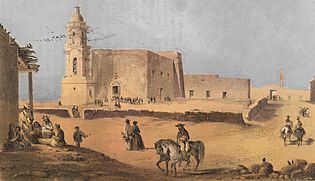
Even Kendall, who spent almost all his time in Mexico complaining, liked El Paso del Norte. Although his report doesn’t mention its famous building, the mission of Guadalupe de los Mansos, he does rhapsodize about the city’s “delightful situation in a quiet and secluded valley, its rippling artificial brooks, its shady streets, its teeming and luxurious vineyards, its dry, pure air and mild climate, and, above all, its kind and hospitable inhabitants” (Kendall, II, 42).

The Guadalupe Mission was painted in 1850 by A. de Vauducourt.
Source: es.wikipedia.org/wiki/Misión_de_Guadalupe_de_los_Mansos_en_el_Paso_del_río_del_Norte Accessed 10/17/23


Part of the reason Kendall was so impressed by the hospitality was that he was one of several Texans hosted by Presidio Commander José María Elías González. And hosted lavishly. Kendall reports the afternoon hot chocolate, the evening wine in glasses the size of New England tumblers, the tasty blood puddings, and other details of the table with great glee.
But the party couldn’t go on forever. The Texan prisoners were on the road again on Tuesday, November 9, heading to Chihuahua en route to Mexico City, where life would again become difficult. The idyll of El Paso was over, and prison and the whims of President Santa Anna, who the Texans had humiliated at San Jacinto, waited ahead.

Partial Sources: Ruben Cobos, A Dictionary of New Mexico & Southern Colorado Spanish, Santa Fe: Museum of New Mexico Press; George Wilkins Kendall, A Narrative of the Texan Santa Fe Expedition, Vol. II, Harper and Brothers: New York, 1847; W.H. Timmons, El Paso, A Borderlands History, El Paso: Texas Western Press, 2004.