
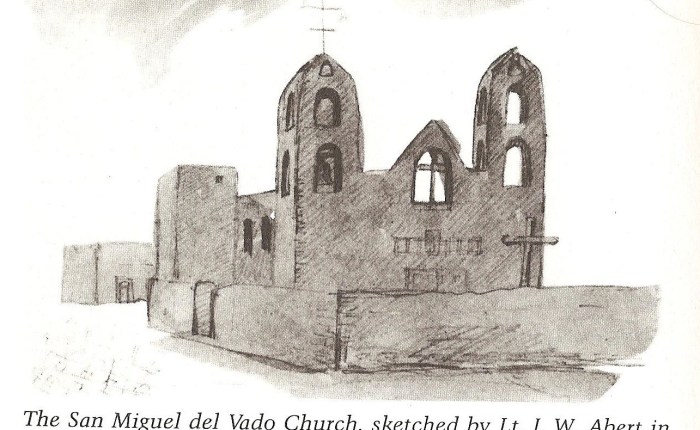
Mexican militia captain Damasio Salazar hadn’t been particularly pleased about his assignment to take the final batch of Santa Fe Texas Expedition prisoners south to El Paso del Norte. However, the past four days hadn’t been too bad. The prisoners had complained, of course, and he’d had a bit of trouble locating enough food for them, but the communities between San Miguel del Bado and Valencia had been surprisingly generous, especially the pueblos north of Albuquerque.
But now, on Monday, October 21, 1841, trouble had really started. First, he woke to a dead prisoner. Felix Ernest had been weak to begin with. And no wonder. He’d been with the Texans who had been out the longest and starved the most. The poor scurvy-ridden devils had ended up eating lizards, snakes, and boiled horse hide. Ernest hadn’t been actually ill, as far as Salazar knew. He was just too weak to wake up.
The Captain acted quickly to prevent other prisoners from dying on him by immediately requisitioning a cart from the Valencia alcalde and loading the weakest men onto it. But the dilapidated thing was so overwhelmed with riders that it fell apart a mile down the road.
This disaster precipitated another problem. A Texan who’d been riding, a man named McAllister, was so lame he couldn’t walk any further. When one of the more stupid of Salazar’s guards threatened to shoot him, the Texan yelled at him to do just that, and the idiot took him at his word.
Now Salazar had two dead prisoners to account for when he reached El Paso. He couldn’t very well carry the bodies with him. He’d had to resort to cutting off the men’s ears as proof they hadn’t run away.
He must have been thankful when he and his column finally reached the day’s destination, a grove of cottonwoods on the east bank of the Rio Grande south of Belen. The captain ordered one of the nineteen Texan cattle slaughtered. Maybe the meat would put some strength into the men and get them through what was to come. There were only a few more towns where he could acquire rations. Then, he and his prisoners would face the Jornada del Muerto.
By his calculations, they would be crossing right at the end of October. He needed to get 187 men, their guards, and the animals across a 90 mile stretch of wasteland notorious for a lack of water, especially this time of year. It was at least a three-day journey across a land of sand, rocky outcroppings, and an occasional stunted cactus. There was a reason it was called the journey at death.
The place lived up to its name. Three more men died crossing the Jornada. Salazar took their ears as well, and presented them to the Presidio commandant at El Paso del Norte. Although the Texan prisoners, particularly American newsman George Kendall, were appalled by what they saw as his savagery, the Captain was actually following orders —and precedent. The use of ears to account for dead enemies had been instituted by the man he presented them to in early November 1841.
Salazar did face a court-martial however, in response to questions Kendall raised about the Texan cattle left grazing outside El Paso. Once he’d been cleared of wrongdoing, the Captain returned to New Mexico. He would live out his days there, although he did have a brush with Anglo retribution in December 1846, when he was accused of participating in a conspiracy against American occupation.
There was no evidence that he’d been involved in those aborted plans and Salazar was allowed to go home in peace. Whether or not he was still haunted by the memories of the 1841 march south to El Paso is another question entirely.

 Fiction and Fact From Old New Mexico