In my forthcoming novel set in Santa Fe, New Mexico, the young people at the heart of the story don’t go home after church. They go to the plaza. They aren’t the only ones. In fact, American newcomers to the city were often shocked at what they saw as a desecration of the Sabbath. People weren’t merely walking. They were shopping, dancing, and gambling, and probably drinking as well.
This Sunday ritual didn’t change after the U.S. Army invaded in 1846. Lt. Abert tells us that “in the square all the people congregate to sell their marketing and one constantly sees objects to interest and amuse. It is filled with donkeys laden with immense packs of wood, fodder, melons, and other articles. The soldiers too are constantly passing and mingling in a motley group.”
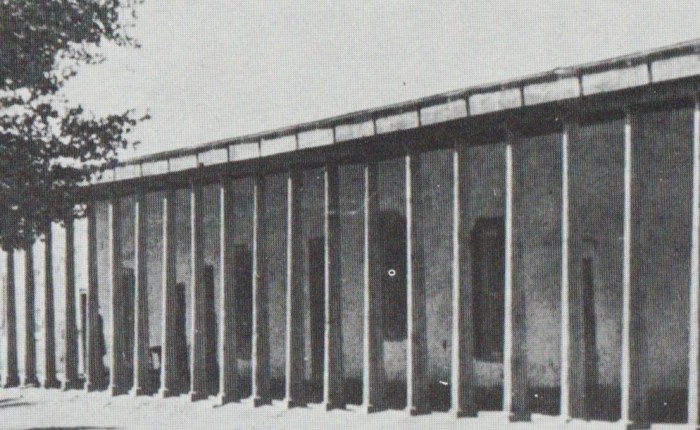
Part of the reason for this activity on the plaza was that it was a pleasant place to be. Even Susan Magoffin, who had little else good to say about New Mexico, found that the square made for “a fine walk.” “The Plaza or square is very large,” she reported. The Governor’s Palace, or palacio, with a wide portal in front, formed the north side of the square, while a church and dwelling houses faced it on the south. “The two remaining sides are fronted by stores and dwellings, all with portals,” she added. “In rainy weather there is no use for an umbrella.”

The portales, or verandas, Magoffin mentioned provided shade for the buildings and were shaded themselves by what Magoffin described as a circle of trees around the square. These were cottonwoods which had been planted only a couple years before, probably using the pole planting method. A small irrigation ditch, or acequia, ran alongside the trees.
Under the portales, vendors sold everything from pottery to sweet onions. There were plenty of other ways to spend one’s money as well, namely gambling. One didn’t have to go indoors to indulge in this pastime. Out-of-doors games included pitarria, which was played on smooth ground inside a marked square, with short sticks of two colors. Quoit pitching, using pegs driven into the ground, was also available.
Those who wanted to gamble could play monte, both with a full deck of Spanish cards, and a three-card version. Roulette was also popular, as were various games of dice.
Later, if one liked, someone in town was apt to be holding a dance, and everyone was welcome, from the priest to the criminal released from jail for the evening. Everybody danced, the lady with the ragged farm worker, the old man with the little girl.
Newcomers also disapproved of the city’s open door dancing policy. Matt Fields tells us of a ball given by the Governor in 1839 which “all the beauty and fashion attended, and also all the rabble,” adding, “the dances, as well as all the manners and customs in Santa Fe, are of a demi-barbarian character”. Nineteenth century Americans, whose country was founded on democratic principles, were certainly quick to make negative social distinctions.
Some things never change.
© Loretta Miles Tollefson
Sources: W.H.H. Allison, Old Santa Fe Magazine, 2:2, “Santa Fe During the Winter of 1837-1838”; Sheila Drumm, Down the Santa Fe Trail and Into Mexico, Diary of Susan Shelby Magoffin 1846-1847; Janet LeCompte in Joan M. Jensen and Darlis M. Miller, New Mexico Women, Intercultural Perspectives; Clyde and Mae Reed Porter, Matt Field on the Santa Fe Trail.

 Fiction and Fact From Old New Mexico