PRODUCTIVE REVENGE

Placido Sandoval slammed the pick mattock into the rocks at his feet in a blind fury. “This Prussian, this not truly Americano, how dare he speak to me in such a way? As if I were dirt, less than nothing?” he fumed. “Mi familia has lived in this country for generations. I am of the conquistadors, the flower of España, while he is of the peasants in his country. I heard him bragging of it, how he has raised himself above his ascendientes.” He smashed the wide edge of his mattock against the largest of the rocks. A chip flew off, ricocheting into the face of the man working beside him.

“¡A redo vaya!” the other laborer said. “The devil! Be careful!”

Placido Sandoval swung the pick again, just as sharply, and his companion stopped his own work to turn away. “It does no good to be angry,” he said over his shoulder.

Placido glared at him. “It is good for my soul,” he growled. He slammed the pick against the nearest rock. Three large pieces broke free and tumbled farther down the stone-filled gully. “I will not be beaten by such as he. I will not be cowed.”

“You there!” Edward Bergmann, the mining supervisor, called from the bank above them. “You Mexicans!”

The two men paused and looked up. The Prussian’s finger pointed accusingly at Sandoval, his fierce black eyes indignant. “Did I not tell you to go slowly, to be more methodical in your approach? I’ll fine you again if you don’t stop flailing around!”

“I’ll flail you!” Placido muttered as he and his companion returned to their work. But his mattock chopped more sullenly now, reflecting the pattern Bergmann had set for it. Suddenly, gold glinted from the ground. Placido glanced up at the bank. Bergmann had disappeared. Placido bent swiftly and pocketed the chip of rock and ore.

Placido’s companion chuckled as he continued to swing his own tool. “That’s a more productive approach,” he said approvingly. He glanced toward the bank. “Though more dangerous if you are caught.”

Placido Sandoval grunted an unwilling acknowledgement as he continued on with his work, chopping at stones.

from Valley of the Eagles
THE LOST SOUL

As Jorgé Ruibal wandered up the middle of the road toward Elizabethtown proper, the men outside the taberna watched him sympathetically. “El joven es como alma en pena,” Carlos Otero the jeweler said. “The young man is like a lost soul.”

“Si,” said the boy’s uncle. “He has lost his laborer job with Señor Bergmann. His papá is very angry with him.”

“I heard he was in love and that his love was unrequited,” Eduardo Suaso, the taberna’s musician, said.

María de la Luz, the boy’s cousin, appeared from around the corner of the building. She carried a basket of clean linens for delivery to Henri Lambert’s Etown restaurant and hotel. She gazed at Jorgé, who’d stopped to poke his foot at a stone in the road. “He wants to leave here, but his mamá is unwilling,” she said.

Jorgé, oblivious to these speculations, still stood in the dusty street, poking at the stone with his boot. It was so inert and yet so full of a kind of compressed energy. He looked east, toward the massive bulk of Baldy Mountain. The gullies that swung out from its sides were full of rocks and men scrambling through them looking for gold. Yet the mountain bulked there impassively, impervious to the miners who crawled over it. Jorgé crammed his hands in his pockets and stared upward, drinking in its stony greenness, its lack of engagement with the tiny men poking at its skin.

Outside the taberna, the americano miner called Hobart Mitchell came to the door with a drink in his hand and considered the staring boy. “He looks like’n idiot, standin’ there,” Mitchell said. “Touched in the head.”

The others all nodded noncommittally and continued to gaze sympathetically after Jorgé as he wandered on up the road.

from Valley of the Eagles

YOU PROMISED ME GLASS WINDOWS

Suzanna’s eyes narrowed and her lips tightened. “I did not come to this god forsaken valley to live in a cave,” she snapped. The toddler on her hip started fussing but Suzanna only shifted impatiently and continued to glare at her husband on the other side of the room. “You promised me glass windows. You also said you wanted to farm, that you were finished with trapping.”

Gerald gestured at the beaver pelts lying just inside the cabin door. “I was finding the means to buy glass,” he said mildly.

Suzanna turned away. “The money will just go to something else.” Alma fussed again and Suzanna bent to place her on the floor. “The mule will go lame or cougars will take down a couple more calves.”

“Suzanna sweet–”

“Don’t you ‘sweet’ me!” She straightened, hands on her hips. “I will not be sweet-talked out of this! You can’t expect me to live in a cabin with just shutters at the windows, sitting in the dark whenever it rains!”

“We have lamps.”

“It’s not the same and you know it!”

Alma had toddled to her father. She clung to his leg, looking up at him. “Papa stay home?” she asked. “Mama ang’y.” She shook her dark curly head. “Me don’ like Mama ang’y.”

Gerald and Suzanna stared at each other for a long moment. Then Gerald scooped Alma into his arms and Suzanna threw her hands in the air helplessly and crossed the room. She leaned her head against his shoulder. “I had no idea when you would return,” she said into his sleeve.

 Copyright © 2016 Loretta Miles Tollefson

The Lizard as Hero: Book Review

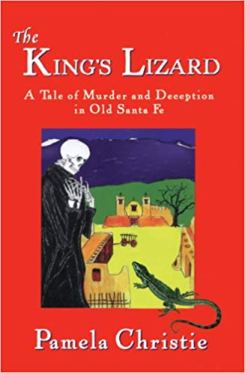
The almost-invisible lizard sunning himself on a rock or a log is a common occurrence  in New Mexico. I almost stepped on one in the garden this morning. However, I would never have thought to use a lizard as a metaphor for a detective and “fixer.” But Pamela Christie did, and the resulting books are a fascinating look at New Mexico in the 1780s.

Kings Lizard cover

In The King’s Lizard, Christie introduces us to the Old New Mexico version of the invisible person—the half-Ute, half-Spanish Fernando “Nando” Aguilar who lives in a kind of limbo between his Spanish and Native origins. This liminal status makes Nando easy to overlook. But it also gives him access to both the Native and Spanish worlds, an access which makes him a valuable tool for Governor Juan Bautista de Anza.

Governor Anza has been tasked with creating a lasting peace with the Comanche. But there are men in New Mexico who don’t want peace. Unsettled conditions give them access to human contraband. And contraband sales fund a more-than-comfortable lifestyle. Nando becomes part of these men’s merchandise and then, after he escapes their clutches, the key to destroying the slave network as well as providing the Governor with a path to peace.

Dead Lizards Dance cover

In Dead Lizard’s Dance, Nando once again saves the day, sorting out a plot that not only threatens the Governor, but also his own family’s security. Rumors of witchcraft go hand in hand with the struggle to control the caravan of goods to and from Mexico that is the colony’s lifeline.

This particular novel also highlights the status of women in the colony, and it isn’t a particularly pretty picture. But Nando protects the women he can, including those who’ve exacted revenge on a man who’s made a life’s work of abuse and betrayal.

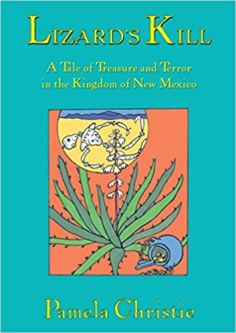
Lizard’s Kill appears to be the end of the road for Nando’s work for Anza, because the Governor’s term of office has ended.

Lizards Kill cover

He’s on his way back to Mexico and retirement. But Anza has one more service he hopes to perform for New Mexico and only Nando Aguilar has the skills to achieve the impossible.

Christie brings a deep knowledge of a complex bygone world  to these three books, a knowledge that seems to expand with each story. Her writing and her observations about New Mexico life and politics in the 1780s grows more deft with each novel. If you’d like to know more about this period and are looking for a good mystery series to dive into I recommend these books.

Long live lizards!

P.S. All of these books are also available directly from Pamela Christie, who says she prefers direct contact with her readers. And she’ll also cut deals! You can contact her at christiepr@gmail.com.

PROTECTION 3 of 3

“She threw a stick at a mountain cat that was goin’ after the boy and it run off?” the old man who was visiting asked. “Mid-lunge?” The two men sat on stools in front of the cabin fire, a whisky jug between them.

“That’s what she says.”

They both turned to look at Gina, who sat on the bed in the corner, singing a lullaby to the child, crooning him to sleep.

“Hard to believe,” the old man said, stroking his stringy white beard.

“Old cat,” Charles said.

“Maybe.” The old man took a sip from the jug. “Coulda been a young one, though. A woman’s protective instincts can be almighty strong.”

There was a disbelieving grunt at the fire and then silence.

“Stranger things’ve happened,” the old man observed. “And she does take kindly to that child.”

“She does that,” her husband said grudgingly.

from Old One Eye Pete

Rosary Without Beads: Book Review

Rosary Without Beads cover
by Diana Holguín-Balogh
ISBN: 9781432844745
Five Star/Cengage, 2018

Rosary Without Beads has changed my mind about Billy the Kid.

I’d been told that, in addition to being an outlaw, Billy the Kid was also a lady’s man. That didn’t make him more attractive to me. A thug and a womanizer. Why would I find that appealing?

However, Diana Holguín-Balogh’s masterful fictional portrayal of Billy the Kid and a young woman who falls for him has me seeing Billy in a new light.

Rosary Without Beads presents a Billy who’s passionate about justice and fair play, and loyal to a fault—characteristics which end up placing him on the wrong side of the law. He also has a facility with English and Spanish that could sweet talk a rattlesnake out of its rattles.

Billy’s linguistic charm is a primary reason I like this book so much. Holguín-Balogh has a gift for writing broken English/Spanish so that it’s not only comprehensible, but has a music all its own. This is true not only of Billy’s verbal skills, but also of the other characters, especially the female protagonist, Ambrosia.

Ambrosia doesn’t have an easy life. She’s been promised to a man who would really rather have her sister. That’s bound to make a girl feel unattractive. So when Billy shows up and shows some interest, she’s pretty much swept off her feet. She doesn’t succumb to his charms easily, though. Holguín-Balogh does a great job of expressing this girl’s mixed emotions about Billy all the way through the novel.

I suppose I can safely tell you that the Kid dies at the end of this book. I suspect that’s a story most of us know. However, Rosary Without Beads presents a take on the usual explanations for the circumstances of Billy’s death, and what happens afterward, which may surprise you. But you’ll have to read the book for yourself to find out what that take is.

If you’re looking for a historical novel you can sink your teeth into and feel like you’ve learned something in the process, I recommend this book!