NOT JUST ANY MAN – CHAPTER 9

NOT JUST ANY MAN – CHAPTER 9

The following material is an extract from NOT JUST ANY MAN, A Novel of Old New Mexico, Copyright © 2018 Loretta Miles Tollefson. Published by Palo Flechado Press, Santa Fe, NM

A Note about Spanish Terms: This novel is set in northern New Mexico and reflects as much as possible the local dialect at that time. Even today, Northern New Mexico Spanish is a unique combination of late 1500s Spanish, indigenous words from the First Peoples of the region and of Mexico, and terms that filtered in with the French and American trappers and traders. I’ve tried to represent the resulting mixture as faithfully as possible. My primary source of information was Rubén Cobos’ excellent work, A Dictionary of New Mexico and Southern Colorado Spanish (University of New Mexico Press, 2003). Any errors in spelling, usage, or definition are solely my responsibility.

CHAPTER 9

Williams and Gerald move down the Cimarron over the course of the next week, trapping as they go, a day or two in each location, setting traps, pulling in beaver, skinning carcasses, and stretching plews. They eat what they trap until the aroma of fatty flesh drifting from the fire begins to turn Gerald’s stomach.

Occasionally, they see wild turkey. The sleek birds slip through the forest without any apparent awareness of the humans, but keep well out of reach. Old Bill claims he doesn’t want to shoot them for fear of bringing larger, two-footed varmints into range, but Gerald suspects the red-haired man has an affinity with the birds that precludes killing them unless absolutely necessary.

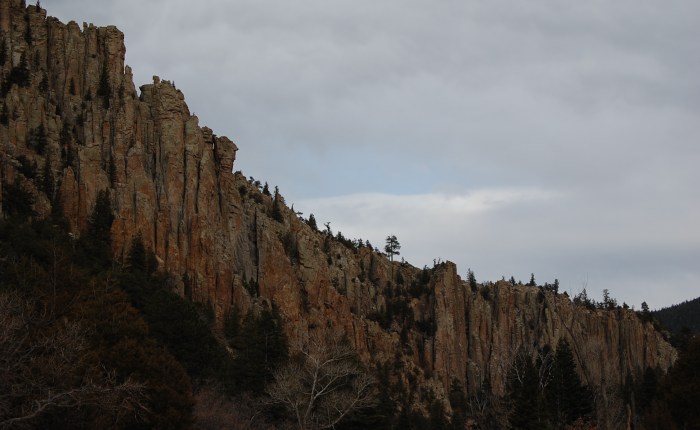
Gerald himself finds the turkeys unaccountably beautiful. There’s a wild wariness to them unlike anything he’s ever encountered in barnyard fowl. Although he has to admit that an alternative to beaver flesh would be nice. When the men and their mules break into the small snow-drifted valley Williams calls Ute Park, it’s more than the scenic value that lifts Gerald’s heart. A herd of perhaps thirty elk browses at the base of a small rocky cliff to his left.

Williams halts, studying the herd. Although the elk seem unaware of the trappers, they also seem restless. Suddenly, a large cow bolts toward the river on the other side of the valley. As the other elk follow, three wolves—two small grays and a big black—circle into sight, tagging the stragglers.

The elk barrel across the snow and grass, surge into the icy stream, then scramble up the far bank into the trees. A young bull, its left hind leg dragging, balks at the river’s edge, perhaps wishing for a more shallow ford. The wolves move in swiftly. As they cut the elk away from the stream, a raven caws overhead.

Williams chuckles, drops his mule’s lead rope, and lifts his rifle. As its muzzle roars, an identical blast erupts from the base of the stone outcropping, and the bull stumbles and goes down. The wolves dart in, then pull slightly back. The big black looks over his shoulder, toward the cliff.

Williams’ head swivels, following the wolf’s gaze. “Well, I’ll be hornswoggled,” he says.

An Indian man, his hair in the long braids and tall pompadour characteristic of Ute men, moves from the cliff. He waves an arm at the wolves and they slink, tails between their legs, toward the leafless willow brush that crowds the riverbank a half-dozen yards downstream. Then they turn and crouch in the grass, eyes flicking between the approaching man and the elk.

“Waagh!” Old Bill groans. “That Ute’s gonna claim that bull, and now him and those wolves have that whole herd most righteously spooked. We don’t have a chance in hell of gettin’ another one, and all we’ve got for supper is that quarter beaver that’s on the edge of sour, and that little bit of tail.”

“It may have been your shot that brought that bull down,” Gerald points out.

“Don’t matter,” Williams says. His eyes rake the valley. “He appears to be alone,” he adds thoughtfully. Then he shrugs. “Well, it’s worth a try anyhow. We’re two against one.”

He grabs his mule’s lead rope and moves forward, Gerald and his mule slightly behind.

The Indian looks up as they move toward him. Then he raises his knife and slices deep into the elk’s belly. He yanks out a long handful of glistening entrails and turns to toss it toward the wolves. The black darts in, mouths the food, and drags it off, his companions following obsequiously.

“That’s us,” Williams says over his shoulder. “Those grays.”

Gerald grins and nods, his eyes on the Ute, who’s pulled off his buckskin shirt and gone back to work on the elk carcass, pointedly ignoring the two trappers. Gerald and Williams are within ten feet before he looks up again.

Old Bill signs “Hello” and the other man nods noncommittally as his knife continues to slice into the elk.

“That there was a good shot,” Williams says, then repeats himself with a few fluent hand signs.

A smile flashes across the Indian’s face. “You shot wide,” he says in English.

Williams chuckles. He looks down at the carcass and gestures toward its front quarters. “Mind if I just turn him a mite?”

The Indian, who’s now crouched at the elk’s tail, incising careful circles around its hooves, nods and pauses in his work. Williams moves forward, grasps the bull’s neck in both hands, and lifts, twisting the body first one way, then the other.

“There’s a bullet in each shoulder,” he says.

The Indian grins. “I arrived first. Made first cut.”

“You did at that,” Williams agrees. “But that’s a whole lot of elk for one man to feed on.”

The man’s eyes flash and the knife in his hand lifts slightly. Gerald shifts his rifle, but the Ute’s eyes remain on Old Bill’s face. He gestures toward the rocky outcropping and the mouth of the narrow valley that stretches further north. “My family waits.”

“I don’t suppose we could trade you a bit of beaver for a haunch?” Gerald asks.

Williams nods at Gerald. “Beaver fat would be just the thing to flavor that elk,” he says. He turns to the Ute. “You know how dry and tough elk can be. Especially this time of year, when the little grass they’ve had is all dried out and worthless.”

The Indian’s gaze moves across the valley’s patches of still-thick brown grass, then to Williams’ face.

“Though, I have to tell you we’ve got a righteous hunger for beaver,” the trapper says. “My partner here likes it so well he just truly can’t get enough of it. So you could say he’s makin’ a sacrifice, offering you some. We can spare you some tail, too, for that matter.” He looks at Gerald. “If that’s all right with you.”

Gerald nods and Williams looks at the Ute. “We just thought we’d do you a favor, is all. Give you somethin’ to sweeten the pot and put some taste in that rangy old winter elk.”

“Show it me.”

Gerald fumbles with the leather thongs that secure the wrapped portion of beaver to his mule’s packsaddle and lifts the meat down. “It was fresh yesterday morning,” he says.

The Indian leans forward slightly, his nostrils flaring. Then he pulls back, nods, and gestures toward the elk carcass. “I trade front left shank,” he says. He grins at Williams. “Your piece.”

Gerald grins. The front pieces are smaller than the hindquarters.

Old Bill nods. “That’ll do right well.” He sticks out a hand. “My name’s Old Bill Williams and this here’s Gerald Locke.”

The Ute frowns at Gerald. “I know older man this name.”

Gerald smiles. “My father and I are both named Gerald Locke,” he says. “I am called Gerald Locke Junior.” The man looks puzzled. “Gerald the younger,” Gerald explains.

The Ute nods, studying Gerald’s face. “I can see it is so.” He lifts a bloodied hand toward his chest. “I am Stands Alone.” His gesture takes in the valley, then the peaks upstream. “This my place.”

Gerald nods. How far does the Ute’s place extend? But he merely says, “We’ve been trapping beaver on the river here. Is that all right with you?”

Williams swings his head, glaring, but neither Gerald nor Stands Alone respond. They stand, looking into each other’s faces, then the Ute says, “For beaver to flavor the pot,” and Gerald grins and nods.

Williams shakes his head in disgust. He jerks his thumb downstream. “We’re trappin’ that direction.” His tone makes it clear that he’s not asking permission.

Stands Alone nods. “No beaver there beyond a half-day journey,” he says. “The water is swift.” He jerks his head southwest, toward the other side of the river. “That way, toward the black valley, there may be beaver.”

Williams frowns. “Not in the Moreno Valley,” he says. “We was just there and there ain’t any there. Never has been, far’s I know.”

Stands Alone gestures toward the peaks that rise above the opposite bank. “That way is a smaller valley with many seeps. I have seen beaver.” He shrugs. “Too far for too little meat.” He spreads his hands and a ghost of a smile glimmers in his eyes. “I give them to you.”

Old Bill throws back his head and barks a laugh. “We can have all we want, huh? As long as we leave the elk here for you?”

Stands Alone smiles noncommittally.

Gerald chuckles and gazes toward the pine-covered slopes. “I suppose the quickest way there is back the way we came.”

Stands Alone nods. “There is a way when grass is green,” he says. “But when snow comes, following water is best.” He bends and goes back to his work, deftly cuts a section of meat from the elk’s shoulder, then proffers it to Old Bill.

Williams shrugs, wraps the meat in a piece of buckskin, and attaches the bundle to his mule’s packsaddle. Stands Alone returns to his labors and doesn’t look up as the trappers turn and move up the valley.

As the canyon narrows around them, Gerald glances back. The Ute man has been joined by two female figures and a horse-drawn travois. The women bend over the elk while he washes his hands in the river.

~ ~ ~ ~

Intermittent snow slides in over the canyon brim as the trappers move west. The flakes become steadily smaller and more intense, and the cold increases proportionately. Gerald and Williams camp again at the foot of the eagle nesting cliff. When they wake, the snow has stopped and the valley beyond is blindingly white. As Gerald squints, trying to see the peaks on the other side, Old Bill grabs charcoal from the coolest edge of the fire and begins smudging it onto his face below his eyes.

“You best be doin’ this, too,” he tells Gerald. “It keeps the glare from gettin’ your eyes. Your skin’s darker’n mine but even the Injuns do it this time of year.”

Gerald swings his head, waiting for Williams to speculate on the difference in their skin tone, but Old Bill has turned away and is smearing charcoal on his mule’s cheeks, as well. The animal pulls back, resisting, and Gerald chuckles and reaches for his own piece of burnt wood.

They move out, into a sweep of icy, concentrated sunlight. The glare bounces from the snow and forces the men’s eyes into mere slits. Gerald’s head feels like it’s being split in two, first by the dry sharpness of the cold, then by the piercing light. Even with the charcoal smudged on his cheeks, he has to work to see Williams, a mere ten feet ahead.

Old Bill hugs the valley’s eastern edge, skirting the base of the snow-covered hills as they move south. On the west, the mountaintops are buried behind a mass of gray clouds that seem to only intensify the blaze of the sun above them.

Then a breeze springs up. It lifts the top layer of snow and spins an icy spray around the men and mules. “Might as well be snowin’ again!” Williams yells. His voice drops, still muttering, then rises. “That Ute can have it!”

Gerald’s lips are too stiff with cold for him to even smile in response, but when they stop to noon in the lee of a snow-covered ridge and he’s recovered a little, he grins at Williams. “You think Stands Alone spends much time up here in winter?”

“Not in a teepee!” Old Bill says. “These winds’d blow his lodge poles to smithereens.” He grunts disparagingly and uses a finger to work a piece of jerky from behind a molar. He pulls the half-chewed meat out, looks at it, puts it back in his mouth, and tilts his canteen. Nothing comes out. “Frozen solid.” He looks at Gerald. “You got any?”

Gerald reaches for his own water container and jiggles it. “It sounds like something’s still liquid,” he says. He hands Williams the canteen.

“See, that’s the difference between an Injun and a white man,” Williams says. “You just hand it to me, knowing I’m wantin’ a drink. An Injun’ll bargain with you, daylight to dark, to see what he can get out of you. Make you beg for what he’s planning to give you.”

Gerald tilts his head. A white man, huh? Well, that answers that question. But he can’t, in all fairness, let the mischaracterization slide. “I wish my experience bore that out,” he says. “I’ve known white men who wouldn’t so much as let you step on their land without making conditions.”

Williams shrugs. “I reckon there’s bad apples in every lot,” he concedes. He turns and looks up the valley. “But that Ute saying this valley is his? Well, that just ain’t so. For one thing, the Apaches come through here regular-like. They might have a difference of opinion about who all it belongs to.” He nods toward the cloud-covered peaks on the other side of the valley. “And, sure as shootin’, the Taos Injuns on the other side of those mountains would have a righteous something to say about his claim. It’s their hunting grounds, too.”

He shakes his head as he returns Gerald’s canteen. “But see, most Injuns don’t see the land the same way we whites do, with clear boundaries marked out and a man’s right to work it. To them, the country’s just something to hunt on and gather from, not to plant and work and turn it into more than it was at the start. Except for the Pueblos, it takes a righteous amount of palaver to get them so’s they’re willing to divide it up between them and actually plow it. Not like us.”

Gerald looks at the other man, thinking of his preference for blazing trail over living in a cabin. Yet here he is, asserting the value of making the land more than a place to hunt and gather. Gerald’s own propensities are toward plowing and planting, so he tends to agree with Old Bill, but the Utes and Apaches have been hunting and gathering on this land for generations. Which gives them some rights. It’s a different way of looking at it, is all. They just don’t feel the need to sink their fingers in the soil, the way he does. A need which is very strong.

Old Bill rises and Gerald grimaces at the quandary, wraps his mule’s lead rope around his gloved hand, and prepares to follow Williams back into the wind-driven snow.

The cold intensifies as the setting sun silhouettes the western clouds. When Gerald lifts his hand to his face, his glove bumps numb cheeks as stiff as boards. He turns stiffly, scanning for another sheltering abutment. Then, out of the corner of his eye, he sees Williams move abruptly left. Numbly, Gerald follows.

A trickle of half-frozen water flows from the tree line, forming a slushy black line in the snow. The men and mules move along the rivulet and into the trees. The wind drops sharply in the lee of the hill and Gerald releases breath he hasn’t realized he’s been holding.

The next morning they discover that Stands Alone spoke truly. Beaver ponds dot the small valley that parallels the larger one. And they’re not completely frozen over. It takes a good two weeks to trap them out.

When the men return to the larger valley, the snow has abated and the grass is visible again. Gerald pauses beside the small, still slushy stream, and gazes at the western peaks, especially the massive middle one. He looks south, then north, and nods. Yes, he has seen this before. From this angle, it’s recognizable as the valley he crossed with Ewing Young’s mule train. The one with the long grasses, the winding streams, the soil so black his fingers itched to to touch it, to tuck seed into its fertile protection.

As he follows Williams’ mule down the valley, he studies the pine trees on its slopes. They’re black against a now-turquoise sky. And to think that same sky was thick with grey snow-bearing clouds just a week ago! What a changeable place it is! He has a sudden urge to laugh out loud.

Copyright © 2018 Loretta Miles Tollefson

NOT JUST ANY MAN – CHAPTER 2

NOT JUST ANY MAN – CHAPTER 2

The following material is an extract from NOT JUST ANY MAN, A Novel of Old New Mexico, Copyright © 2018 Loretta Miles Tollefson. Published by Palo Flechado Press, Santa Fe, NM

A Note about Spanish Terms: This novel is set in northern New Mexico and reflects as much as possible the local dialect at that time. Even today, Northern New Mexico Spanish is a unique combination of late 1500s Spanish, indigenous words from the First Peoples of the region and of Mexico, and terms that filtered in with the French and American trappers and traders. I’ve tried to represent the resulting mixture as faithfully as possible. My primary source of information was Rubén Cobos’ excellent work, A Dictionary of New Mexico and Southern Colorado Spanish (University of New Mexico Press, 2003). Any errors in spelling, usage, or definition are solely my responsibility.

CHAPTER 2

The train trundles uneventfully southwest after that. They’re on the Cimarron Cut Off, so the only real issue is lack of water, a lack that gives Gerald a new appreciation for the wide and steady flow of the Missouri River. And the taste of fresh water, which they don’t experience until they reach the springs near a rocky outcropping unimaginatively called Point of Rocks.

From here, the Sangre de Cristo mountains break blue across the western horizon. Men and animals are travel weary and dusty, but Young doesn’t give them more than a day to rest and clean up. He begins almost immediately to divide the horses and mules into two groups: those who’ll tolerate a pack and those who won’t.

The second morning finds the one who will being fitted with loads of merchandise to be carried over the mountains to Don Fernando de Taos. The other, smaller group will tow the remaining merchandise in the now half-empty wagons to Santa Fe, where the Mexican government officials will levy a tariff on the goods. Apparently there’s no such tariff levied in Taos and this division of goods is common practice. Certainly, the teamsters seem to consider it routine.

“I guess you’ll be wantin’ to head straight to Taos,” Young says to Gerald as they watch the packs being loaded. “Since you’ve got business there.”

“I do, if you don’t need me with the wagons,” Gerald answers.

Young nods. “I’ll meet you and the others there and pay you all off,” he says. “You can find me at my store or at Peabody’s.”

Gerald nods. “That’ll be fine,” he says. “Where—”

A scuffle breaks out just then between two horses and a teamster, and Young heads toward them, leaving Gerald with his question unasked. He shrugs. He’ll learn soon enough how to find his way around Taos, locate Young’s mercantile, or this Peabody’s place of business.

He moves out with the pack train the next morning. They head due west, the animals strung together with ropes in long groups of ten, a man at the head of each group and one halfway back. Charlie is master now and he tells Gerald to settle in beside the middle of the second string, the one led by Enoch Jones.

The scout steers the mule train toward a gap in the hills. As they move west, the grass thickens. The late summer rains have greened the landscape nicely. Yellow sunflowers brighten the ground wherever there’s a bit of an indentation to hold the moisture. Gerald looks at them approvingly.

The next day, the grassy slopes begin to tilt upward and the sunflowers shrink in size and number. Juniper bushes scatter the landscape and fill the warm afternoon with a sharp urine smell. Farther up, there’s a type of tree Gerald’s never seen before: a kind of resinous pine, its trunk gnarled as if it’s been wind blasted for at least a hundred years.

The route moves uphill, along the side of a rocky slope, and the path narrows. Gerald focuses on his work. There’s not room for both man and mule, and he drops into the trees below the path to give the animals room to maneuver. Dirt and small rocks break under his feet and dribble down the slope to the gully below. He has to work to stay in line with his string.

Then the trail ahead becomes little more than a rocky outcropping. Gerald’s string of mules comes to a halt as the animals ahead of them edge cautiously across the ledge. The mules bunch together on the narrow path and snuffle at each other as if commiserating on their lot. Gerald scrambles up the bank to them, then farther up the slope to get out of their way but be within reach if they need him.

At the sound of rocks skittering down the bank, Enoch Jones turns and glares. “No time t’ be explorin’,” he growls.

“There’s not room on the path for both man and beast,” Gerald points out. The dirt moves under his feet and he clutches at a juniper branch for support. “I’ll be down as soon as we start moving again.”

Jones scowls and yanks on his lead mule’s chin strap, forcing the animal’s muzzle toward him. The mule pulls its head back, baring its teeth, and Jones whips the free end of the lead rope across its nose. The animal snorts angrily and jerks away, but this puts its hooves off the trail, scrambling in the dirt and rocks. The pack on its back tilts precariously.

Jones is pulled forward by the mule’s weight. Just as his feet hit the edge of the trail, the mule lurches backward down the slope, wrenching the rope from Jones’ hands. He drops to the ground and his right foot twists awkwardly under his left leg. “Whoa, damn you!” he yells.

But it’s too late. As the lead mule slides down the bank, the animals linked to it are pulled inexorably toward the edge of the trail. They brace themselves, their eyes rolling.

Gerald slips gingerly down the bank, trying to move as smoothly as possible to keep from knocking gravel onto the trail and frightening the animals even more.

“Whoa, now,” he says soothingly. “Whoa now.”

The mule nearest him turns its head, its eyes wild with fright. Gerald stretches to touch the mule’s neck, then moves cautiously to its head. He grabs the animal’s halter and peers over its shoulder and down the hillside. “Whoa now,” he says again.

Fortunately, the lead mule has found its footing. It stands, huffing irritably, on a small flat space below, its pack still intact but tilted to one side. The four mules strung behind it are stranded in an uneven row between it and the trail above. They scuffle rocky dirt anxiously as they try to find secure footing. They look more puzzled than frightened.

Gerald pats the mule he’s standing next to soothingly and moves past it, grateful that it and the four still behind it stalled when they did.

He looks at Jones, who’s still on the ground, his hands on his twisted ankle. “No harm done,” Gerald says.

Just then, Charlie appears on the trail ahead. “Ya’ll all right back there?” he calls. As he gets closer, Jones pushes himself upright, his right foot carefully lifted from the ground, his face twisted in fury.

“You give me green help, this is what happens,” Jones jabs a thumb toward Gerald. “He was too busy wandering uphill to keep ’em in line.” He puts his foot on the ground and winces. “An’ now I can’t walk.”

Charlie gives Jones a long look, then turns to Gerald. “On slopes like this, it’s best if ya stay below ’em, when ya ken,” he says. “Or directly behind. They get nervous when there’s somethin’ on the hillside above. Think yer a catamount or somethin’.”

Gerald nods. There’s no point in pointing out that Jones triggered this particular nervousness.

The scout moves to the edge of the path and peers down. “Looks like nothin’s lost.” He turns to consider Jones’ foot, then Gerald. “Think ya ken lead ’em up? Jones is gonna need to favor that foot a mite.”

Gerald nods and maneuvers around the other men to find a way down the hillside to the lead mule. As he passes, Jones mutters, “Damn green hand!” and Charlie answers evenly, “A man ken’t do what he ain’t been told, now ken he?”

Once all of the string is back on the path, Gerald and Charlie straighten the lead mule’s pack and tighten it down again, then Charlie returns to his own string and Gerald keeps the mule steady until it’s their turn to make their way across the outcropping.

Jones limps behind, alternately cursing damn mules and green hands. He soon falls behind the entire mule train, so Gerald doesn’t have to listen to him for long. But Jones is still fuming when he limps into camp that night, well after everyone else.

“Coulda been killed,” he growls, tossing aside the stick he’s been using as a crutch. He sinks onto a large piece of sandstone and begins loosening his bootlaces. “There’s Apaches out there, ya know.”

“There was nothin’ for ya t’ ride,” Charlie says mildly from across the fire. “And we weren’t that far ahead.”

Jones grunts and reaches down to pull off his boot, but the angle is wrong and he wrenches the swollen ankle out of position. “Hell!” he yelps.

“Want some help with that?” Gerald asks, moving toward him.

“Stay away from me!” Jones snarls.

“You know, Jones, if you’d been a little easier on that mule, she wouldn’t of jumped,” says the man who’d been leading the set of mules directly behind Jones and Gerald’s string. He glances at Jones, then Charlie, then the fire. “Looked to me like she was pretty calm ’til you slapped her muzzle with that rope.”

Charlie looks first at Jones, then Gerald. Jones glares at the man on the other side of the flames, who ignores him, but Gerald returns Charlie’s gaze steadily.

“You don’t know nothin’,” Jones growls. He glares at Charlie. “I got stuck with a idiot mule and a damn green hand. What’d ya expect?” The scout doesn’t respond and Jones turns his scowl on Gerald. “You green hands come out here and think ya know everything there is t’ know, an’ ya don’t know shit!” He moves his foot impatiently, then flinches and reaches for his swollen ankle.

“If ya wrap that up good and tight, it’ll help bring that swellin’ down,” Charlie says. “We ken redistribute goods in the morning and set up somethin’ fer ya to ride on fer tomorrow, at least.”

Jones nods sullenly. “In the meantime, someone could bring me some food,” he grumbles and Charlie nods to the other stringer, who rises quietly to make the arrangements.

Early the next day, with Jones riding at the head of the mule train, Charlie and his men drop into the south end of a valley thick with ripe grass. A small sparkling stream winds its way through the valley floor, heading north through more grassland. Mountains glimmer at the valley’s head, a good ten miles away. The bank of the little creek below has broken off in places, exposing a soil so black and fertile that Gerald’s fingers itch to run through it. Now this is land a man could raise a crop on.

He looks up at the almost-black fir-covered mountains in front of them, then northwest to taller, stonier peaks, the largest a massive, curved wall of rock. They’ve been climbing the last two days. The growing season here would be short, and the winters strong.

But still— Gerald looks down at the thick grass on the valley floor. Cattle would do well here. If a man built them adequate shelter, they could feed all through the cold season on hay harvested from these rich bottom lands.

But he has no money for land and the outlay needed to raise cattle or anything else. And this is Indian country. It’s an impossible dream. Even so, as the mule train moves into the trees on the other side of the valley, toward what Charlie says is Apache Pass, Gerald finds himself glancing back toward the bright trickle of water running steadily north.

Copyright © 2018 Loretta Miles Tollefson

Southwest Proverbial Rolling Stones

Southwest Proverbial Rolling Stones

I’m fascinated by Southwestern proverbs, also known as refranes or dichos. In fact, I’m so fascinated that my monthly newsletter always includes one, with a translation.

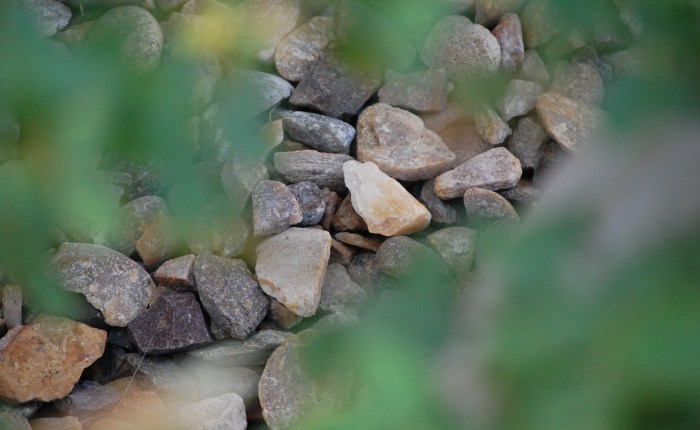
My primary source for that content is Refranes: Southwest Spanish Proverbs, collected and translated by Rubén Cobos. As I was perusing Refranes for this month’s inspiration, I noticed that Cobos included five proverbs for the concept that’s generally expressed in English as “a rolling stone gathers no moss.”

That English expression dates back to sixteenth century translations of Roman author Publius Syrus. It’s generally interpreted as advice to stay in one place. If you don’t, you’re never going to accumulate “green,” meaning dollars.

Here are the proverbs that Rubén Cobos collected, along with the translations he provided:

Piedra movediza el musgo no la cobija: A moving rock allows no moss. (#1368)
Piedra movediza no cría enlame: A moving rock allows no slime. (#1369) Piedra movediza no cría mojo: A rolling rock allows no rust. (#1370)
Piedra movediza nunca mojo la cobija: A moving stone never gets rusty. (#1371)
Piedra que rueda no cría mojo: A rock that rolls doesn’t get rusty. (#1372)

I was puzzled by the fact that only one of these refranes (#1368) actually includes the word “musgo,” or “moss.” The rest of them talk about slime (elame) and rust (mojo).

When I went to the dictionary to confirm Cobos’ translations, I became even more puzzled. The most up-to-date one, The American Heritage Spanish Dictionary), says “mojo” means “gravy” or “juice,” and doesn’t even include an entry for “enlame.” My older (1960) copy of Cassell’s Spanish-English Dictionary doesn’t include a definition for either word, although it does have an entry for “enlamar,” which it defines as “to cover with slime.” This word is also in an even older source (Velasquez’s Pronouncing Dictionary, originally published in 1852), which says it is “applied to inundations.”

Interestingly, Velasquez also says “mojo” is from “remojo,” which means the act of steeping or soaking. So, my older resources do indicate both words have to do with liquid, some of it not very tasty. I suppose you could make the link between these definitions and moss. After all, moss grows in wet conditions. But it seemed odd. Those wet conditions are unpleasant. And could produce other things besides moss. Illness, for example.

At this point, I remembered that I owned another book by Mr. Cobos, his Dictionary of New Mexico and Southern Colorado Spanish. When I pulled it out, I discovered that, in early to mid-nineteenth century New Mexico, “mojo” meant “rust, mold, or mildew.” Perhaps reflecting what happens when things are left steeping in liquid too long? “Enlame” meant “scum, slime; a kind of moss.” So there was the link between scum and moss. Not a very salubrious one, but still a link.

As a result of all this research, I began to wonder if Publius Syrus actually meant that a rolling stone should keep on rolling and not stick around to be loaded down with moss. Or rust, mold, or mildew.

Which reminded me that I originally thought the rolling stone proverb meant “stay home, don’t go adventuring, etc.” And led me to ponder whether a closer look at old proverbs can give us more than interesting images and turns of phrase. Perhaps they can also help us examine what we think we’ve been taught.

This particular set of refranes certainly implies that being a metaphorical rolling stone may be a good thing, at least in terms of our world view. Perhaps keeping ourselves open to new perspectives, not letting ourselves stew in what we think we know, can reduce the possibility of metaphorical moss, rust, mold, slime, or mildew sticking to us.

Even if we consider ourselves a cut above the rocks around us, we still might want to think about examining what we think we know. Because, as refrane #750 (“fierro movedizo no cría mojo”) points out, a moving piece of iron doesn’t get rusty, either.

The Priest at El Paso del Norte

The Priest at El Paso del Norte

When the men in my recent novel The Texian Prisoners reach El Paso del Norte (today’s Ciudad Juárez in November 1841, one of the kindest people they meet is local priest, Padre Ramón Ortiz. Prisoner George Wilkins Kendall, who later wrote a book about their trek, says Ortiz had a “benevolent countenance … that at once endeared him to every one.” The priest was also generous, “continually seeking opportunities to do some delicate act of kindness, which, by the manner of its bestowal, showed that he possessed all the more refined feelings of our nature.”


The padre housed, clothed, and gave money to Kendall and other men of the Texas Santa Fe Expedition while they were in El Paso. And his generosity didn’t stop there. When the prisoners headed out on the next leg of their journey, he sent along two or three ox-carts filled with “excellent bread.”


“Seldom have I parted from a friend with more real regret,” Kendall said later. “If ever a noble heart beat in man it was in the breast of this young, generous, and liberal priest. Professing a different religion from mine, and one, too, that I had been taught to believe, at least in Mexico, inculcated a jealous intolerance towards those of any other faith, I [thought I] could expect from him neither favour nor regard. How surprised was I, then, to find him liberal to a fault, constant in his attentions, and striving to make my situation as agreeable as the circumstances would admit.”


One would be tempted to conclude from Kendall’s description that Ramon Ortiz was sympathetic toward the Texians and, by extension, Americans. After all, most of the prisoners had been born in the United States. And the padre may well have felt that way in 1841. But he seems to have changed his mind by the end of the decade.


Padre Ortiz opposed America’s 1846 invasion of Mexico so vociferously that U.S. soldiers arrested him when they reached El Paso. Incarceration doesn’t seem to have curbed his spirit. He continued to voice his opposition and, as a deputy to Mexico’s Congress, fought ratification of its 1848 treaty with the U.S.


Ortiz was concerned about the amount of land the treaty of Guadalupe Hidalgo proposed to give away, which included today’s California, Arizona, Utah, and New Mexico. But he didn’t give up when he lost that cause. After the treaty was signed, he took on another role: helping New Mexico families who wished to move south across the new border, and thus remain Mexican citizens.


In late 1848, Mexico sent Padre Ortiz north into New Mexico to identify these people and assist them in the transition. His mission was so successful that the new regime in Santa Fe shut it down.


Ortiz arrived in the Santa Fe area in April 1849 and soon had approximately 1,000 families signed up for the trek south. And those were just the ones from San Miguel del Bado. When he then headed north toward Taos, the American administration panicked and started actively discouraging people from leaving while also throwing up bureaucratic obstacles related to signatures, funding, deadlines, and so forth.

Church at Mesilla, courtesy https://www.mesillanm.gov/history/


Even with these roadblocks, by mid-1850, the padre had successfully assisted 1,552 people to leave their homes in the new American possessions and move across the border to the Mesilla area. He then took on a new role and served as the commissioner responsible for issuing land grants to the new settlers.


If you’re familiar with New Mexico, you’ll know Mesilla is a town in the southern part of the state, on the U.S. side of the border. No, it didn’t move. The land on which the padre settled the newcomers was sold to the Americans in late December 1853. While the emigrants were adjusting to their new location, the U.S. had arranged to pay Mexico another $10 million for a strip of land that would enable a railroad route from Texas to California. Land that included Mesilla.


I haven’t found a record of Padre Ortiz’s response to that exchange of real estate. I doubt he was pleased. But he had plenty of time to adjust to what had happened. He was priest at El Paso del Norte for another forty-two years.


If Kendall’s portrayal of him is accurate, it’s possible that Padre Ortiz, unlike so many of us, was able to distinguish between individuals and the country they came from and continued to be as full of “exceeding liberality” as he’d been in 1841. I don’t think I could have done so.

If you want to learn more about Mesilla’s fascinating history, see https://www.mesillanm.gov/history/ or Erlinda Gonzales-Berry and David R. Maciel’s, The Contested Homeland, A Chicano History of New Mexico. You can find a short review of this book in this month’s newsletter. Sign up here!

Source List: Erlinda Gonzales-Berry and David R. Maciel, The Contested Homeland, A Chicano History of New Mexico, University of New Mexico Press, 2000; George Wilkins Kendall, Narrative of the Texan Santa Fe Expedition, Harper and Brothers, 1847; W.H. Timmons, El Paso, A Borderlands History, Texas Western Press, 2004

The Call of the Cranes

The Call of the Cranes

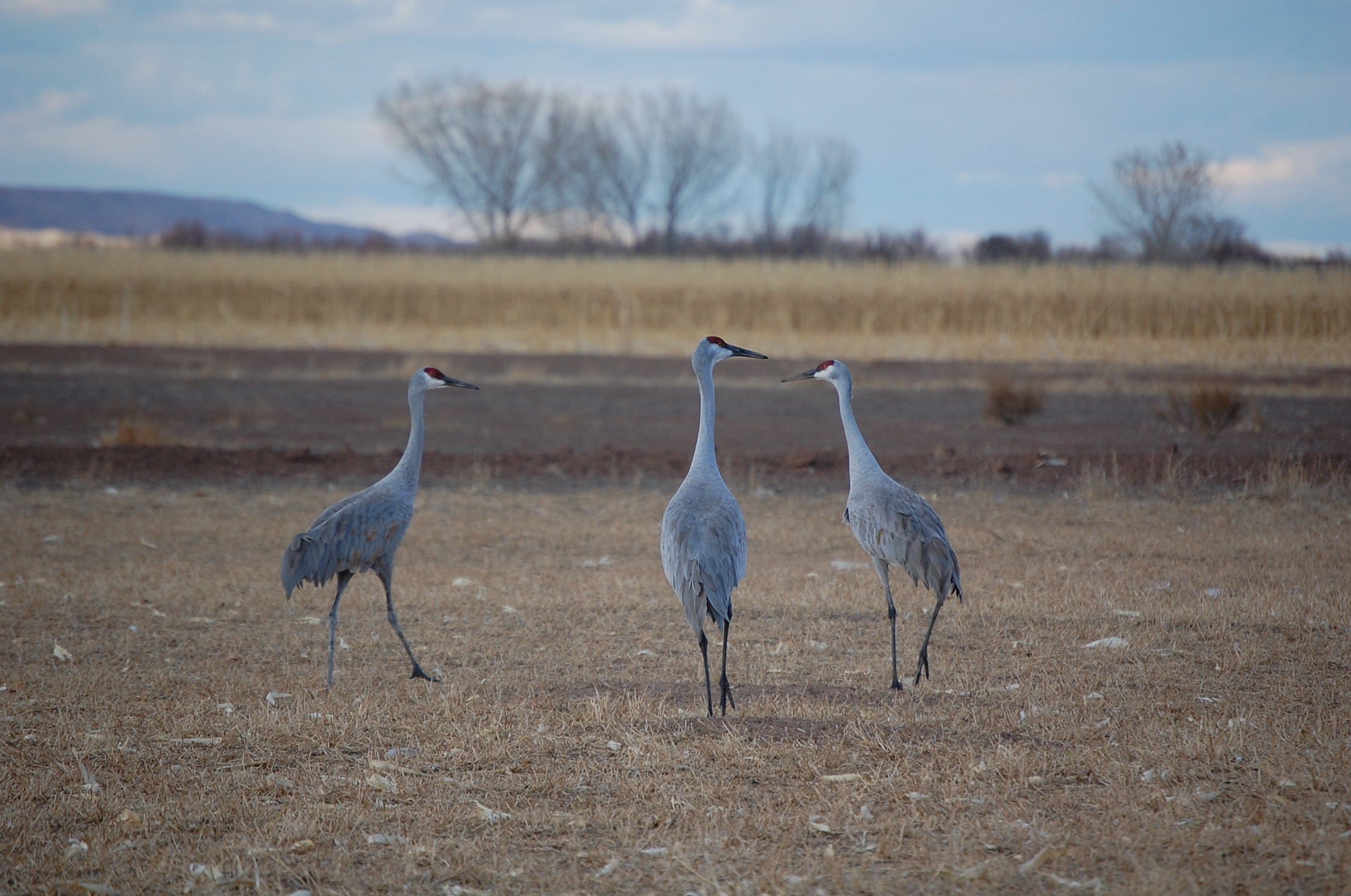
I haven’t seen any sandhill cranes in the Santa Fe area yet this year, but recently I ran across a section of Lt. James W Abert’s 1846-47 New Mexico travel diary which definitely evoked them:

Tuesday, October 13: [outside Bernalillo] “… we are now surrounded by cranes that keep up a great whooping all night. Their cry bears some resemblance to that of the red[headed] woodpecker.” The following day, the roadside ponds near Alameda “were covered with cranes, geese, and ducks. All these birds are quite tame and suffered us to approach very close (Abert, 44).”

Not close enough to be killed, though. In fact, whenever Abert or one of his companions appeared with a gun, the birds slipped out of range.

If you’ve had a chance to read The Texian Prisoners, you’ll notice that the men under Damasio Salazar also encounter sandhill cranes, first at Pecos Pueblo and then later along the Rio Grande. The birds, grazing in the stubble of harvested corn and wheat, stay well out of reach. When a horseman canters across the fields, they and the snow geese with them rise in great waves, their cries filling the air.

I have responded viscerally to the call of the cranes since I first heard it here in New Mexico. Abert’s observation that the sound resembled that of the redheaded woodpecker prompted more research. While the woodpecker’s actual call doesn’t seem to have much similarity to the sandhill’s, the sound of its drumming actually does.

Listen for yourself: Here’s the woodpecker drumming (at :31) and here’s the sandhill crane (choose the Garrett McDonald one). Isn’t the similarity amazing?

There’s an important difference to my ear though. The woodpecker is boring a hole in something. The cranes are talking, calling across the sky as they fly overhead through the long shadows of a New Mexico sunset.

How the Texian prisoners must have envied their freedom.

Note: the attached crane images were taken by me at two of my favorite birding places in New Mexico, the Bernardo Waterfowl Area of the Ladd S. Gordon complex south of Belen and the Bosque del Apache National Wildlife Refuge.

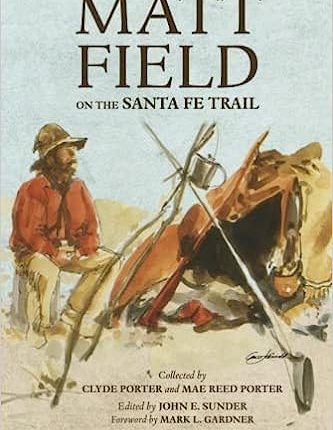
BOOK REVIEW: Matt Field on the Santa Fe Trail

BOOK REVIEW: Matt Field on the Santa Fe Trail

In 1839, a former actor named Matt Field decided to go to Santa Fe, New Mexico to regain his health. Although he failed to recover his physical well-being, Field did collect impressions and notes throughout his journey. After he returned to the U.S., he got a job at what is now the Time-Picayune/New Orleans Advocate and converted his jottings into a series of newspaper articles. The pieces were popular and were reprinted in papers as far away as London. I believe their positive reception inspired Picayune editor George Wilkins Kendall to make his own attempt to reach Santa Fe, a journey he would record in his Narrative of an Expedition Across the Great Southwestern Prairies from Texas to Santa Fé, which I discussed in June.

Over a hundred years after his trip, Matt Field’s articles were collected and published as Matt Field on the Santa Fe Trail. The young actor turned reporter definitely reflected the attitudes of his day, and some readers may find those biases upsetting, but there is also much to enjoy and to learn from this book. Field’s views of Santa Fe specifically and New Mexico in general are excellent examples of how Americans viewed the land and people that blocked their access to the Pacific Ocean. The book is a mixture of admiration for the women’s beauty, fascination with everything from Taos Lightning (wheat-based whiskey) to the New Mexican custom of community dances, and shock at the idea of priests and women who gamble and make money at it.

Matt Field on the Santa Fe Trail can be an exasperating book. His description of Governor Manuel Armijo’s wife as an elephant dancing is just rude and his misunderstanding of the role of Gertrudes Barceló as a business woman is a clear example of one society’s gender expectations being loaded onto another culture. However, these and other passages are precisely why I keep this book in my library. Matt Field on the Santa Fe Trail reminds me that we do not always see ourselves and our biases as clearly as we think we do. Even when we believe we’re open to new experiences, our unexpanded frames of references can still distort our perceptions.

And that is why I recommend Matt Field on the Santa Fe Trail to anyone interested in history in general and New Mexico in particular. It’s a fascinating historical document in itself and can also help keep us honest about our own take on the world around us and remind us that we may also possess attitudes we haven’t completely examined. And may not want others to know about a hundred years from now.

BOOK REVIEW: Narrative of an Expedition

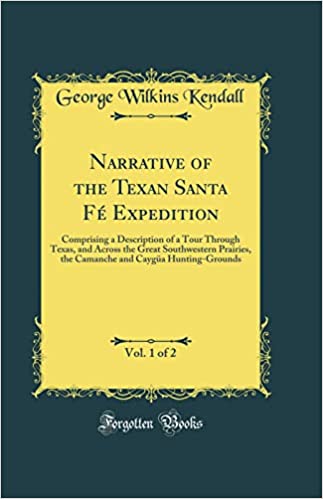
As a general rule, I only review books that I can recommend wholeheartedly. George Wilkins Kendall’s two-volume Narrative of an Expedition Across the Great Southwestern Prairies from Texas to Santa Fé is an exception to that rule.

The Narrative is Kendall’s report of the experiences of the roughly 300 men who left Austin, Texas in June 1841 to capture New Mexico for the Republic of Texas. Many of the approximately 280 soldiers accompanying the Texas Santa Fé Expedition had been told it was a trading mission. In actuality, the goal was to enforce the Texan claim that its boundaries extended west to the Rio Grande and north to that river’s headwaters.

That enforcement never happened. The rugged landscape between Austin and New Mexico, along with the Expedition’s lack of planning and discipline, weakened the starving Expedition to the point that men threw away their weapons to lighten the load they carried.

Rounded up by the New Mexicans, the Expedition members were taken south to Mexico City in three groups. The third included Kendall and 186 other men. It was escorted by Mexican militia Captain Damasio Salazar and roughly 150 guards.

Salazar, hurrying to get this largest of the three groups south to El Paso del Norte before winter set in, did not spare his guards or the Texans, the majority of whom were still weak from their ordeal on the Eastern Plains. Five died, three from natural causes. Kendall’s Narrative blames Salazar for all these deaths, painting him as such a monster that the Americans who invaded New Mexico five years later made it one of their first tasks to hunt the Captain down.

The fact that these men made finding Salazar a priority points to the popularity of Kendall’s Narrative and its impact in the run-up to the Mexican-American War. Indeed, it could be argued that Kendall accompanied the Texas Expedition with the sole purpose of providing a reconnaissance report for the conflict on the horizon. From El Paso to Mexico City, he provides details about distances, road conditions,  and fortifications, as well as his perception of the make-up and morale of Mexico’s military.

The way Kendall’s Narrative blames the Mexicans for not welcoming the invading Texans with open arms, brushes aside the gifts of food and clothing they did receive, and lays out information useful for a military incursion is almost breathtaking in its audacity. And yet his readers seem to have accepted his assertions without question. This makes the Narrative a useful example of the risks of reading uncritically, something that is still a danger for us today.

If you are interested in exploring historical sources with an eye to reading between the lines and trying to determine what might have really happened, and if you can stomach racist attitudes throughout the text, then I suggest you pick up a copy of Kendall’s Narrative and read it in light of the inception and outcome of the subsequent 1846 invasion. You may find it quite enlightening.

BOOK REVIEW: The White Sands, The Two Valleys Saga, Book 3

The third book in Mary Armstrong’s Two Valleys saga, The White Sands, takes a further dive into the history of southern New Mexico as it explores the events that led up to the famous feud between  Albert Fountain and Albert Fall. While Fall would go on to be implicated in the Teapot Dome scandal, Fountain would disappear into the White Sands in 1896  with his ten-year-old son Henry.

But I’m getting ahead of myself and Armstrong’s novel The White Sands. In this book, her narrator, Jesús Messi, gets to know the Lee family, the clan that was thought by many to be responsible for the Fountain disappearance. What he discovers is that there are two sides to every story, and more than one way to deal with a problem.

Armstrong uses Messi’s memory loss, suffered at the end of Book 2, to place him in the midst of the Tularosa Basin and the Lee network of family and friends. As part of that group, he comes to understand their perspective, which makes things awkward for him when he returns to Las Cruces. The teenage Jesús is caught between two worlds as he realizes that neither side is totally in the right—or the wrong.

His struggles are thoughtfully portrayed and provide a great way for Armstrong to explore the antagonism between the political parties at the time and the way those political divisions became deeply personal. In fact, the attitudes and events she recounts are eerily echoed in today’s news. They involve strong, opinionated personalities, convoluted legal questions, impatient and potentially coerced witnesses, and much more.

If you’re interested in southern New Mexico history in the late 1800s, the way our past is echoed by our present, or simply want an insightful coming-of-age story about an intelligent and perceptive young man, I highly recommend The White Sands.

George Wilkins Kendall Sails for New Mexico

On Monday, May 17, 1841 journalist George Wilkins Kendall sailed from New Orleans, Louisiana to join an expedition the Texas Republic was sending to Santa Fé, New Mexico.

Santa Fé had been a major destination of Americans heading west from Missouri for the past twenty years. Many had returned home wealthy. The Texans wanted to break a trail from Austin that would move that trade south to them instead. The resulting profits could prove critical to the Texan coffers, which were verging on empty.

If the Texans had only intended to trade, the reception the Texas Santa Fe Expedition received might have been different. But five years before, their Legislature had declared that Santa Fé and all its wealth was inside Texan borders. This was followed by President Mirabeau Bonaparte Lamar’s open letter in Spring 1840 telling the New Mexicans the Rio Grande was “the natural and convenient boundary” of Texas and that “we shall take great pleasure in hailing you as fellow citizens.”  

Lamar promised to send an expedition in September 1840, with commissioners who would “cement the perfect union” of Santa Fé and Texas. These men would “be accompanied by a military escort for the purpose of repelling any hostile Indians that may infest the passage.”

George Wilkins Kendall, circa 1837. Source: Kendall of the Picayune, by Fayette Copeland

The Expedition he sent, which was comprised of three Commissioners, their staff members and companions, roughly ten merchants, and around 270 soldiers, was a little late getting started. It left Austin in June 1841. In the meantime, New Mexico Governor Manual Armijo had been busy gathering his resources while keeping a close eye on the Americans in New Mexico.

Although the Texans had been led to believe they would be welcomed to Santa Fé with open arms, they would find the situation a little more complicated than they assumed. George Kendall had estimated his journey would take a pleasant four months. It would actually be twelve, the majority of them uncomfortable, including time in a Mexican prison. 

All because he didn’t take the time before he left New Orleans to check whether Mexico agreed with the Texan desire to take over the Santa Fé trade.  

Loretta Miles Tollefson, copyright 5/15/23

Taxes Bring Trouble To New Mexico

Taxes Bring Trouble To New Mexico

By early Summer 1837, tales were spreading across New Mexico about the taxes the Mexican Congress had recently imposed, and getting taller as they went. Rumor had it that collectors would be confiscating one-third of the fruits of individual families’ labor—crops and chickens alike—and also levying charges on community-held water, wood, and pastures. There were even stories that men would have to pay a fee every time they lay with their wives.

Although New Mexicans paid municipal tariffs, they’d hadn’t paid the alcabala, or Federal sales tax, for most of the time since 1795. They’d been exempted in exchange for their role on Mexico’s northern frontier, providing a buffer for the interior against the United States as well as uncolonized Native tribes.

This tax exemption was due to expire in mid-1837. In addition, Congress had added a 12.5 cent per vara tariff on U.S. goods like plain-weave cotton (white or printed), and banned the import of shirting, calico, and other cloth. While the law seems to have been intended to protect Mexican production of these items, it was also likely to raise their cost.

So prices were going to go up. This in itself was upsetting. In addition, Mexico City had given Governor Pérez the authority to supervise tax collections. This was perhaps more worrisome. While New Mexico didn’t send tax revenues to Mexico City, it didn’t receive assistance from it, either. The Santa Fe administration was funded via levies on goods imported from the U.S. over the Santa Fe Trail. With imports being curtailed, government funds were going to have to come from somewhere else.

Since he’d arrived in Santa Fe two years before, the governor had demonstrated a talent for finding new sources of revenue, including enforced loans from rico families and, in 1836, a sweeping set of new fees that affected everyone else. While some taxes, such as the two dollars per vehicle carrying foreign merchandise and additional charges for the animals pulling them, were directed at American traders, those costs were still going to be passed on to consumers.

On top of this, Santa Fe residents now had to pay five dollars a month for the right to cut timber for lumber, twenty-five cents a head for cattle or sheep driven through the city, two dollars per performance for “entertainments” (presumably plays), and fifty cents for a dance license.

So people were already hurting. With the governor’s new authority to supervise collections, there was little chance to get around the coming taxes. There’d be no appeals to friendship, cousinship, or any other kind of interpersonal relation to ease the financial burden that was about to descend.

And then rumors about even more taxes began moving up and down the Río Grande Valley. Governor Pérez apparently made no effort to squash the more exaggerated claims or to let people know he’d asked Mexico City to renew the alcabala exemption. As the stories grew wilder and spread further, they ignited a fire that would cost Perez his life in early August 1837.

For more about what happened in New Mexico before, during, and after August 1837, check out my novel There Will Be Consequences. It’s available from your favorite brick-and-mortar storeBookshop.orgebook retailerAmazon, and Barnes and Noble.

Sources: Paul Horgan, Great River: The Rio Grande in North American History, Middleton: Wesleyan University Press, 1984; Janet Lecompte, Rebellion in Río Arriba 1837, Albuquerque: University of New Mexico Press, 1985; Benjamin M. Read, Illustrated History of New Mexico, Santa Fe: New Mexican Printing Company, 1912; Joseph P. Sanchez, “It happened in Old Santa Fe, The Death of Governor Albino Pérez, 1835-1837,” All Trails Lead to Santa Fe, Santa Fe: Sunstone Press, 2010; Marc Simmons, Spanish Government in New Mexico, Albuquerque: University of New Mexico Press, 1968; Ralph E. Twitchell, The Leading Facts of New Mexico History, Vol. 2, Cedar Rapids: Torch Press, 1912.