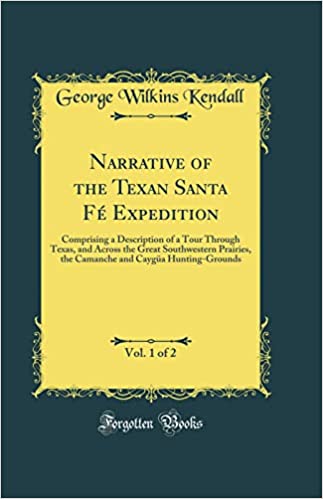
As a general rule, I only review books that I can recommend wholeheartedly. George Wilkins Kendall’s two-volume Narrative of an Expedition Across the Great Southwestern Prairies from Texas to Santa Fé is an exception to that rule.
The Narrative is Kendall’s report of the experiences of the roughly 300 men who left Austin, Texas in June 1841 to capture New Mexico for the Republic of Texas. Many of the approximately 280 soldiers accompanying the Texas Santa Fé Expedition had been told it was a trading mission. In actuality, the goal was to enforce the Texan claim that its boundaries extended west to the Rio Grande and north to that river’s headwaters.
That enforcement never happened. The rugged landscape between Austin and New Mexico, along with the Expedition’s lack of planning and discipline, weakened the starving Expedition to the point that men threw away their weapons to lighten the load they carried.
Rounded up by the New Mexicans, the Expedition members were taken south to Mexico City in three groups. The third included Kendall and 186 other men. It was escorted by Mexican militia Captain Damasio Salazar and roughly 150 guards.
Salazar, hurrying to get this largest of the three groups south to El Paso del Norte before winter set in, did not spare his guards or the Texans, the majority of whom were still weak from their ordeal on the Eastern Plains. Five died, three from natural causes. Kendall’s Narrative blames Salazar for all these deaths, painting him as such a monster that the Americans who invaded New Mexico five years later made it one of their first tasks to hunt the Captain down.
The fact that these men made finding Salazar a priority points to the popularity of Kendall’s Narrative and its impact in the run-up to the Mexican-American War. Indeed, it could be argued that Kendall accompanied the Texas Expedition with the sole purpose of providing a reconnaissance report for the conflict on the horizon. From El Paso to Mexico City, he provides details about distances, road conditions, and fortifications, as well as his perception of the make-up and morale of Mexico’s military.
The way Kendall’s Narrative blames the Mexicans for not welcoming the invading Texans with open arms, brushes aside the gifts of food and clothing they did receive, and lays out information useful for a military incursion is almost breathtaking in its audacity. And yet his readers seem to have accepted his assertions without question. This makes the Narrative a useful example of the risks of reading uncritically, something that is still a danger for us today.
If you are interested in exploring historical sources with an eye to reading between the lines and trying to determine what might have really happened, and if you can stomach racist attitudes throughout the text, then I suggest you pick up a copy of Kendall’s Narrative and read it in light of the inception and outcome of the subsequent 1846 invasion. You may find it quite enlightening.
 Fiction and Fact From Old New Mexico