BOOK REVIEW: In The Shadow of Sunrise

BOOK REVIEW: In The Shadow of Sunrise

I normally review books set in or about New Mexico in the 1800s, but I couldn’t resist sharing In The Shadow of Sunrise by Jennifer Bohnhoff with you. This novel tells a story from a much earlier time frame—the Folsum Culture period about 9,000 years ago. So it’s definitely a trip back in time.

And it’s a really special trip. This is one of those stories that linger in your mind long after you’ve read it. Its protagonist is a young man named Earth Shadow, who is physically handicapped and feels inferior to his stronger twin brother, Sunrise. As the boys join the healthy adults of their clan for the annual migration to hunt and meet other groups, Earth Shadow must come to terms with his physical handicaps and learn that his mental capabilities give him a capacity for leadership that his brother will never have.

Although this book is written for middle grade readers, its characters and situations make for fascinating reading for adults, as well. Bohnhoff does an excellent job of presenting her meticulous research in a way that informs but never gets in the way of the story and its characters. I highly recommend In The Shadow of Sunrise to audiences of all ages.

You can find a free teacher’s guide and special rates for class sets at jenniferbohnhoff.com/in-the-shadow-of-sunrise.html. 

© Loretta Miles Tollefson

BOOK REVIEW: A Wicked War

BOOK REVIEW: A Wicked War

Amy S. Greenberg’s A Wicked War: Polk, Clay, Lincoln and the 1846 U.S. Invasion of Mexico is a comprehensive look at the war America prefers to forget. The one undertaken in 1846-47 for the sole purpose of stealing territory. The one known in the U.S. as the Mexican American War and in Mexico as “the United States’ intervention in Mexico.” It would result in the annexation of what are today the U.S. states of New Mexico, Arizona, California, Utah, Nevada, and parts of Colorado.

It would also be the impetus for the first national antiwar movement in the United States and the first of Abraham Lincoln’s speeches as a newly minted Congressman from Illinois. A Wicked War provides a comprehensive look at these events, the rationale and excuses for the invasion, the political campaigns and jealousies that affected its trajectory, and the maneuvering of President Polk and his wife to ensure it happened.

Along the way, we meet a young Abraham Lincoln; Nicholas Trist, the U.S. negotiator who disobeyed his instructions in favor of the enemy; Henry Clay in the last great action of his career; and Ulysses S. Grant, a young officer who later wrote that the conflict was one of the most unjust wars ever waged by a strong nation against a weaker one.

If you’re looking for a book that gives you both the background to and events of the Mexican American War, or just a good overview of the events during that period of U.S. history, I strongly recommend A Wicked War.

Book Review: Home Ground, Language for an American Landscape

Trinity University Press, 2006
ISBN: 978-1595340573

Do you know what an hourglass valley is? Or a long-lot field? These are just two of the many terms defined in one of my favorite books, Home Ground, Language for an American Landscape. Edited by Barry Lopez and Debra Gwartney, this book is a treasure trove of words that describe the outdoor spaces around us.

One of the things that makes Home Ground different from other dictionaries is that its definitions were provided by writers who live in or are deeply knowledgeable about the areas where the terms are used. For example, William deBuys writes about forms characteristic of New Mexico’s Sangre de Cristo mountains, while Robert Hass contributes definitions connected with the San Francisco area, and Luis Alberto Urrea focuses on the Rocky Mountain Front Range. As a result, the material in this book is a high step above the dry and impersonal explanations you might expect in this type of endeavor.

I bought Home Ground as a research tool. But I find myself dipping into it for the sheer pleasure of the writing and of discovering new terms. For example, just today I learned that the Navajo word for “slot canyon” is tseghiizi. And confirmed that the Moreno Valley, where so many of my Old New Mexico books are set, is an hourglass valley like Mosaic Canyon in Death Valley.

I also discovered a term for the long narrow fields that line up, short-end to the water, along so many of New Mexico’s streams and acequias. They’re long-lot fields. That certainly reduces the number of words I need to use to describe that particular geographical feature!

If you’re looking for a resource to describe and understand the landscape of the U.S., I recommend this book. If you’d simply like an enjoyable and very readable way to learn something new, I also recommend this book. Home Ground is a real treasure! 

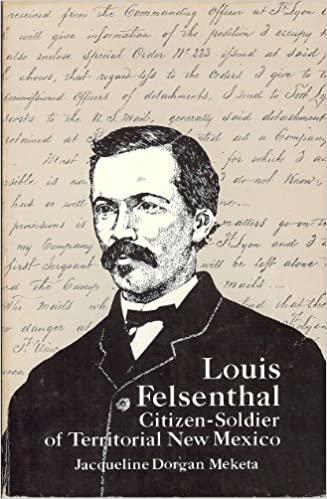
Book Review: Louis Felsenthal, Citizen-Soldier of Territorial New Mexico

Meketa.Louis Felsenthal.Cover
UNM Press, 1982
ISBN-13: 978-0826306043

Most of the people prominent in New Mexico history have had at least one book written about them (Kit Carson, Padre Martinez, Bishop Lamy, and Thomas Catron, to name a few). However, there aren’t many books about people who played minor roles in New Mexico’s history. That’s why Jacqueline Dorgan Meketa’s biography of Louis Felsenthal is so valuable.

Louis Felsenthal, Citizen-Soldier of Territorial New Mexico tells the story of a young Prussian Jew who arrived in Santa Fe in 1858 with high hopes. He had a gift for language and law, and was extremely interested in New Mexico’s history. When the Civil War broke out, he joined the Army and saw action at Valverde. He stayed in the military after the war and led patrols along the Santa Fe Trail that ensured the safety of the mail as well as stage passengers.

But Louis Felsenthal did not become famous. His passion for preserving New Mexico’s archives led him into conflict with the politicians of the day, and the effects of a stroke caused some of his fellow Anglos to believe he had an alcohol problem. As a result, he was denied the Veterans assistance to which he was entitled. He died in poverty and obscurity.

In some ways, this is a sad tale of a talented young man who didn’t achieve fame and fortune. But in other ways, Louis Felsenthal’s story is a heartening one. He’s one of many Anglos who came to New Mexico looking for adventure and fortune and instead fell in love with the land and its history, and did his best to protect it and to preserve its historical record. He may not be famous now, but he contributed to the society of his day and to posterity to the best of his abilities.

For this reason, and for its discussion of New Mexico in the second half of the 1800s, I recommend Louis Felsenthal, Citizen-Soldier of Territorial New Mexico.

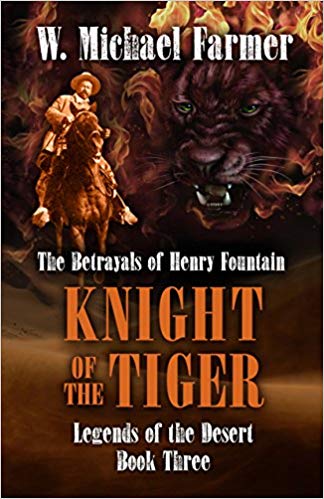
Book Review: Knight of the Tiger

Farmer.Knight of the Tiger.cover
Five Star Publishing, 2018
ISBN: 9781432837990

I don’t know much about Pancho Villa. At least, I didn’t until I read Knight of the Tiger. I knew Villa was one of a group of generals who competed for control of Mexico in the early 1900’s and that he led a raid into New Mexico in March 1916. I knew nothing about his background or his personality.

Now I know a good deal more than I did. But I didn’t pick up Knight of the Tiger in order to learn about Pancho Villa. I wanted to know what happened next to Henry Fountain, the protagonist of W. Michael Farmer’s Mariana’s Knight and Knight’s Odyssey.

This third volume of the Legends of the Desert didn’t disappoint me. I did follow Henry on his further adventures. But I also learned about Pancho Villa.

At its finest, that’s what historical fiction does. It tells us a good story and also teaches us something along the way. However, Knight of the Tiger does more than that. It also explores the concept of revenge—when it’s appropriate, when it’s counter-productive, and what exacting it can do to the human soul.

Knight of the Tiger did a great job of telling a great story, teaching me some history, and giving me something to think about. I recommend it!


Book Review: Philmont, A History Of New Mexico’s Cimarron Country

Murphy.Philmont.cover
University of New Mexico Press, Albuquerque, 1972
ISBN: 9780826302441

The summer staff at the Boy Scouts of America Philmont Scout Ranch outside Cimarron, New Mexico are often working their first “real” job. For Lawrence R Murphy in the 1960s, that job became the springboard to a history degree and a master’s thesis on the Baldy Mountain mining district, part of which lies inside the Scout Ranch boundaries. Murphy’s thesis and other writings became the foundation for Philmont, A History Of New Mexico’s Cimarron Country.

But Philmont is much more than a history of Baldy Mountain or Philmont Scout Ranch. It’s also a history of Colfax County, New Mexico.

And it’s a thorough one. The book begins with the region’s plants and animals, then goes on to discuss the Native Americans who were present when the Spanish moved into the area and the uneasy truce and outright conflict between the two groups. It then moves on to the advent of fur trapping in the southern Rockies, the Santa Fe Trail, the establishment and settling of the Beaubien and Miranda Land Grant, and Lucien Bonapart Maxwell’s acquisition of the grant.

This section also covers construction of Fort Union, Cimarron’s role as an Indian agency, the discovery of gold on Baldy Mountain, the Colfax County War, and subsequent events on into the early 1900s.

For a book titled Philmont, this history provides remarkably little space to the actual acquisition and development of the Boy Scout ranch. As a result, its potential readership is far larger than the many Scouts who gather each year at the Ranch. For those of us interested in the history of New Mexico’s Colfax County, including the Colfax County War, it provides a great overview of events.

As a writer of historical fiction who focuses on Northern New Mexico, I found Philmont fascinating and useful as a springboard for my own research. I highly recommend this well-written history of the Boy Scouts of America Philmont Scout Ranch and its region.