NOT JUST ANY MAN – CHAPTER 3

NOT JUST ANY MAN – CHAPTER 3

The following material is an extract from NOT JUST ANY MAN, A Novel of Old New Mexico, Copyright © 2018 Loretta Miles Tollefson. Published by Palo Flechado Press, Santa Fe, NM

A Note about Spanish Terms: This novel is set in northern New Mexico and reflects as much as possible the local dialect at that time. Even today, Northern New Mexico Spanish is a unique combination of late 1500s Spanish, indigenous words from the First Peoples of the region and of Mexico, and terms that filtered in with the French and American trappers and traders. I’ve tried to represent the resulting mixture as faithfully as possible. My primary source of information was Rubén Cobos’ excellent work, A Dictionary of New Mexico and Southern Colorado Spanish (University of New Mexico Press, 2003). Any errors in spelling, usage, or definition are solely my responsibility.

CHAPTER 3

As they move closer to Taos, Gerald begins to ponder just how best to go about locating his father. The pack mules move steadily through the ponderosa forest, then turn and follow a small green valley to the canyon of the Rio Fernando, a river that seems like a mere creek by Missouri standards. By late morning the next day, the men and mules move out of the juniper at the mouth of the canyon and gaze at the sweep of the Taos Valley. It’s so broad it hardly seems like a valley, the mountains on the western edge a dim blue in the distance.

“That there’s the Taos Gorge,” Charlie says, ahead of him.

Gerald nods. It’s a gash in the earth that cuts the valley in two along its length.

“Doesn’t look like much from here,” the Scout says. “You oughta see it from the south. It’s somethin’ else agin.”

Gerald nods politely, his gaze moving to the objects nearer at hand, the town of Don Fernando de Taos. Though to call Taos a town seems rather pretentious. Flat-roofed mud houses cluster along narrow dirt streets that straggle out from a central square, or plaza. The town’s a hamlet, really, although the walls around the square look substantial enough. As the train draws closer, Gerald sees that the plaza walls are actually the back side of long low adobe buildings, all facing inward in a protective stance. The early afternoon sunlight reflects bits of mica in their walls. There are perhaps eight or nine buildings in all. Surely it won’t be difficult to find his father in a community this small.

The problem is how to go about asking for him. To need the services of a blacksmith is common enough, even if one doesn’t own a mount. The blade of a knife might be loose, a belt buckle might need to be mended. But looking specifically for a black-skinned smith whose last name is Locke is bound to raise questions. Why would a white man be looking for a black man with the same last name?

And there’s no guarantee that his father is actually in Taos itself. Gerald’s already discovered from the campfire talk that when someone says “Taos” they can mean one of a number of different locations: the village of Don Fernando de Taos, the Taos Indian pueblo north of the village, or the widespread Taos valley and one of the many hamlets it contains. So, while knowing his father is in Taos keeps him from having to search the entire Rocky Mountain region, it doesn’t narrow down his location as much as Gerald would like.

Well, he’s closer to his father here than he was in Missouri. That’s something. The question is whether to drop this attempt to pass as a white man and acknowledge their relationship. He isn’t sure how his father, ever the practical one and yet a man who treasures his son, will feel about that. Hopefully, they’ll have an opportunity to discuss the situation in private.

But while Gerald is still trying to decide how to go about his search, Charlie announces that he has business to take care of and needs help to accomplish it.

The men from the mule train are still together and camped on the northern edge of Don Fernando de Taos on land controlled by Ewing Young. No one wants to move on until Young shows up to pay them. Besides, he’s still providing the rations. But none of the men have been doing much to earn their keep, so when Charlie appears at the campfire two nights after they arrive, he isn’t in an asking mood.

“I need some of ya to head south to Ranchos with me tomorrow, first light,” he says abruptly. “We got a passel of animals that need their shoes looked after an’ the only smith Young trusts is in Ranchos.”

“Nothin’ in Ranchos I wanna see,” Enoch Jones says. “’Sides, it’s too far, with this ankle.”

“It’s three miles,” Charlie says dryly. “Yer ankle was well enough this mornin’, chasin’ the girls on the plaza like ya were.”

“Gonna cost you,” Jones says.

“None of ya’s been exactly pullin’ yer weight the last few days.”

Jones gestures toward Gerald, on the other side of the fire. “Green hand can go. It’s his fault I’m tied up.”

Charlie looks at Gerald, who nods agreement, then swings back to Jones. “I ken’t promise you extra,” he says. “That’s up t’ Young. But I’m sure he’d look kindly on a little help.”

Jones grunts and nods unwillingly. “When?”

“First light.” Charlie turns away and nods at two other men who are sitting at the far edge of the fire. “You, too.” They nod back, and he turns and disappears into the night.

“Gotta go visit his señora,” Jones says derisively. He pulls out his bone-handled knife, reaches for a flat stone, spits on it, and begins to draw the blade across the stone, honing the steel.

Gerald glances up and speaks in spite of himself. “He’s married to a Spanish girl?”

Jones snorts derisively. “Keepin’ her. Gotta turn Catholic t’ marry one of these gals.” He examines the knife’s blade, slips it back into the beaded sheath at his waist, then pulls out a flask and takes a swig. “But you don’t have t’ get religion anyways. These putas are all easy enough to come by.”

Gerald stares into the dying flames. Jones seems to make a habit of quick judgments. Not that the characters of the girls here really matter. Gerald’s more interested in land than women, though he doesn’t have the funds for either of them. His thoughts turn to the mountain valley with its black soil and long grasses, its tiny sparkling streams, running even in the fall. From what he’s seen of this land so far, that much water in the landscape, the thickness of those grasses, is unusual.

The men are up at first light, preparing to move out, the animals balky with sleep. They see no reason to move any further than Ewing Young’s grassy meadow.

The fall nights and early mornings here are cooler than Gerald is used to. He shivers a little as he waits for the others. The two mules he’s responsible for crowd him a little, as if they too are chilled. The mule with the missing shoe pushes its nose against Gerald’s shoulder and the jenny with the two loose nails shakes her hoof impatiently.

Gerald gives her a reassuring pat and looks over her shoulder. Enoch Jones seems to be adjusting a halter strap on his far mule. Gerald’s animals block his view somewhat, but he can see that Jones’ mules seem agitated.

Then the nearer one pulls back sharply, ears flat against his head. Gerald catches a glimpse of a sharp object in Jones’ hand as his fingers slap up and against the far mule’s lip. The mule’s right hoof comes forward and catches Jones in the left leg, knocking him off balance, and Jones lets out a howl of protest.

Gerald’s own mules stir anxiously and he speaks softly to them as Charlie materializes from the gray dawn.

“What’s goin’ on?” Charlie demands.

Jones gets to his feet. The object that had been in his hand is nowhere in sight. “Damn mule kicked me,” he says.

Charlie looks at Jones’ leg, then the mule, which stands, panting slightly, its ears still back. “If yer leg ain’t broke, keep usin’ it,” Charlie says. He turns away. “We need to get goin’.” He moves toward Gerald. “You ready, Locke?”

“Yes, sir.”

“Glad someone’s got some sense,” he mutters, just loud enough for Gerald to hear, as he passes him on the way back to his own animals. “Here we go!” he says over his shoulder as he snaps his lead rope. “Let’s get ’er done!”

The mules are slowed by missing shoes and loose nails, and it takes a full hour to reach Ranchos, but Gerald doesn’t mind the leisurely pace. As the sun rises behind the eastern mountains, the landscape begins to glow with light. The adobe walls of the houses are soft in the light. Then their flecks of mica begin to spark as the sun strengthens and fingers its way across the flat plain to the west and the mountains bulking beyond.

Gerald is craning his neck to see more when the view is abruptly blocked by a row of rangy narrow leaf cottonwoods strung out along a small stream and the men and mules reach the blacksmith’s shop. It’s not much of a shop. Just a ramshackle structure at one end of a barren compound of small adobe buildings. Thick posts support a loosely-spaced layer of thin, unpeeled poles. Sunlight filters through the gaps and dapples the dirt floor. A waist-high chimneyless adobe hearth stands in the center of the space, a small leather bellows on the ground beside it.

The coals on the hearth are cold and no one stirs in the compound. Gerald and the others hold the mules while Charlie knocks on the door of the nearest hut. He speaks to the man who opens it, then comes back to the mules. “It’ll be a minute,” he says. He gestures to the men behind Gerald. “Those ken wait a bit. He’s gonna hafta get a fire goin’ before he ken shape the shoes. Jest take ’em to the corral in the back.” He turns to Gerald. “We’ll get the loose nails done first.”

Gerald nods and leads his animals around the building, then returns to the smithy with the jenny with the loose nails. The blacksmith has come out of his hut now and is building a fire on the smithy hearth as he and Charlie talk.

“We got us a pretty good set o’ men this time,” Charlie’s saying as Gerald approaches the shed. “No Mexicans this time, though. All white men.”

As Gerald steps into the shed, the smith’s head swings toward him and his hand, reaching for another handful of coal, freezes. Then he recovers himself and continues feeding the fire.

Gerald’s a little slower. Joy surges through him and his face breaks into a broad smile. Then he realizes what he’s done and flattens his face. But Enoch Jones, standing in the corner has seen both reactions, and his pale blue eyes narrow with suspicion.

“No mulattos this time?” the smith says to Charlie with a small grin. “You didn’t want another Jim Beckworth in your crowd?”

Charlie grins. “Ah, old Jim’s well enough. Ya jest ken’t expect to believe anything he says.”

The smith chuckles and turns to insert his bellows into a small hole halfway down the side of the hearth and give it a light pump. He glances over his shoulder. “No green hands this time?”

In the corner, Jones snorts derisively. Charlie grins and jerks his head toward Gerald. “Well, we’re still trying to figure out what Locke here is. He says he don’t know anything but he keeps provin’ himself wrong.” He grins at Gerald and nods toward the smith. “This here’s Jerry Smith.” Gerald and the smith nod politely at each other, Jones watching them with narrowed eyes. “And you know Enoch Jones, I think,” Charlie continues. “He’s been around a while.”

The smith nods to Jones. “I think I did some work for you last spring,” he says politely. “Reset the blade of that big knife of yours.”

Jones shrugs. “Could be.”

Smith looks at Gerald. “You plannin’ on stayin’ for a while?”

“I hope to,” Gerald says. “If I can find a way to make a living.”

“He’s got the brains to be a trapper,” Charlie says.

Smith chuckles and shakes his head. He picks up a small bucket and pours more coals onto the fire, then pushes down on the bellows handle again. “Beggin’ your pardon, but I’m not sure how many brains that takes,” he says dryly.

Charlie laughs as the black man gathers up his hammer, files, and shoe nails and heads for the mule tethered outside. “Let’s see what we’ve got here,” the smith says.

Copyright © 2018 Loretta Miles Tollefson

NOT JUST ANY MAN – CHAPTER 2

NOT JUST ANY MAN – CHAPTER 2

The following material is an extract from NOT JUST ANY MAN, A Novel of Old New Mexico, Copyright © 2018 Loretta Miles Tollefson. Published by Palo Flechado Press, Santa Fe, NM

A Note about Spanish Terms: This novel is set in northern New Mexico and reflects as much as possible the local dialect at that time. Even today, Northern New Mexico Spanish is a unique combination of late 1500s Spanish, indigenous words from the First Peoples of the region and of Mexico, and terms that filtered in with the French and American trappers and traders. I’ve tried to represent the resulting mixture as faithfully as possible. My primary source of information was Rubén Cobos’ excellent work, A Dictionary of New Mexico and Southern Colorado Spanish (University of New Mexico Press, 2003). Any errors in spelling, usage, or definition are solely my responsibility.

CHAPTER 2

The train trundles uneventfully southwest after that. They’re on the Cimarron Cut Off, so the only real issue is lack of water, a lack that gives Gerald a new appreciation for the wide and steady flow of the Missouri River. And the taste of fresh water, which they don’t experience until they reach the springs near a rocky outcropping unimaginatively called Point of Rocks.

From here, the Sangre de Cristo mountains break blue across the western horizon. Men and animals are travel weary and dusty, but Young doesn’t give them more than a day to rest and clean up. He begins almost immediately to divide the horses and mules into two groups: those who’ll tolerate a pack and those who won’t.

The second morning finds the one who will being fitted with loads of merchandise to be carried over the mountains to Don Fernando de Taos. The other, smaller group will tow the remaining merchandise in the now half-empty wagons to Santa Fe, where the Mexican government officials will levy a tariff on the goods. Apparently there’s no such tariff levied in Taos and this division of goods is common practice. Certainly, the teamsters seem to consider it routine.

“I guess you’ll be wantin’ to head straight to Taos,” Young says to Gerald as they watch the packs being loaded. “Since you’ve got business there.”

“I do, if you don’t need me with the wagons,” Gerald answers.

Young nods. “I’ll meet you and the others there and pay you all off,” he says. “You can find me at my store or at Peabody’s.”

Gerald nods. “That’ll be fine,” he says. “Where—”

A scuffle breaks out just then between two horses and a teamster, and Young heads toward them, leaving Gerald with his question unasked. He shrugs. He’ll learn soon enough how to find his way around Taos, locate Young’s mercantile, or this Peabody’s place of business.

He moves out with the pack train the next morning. They head due west, the animals strung together with ropes in long groups of ten, a man at the head of each group and one halfway back. Charlie is master now and he tells Gerald to settle in beside the middle of the second string, the one led by Enoch Jones.

The scout steers the mule train toward a gap in the hills. As they move west, the grass thickens. The late summer rains have greened the landscape nicely. Yellow sunflowers brighten the ground wherever there’s a bit of an indentation to hold the moisture. Gerald looks at them approvingly.

The next day, the grassy slopes begin to tilt upward and the sunflowers shrink in size and number. Juniper bushes scatter the landscape and fill the warm afternoon with a sharp urine smell. Farther up, there’s a type of tree Gerald’s never seen before: a kind of resinous pine, its trunk gnarled as if it’s been wind blasted for at least a hundred years.

The route moves uphill, along the side of a rocky slope, and the path narrows. Gerald focuses on his work. There’s not room for both man and mule, and he drops into the trees below the path to give the animals room to maneuver. Dirt and small rocks break under his feet and dribble down the slope to the gully below. He has to work to stay in line with his string.

Then the trail ahead becomes little more than a rocky outcropping. Gerald’s string of mules comes to a halt as the animals ahead of them edge cautiously across the ledge. The mules bunch together on the narrow path and snuffle at each other as if commiserating on their lot. Gerald scrambles up the bank to them, then farther up the slope to get out of their way but be within reach if they need him.

At the sound of rocks skittering down the bank, Enoch Jones turns and glares. “No time t’ be explorin’,” he growls.

“There’s not room on the path for both man and beast,” Gerald points out. The dirt moves under his feet and he clutches at a juniper branch for support. “I’ll be down as soon as we start moving again.”

Jones scowls and yanks on his lead mule’s chin strap, forcing the animal’s muzzle toward him. The mule pulls its head back, baring its teeth, and Jones whips the free end of the lead rope across its nose. The animal snorts angrily and jerks away, but this puts its hooves off the trail, scrambling in the dirt and rocks. The pack on its back tilts precariously.

Jones is pulled forward by the mule’s weight. Just as his feet hit the edge of the trail, the mule lurches backward down the slope, wrenching the rope from Jones’ hands. He drops to the ground and his right foot twists awkwardly under his left leg. “Whoa, damn you!” he yells.

But it’s too late. As the lead mule slides down the bank, the animals linked to it are pulled inexorably toward the edge of the trail. They brace themselves, their eyes rolling.

Gerald slips gingerly down the bank, trying to move as smoothly as possible to keep from knocking gravel onto the trail and frightening the animals even more.

“Whoa, now,” he says soothingly. “Whoa now.”

The mule nearest him turns its head, its eyes wild with fright. Gerald stretches to touch the mule’s neck, then moves cautiously to its head. He grabs the animal’s halter and peers over its shoulder and down the hillside. “Whoa now,” he says again.

Fortunately, the lead mule has found its footing. It stands, huffing irritably, on a small flat space below, its pack still intact but tilted to one side. The four mules strung behind it are stranded in an uneven row between it and the trail above. They scuffle rocky dirt anxiously as they try to find secure footing. They look more puzzled than frightened.

Gerald pats the mule he’s standing next to soothingly and moves past it, grateful that it and the four still behind it stalled when they did.

He looks at Jones, who’s still on the ground, his hands on his twisted ankle. “No harm done,” Gerald says.

Just then, Charlie appears on the trail ahead. “Ya’ll all right back there?” he calls. As he gets closer, Jones pushes himself upright, his right foot carefully lifted from the ground, his face twisted in fury.

“You give me green help, this is what happens,” Jones jabs a thumb toward Gerald. “He was too busy wandering uphill to keep ’em in line.” He puts his foot on the ground and winces. “An’ now I can’t walk.”

Charlie gives Jones a long look, then turns to Gerald. “On slopes like this, it’s best if ya stay below ’em, when ya ken,” he says. “Or directly behind. They get nervous when there’s somethin’ on the hillside above. Think yer a catamount or somethin’.”

Gerald nods. There’s no point in pointing out that Jones triggered this particular nervousness.

The scout moves to the edge of the path and peers down. “Looks like nothin’s lost.” He turns to consider Jones’ foot, then Gerald. “Think ya ken lead ’em up? Jones is gonna need to favor that foot a mite.”

Gerald nods and maneuvers around the other men to find a way down the hillside to the lead mule. As he passes, Jones mutters, “Damn green hand!” and Charlie answers evenly, “A man ken’t do what he ain’t been told, now ken he?”

Once all of the string is back on the path, Gerald and Charlie straighten the lead mule’s pack and tighten it down again, then Charlie returns to his own string and Gerald keeps the mule steady until it’s their turn to make their way across the outcropping.

Jones limps behind, alternately cursing damn mules and green hands. He soon falls behind the entire mule train, so Gerald doesn’t have to listen to him for long. But Jones is still fuming when he limps into camp that night, well after everyone else.

“Coulda been killed,” he growls, tossing aside the stick he’s been using as a crutch. He sinks onto a large piece of sandstone and begins loosening his bootlaces. “There’s Apaches out there, ya know.”

“There was nothin’ for ya t’ ride,” Charlie says mildly from across the fire. “And we weren’t that far ahead.”

Jones grunts and reaches down to pull off his boot, but the angle is wrong and he wrenches the swollen ankle out of position. “Hell!” he yelps.

“Want some help with that?” Gerald asks, moving toward him.

“Stay away from me!” Jones snarls.

“You know, Jones, if you’d been a little easier on that mule, she wouldn’t of jumped,” says the man who’d been leading the set of mules directly behind Jones and Gerald’s string. He glances at Jones, then Charlie, then the fire. “Looked to me like she was pretty calm ’til you slapped her muzzle with that rope.”

Charlie looks first at Jones, then Gerald. Jones glares at the man on the other side of the flames, who ignores him, but Gerald returns Charlie’s gaze steadily.

“You don’t know nothin’,” Jones growls. He glares at Charlie. “I got stuck with a idiot mule and a damn green hand. What’d ya expect?” The scout doesn’t respond and Jones turns his scowl on Gerald. “You green hands come out here and think ya know everything there is t’ know, an’ ya don’t know shit!” He moves his foot impatiently, then flinches and reaches for his swollen ankle.

“If ya wrap that up good and tight, it’ll help bring that swellin’ down,” Charlie says. “We ken redistribute goods in the morning and set up somethin’ fer ya to ride on fer tomorrow, at least.”

Jones nods sullenly. “In the meantime, someone could bring me some food,” he grumbles and Charlie nods to the other stringer, who rises quietly to make the arrangements.

Early the next day, with Jones riding at the head of the mule train, Charlie and his men drop into the south end of a valley thick with ripe grass. A small sparkling stream winds its way through the valley floor, heading north through more grassland. Mountains glimmer at the valley’s head, a good ten miles away. The bank of the little creek below has broken off in places, exposing a soil so black and fertile that Gerald’s fingers itch to run through it. Now this is land a man could raise a crop on.

He looks up at the almost-black fir-covered mountains in front of them, then northwest to taller, stonier peaks, the largest a massive, curved wall of rock. They’ve been climbing the last two days. The growing season here would be short, and the winters strong.

But still— Gerald looks down at the thick grass on the valley floor. Cattle would do well here. If a man built them adequate shelter, they could feed all through the cold season on hay harvested from these rich bottom lands.

But he has no money for land and the outlay needed to raise cattle or anything else. And this is Indian country. It’s an impossible dream. Even so, as the mule train moves into the trees on the other side of the valley, toward what Charlie says is Apache Pass, Gerald finds himself glancing back toward the bright trickle of water running steadily north.

Copyright © 2018 Loretta Miles Tollefson

That Free Chapter….

That Free Chapter….

If you wondered what I was up to when I posted the first chapter of my novel Not Just Any Man last Sunday, I apologize. I scheduled the post intending to write an explanation before it went live, and then got waylaid by a recalcitrant spine. I had no idea a herniated lumbar disk could be so energy-sapping.

But now the meds are kicking in and I’m able to actually sit long enough to create this post and explain what I’m doing.

The reason I posted the first chapter of Not Just Any Man is that I intend to keep on posting additional chapters until the entire novel is available FREE at LorettaMilesTollefson.com/Not-Just-Any-Man-index. This is because I’ve decided to turn my focus to readership rather than sales.

If you want to buy the book, I’m not going to complain, of course. But I will be delighted if you decide to help spread the word that Not Just Any Man is available free at LorettaMilesTollefson.com.

My plan right now is to post a chapter a week. There are forty chapters, plus the Author’s Note and the list and short bios of historical characters. As my back pain subsides and I can spend more time at the computer, I hope to post twice a week. We’ll see. At the moment, my spine is telling me I need to go lie down.

P.S. Before I do that, I’m currently scheduling these to go live on Sunday mornings. Is this a good day of the week to do this? Is there a better one? When I go to twice a week, which days would be optimum? I welcome any input!

NOT JUST ANY MAN – CHAPTER 1

NOT JUST ANY MAN – CHAPTER 1

The following material is an extract from NOT JUST ANY MAN, A Novel of Old New Mexico, Copyright © 2018 Loretta Miles Tollefson. Published by Palo Flechado Press, Santa Fe, NM

A Note about Spanish Terms: This novel is set in northern New Mexico and reflects as much as possible the local dialect at that time. Even today, Northern New Mexico Spanish is a unique combination of late 1500s Spanish, indigenous words from the First Peoples of the region and of Mexico, and terms that filtered in with the French and American trappers and traders. I’ve tried to represent the resulting mixture as faithfully as possible. My primary source of information was Rubén Cobos’ excellent work, A Dictionary of New Mexico and Southern Colorado Spanish (University of New Mexico Press, 2003). Any errors in spelling, usage, or definition are solely my responsibility.

CHAPTER 1

When Gerald tops the low rise and sees the mule-drawn wagons strung out along a rutted track across the prairie, it takes him a moment to adjust. After five days walking westward, he is still absorbing the healing beauty of the wind bending the grass, the bulk of buffalo in the distance. The sweep of the land has been a balm to his eyes. So the eight mule-drawn wagons jolting along the rutted trail below are a bit of a shock.

A loose collection of mules and horses meander to one side. Gerald stops, considering. Approaching the train is the sensible thing to do. It’s pure luck that he hasn’t encountered any Indians so far. But he isn’t quite ready to give up the silent grassland, regardless of the risk to his light brown skin.

Then a long-haired man with a wind-reddened face canters a chestnut-colored horse out from the wagon train. A firearm is braced in the crook of his right arm. Gerald moves toward him, down the slope.

The man on the chestnut reins in at a safe distance, rifle still in a position to be easily lifted and fired. Gerald stops walking and lifts his hands away from his sides, palms out.

“Ya’ll stranded?” the man calls.

Gerald takes off his hat, runs his hand through his curly black hair, and shakes his head. “Headed west.”

The man turns his head and spits. “Lose yer ride?”

“I figure my feet are more dependable.”

The man snorts. “And slower.”

“They also give me a lower profile, out of Indian sight.”

The other man nods begrudgingly, then jerks his head toward the caravan. “Wagon master says come on in, he’ll trade ya for a mount ’n some food.”

“Where are you headed?” Gerald asks.

“Santa Fe, where else?”

“I’m hoping to reach Don Fernando de Taos.”

“Same thing, pretty much. North o’ Santa Fe a couple o’ days.” The man jerks his head toward the wagon train again. “Young’s got a mercantile there.”

“Young?”

“The train master. Ewing Young. He’s been merchanting, bringin’ in goods from Missouri, selling ’em, then goin’ back fer more.” The chestnut stirs restlessly. “Come on in an’ he’ll tell ya himself.”

If he refuses, they’ll suspect him of trouble and who knows where that will lead? Gerald nods and follows the horseman toward the wagons.

As he gets closer, a tall powerfully built man wearing fringed buckskins and a broad-brimmed felt hat walks out from the lead wagon. In his early thirties, the man’s air of command is enhanced by intelligent brown eyes under a high forehead, a hawkish nose, and a mouth that looks as if it rarely smiles.

“Well now, it’s not often we find someone walkin’ the trail,” he says in a Tennessee drawl. He looks steadily into Gerald’s face.

“A horse seemed like an unnecessary expense and more than likely to make me a target,” Gerald says.

“It’s a slow way to travel, though,” the other man observes.

Gerald glances toward the wagon trundling past at the pace of a slow-walking mule. The way it lurches over the rutted track says it’s heavy with goods. “If I had what you’re carrying, it would be,” he says.

The man sticks out his hand. “I’m Ewing Young, owner of this outfit.” He jerks a thumb toward the rider who’d met Gerald on the hill. “This here’s Charlie Westin, my scout.”

Gerald nods at the scout and reaches to shake Ewing Young’s hand. “I’m Gerald Locke Jr., hoping to one day own an outfit.” He grins, gray eyes crinkling in his square brown face. “Though not a wagon outfit.”

Young chuckles. “Well, out here just about anything’s possible.” The last of the wagons trundles past and he gestures at it. “Come along to camp and we’ll talk about how you can get started on that.”

Gerald falls into step with the older man, cursing himself for a fool. He doesn’t need to tell his intentions to everyone he meets. It comes from not speaking to another living being in the last five days, he thinks ruefully. Solitude makes a man too quick to speech. How often has his father repeated, “Words can be a burden”? He’d do well to heed that idea. Especially until he knows the character of the men he’s fallen in with.

So when the small train stops that night, Gerald says nothing of joining his father or of his desire for land. That he’s from Missouri and going west to try his fortune are all that Young needs to know.

It seems to be all he wants to know. The men with him are silent, clearly playing subordinate roles, and the wagon master does the talking, mostly about himself and the part his merchandise is playing in opening up the Santa Fe trade.

“It’s slow goin’ though,” he says. “Now, trappin’s a way to make yourself some real money. But it’s a risky business. You’ve got to throw in with the right men and steer clear of the Mexican officials as much as you can.” He grimaces and shakes his head. “The Mexican government’s as changeable as the weather when it comes to what’s allowed and what’s not.” He takes a sip from his tin cup of coffee. “The best way to do it, is to find a seasoned man to work with. Someone who can show you the ropes and knows whose hands to grease.”

Gerald raises an eyebrow. “New Mexico sounds like it’s not much different from Missouri.”

Young chuckles and looks into the fire. “Oh, it’s different all right. For one thing, the women are more forgiving. And the houses the people live in are like nothin’ you’ve ever seen. But government’s government no matter where you go, so the main thing is to steer clear of it as much as possible. That’s why I like Taos. It’s a good stretch from the official center of things. And it’s within strikin’ distance of good fur country. Trappers bring in the furs and I trade for ’em. Do a little trapping myself, for that matter.” He swings his head, eyes on Gerald’s face. “But Charlie says you’re headin’ there, not Santa Fe. Where’d you learn about Taos, anyhow?”

Gerald shrugs. “I don’t rightly know,” he lies. “Someone passing through, I suppose.”

And that’s all it takes. Young gives him a sharp look, then nods as if he approves. “We could use another man on the remuda,” he says.

Gerald feels something like hope stir in his chest. Could it be this easy?

But then he turns his head and catches the flat contemptuous gaze of a big man with long, matted dirty-blond hair, who’s leaning against a nearby wagon bed. He knows. In spite of Gerald’s light skin that could pass for a tanned white man, and the red highlights in his wavy black hair, he knows.

Rebellion stirs. Gerald’s eyes tighten and he looks deliberately at Ewing Young. “Remuda?” he asks.

Young gestures toward the herd of mules and horses grazing beside the wide, dusty track that breaks across the prairie. “What in New Mexico they call the extra mounts we’ve brought along as spares. I could do with another herder. Not much in wages, but bread and board and a mount.”

Gerald’s lips twitch as he remembers the Missouri farmer who refused his back wages and predicted he’d be back within a month. He looks into Ewing Young’s eyes. “I can do that,” he says.

As he unrolls his bedding that night, Gerald shakes his head. His father’s letter said a man isn’t judged by his color out here. Is it possible that it’s not even noticed? Then he tamps down the tingle of hope. Some men do notice and judge. The dirty-haired blond man with the narrow blue eyes certainly seems to suspect something. Can somehow tell that, along with the Irish and Cherokee blood in Gerald’s veins, there’s blackness in there, too.

Gerald scowls. Somehow, that piece of his heritage outweighs everything else. But not, apparently, for everyone, he reminds himself. And Young is the boss, not the man with the sneer. He’ll just have to wait and see. To work for a man who accepts him as just any other man would be a new experience in itself.

The work is simple enough: keep the loose horses and mules alongside the wagon train, spell a teamster when it’s needed, brush down whatever mount he’s ridden that day. The days are long and, when sundown comes, no one’s in much of a mood for talk.

There’s also guard duty. Each man takes a shift every three nights, watching to make sure the animals don’t stray, or that interested coyotes or wolves don’t get too close. No one speaks of the possibility of human interest in the resting animals, but there’s always that danger, as well.

But it’s another week before there’s any sign of other humans on the prairie. Young’s merchandise train bumps steadily along the dusty Santa Fe Trail, the grass beside it growing ever more golden-brown as the autumn heat bakes the ground, the loose herd wandering a little farther off trail each day as they search for tender shoots in the occasional water seep. Gerald follows their wanderings on his plodding horse, both of them half-asleep in the warm fall sun.

Enoch Jones, the man who’d scowled when Gerald and Young were negotiating Gerald’s pay, is also with the remuda, but he’s made a point of steering clear of Gerald, so Gerald’s lost his edge of concern about the big man. He’s stretching himself sleepily, trying to stay awake, when there’s a sudden hail from the head wagon.

Gerald looks up to see Ewing Young half-standing on the wagon seat. He’s leaning out from the wagon and rotating his arms over his head, signaling the herders to move the remuda closer to the train. Charlie’s on his horse beside the wagon, his head turned to focus on a low ridge to the south.

As the spare animals move closer to the train, Young swings onto a horse and rides out to meet the herders, the scout behind him.

“Charlie tells me we’re goin’ to have company shortly,” Young says. “We’ll make a halt up on that rise ahead.” He gestures toward the loose animals. “When we do, I want all these hobbled or staked close by so they can’t be run off.”

“Comanche?” someone asks.

Young shakes his head. “Pawnee. They should be friendly. They don’t look painted up and he didn’t see any war shields.” He turns to gaze at the ridge to the south. A line of men on ponies is strung out along its top, facing the train. They could be trees, they’re so still. Young turns back to his men. “Go cautious, though. No gun waving. No heroics.”

Enoch Jones growls “Coward,” and there’s a low mutter from the men at the back of the group.

His mount moves restlessly, but Young just turns to his scout. “Charlie, why don’t you go see what they want. Raise both hands comin’ back if they’re lookin’ to trade.”

The scout’s face tightens, but he nods and turns the chestnut’s head. They all watch silently as he trots toward the waiting Indians. When he reaches sign-language distance, half a dozen yards below the ridge, there’s a long tense moment. Charlie moves his hands, then one of the Pawnee moves his. Finally, Charlie turns and begins to trot back, both hands up and waving.

The tension goes out of the group. The herders scatter to gather the remuda and follow the wagons up the trail. When the train stops, the teamsters leave their mules in their traces but the herders vault from their mounts to hobble or stake out the spares. When Gerald’s finished his work, he heads for the train, where the teamsters are pulling boxes of goods from the wagon beds.

Young moves along the little train, confirming what should be displayed and what left covered. “No liquor,” he says as he passes the third wagon. “Move those jugs farther back and cover up that barrel. We don’t need them to know we’ve got all that on board.”

“Too good for ’em anyway,” a teamster chuckles. “Let ’em go t’ Taos for some lightning.”

Young grins. “Make sure it’s well covered,” he says.

Gerald watches in fascination as the Pawnee canter toward the train. Their ponies are full of energy and seem to respond to the slightest touch. The men have no hair on their faces at all, whiskers or eyebrows. Gerald tries not to stare. The sides of their heads are also shaved, leaving a mop of hair and feathers on top. This has been stiffened with something that glints red in the sun, and arranged so it curves up and out over the men’s foreheads like the prow of a ship. Ridges of hair run from this puff toward the back of the warriors’ heads, then hang down their backs in a kind of braided tail. Silver and brass earrings dangle from the Pawnees’ ears.

The Indians vault off their horses and stalk alongside the wagons, looking imperiously at the goods Young’s men have pulled from the boxes. The cloth shirts the warriors are wearing with their buckskin leggings say the Pawnee have traded before. The shirts are weighted down with necklaces of shells and beads.

But it won’t do to stare. After all, Gerald’s seen Indians before, in the Missouri settlements. They aren’t a brand new phenomenon. But they seem different out here, somehow. More at home.

Certainly more confident. A tall young man strides up to Gerald and reaches toward the tooled leather scabbard at Gerald’s waist and the carved wooden handle of the knife protruding from it. Gerald starts to flinch away, then catches himself and forces himself still. He raises his eyebrows and stares inquiringly into the man’s face. The Pawnee points his index fingers into the air, then begins crossing his hands and swinging them up and back, in a kind of arch.

“He’s wantin’ to trade for yer knife,” Charlie says from behind him.

As Gerald turns toward Charlie, the Indian reaches out and pulls Gerald’s knife from its sheath. Gerald’s hand clamps instinctively on the man’s wrist. “Leave it alone!” he snaps.

“Easy now,” Charlie cautions. “Ya hafta agree it’s a right purty thing.”

Gerald turns to the Pawnee and holds out his hand. The man lays the knife in Gerald’s palm. The ten inch double-edged steel blade gleams in the prairie sun. The knife guard is well balanced and solid, the finely carved maple handle cool to the touch. Gerald’s fingers curve around it protectively.

“My father made this for me,” Gerald says. He looks at Charlie. “I won’t trade it.”

Charlie nods and turns to the Pawnee. His hands gesture rapidly and the man looks again at the knife, then into Gerald’s face. He nods, looks at Charlie, moves his own hands in a few fluid gestures, then turns and is gone.

“This talking with the hands is hard to get used to,” Gerald says. “What did you say?”

“That it was made by yer father fer you only, an’ its medicine would be bad fer anyone who takes it away from ya.”

Gerald grins. “He swallowed that?”

“He said it’s good for a man to own such a thing from his ancestors and yer a wise man to protect it.”

“Thanks Charlie. I appreciate it.” Gerald looks down at the knife again, then slips it back into its sheath. He grins. “Guess I’d better try to learn some sign language.”

It’s another eight days before they see more Indians. They’re Kiowa this time, and they also want to trade. Ewing Young agrees and again orders his men to cover the liquor in the third wagon and place a guard on it. “That bourbon isn’t intended for the likes of them,” he says, turning away. He looks at Charlie. “In fact, let’s put all the trade goods up front by the lead wagon.”

But the Kiowa don’t seem at all interested in the third wagon. The older men cluster around the trade goods while the younger men wander freely along the rest of the wagons, stopping now and then to chat in sign language with a teamster or herder, or standing to gaze at the hobbled horses and mules nearby.

Gerald hasn’t been assigned guard duty, but he happens to be passing the fourth wagon when the shoving starts. Enoch Jones staggers to one side and his spine scrapes against the wagon wheel. He comes up in a crouch, long bone-handled knife at the ready. Steel flashes in the hand of the long-haired teenage Kiowa who pushed him, and the men standing guard on the liquor wagon, Charlie included, form a silent circle around the combatants.

Gerald glances toward the third wagon. A younger Indian, no more than a boy, is climbing over the tailgate, his yellow-painted leather moccasins braced on the rim of the big wheels as he leans to push the wagon’s canvas cover to one side.

“Hah!” Gerald shouts. Startled, the youngster looks toward him. Gerald laughs. “Good try!” He waves his hands as he walks toward the wagon, shooing the boy away. The boy looks toward the combatants, shrugs, pushes his long black hair away from his face, and hops down. The wagon guards turn to look. They grin sheepishly, then move back into position.

The teenager who’d pushed Jones glances toward them, then tosses his knife into the dirt and lifts his empty palms toward Jones. He grins mischievously, his silver earrings flashing in the sunlight. Jones scowls in confusion.

“We’ve been had,” one of the guards tells him. “Bloody devils were tryin’ to distract us to get at the liquor.”

“Bastards!” Jones growls. He lunges toward the Kiowa boy, but the Indian dances backwards, swoops down to retrieve his knife, then flashes Jones another smile and turns on his heel to trot toward the men clustered around the lead wagon.

“It’s just a couple of kids,” Gerald says.

Jones glares at him and opens his mouth, but then Charlie says, “They’ll be trying the mules an’ horses next,” and Jones sticks his knife back into his belt and heads off toward the remuda.

That night, Ewing Young settles beside Gerald as they drink the last round of coffee by the fire. “Good work there today,” Young says. “Kept a battle from starting.”

“Would it have gone that far?” Gerald asks in surprise.

“You never can tell. How’d you know what they were up to?”

“I guess I’ve learned to watch out for the unexpected.”

Young grins. “Even Charlie got caught by that one. And here I thought you were a green hand.”

“When it comes to the wilderness, I am,” Gerald says. “But when it comes to people, I’ve got more experience than I would prefer.”

Young studies him, a question in his eyes, but Gerald turns his face to the fire. Once again, he’s said more than he should have. But it doesn’t seem to matter to Young, who nods thoughtfully, then rises to name the men who’ll take the first watch.

Copyright © 2018 Loretta Miles Tollefson

Southwest Proverbial Rolling Stones

Southwest Proverbial Rolling Stones

I’m fascinated by Southwestern proverbs, also known as refranes or dichos. In fact, I’m so fascinated that my monthly newsletter always includes one, with a translation.

My primary source for that content is Refranes: Southwest Spanish Proverbs, collected and translated by Rubén Cobos. As I was perusing Refranes for this month’s inspiration, I noticed that Cobos included five proverbs for the concept that’s generally expressed in English as “a rolling stone gathers no moss.”

That English expression dates back to sixteenth century translations of Roman author Publius Syrus. It’s generally interpreted as advice to stay in one place. If you don’t, you’re never going to accumulate “green,” meaning dollars.

Here are the proverbs that Rubén Cobos collected, along with the translations he provided:

Piedra movediza el musgo no la cobija: A moving rock allows no moss. (#1368)
Piedra movediza no cría enlame: A moving rock allows no slime. (#1369) Piedra movediza no cría mojo: A rolling rock allows no rust. (#1370)
Piedra movediza nunca mojo la cobija: A moving stone never gets rusty. (#1371)
Piedra que rueda no cría mojo: A rock that rolls doesn’t get rusty. (#1372)

I was puzzled by the fact that only one of these refranes (#1368) actually includes the word “musgo,” or “moss.” The rest of them talk about slime (elame) and rust (mojo).

When I went to the dictionary to confirm Cobos’ translations, I became even more puzzled. The most up-to-date one, The American Heritage Spanish Dictionary), says “mojo” means “gravy” or “juice,” and doesn’t even include an entry for “enlame.” My older (1960) copy of Cassell’s Spanish-English Dictionary doesn’t include a definition for either word, although it does have an entry for “enlamar,” which it defines as “to cover with slime.” This word is also in an even older source (Velasquez’s Pronouncing Dictionary, originally published in 1852), which says it is “applied to inundations.”

Interestingly, Velasquez also says “mojo” is from “remojo,” which means the act of steeping or soaking. So, my older resources do indicate both words have to do with liquid, some of it not very tasty. I suppose you could make the link between these definitions and moss. After all, moss grows in wet conditions. But it seemed odd. Those wet conditions are unpleasant. And could produce other things besides moss. Illness, for example.

At this point, I remembered that I owned another book by Mr. Cobos, his Dictionary of New Mexico and Southern Colorado Spanish. When I pulled it out, I discovered that, in early to mid-nineteenth century New Mexico, “mojo” meant “rust, mold, or mildew.” Perhaps reflecting what happens when things are left steeping in liquid too long? “Enlame” meant “scum, slime; a kind of moss.” So there was the link between scum and moss. Not a very salubrious one, but still a link.

As a result of all this research, I began to wonder if Publius Syrus actually meant that a rolling stone should keep on rolling and not stick around to be loaded down with moss. Or rust, mold, or mildew.

Which reminded me that I originally thought the rolling stone proverb meant “stay home, don’t go adventuring, etc.” And led me to ponder whether a closer look at old proverbs can give us more than interesting images and turns of phrase. Perhaps they can also help us examine what we think we’ve been taught.

This particular set of refranes certainly implies that being a metaphorical rolling stone may be a good thing, at least in terms of our world view. Perhaps keeping ourselves open to new perspectives, not letting ourselves stew in what we think we know, can reduce the possibility of metaphorical moss, rust, mold, slime, or mildew sticking to us.

Even if we consider ourselves a cut above the rocks around us, we still might want to think about examining what we think we know. Because, as refrane #750 (“fierro movedizo no cría mojo”) points out, a moving piece of iron doesn’t get rusty, either.

The Priest at El Paso del Norte

The Priest at El Paso del Norte

When the men in my recent novel The Texian Prisoners reach El Paso del Norte (today’s Ciudad Juárez in November 1841, one of the kindest people they meet is local priest, Padre Ramón Ortiz. Prisoner George Wilkins Kendall, who later wrote a book about their trek, says Ortiz had a “benevolent countenance … that at once endeared him to every one.” The priest was also generous, “continually seeking opportunities to do some delicate act of kindness, which, by the manner of its bestowal, showed that he possessed all the more refined feelings of our nature.”


The padre housed, clothed, and gave money to Kendall and other men of the Texas Santa Fe Expedition while they were in El Paso. And his generosity didn’t stop there. When the prisoners headed out on the next leg of their journey, he sent along two or three ox-carts filled with “excellent bread.”


“Seldom have I parted from a friend with more real regret,” Kendall said later. “If ever a noble heart beat in man it was in the breast of this young, generous, and liberal priest. Professing a different religion from mine, and one, too, that I had been taught to believe, at least in Mexico, inculcated a jealous intolerance towards those of any other faith, I [thought I] could expect from him neither favour nor regard. How surprised was I, then, to find him liberal to a fault, constant in his attentions, and striving to make my situation as agreeable as the circumstances would admit.”


One would be tempted to conclude from Kendall’s description that Ramon Ortiz was sympathetic toward the Texians and, by extension, Americans. After all, most of the prisoners had been born in the United States. And the padre may well have felt that way in 1841. But he seems to have changed his mind by the end of the decade.


Padre Ortiz opposed America’s 1846 invasion of Mexico so vociferously that U.S. soldiers arrested him when they reached El Paso. Incarceration doesn’t seem to have curbed his spirit. He continued to voice his opposition and, as a deputy to Mexico’s Congress, fought ratification of its 1848 treaty with the U.S.


Ortiz was concerned about the amount of land the treaty of Guadalupe Hidalgo proposed to give away, which included today’s California, Arizona, Utah, and New Mexico. But he didn’t give up when he lost that cause. After the treaty was signed, he took on another role: helping New Mexico families who wished to move south across the new border, and thus remain Mexican citizens.


In late 1848, Mexico sent Padre Ortiz north into New Mexico to identify these people and assist them in the transition. His mission was so successful that the new regime in Santa Fe shut it down.


Ortiz arrived in the Santa Fe area in April 1849 and soon had approximately 1,000 families signed up for the trek south. And those were just the ones from San Miguel del Bado. When he then headed north toward Taos, the American administration panicked and started actively discouraging people from leaving while also throwing up bureaucratic obstacles related to signatures, funding, deadlines, and so forth.

Church at Mesilla, courtesy https://www.mesillanm.gov/history/


Even with these roadblocks, by mid-1850, the padre had successfully assisted 1,552 people to leave their homes in the new American possessions and move across the border to the Mesilla area. He then took on a new role and served as the commissioner responsible for issuing land grants to the new settlers.


If you’re familiar with New Mexico, you’ll know Mesilla is a town in the southern part of the state, on the U.S. side of the border. No, it didn’t move. The land on which the padre settled the newcomers was sold to the Americans in late December 1853. While the emigrants were adjusting to their new location, the U.S. had arranged to pay Mexico another $10 million for a strip of land that would enable a railroad route from Texas to California. Land that included Mesilla.


I haven’t found a record of Padre Ortiz’s response to that exchange of real estate. I doubt he was pleased. But he had plenty of time to adjust to what had happened. He was priest at El Paso del Norte for another forty-two years.


If Kendall’s portrayal of him is accurate, it’s possible that Padre Ortiz, unlike so many of us, was able to distinguish between individuals and the country they came from and continued to be as full of “exceeding liberality” as he’d been in 1841. I don’t think I could have done so.

If you want to learn more about Mesilla’s fascinating history, see https://www.mesillanm.gov/history/ or Erlinda Gonzales-Berry and David R. Maciel’s, The Contested Homeland, A Chicano History of New Mexico. You can find a short review of this book in this month’s newsletter. Sign up here!

Source List: Erlinda Gonzales-Berry and David R. Maciel, The Contested Homeland, A Chicano History of New Mexico, University of New Mexico Press, 2000; George Wilkins Kendall, Narrative of the Texan Santa Fe Expedition, Harper and Brothers, 1847; W.H. Timmons, El Paso, A Borderlands History, Texas Western Press, 2004

The Call of the Cranes

The Call of the Cranes

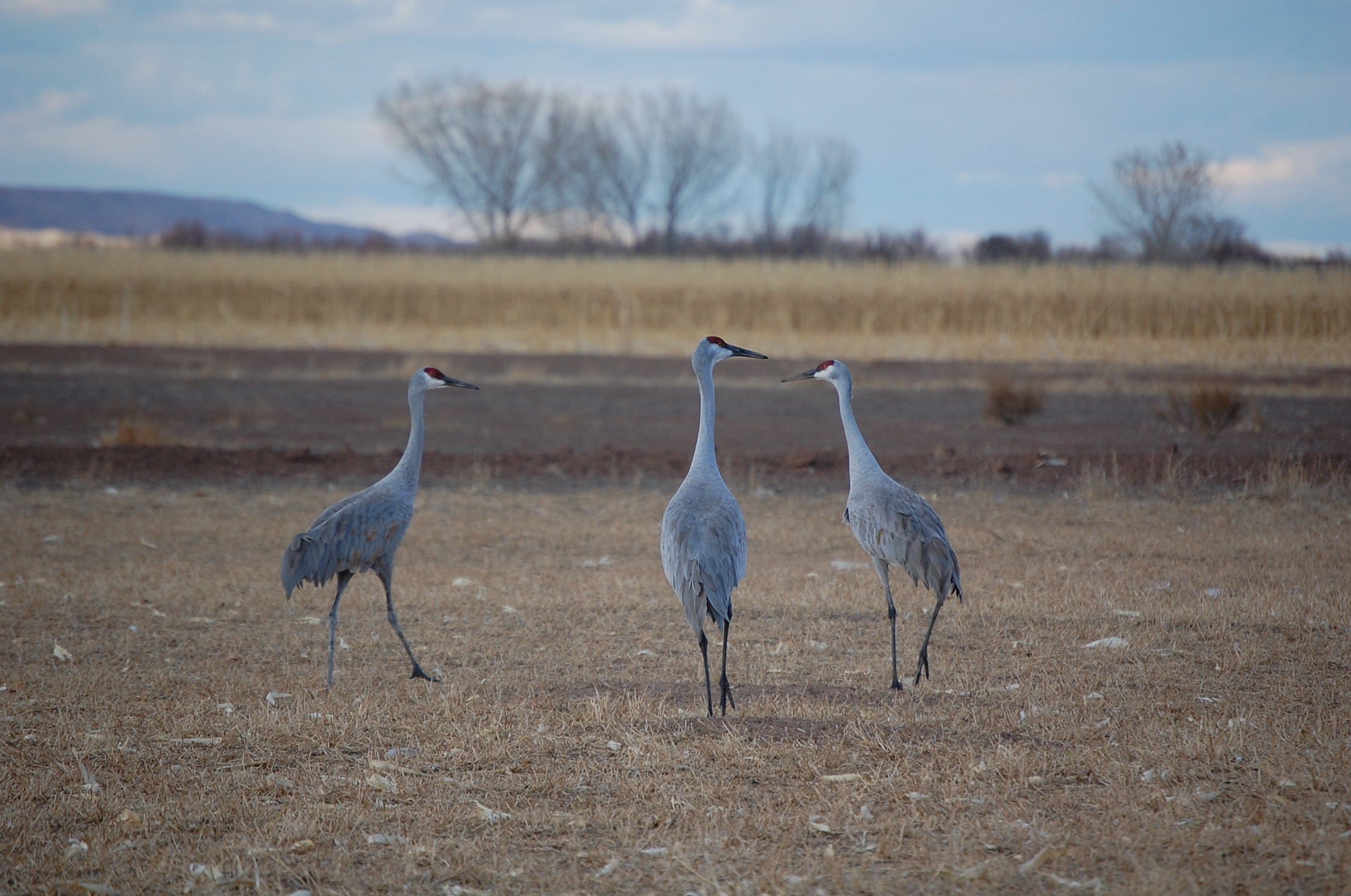
I haven’t seen any sandhill cranes in the Santa Fe area yet this year, but recently I ran across a section of Lt. James W Abert’s 1846-47 New Mexico travel diary which definitely evoked them:

Tuesday, October 13: [outside Bernalillo] “… we are now surrounded by cranes that keep up a great whooping all night. Their cry bears some resemblance to that of the red[headed] woodpecker.” The following day, the roadside ponds near Alameda “were covered with cranes, geese, and ducks. All these birds are quite tame and suffered us to approach very close (Abert, 44).”

Not close enough to be killed, though. In fact, whenever Abert or one of his companions appeared with a gun, the birds slipped out of range.

If you’ve had a chance to read The Texian Prisoners, you’ll notice that the men under Damasio Salazar also encounter sandhill cranes, first at Pecos Pueblo and then later along the Rio Grande. The birds, grazing in the stubble of harvested corn and wheat, stay well out of reach. When a horseman canters across the fields, they and the snow geese with them rise in great waves, their cries filling the air.

I have responded viscerally to the call of the cranes since I first heard it here in New Mexico. Abert’s observation that the sound resembled that of the redheaded woodpecker prompted more research. While the woodpecker’s actual call doesn’t seem to have much similarity to the sandhill’s, the sound of its drumming actually does.

Listen for yourself: Here’s the woodpecker drumming (at :31) and here’s the sandhill crane (choose the Garrett McDonald one). Isn’t the similarity amazing?

There’s an important difference to my ear though. The woodpecker is boring a hole in something. The cranes are talking, calling across the sky as they fly overhead through the long shadows of a New Mexico sunset.

How the Texian prisoners must have envied their freedom.

Note: the attached crane images were taken by me at two of my favorite birding places in New Mexico, the Bernardo Waterfowl Area of the Ladd S. Gordon complex south of Belen and the Bosque del Apache National Wildlife Refuge.

New Year, New Book!

New Year, New Book!

I’m pleased to announce that my novel The Texian Prisoners will be published in March next year and that the ebook is now available for pre-order!

In Fall 1841, a band of roughly 300 Texans straggled out of the Staked Plains into New Mexico. They had intended to claim everything east of the Rio Grande for Texas. Instead, they were captured and sent south to El Paso del Norte, then on to Mexico City. The largest group of prisoners, which included journalist George Wilkins Kendall, was escorted to El Paso by Captain Damasio Salazar. Five prisoners died on that trek. Kendall would later write a book describing the experience, a book which accused Salazar of food deprivation, mutilation, and murder, and fed the glowing coals that would become the Mexican-American War.

But what really happened on the way to El Paso? The Texian Prisoners tells the story through the eyes of Kendall’s friend George Van Ness, a lawyer burdened with the ability to see his enemy’s point of view, and asks us to consider the possibility that Kendall’s report was not unbiased.

A historically accurate retelling of Larry McMurtry’s Dead Man’s Walk, this fictional memoir will make you question everything you thought you knew about Texas, New Mexico, and the boundary between them.

Available for pre-order from Amazon.com and other ebook retailers.

BOOK REVIEW: Letters and Notes on the Texan Santa Fe Expedition, 1841-1842

In June this year, I posted something very rare for me: a less-than-positive book review. The review was of a book that serves as a primary source for most historical research about the ill-fated 1841 Texan Santa Fe Expedition. I had a number of issues with that text. However, during my own work on the Expedition, I was pleased to discover primary source that I can recommend wholeheartedly: Letters and Notes on the Texan Santa Fe Expedition, 1841-1842 by Thomas Falconer.


Falconer was one of the few British members of the Expedition. A trained barrister with a strong interest in the natural sciences, he traveled to Texas to explore emigrating there and was almost immediately invited by President Lamar to accompany the Expedition as a scientific observer.
Kendall describes Falconer as a “gentleman of high literary and scientific attainments [with] mild and agreeable manners,” who was “extremely sociable and companionable” (Kendall, I, 26-27), rather careless of his appearance, but well equipped with “a number of books and scientific instruments” (Kendall, I, 43).


Falconer’s books, instruments, and notes were, unfortunately, confiscated when the Texans finally reached New Mexico. However, his memory and interest in his surroundings stood him in good stead. After he was released from prison in Mexico City, he went to New Orleans, where he developed a report for Kendall’s newspaper, the New Orleans Picayune. This and his “Notes of a Journey Through Texas and New Mexico,” published in the British Journal of the Royal Geographical Society in 1844, form the core of Letters and Notes.


This book is valuable for several reasons. First, it provides an antidote to Kendall’s more excitable, and not altogether trustworthy, version of events in New Mexico in 1841; second, it gives us valuable information about the geography and plants of the region during the early 1840s; and third, it provides an outsider’s view of the Texans and their foibles, as well as insight into the sort of information about the North American continent that the English found useful.


Falconer’s other books, one about the Oregon question, and another about the discovery of the Mississippi, are also fascinating reads, but if you’re interested in the history of New Mexico, particularly the 1841 Texan Santa Fe Expedition, I highly recommend his Letters and Notes.

Sources: Thomas Falconer, Letters and Notes on the Texan Santa Fe Expedition, 1841-1842, New York: Dauber and Pine, 1930; George Wilkins Kendall, A Narrative of the Texan Santa Fe Expedition, Vol. II, Harper and Brothers: New York, 1847.

Damasio Salazar on the Assignment From Hell

Damasio Salazar on the Assignment From Hell

Mexican militia captain Damasio Salazar hadn’t been particularly pleased about his assignment to take the final batch of Santa Fe Texas Expedition prisoners south to El Paso del Norte. However, the past four days hadn’t been too bad. The prisoners had complained, of course, and he’d had a bit of trouble locating enough food for them, but the communities between San Miguel del Bado and Valencia had been surprisingly generous, especially the pueblos north of Albuquerque.


But now, on Monday, October 21, 1841, trouble had really started. First, he woke to a dead prisoner. Felix Ernest had been weak to begin with. And no wonder. He’d been with the Texans who had been out the longest and starved the most. The poor scurvy-ridden devils had ended up eating lizards, snakes, and boiled horse hide. Ernest hadn’t been actually ill, as far as Salazar knew. He was just too weak to wake up.


The Captain acted quickly to prevent other prisoners from dying on him by immediately requisitioning a cart from the Valencia alcalde and loading the weakest men onto it. But the dilapidated thing was so overwhelmed with riders that it fell apart a mile down the road.


This disaster precipitated another problem. A Texan who’d been riding, a man named McAllister, was so lame he couldn’t walk any further. When one of the more stupid of Salazar’s guards threatened to shoot him, the Texan yelled at him to do just that, and the idiot took him at his word.


Now Salazar had two dead prisoners to account for when he reached El Paso. He couldn’t very well carry the bodies with him. He’d had to resort to cutting off the men’s ears as proof they hadn’t run away.


He must have been thankful when he and his column finally reached the day’s destination, a grove of cottonwoods on the east bank of the Rio Grande south of Belen. The captain ordered one of the nineteen Texan cattle slaughtered. Maybe the meat would put some strength into the men and get them through what was to come. There were only a few more towns where he could acquire rations. Then, he and his prisoners would face the Jornada del Muerto.


By his calculations, they would be crossing right at the end of October. He needed to get 187 men, their guards, and the animals across a 90 mile stretch of wasteland notorious for a lack of water, especially this time of year. It was at least a three-day journey across a land of sand, rocky outcroppings, and an occasional stunted cactus. There was a reason it was called the journey at death.


The place lived up to its name. Three more men died crossing the Jornada. Salazar took their ears as well, and presented them to the Presidio commandant at El Paso del Norte. Although the Texan prisoners, particularly American newsman George Kendall, were appalled by what they saw as his savagery, the Captain was actually following orders —and precedent. The use of ears to account for dead enemies had been instituted by the man he presented them to in early November 1841.


Salazar did face a court-martial however, in response to questions Kendall raised about the Texan cattle left grazing outside El Paso. Once he’d been cleared of wrongdoing, the Captain returned to New Mexico. He would live out his days there, although he did have a brush with Anglo retribution in December 1846, when he was accused of participating in a conspiracy against American occupation.


There was no evidence that he’d been involved in those aborted plans and Salazar was allowed to go home in peace. Whether or not he was still haunted by the memories of the 1841 march south to El Paso is another question entirely.