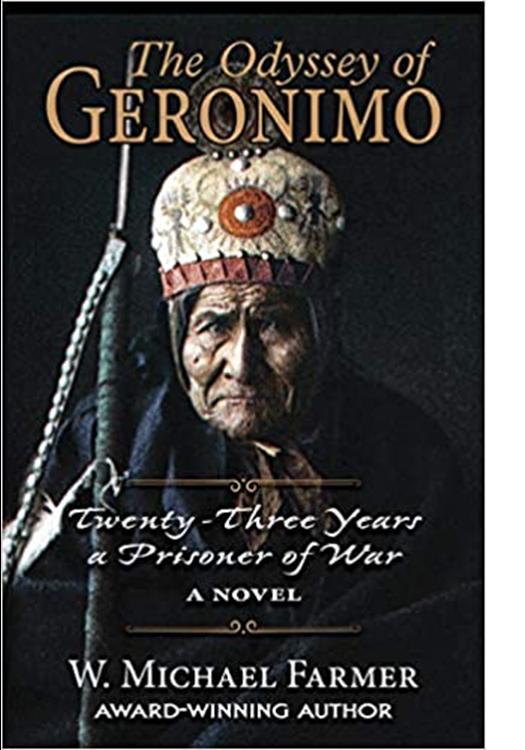
W. Michael Farmer’s The Odyssey of Geronimois one of those rare books, a true biographical fiction that doesn’t sugar-coat the less comfortable characteristics of its protagonist.
I find the title of this book, with its homage to the Odyssey of Homer, especially appealing. Like Homer’s hero, Farmer’s is also a wily man whose actions do not always seem admirable to us today. And yet he lingers in our consciousness. Even though we don’t quite know how to think about it, his story endures. Geronimo, an Apache warrior whose deeds of war made him feared across the American Southwest, continued in captivity and beyond to exert a powerful influence on the American psyche, as Odysseus’s has on the European imagination.
The Odyssey of Geronimo provides context for the old warrior’s actions before, during, and after his capture, and draws an illuminating portrait of a man who spent twenty-three years bridging the gap between his culture and the one he was thrust into by circumstances beyond his control.
This is a book about survival, with all its complexities. I highly recommend it.
On Tuesday, March 6, 1838, Carlos Santistevan asked the New Mexico government for 50 pesos for killing rebel leader Juan Antonio “El Coyote” Vigil five-and-a-half weeks earlier during the battle of Pojoaque Pass. Vigil had co-led the New Mexico revolutonaries with José Angel Gonzales since late the previous year, and had issued the January 1838 call to arms that initiated the final phase of the rebellion and the battle just north of Pojoaque Pueblo.
We don’t know precisely how El Coyote Vigil died, but we do know what happened to his body afterward. It was hung at the nearest crossroads as a warning to anyone with further insurrectionary ideas.
Vigil, from the mountain village of Truchas east of Chimayó, seems to have spent most of late 1837 in Taos. There, he’d threatened Padre Antonio Jose Martínez’s life if the priest didn’t stop preaching against the revolution. This frightened Martínez enough to send him fleeing south to Santa Fe. But it also angered the priest. Once in the capitol, he volunteered to serve as Governor Manuel Armijo’s military chaplain during the January campaign.
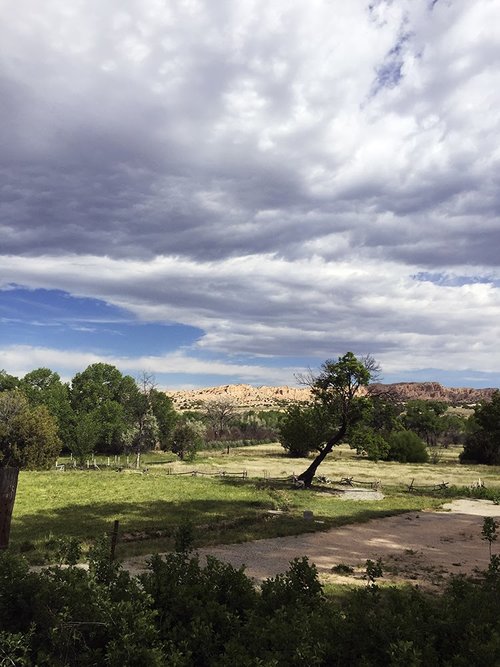
The cliffs of Pojoaque Pass in the distance. Courtesy: RanchoJacona.com
Martínez was at Armijo’s side at the battle of Pojoaque Pass and afterward. While the governor gave the order to hang Vigil’s body at the crossroads, one has to wonder if the priest had anything to do with the idea. Certainly, he doesn’t seem to have hesitated to comply with Armijo’s order later that day to hear José Angel Gonzales’ confession before he was taken out to be shot.
If you’re interested in learning more about Vigil, Gonzales, the rebellion, and the loyalist response, check out my recently-published novel There Will Be Consequences. You can find more information here.
Sources: Lansing Bloom, “The Insurrection of 1837,” Old Santa Fe Magazine, Vol. II, Santa Fe: Old Santa Fe Press; Fray Angelico Chavez, But Time and Chance, the story of Padre Martinez of Taos, Sunstone Press, Santa Fe, 1981; Janet Lecompte, Rebellion in Rio Arriba, 1837, UNM Press, Albuquerque, 1985; Ralph E. Twitchell, The Leading Facts of New Mexican History, Vol. II, Torch Press, Cedar Rapids, 1911.
On Friday, February 21, 1862, the Army of the Confederate States of America once again won a battle in New Mexico, their third in a row.
The conflict took place at the Valverde Ford of the Río Grande, and was a decisive victory for the Texan Confederates. Under former Fort Union commander Henry Hopkins Sibley, they moved north, occupying Socorro, Albuquerque, then Santa Fe, en route to their ultimate destination, Colorado’s gold and silver mines. They were on track to replenish the Confederacy’s coffers, then swing west to California and its unblockaded coast.
They never made it. In late March, the Confederates were stopped at Glorieta Pass by Union troops and the scouting skills of New Mexico’s Manuel Antonio Chavez y Garcia de Noriega.
But at Valverde, the Confederates reigned. When Union soldiers attempted to cross the river, the Texans opened fire, killing New Mexico volunteers who were armed with outdated single-shot muskets. The victory was decisive.
Map of the battle at Valverde Ford, courtesy of Matt Bohnhoff.
However, the New Mexicans did capture over 200 of the enemy’s horses and mules. This loss forced the Confederates to discard some of their wagons and supplies. When additional animals and goods were destroyed during the conflict at Glorieta Pass, all hope of reaching Colorado collapsed. The Confederates were forced to turn south for home.
During that retreat, even more supplies would be left behind as the remaining horses and mules died in the harsh conditions. Men perished as well, some of them only half-buried in the rocky soil of New Mexico’s Magdalena Mountains. The Texans would lose a full third of their men to capture or death before they reached home.
Which only goes to show that even a series of initial victories does not guarantee a successful campaign. And that even small losses can lead to catastrophe.
For a fictional telling of the Confederate story in New Mexico, I recommend Jennifer Bohnhoff’s excellent middle-grade Rebels of the Rio Grande novels. The first of the series, which deals with the events at Valverde, is available here. This book, with a map similar to the one above, will be re-released as When Duty Calls this June by Kinkajou Press.
Sources: Jacqueline Dorgan Meketa, Louis Felsenthal, University of New Mexico Press, Albuquerque, 1982; Francois-Marie Patorni, The French in New Mexico, French in America Press, Santa Fe, 2020; Jerry D. Thompson, A Civil War History of the New Mexico Volunteers and Militia, University of New Mexico Press, Albuquerque, 2015.
On Tuesday, February 7, 1837, Governor Albino Pérez, his New Mexico militia, and their Pueblo allies returned to the Rio Grande Valley from an unsuccessful campaign against the Navajo.
It had been a difficul campaign from its inception. When the Governor issued a call for the militia to assemble in November 1836, nobody came. This was primarily because of the members’ personal finances. They wouldn’t be paid to be on campaign and also had to supply their own ammunition and mounts. And Pérez couldn’t promise to help. He barely had enough funds to pay his Presidio soldiers to guard Santa Fe while he was gone.
So he decided to levy a forced loan on New Mexico’s ricos. This wasn’t exactly met with enthusiasm either. In fact, the necessary funds for the campaign still hadn’t arrived in the capital when Perez mustered the men who’d finally shown up and set out for Navajo country. They would be gone two months.
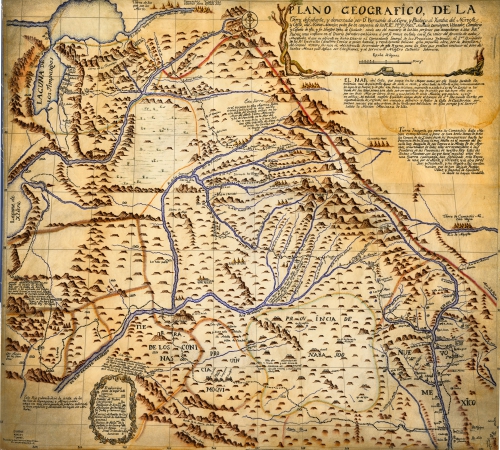
Miera map of New Mexico, circa 1788.
This type of campaign typically lasted forty-five days, so this one was longer than usual. If the militia were going to be paid at the end of it, or at least collect some spoils of war while they were gne, they probably wouldn’t have minded too much. But food supplies ran low. Also, the weather was so cold that one man froze to death and others lost toes and ears to frostbite. The temperatures affected the animals too. The militia’s mounts began to fail. To add insult to injury, the New Mexicans made no contact with the enemy during the entire period they were in the field.
By the time they got home, the New Mexicans and Pueblo warriors were fed up. They headed home in disgust and Governor Pérez turned to local governance issues only to discover that there wasn’t enough money in the treasury to continue paying his Presidio troops. He saw no alternative but to send them home as well. And then the Navajos who hadn’t been anywhere in sight during the winter campaign suddenly materialized and began raiding across the region. The Governor’s year was not starting out well.
It wouldn’t end well, either. Mexico’s Congress had made changes to the Federal constitution, reducing the autonomy of communities throughout the country. In addition, Federal taxes were going up and were set to be collected directly from New Mexicans for the first time in decades. To say people were unhappy is putting it mildly. Navajo raids would be the least of Governor Pérez’s worries in the coming months.
Sources: Lansing Bloom, Old Santa Fe Magazine, Vol. II, Santa Fe: Old Santa Fe Press; Janet Lecompte, Rebellion in Río Arriba 1837, Albuquerque: University of New Mexico Press, 1985; Benjamin M. Read, Illustrated History of New Mexico. Santa Fe: New Mexican Printing Company, 1912, Francis Stanley, Giant in Lilliput: The Story of Donaciano Vigil. Pampa: Pampa Printing, 1963; Daniel Tyler, New Mexico in the 1820’s: The First Administration of Manuel Armijo, PhD Dissertation, 1970, UNM, Albuquerque, New Mexico.
There Will Be Consequences is now available at Bookshop.org, so you can buy it from an independent bookstore without leaving the comfort of your home! Personally, my favorite store to order from is Collected Works here in Santa Fe. If you don’t already have a favorite Bookshop.org store, please give them a try or order from them directly
Sometimes I wonder why I’m so obsessed with past events, why the historical record calls to me, demanding to be examined, reimagined, turned into story. Am I just seeking an escape from today’s reality?
But then I remember something that happened just over a year ago.
It was early January 2021. A mob of U.S. citizens invaded the Capitol building in Washington D.C. while Congress was in session. Some of them were on the hunt for the Vice President and the Speaker of the House. They carried firearms and nooses. Across the country, people were glued to their screens, waiting to see what would happen.
What those viewers hoped would occur varied widely. If you saw my Facebook posts at the time, you had a pretty good idea of where I stood. I didn’t vote for Donald J. Trump in November 2020 and my comments made that clear. Some of them weren’t very kind.
Then a dear friend called me out on my attitude. On Facebook. She pointed out that my posts reflected only one side of the story, that those who didn’t agree with me politically had deep-seated concerns and fears and a right to be heard. She didn’t approve of what had happened on January 6, but she understood the frustration and anxiety. She expanded my perspective.
Her post got me thinking about my then work-in-progress, There Will Be Consequences (released February 1), which deals with a similar situation in 1837 New Mexico: a deeply frustrated and angry group of people who staged a bloody revolt against the appointed authorities. There are certain parallels to the events of January 2020. First, the precipitating events (in 1837, new taxes and a non-New Mexican governor) were only the tip of the iceberg of the rebels’ frustrations. Second, if the authorities had been willing to listen more deeply to the rebels’ concerns instead of treating them with disdain, the revolt might never have occurred. Third, the insurrectos got a little ahead of themselves. At least one of their issues—taxation—was actually in the process of being addressed when they revolted.
Which brings me to the present-day United States of America. Congress is busily trying to bring people to account for what happened on January 6, 2021. While this may be necessary to maintain law and order, I’m not sure it’s going to resolve the deeper issues which prompted the events of that day. A longer term strategy might be to start truly listening to each other, adjust our expectations (on both sides), and agree to meet somewhere in the middle. Because, if we don’t, we could very well face a scenario similar to what happened in New Mexico in 1837. People died, some of them pretty horrifically. Because they wouldn’t listen. Others lived with the scars of those events for the rest of their lives. Because they wouldn’t listen. I’m not saying either side was one hundred percent right or wrong, either in 1837 or 2021. We humans rarely are, as much as we’d like to believe otherwise.
So this is why the past calls me to explore, discover, mull it over, turn it into story. Because I am convinced that it can be easier to see the past more clearly than it is to see the present and that, perhaps—just maybe—it can teach us lessons that can help us move into the future with a little more understanding of why we humans do what we do and what we might learn from each other.
My latest Old New Mexico novel, There Will Be Consequences, is now available for purchase! You can find it at Barnes and Noble, Amazon, and Books2Read. You can also order copies from your local bookseller. The paperback should be available at Bookshop.org in the next week. I’ll let you know….
The prices for both the paperback and ebook are introductory specials for the next week. So get them now!
In case you’re wondering what this novel is about, here’s the book description:
It’s August 3, 1837, and rebellion has broken out in northern New Mexico. By the end of the week, Governor Albino Pérez and key members of his administration will be dead, and a governor with indigenous ancestry will be installed in Santa Fe.
Trouble’s been brewing for over a year, fed by new laws restricting the right to vote, the threat of new taxes, and a governor who’s quicker to borrow money than distribute it. On top of that, Pérez has jailed the Santa Cruz de la Cañada alcalde for making a decision he didn’t like. The locals free the alcalde and go to war, campesinos and Pueblo warriors against the ricos of the south.
But the rich aren’t about to give up their privileges so easily. More people will die before the violence ends.
A deeply-researched biographical novel with implications for today, There Will be Consequencesexplores the events before, during, and after early August 1837 through the eyes of the people who participated in them. Twelve linked stories propel the narrative forward from the perspective of individuals as diverse as Albino Pérez, rebel governor José Angel Gonzales, Santa Fe gambler Gertrudes “Doña Tules” Barceló, Taos priest Antonio José Martinez, and that most flexible of New Mexico’s politicians, Manuel Armijo.
The countdown has begun! This time next week, my new novel There Will Be Consequences will be live and available for purchase at Amazon.com, BarnesandNoble.com, and other retailers! For the first week, both ebooks and paperbacks will be available at special discount prices, so pre-order or mark your calendar now to get this book!
It’s August 3, 1837, and rebellion has broken out in northern New Mexico. By the end of the week, Governor Albino Pérez and key members of his administration will be dead, and a governor with indigenous ancestry will be installed in Santa Fe.
Trouble’s been brewing for over a year, fed by new laws restricting the right to vote, the threat of new taxes, and a governor who’s quicker to borrow money than distribute it. On top of that, Pérez has jailed the Santa Cruz de la Cañada alcalde for making a decision he didn’t like. The locals free the alcalde and go to war, campesinos and Pueblo warriors against the ricos of the south.
But the rich aren’t about to give up their privileges so easily. More people will die before the violence ends.
A deeply-researched biographical novel with implications for today, There Will be Consequences explores the events before, during, and after early August 1837 through the eyes of the people who participated in them. Twelve linked stories propel the narrative forward from the perspective of individuals as diverse as Albino Pérez, rebel governor José Angel Gonzales, Santa Fe gambler Gertrudes “Doña Tules” Barceló, Taos priest Antonio José Martinez, and that most flexible of New Mexico’s politicians, Manuel Armijo.
The illustration for this post is a picture of New Mexico monte dealer, power broker, and business woman María Gertrudis Barceló. It accompanied an April 1854 Harper’s Weekly Magazine article by Lt. G. Douglas Brewerton about New Mexico. The evidence suggests it was created by a Harper’s artist who never actually met Barceló.
The picture appeared alongside a lengthy quote about Barceló from Josiah Gregg’s 1844 Commerce of the Prairies:
“Some twelve or fifteen years ago, there lived, or rather, roamed in Taos a certain female of very loose habits, known as La Tules. Finding it difficult to obtain the means of subsistence in that district, she finally extended her wanderings to the capital. She there became a constant attendant upon one of those pandemoniums where the favorite game of monte was dealt … for some years she spent her days in lowliness and misery. At last her luck turned … [and she was able] to open a [monte] bank of her own, and being favored with a continuous run of good fortune, she gradually rose higher and higher in the scale of affluence … [and is] now known as Señora Doña Gertrudes Barceló… ”[1]
While Gregg’s book seems to contain solid data about the goods that moved between Missouri and New Mexico in the 1830s, I’ve found him less than accurate in his reports about the people he met in Santa Fe. This is certainly true in the case of Gertrudis Barceló.
For example, Barceló was not from Taos. She was born in Sonora circa 1800 and in 1815 moved with her parents and siblings to the hamlet of Valencia, New Mexico, about 100 miles south of Santa Fe. They were well-off—her parents are identified as Don and Doña in extant baptism records.
In addition to these rico beginnings, Gertrudis became wealthy in her own right as a result of her skill with numbers and cards. As a monte dealer in the mid to late 1820s, she spent time in the mining camps of what is now Cerrillos, New Mexico where she accumulated a large enough stake to set up a gambling salon in Santa Fe. There, she entertained officials, dealt cards, loaned money at interest, purchased property, and provided a home for her mother, an adopted daughter, and more than one foster child.
Barceló had married Manuel Antonio Sisneros on June 20, 1823. She was about 4 months pregnant at the time. That baby boy, and a subsequent son two years later, died in infancy. Her relationship with Sisneros may not have been ideal. They seem to have lived in separate houses on the same Santa Fe street from 1836 to at least 1841. He may have died or it’s possible they simply went their separate ways. The records don’t indicate that he participated in her business activities.
Barceló made ends meet not only as a money lender and monte dealer, but also by taking in boarders. This led to an 1835 accusation that she was illegally cohabiting with americano Lucius Thruston. She refuted the charge and it was withdrawn. She was still renting rooms out in the early 1850s, when she provided space to Governor John Munroe.
Around 1846, Gertrudis did become romantically involved with a foreigner, a highly-educated Prussian lieutenant in the U.S. Army named Augustus de Marle, who provided security for her monte dealings and represented her in court during at least one debt collection process. They remained close until her death in 1852, when he served as an executor of her will.
Other anglos were not so friendly. In addition to quoting Josiah Gregg’s inaccuracies about Barceló’s background, Brewerton described her face as “scarred and seamed, and rendered unwomanly by those painful lines which unbridled passions … never fail to stamp upon the countenance.”[2]
Susan Shelby Magoffin also encountered Barceló and found her wanting, reporting that the “stately dame of a certain age” wore false hair (probably the curls then fashionable) and teeth, smoked, and exhibited “that shrewd sense and fascinating manner necessary to allure the wayward, inexperienced youth to the hall of final ruin.”[3]
These statements contradict other reports, which tell us Barceló had a neat figure and intelligent, shrewd eyes, and was an elegant dancer. However, she did like fashionable clothes and heavy jewelry, often wearing a gold chain with a large crucifix.[4] The jewelry is included in the Harper’s Weekly image. The artist also uses the fashionable curls and cigarette, wielding them to portray someone who’s everything he believes a woman shouldn’t be—haggard from “fast living,” with long straggly hair, and smoke billowing around her head from a dangling cigarette. In the eastern part of the United States at the time, smoking by women had long been associated with loose morals and dubious sexual behavior. So a picture showing Barceló with a lit cigarette effectively placed her in the lowest possible social category, that of a sexually promiscuous woman.
I can find no evidence she was, in fact, promiscuous or involved romantically with anyone other than her husband and, later, Augustus de Marle. To the contrary, in some ways, Barceló could be held up as a model of how to behave toward others. She seems to have made a habit of taking in children who needed a home.
In March, 1826, she and Sisneros adopted at least one little girl, Maria del Refugio. In 1832, Gertrudis adopted another child, named María Guadalupé de Altagracia. She also fostered Petra Gutierrez, daughter of Diego Gutierrez and Dolores Sisneros. When Petra became pregnant at 14, Barceló raised the baby herself, freeing Petra to marry James Giddings four years later. When Barceló died, her will included provisions for the unmarried girls still in her care.
But nothing she did would be enough for the americanos. Even after Barceló died and was buried in the Santa Fe parish church, they couldn’t leave her alone. Almost immediately, the Missouri Daily Republican reported that “she took early to two professions [gambling and prostitution] common in this country of easy morals,”[5] a dig at both Barceló and New Mexico.
This attitude continued through the next century. In his 1912 discussion of the 1847 revolt, Ralph Emerson Twitchell called Barceló “a woman of shady reputation”[6] even while he credited her (in a footnote) with warning the Americans of the planned uprising and providing the names of its leaders. In 1984, Paul Horgan described Barceló “with her wig and false teeth”[7] whispering this same warning to Governor Bent, as if her appearance was somehow relevant to the service she provided.
Even in the 21st century, the defamation hasn’t stopped. An essay in the 2009 Telling New Mexico identifies Barceló as an unmarried woman with a dubious reputation.[8] The first statement is flat out wrong and the second depends on who your source is. Certainly, she had a dubious reputation with some Americans.
As far as I can tell, the primary reason they disliked her so much was that she had the audacity to be a successful businesswoman. No other New Mexico monte dealer is singled out in the historical record with the abuse and accusations that are levied against Barceló. This is doubly annoying considering that the U.S. would have had a much more difficult time occupying New Mexico in 1846/47 without her assistance. She not only provided valuable information during a precarious time, she also gave them a loan to cover Army salaries until funds arrived from the East.
The fact that this loan was from a woman must have galled them. A woman who’d acquired her riches via gambling and loaning money at interest. These were provinces of male endeavor, not female. And then (gasp!) she took a lover! So they tried to erase her with ugly words and grotesque drawings.
But María Gertrudis Barceló lives on, the very symbol of the independent New Mexican woman who could love and care for children she didn’t bear while using her brains and skills to amass enough wealth to provide for them after she died. The americanos tried to cancel her with jeering words and an ugly picture. These representations are what should be cancelled. I’ve tried to do so in my forthcoming novel There Will Be Consequences, by showing Barceló’s positive interactions with the women of Santa Fe during the revolt of 1836 and also with her employees and the children in her life. It’s only a small part of what I believe should be done to mitigate the nonsense that has been written about her.
[1] “Incidents of Travel in New Mexico,” G. Douglas Brewerton, Harper’s Weekly Magazine, Vol. XLVII, April 1854, p. 588.
While writing my forthcoming biographical novel, There Will Be Consequences,I struggled with the historical record regarding José Angel Gonzales, rebel leader and governor of New Mexico from August 10 to September 10, 1837. The accounts are unanimous that Gonzales was the son of María Dominga Martín Liston of Taos Pueblo and a mestizo man named José Santos Gonzales. However, they also insist on identifying José Angel as genízaro.
In New Mexico at that time, a genízaro was a person from one of the unchristianized Native groups, or losindios bárbaros—typically the Ute, Apache, Comanche, or Navajo—who had been baptized and now lived among the “civilized” Christians. The term was used both for people who’d been captured directly from these tribes and for their descendants.
What’s odd about the identification of José Angel Gonzales as genízaro is that he almost certainly wasn’t. His father was mestizo, not genízaro. The term mestizo designated someone of mixed heritage, usually Indian and Spanish. It was a different classification from genízaro, which specified the person’s Native ancestry as “barbarous”. José Santos may very well have been the child of a Spanish mother and Pueblo father, or vice versa.
It’s interesting to me that the historical accounts of New Mexico’s 1837 revolt don’t reflect an awareness that José Angel’s forebears may have included Spanish men or women. Instead, he’s labeled genízaro and thus placed firmly in the “barbarous Indian” category. This labeling provides a useful lens for reading the historical record and assisting us in understanding how Gonzales was viewed by his biographers. A “barbarous Indian” was someone a civilized person might do business with, but they weren’t necessarily to be trusted. They wore clothing that was different from the norm and not entirely respectable. They had different customs. Because of this differentness, someone with this heritage might be less than trustworthy and not as cultivated and respectable as people with Spanish ancestors. Gonzales, as genízaro, could be expected to exhibit these traits.
However, that’s not what the historians report. Instead, we’re told Gonzales was a good, brave man but ignorant of politics, that he had a respectable appearance and a reputation as a good buffalo hunter, or cibolero. In fact, according to one early source, Gonzales was named governor because of his hunting skill. Yet, even as the accounts speak of Gonzales’ honesty and bravery, they insist on his ignorance. The fact that he was functionally illiterate—meaning he could sign his name, but little else—is put forth as proof of this “fact.”
These dichotomies of genízaro/respectable, honest/ignorant indicate to me that the historians didn’t know what to make of Gonzales. He was supposedly the descendant of “wild Indians” and yet he had a respectable appearance. He was the leader of rebels who took supplies without paying for them, and yet was honest. He was ignorant and still managed to impress his fellows enough for them to place him in the Governor’s office (there’s no record that he sought the position).
The fact is, Gonzales was far from ignorant. He was a renowned buffalo hunter, an occupation that required deep knowledge of the animals’ habits as well as skill in killing them and getting the resulting meat and hides back home from the plains. Gonzales was also a clever military tactician, leading the rebels to victory in early August 1837 and engineering their successful withdrawal at the Battle of Pojoaque Pass the following January. The insistence on his ignorance is based solely on the fact that he didn’t display the characteristics of Spanish learning, a learning he almost certainly never had access to. Padre Martinez’s school at Don Fernando de Taos didn’t open until Gonzales was an adult and even then wasn’t large enough to provide for every child in the area.
Gonzales was in office barely a month before the ricos from the lower Rio Grande met to plot his ouster. Some of the men at this meeting (including Manuel Armijo) had been in Santa Fe two weeks earlier and watched Gonzales in action as he presided over the Assembly to organize the new government. What had they seen? A man who was honest, who had experience leading men, who was from Taos Pueblo, and who may have had darker skin than they did. And they wanted him out of office. My guess is that it wasn’t Gonzales’s experience on the battlefield that was in question. Clearly, these men had a problem with some aspects of the governor’s person.
So, to answer the question in the title: Yes, I believe the historical record is racist. I realize the historians of the 19th and early 20th century were ensconsed within their world view and couldn’t see past their prejudices, but I have trouble absolving them of their attitude. No matter what Gonzales did, it was going to be wrong, because he was genízaro. I believe the way I’ve portrayed Gonzales in There Will Be Consequences moves beyond what has been written of him in the past to demostrate what even the racist recounting of the 1837/38 events can’t hide: the man’s honesty, ability to think strategically, and deep desire to aid his fellow humans. I hope you’ll agree with me.




 Fiction and Fact From Old New Mexico