The Priest at El Paso del Norte

The Priest at El Paso del Norte

When the men in my recent novel The Texian Prisoners reach El Paso del Norte (today’s Ciudad Juárez in November 1841, one of the kindest people they meet is local priest, Padre Ramón Ortiz. Prisoner George Wilkins Kendall, who later wrote a book about their trek, says Ortiz had a “benevolent countenance … that at once endeared him to every one.” The priest was also generous, “continually seeking opportunities to do some delicate act of kindness, which, by the manner of its bestowal, showed that he possessed all the more refined feelings of our nature.”


The padre housed, clothed, and gave money to Kendall and other men of the Texas Santa Fe Expedition while they were in El Paso. And his generosity didn’t stop there. When the prisoners headed out on the next leg of their journey, he sent along two or three ox-carts filled with “excellent bread.”


“Seldom have I parted from a friend with more real regret,” Kendall said later. “If ever a noble heart beat in man it was in the breast of this young, generous, and liberal priest. Professing a different religion from mine, and one, too, that I had been taught to believe, at least in Mexico, inculcated a jealous intolerance towards those of any other faith, I [thought I] could expect from him neither favour nor regard. How surprised was I, then, to find him liberal to a fault, constant in his attentions, and striving to make my situation as agreeable as the circumstances would admit.”


One would be tempted to conclude from Kendall’s description that Ramon Ortiz was sympathetic toward the Texians and, by extension, Americans. After all, most of the prisoners had been born in the United States. And the padre may well have felt that way in 1841. But he seems to have changed his mind by the end of the decade.


Padre Ortiz opposed America’s 1846 invasion of Mexico so vociferously that U.S. soldiers arrested him when they reached El Paso. Incarceration doesn’t seem to have curbed his spirit. He continued to voice his opposition and, as a deputy to Mexico’s Congress, fought ratification of its 1848 treaty with the U.S.


Ortiz was concerned about the amount of land the treaty of Guadalupe Hidalgo proposed to give away, which included today’s California, Arizona, Utah, and New Mexico. But he didn’t give up when he lost that cause. After the treaty was signed, he took on another role: helping New Mexico families who wished to move south across the new border, and thus remain Mexican citizens.


In late 1848, Mexico sent Padre Ortiz north into New Mexico to identify these people and assist them in the transition. His mission was so successful that the new regime in Santa Fe shut it down.


Ortiz arrived in the Santa Fe area in April 1849 and soon had approximately 1,000 families signed up for the trek south. And those were just the ones from San Miguel del Bado. When he then headed north toward Taos, the American administration panicked and started actively discouraging people from leaving while also throwing up bureaucratic obstacles related to signatures, funding, deadlines, and so forth.

Church at Mesilla, courtesy https://www.mesillanm.gov/history/


Even with these roadblocks, by mid-1850, the padre had successfully assisted 1,552 people to leave their homes in the new American possessions and move across the border to the Mesilla area. He then took on a new role and served as the commissioner responsible for issuing land grants to the new settlers.


If you’re familiar with New Mexico, you’ll know Mesilla is a town in the southern part of the state, on the U.S. side of the border. No, it didn’t move. The land on which the padre settled the newcomers was sold to the Americans in late December 1853. While the emigrants were adjusting to their new location, the U.S. had arranged to pay Mexico another $10 million for a strip of land that would enable a railroad route from Texas to California. Land that included Mesilla.


I haven’t found a record of Padre Ortiz’s response to that exchange of real estate. I doubt he was pleased. But he had plenty of time to adjust to what had happened. He was priest at El Paso del Norte for another forty-two years.


If Kendall’s portrayal of him is accurate, it’s possible that Padre Ortiz, unlike so many of us, was able to distinguish between individuals and the country they came from and continued to be as full of “exceeding liberality” as he’d been in 1841. I don’t think I could have done so.

If you want to learn more about Mesilla’s fascinating history, see https://www.mesillanm.gov/history/ or Erlinda Gonzales-Berry and David R. Maciel’s, The Contested Homeland, A Chicano History of New Mexico. You can find a short review of this book in this month’s newsletter. Sign up here!

Source List: Erlinda Gonzales-Berry and David R. Maciel, The Contested Homeland, A Chicano History of New Mexico, University of New Mexico Press, 2000; George Wilkins Kendall, Narrative of the Texan Santa Fe Expedition, Harper and Brothers, 1847; W.H. Timmons, El Paso, A Borderlands History, Texas Western Press, 2004

Texan Prisoners Reach El Paso!

Texan Prisoners Reach El Paso!

When the last of the men from the Texas Santa Fe Expedition reached El Paso del Norte (today’s Juarez) in early November 1841, they must have felt as if they’d come out of hell into paradise.


They had traveled roughly 1000 miles from Austin, Texas to New Mexico, starving a good deal of the way, then about 500 more, as prisoners, from eastern New Mexico to the Rio Grande, then south, a route that included the desert-like Jornada del Muerto, or Journey of the Dead Man. They had endured unbearable heat on the plains and snow and icy winds on the Jornada. Now, though they were still prisoners, life had become much easier.


The very weather had changed. George Wilkins Kendall noticed it the night before they arrived, when, he says, “the evening air was of a most wooing temperature mild and bland” (Kendall, II, 23). As the Texans reached the outskirts of El Paso, they saw that the very plant life was different. The valley, irrigated by a canal from the Rio Grande, boasted abundant wheat, onions up to four pounds in weight, fruit trees, and extensive vineyards (Timmons, 195).


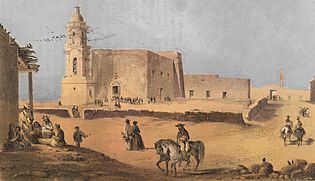
Even Kendall, who spent almost all his time in Mexico complaining, liked El Paso del Norte. Although his report doesn’t mention its famous building, the mission of Guadalupe de los Mansos, he does rhapsodize about the city’s “delightful situation in a quiet and secluded valley, its rippling artificial brooks, its shady streets, its teeming and luxurious vineyards, its dry, pure air and mild climate, and, above all, its kind and hospitable inhabitants” (Kendall, II, 42).

The Guadalupe Mission was painted in 1850 by A. de Vauducourt.
Source: es.wikipedia.org/wiki/Misión_de_Guadalupe_de_los_Mansos_en_el_Paso_del_río_del_Norte Accessed 10/17/23


Part of the reason Kendall was so impressed by the hospitality was that he was one of several Texans hosted by Presidio Commander José María Elías González. And hosted lavishly. Kendall reports the afternoon hot chocolate, the evening wine in glasses the size of New England tumblers, the tasty blood puddings, and other details of the table with great glee.
But the party couldn’t go on forever. The Texan prisoners were on the road again on Tuesday, November 9, heading to Chihuahua en route to Mexico City, where life would again become difficult. The idyll of El Paso was over, and prison and the whims of President Santa Anna, who the Texans had humiliated at San Jacinto, waited ahead.

Partial Sources: Ruben Cobos, A Dictionary of New Mexico & Southern Colorado Spanish, Santa Fe: Museum of New Mexico Press; George Wilkins Kendall, A Narrative of the Texan Santa Fe Expedition, Vol. II, Harper and Brothers: New York, 1847; W.H. Timmons, El Paso, A Borderlands History, El Paso: Texas Western Press, 2004.

Damasio Salazar on the Assignment From Hell

Damasio Salazar on the Assignment From Hell

Mexican militia captain Damasio Salazar hadn’t been particularly pleased about his assignment to take the final batch of Santa Fe Texas Expedition prisoners south to El Paso del Norte. However, the past four days hadn’t been too bad. The prisoners had complained, of course, and he’d had a bit of trouble locating enough food for them, but the communities between San Miguel del Bado and Valencia had been surprisingly generous, especially the pueblos north of Albuquerque.


But now, on Monday, October 21, 1841, trouble had really started. First, he woke to a dead prisoner. Felix Ernest had been weak to begin with. And no wonder. He’d been with the Texans who had been out the longest and starved the most. The poor scurvy-ridden devils had ended up eating lizards, snakes, and boiled horse hide. Ernest hadn’t been actually ill, as far as Salazar knew. He was just too weak to wake up.


The Captain acted quickly to prevent other prisoners from dying on him by immediately requisitioning a cart from the Valencia alcalde and loading the weakest men onto it. But the dilapidated thing was so overwhelmed with riders that it fell apart a mile down the road.


This disaster precipitated another problem. A Texan who’d been riding, a man named McAllister, was so lame he couldn’t walk any further. When one of the more stupid of Salazar’s guards threatened to shoot him, the Texan yelled at him to do just that, and the idiot took him at his word.


Now Salazar had two dead prisoners to account for when he reached El Paso. He couldn’t very well carry the bodies with him. He’d had to resort to cutting off the men’s ears as proof they hadn’t run away.


He must have been thankful when he and his column finally reached the day’s destination, a grove of cottonwoods on the east bank of the Rio Grande south of Belen. The captain ordered one of the nineteen Texan cattle slaughtered. Maybe the meat would put some strength into the men and get them through what was to come. There were only a few more towns where he could acquire rations. Then, he and his prisoners would face the Jornada del Muerto.


By his calculations, they would be crossing right at the end of October. He needed to get 187 men, their guards, and the animals across a 90 mile stretch of wasteland notorious for a lack of water, especially this time of year. It was at least a three-day journey across a land of sand, rocky outcroppings, and an occasional stunted cactus. There was a reason it was called the journey at death.


The place lived up to its name. Three more men died crossing the Jornada. Salazar took their ears as well, and presented them to the Presidio commandant at El Paso del Norte. Although the Texan prisoners, particularly American newsman George Kendall, were appalled by what they saw as his savagery, the Captain was actually following orders —and precedent. The use of ears to account for dead enemies had been instituted by the man he presented them to in early November 1841.


Salazar did face a court-martial however, in response to questions Kendall raised about the Texan cattle left grazing outside El Paso. Once he’d been cleared of wrongdoing, the Captain returned to New Mexico. He would live out his days there, although he did have a brush with Anglo retribution in December 1846, when he was accused of participating in a conspiracy against American occupation.


There was no evidence that he’d been involved in those aborted plans and Salazar was allowed to go home in peace. Whether or not he was still haunted by the memories of the 1841 march south to El Paso is another question entirely.