The countdown has begun! This time next week, my new novel There Will Be Consequences will be live and available for purchase at Amazon.com, BarnesandNoble.com, and other retailers! For the first week, both ebooks and paperbacks will be available at special discount prices, so pre-order or mark your calendar now to get this book!
It’s August 3, 1837, and rebellion has broken out in northern New Mexico. By the end of the week, Governor Albino Pérez and key members of his administration will be dead, and a governor with indigenous ancestry will be installed in Santa Fe.
Trouble’s been brewing for over a year, fed by new laws restricting the right to vote, the threat of new taxes, and a governor who’s quicker to borrow money than distribute it. On top of that, Pérez has jailed the Santa Cruz de la Cañada alcalde for making a decision he didn’t like. The locals free the alcalde and go to war, campesinos and Pueblo warriors against the ricos of the south.
But the rich aren’t about to give up their privileges so easily. More people will die before the violence ends.
A deeply-researched biographical novel with implications for today, There Will be Consequences explores the events before, during, and after early August 1837 through the eyes of the people who participated in them. Twelve linked stories propel the narrative forward from the perspective of individuals as diverse as Albino Pérez, rebel governor José Angel Gonzales, Santa Fe gambler Gertrudes “Doña Tules” Barceló, Taos priest Antonio José Martinez, and that most flexible of New Mexico’s politicians, Manuel Armijo.
The illustration for this post is a picture of New Mexico monte dealer, power broker, and business woman María Gertrudis Barceló. It accompanied an April 1854 Harper’s Weekly Magazine article by Lt. G. Douglas Brewerton about New Mexico. The evidence suggests it was created by a Harper’s artist who never actually met Barceló.
The picture appeared alongside a lengthy quote about Barceló from Josiah Gregg’s 1844 Commerce of the Prairies:
“Some twelve or fifteen years ago, there lived, or rather, roamed in Taos a certain female of very loose habits, known as La Tules. Finding it difficult to obtain the means of subsistence in that district, she finally extended her wanderings to the capital. She there became a constant attendant upon one of those pandemoniums where the favorite game of monte was dealt … for some years she spent her days in lowliness and misery. At last her luck turned … [and she was able] to open a [monte] bank of her own, and being favored with a continuous run of good fortune, she gradually rose higher and higher in the scale of affluence … [and is] now known as Señora Doña Gertrudes Barceló… ”[1]
While Gregg’s book seems to contain solid data about the goods that moved between Missouri and New Mexico in the 1830s, I’ve found him less than accurate in his reports about the people he met in Santa Fe. This is certainly true in the case of Gertrudis Barceló.
For example, Barceló was not from Taos. She was born in Sonora circa 1800 and in 1815 moved with her parents and siblings to the hamlet of Valencia, New Mexico, about 100 miles south of Santa Fe. They were well-off—her parents are identified as Don and Doña in extant baptism records.
In addition to these rico beginnings, Gertrudis became wealthy in her own right as a result of her skill with numbers and cards. As a monte dealer in the mid to late 1820s, she spent time in the mining camps of what is now Cerrillos, New Mexico where she accumulated a large enough stake to set up a gambling salon in Santa Fe. There, she entertained officials, dealt cards, loaned money at interest, purchased property, and provided a home for her mother, an adopted daughter, and more than one foster child.
Barceló had married Manuel Antonio Sisneros on June 20, 1823. She was about 4 months pregnant at the time. That baby boy, and a subsequent son two years later, died in infancy. Her relationship with Sisneros may not have been ideal. They seem to have lived in separate houses on the same Santa Fe street from 1836 to at least 1841. He may have died or it’s possible they simply went their separate ways. The records don’t indicate that he participated in her business activities.
Barceló made ends meet not only as a money lender and monte dealer, but also by taking in boarders. This led to an 1835 accusation that she was illegally cohabiting with americano Lucius Thruston. She refuted the charge and it was withdrawn. She was still renting rooms out in the early 1850s, when she provided space to Governor John Munroe.
Around 1846, Gertrudis did become romantically involved with a foreigner, a highly-educated Prussian lieutenant in the U.S. Army named Augustus de Marle, who provided security for her monte dealings and represented her in court during at least one debt collection process. They remained close until her death in 1852, when he served as an executor of her will.
Other anglos were not so friendly. In addition to quoting Josiah Gregg’s inaccuracies about Barceló’s background, Brewerton described her face as “scarred and seamed, and rendered unwomanly by those painful lines which unbridled passions … never fail to stamp upon the countenance.”[2]
Susan Shelby Magoffin also encountered Barceló and found her wanting, reporting that the “stately dame of a certain age” wore false hair (probably the curls then fashionable) and teeth, smoked, and exhibited “that shrewd sense and fascinating manner necessary to allure the wayward, inexperienced youth to the hall of final ruin.”[3]
These statements contradict other reports, which tell us Barceló had a neat figure and intelligent, shrewd eyes, and was an elegant dancer. However, she did like fashionable clothes and heavy jewelry, often wearing a gold chain with a large crucifix.[4] The jewelry is included in the Harper’s Weekly image. The artist also uses the fashionable curls and cigarette, wielding them to portray someone who’s everything he believes a woman shouldn’t be—haggard from “fast living,” with long straggly hair, and smoke billowing around her head from a dangling cigarette. In the eastern part of the United States at the time, smoking by women had long been associated with loose morals and dubious sexual behavior. So a picture showing Barceló with a lit cigarette effectively placed her in the lowest possible social category, that of a sexually promiscuous woman.
I can find no evidence she was, in fact, promiscuous or involved romantically with anyone other than her husband and, later, Augustus de Marle. To the contrary, in some ways, Barceló could be held up as a model of how to behave toward others. She seems to have made a habit of taking in children who needed a home.
In March, 1826, she and Sisneros adopted at least one little girl, Maria del Refugio. In 1832, Gertrudis adopted another child, named María Guadalupé de Altagracia. She also fostered Petra Gutierrez, daughter of Diego Gutierrez and Dolores Sisneros. When Petra became pregnant at 14, Barceló raised the baby herself, freeing Petra to marry James Giddings four years later. When Barceló died, her will included provisions for the unmarried girls still in her care.
But nothing she did would be enough for the americanos. Even after Barceló died and was buried in the Santa Fe parish church, they couldn’t leave her alone. Almost immediately, the Missouri Daily Republican reported that “she took early to two professions [gambling and prostitution] common in this country of easy morals,”[5] a dig at both Barceló and New Mexico.
This attitude continued through the next century. In his 1912 discussion of the 1847 revolt, Ralph Emerson Twitchell called Barceló “a woman of shady reputation”[6] even while he credited her (in a footnote) with warning the Americans of the planned uprising and providing the names of its leaders. In 1984, Paul Horgan described Barceló “with her wig and false teeth”[7] whispering this same warning to Governor Bent, as if her appearance was somehow relevant to the service she provided.
Even in the 21st century, the defamation hasn’t stopped. An essay in the 2009 Telling New Mexico identifies Barceló as an unmarried woman with a dubious reputation.[8] The first statement is flat out wrong and the second depends on who your source is. Certainly, she had a dubious reputation with some Americans.
As far as I can tell, the primary reason they disliked her so much was that she had the audacity to be a successful businesswoman. No other New Mexico monte dealer is singled out in the historical record with the abuse and accusations that are levied against Barceló. This is doubly annoying considering that the U.S. would have had a much more difficult time occupying New Mexico in 1846/47 without her assistance. She not only provided valuable information during a precarious time, she also gave them a loan to cover Army salaries until funds arrived from the East.
The fact that this loan was from a woman must have galled them. A woman who’d acquired her riches via gambling and loaning money at interest. These were provinces of male endeavor, not female. And then (gasp!) she took a lover! So they tried to erase her with ugly words and grotesque drawings.
But María Gertrudis Barceló lives on, the very symbol of the independent New Mexican woman who could love and care for children she didn’t bear while using her brains and skills to amass enough wealth to provide for them after she died. The americanos tried to cancel her with jeering words and an ugly picture. These representations are what should be cancelled. I’ve tried to do so in my forthcoming novel There Will Be Consequences, by showing Barceló’s positive interactions with the women of Santa Fe during the revolt of 1836 and also with her employees and the children in her life. It’s only a small part of what I believe should be done to mitigate the nonsense that has been written about her.
[1] “Incidents of Travel in New Mexico,” G. Douglas Brewerton, Harper’s Weekly Magazine, Vol. XLVII, April 1854, p. 588.
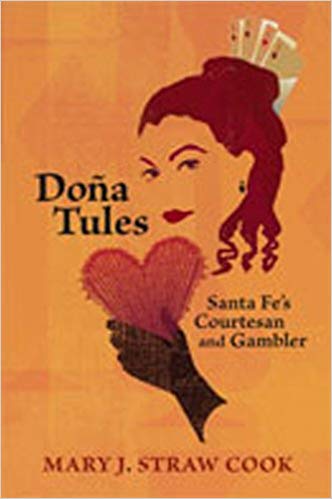
by Mary J. Straw Cook UNM Press, 2007 ISBN-13: 978-0826343130
In early August I posted a review of a fictional account of the life of Doña Tules Barceló. In it, I said it was the only fictional or non-fictional treatment that had been published about her life. I was wrong.
Admittedly, there isn’t a lot of information available about Tules Barceló’s life. However, in this book Mary J. Straw Cook has gathered what is known and fleshed it out with information about Barceló’s family members, both blood and adopted, and her contemporaries. While I don’t agree with all of Cook’s conclusions about Tules—the evidence for prostitution seems weak—the book does provide insight into her life, as well as into the era in which she lived, how it may have influenced her, and how she definitely influenced it.
This is a treasure of a book that reads like a novel. If you want to know more about this fascinating woman, her contemporaries, and her times, I recommend Doña Tules, Santa Fe’s Courtesan and Gambler.
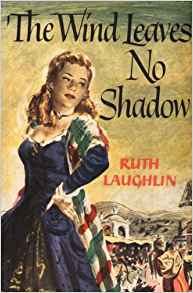
by Ruth Laughlin Caxton Printers, 1951 ISBN-13: 978-0870040832
Doña Tules Barceló was one of New Mexico’s most colorful 19th century characters, andThe Wind Leaves No Shadow is, as far as I know, the only fictional or non-fictional treatment of her life.
From humble origins, which Ruth Laughlin imagines effectively, Doña Tules became owner of a Santa Fe gambling establishment where political opponents could meet to arrange accommodations that worked for everyone involved. She also acted as a kind of informal bank, lending money to key actors at critical junctures in New Mexico’s history. Because her gambling house gave her access to information not available everywhere, she was a valuable resource for both the Mexican and the American officials. She is said to have provided information in late 1846 to Governor Bent’s administration about the incipient rebellion against the U.S. occupation, the one that would result in his death a couple months later.
Not much is known about Doña Tules’ life, and Laughlin uses this fact to her advantage, weaving a story that places her in Santa Fe by the mid-1820’s and keeps her there until her death in 1852. The result is a story that not only imagines Doña Tules’ life but also provides the opportunity for an inside look at events (the 1837 Tax Revolt, the 1846 U.S. invasion, the 1847 death of Charles Bent) and people (the fur trappers, the ricos, the Santa Fe merchants, the priests) in Santa Fe during this period.
The Wind Leaves No Shadow was originally published in 1951 and reflects the historical information available to the author at the time as well as the prejudices that period. Although I didn’t always agree with Laughlin’s interpretation of historical events, she does a really great job of incorporating them into an effective story line. I was also uncomfortable with her insistence on Doña Tules’ white skin, red hair, and green eyes. In Laughlin’s interpretation, her coloring sounds more Irish than Spanish. In spite of these caveats, I believe this is still a useful book. If you’d like to get some idea of the life and trials of New Mexico’s famous lady gambler might have been like, or you’d like a fictional interpretation of New Mexico’s history in the 1820-1850 time frame, I recommend this book.


 Fiction and Fact From Old New Mexico