
David Caffey’s recent book When Cimarron Meant Wild fills an important gap in the historiography of northeast New Mexico, specifically Colfax County, a.k.a. Cimarron Country. There are a number of books available about different aspects of the county and the personalities that made it legendary in its time, but up to this point, none of them have tied everything together, as Caffey’s does.
The County is inextricably linked to what became known as the Lucien B. Maxwell Land Grant. But When Cimarron Meant Wild begins long before the grant was established in the 1840s and reminds us that the land was home to indigenous populations well prior to either Spanish or American occupation.
Caffey also explains how these peoples—the Jicarilla Apache and Moache Ute—continued to play a role in the area well into the mid-19th century. Most of the material about Colfax County I’ve seen up to this point has very little to say about the original peoples, their rights to the land, and how they were gradually pushed off of it. I was impressed with the way When Cimarron Meant Wild addresses this issue.
The book also does an excellent job of describing Lucien Maxwell’s rather relaxed approach to exploiting the area’s resources, both agricultural and mineral. The difference between his strategy and that of the British corporation he and his wife sold out to in 1870 is an excellent study in contrasts. The Corporation was intent on wringing every penny out of their new possession, previous arrangements be damned. This shift in attitude created the environment that erupted into what became known as the Colfax County War, a conflict Caffey estimates resulted in 52 deaths over the next 11 years.
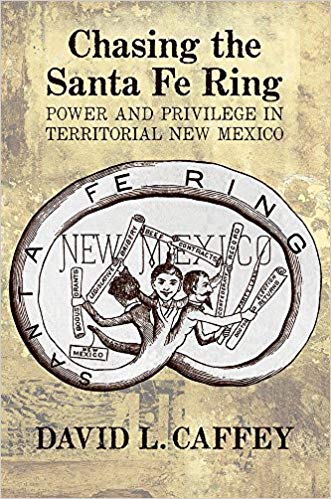
When Cimarron Meant Wild builds on Caffey’s previous work on New Mexico’s Santa Fe Ring and details the way the British corporation worked with Ring members, most notably Thomas B. Catron and Thomas Elkins, to eliminate the small-holders and miners who they felt were blocking the way to greater profits. The violence that resulted is documented here in detail but never sinks to a mere record of facts. Quite the opposite. The book’s organization and narrative flow is so masterful that it reads like a novel.
When Cimarron Meant Wild contains the best description I have yet read of the Colfax County War. Caffey not only provides an excellent retelling of both small and large events, he also gives us snapshots of the personalities involved without sentimentality or condemnation something I as a fiction writer find especially compelling.
This book is readable, historically accurate, and fills in important gaps for those of us who know a little about the area and want to learn more. If you aren’t familiar with northeast New Mexico’s or the Maxwell Land Grant’s fascinating history, When Cimarron Meant Wild is definitely the place to start learning about it. I highly recommend this book!
 Fiction and Fact From Old New Mexico