NOT JUST ANY MAN – CHAPTER 4

NOT JUST ANY MAN – CHAPTER 4

The following material is an extract from NOT JUST ANY MAN, A Novel of Old New Mexico, Copyright © 2018 Loretta Miles Tollefson. Published by Palo Flechado Press, Santa Fe, NM

A Note about Spanish Terms: This novel is set in northern New Mexico and reflects as much as possible the local dialect at that time. Even today, Northern New Mexico Spanish is a unique combination of late 1500s Spanish, indigenous words from the First Peoples of the region and of Mexico, and terms that filtered in with the French and American trappers and traders. I’ve tried to represent the resulting mixture as faithfully as possible. My primary source of information was Rubén Cobos’ excellent work, A Dictionary of New Mexico and Southern Colorado Spanish (University of New Mexico Press, 2003). Any errors in spelling, usage, or definition are solely my responsibility.

CHAPTER 4

Ewing Young appears at the Taos campsite three days later and pays off his men. It’s heading toward late October now, the cottonwoods gold along the stream banks, the temperatures cold at night but still warm during the daylight hours. Most of the teamsters leave the next morning. They hope to sign on with a Santa Fe train that will head east to Missouri before winter sets in. A small group remains behind in the pasture. Most of them plan to either winter in Taos or join a beaver trapping group and overwinter in the mountains.

Gerald isn’t sure how he wants to proceed. He’d like to see his father again and have a real conversation with him, but he can’t figure out how to do this without rousing suspicion. Jones is still in the Don Fernando de Taos area, though Gerald isn’t sure where. The matted-haired man sloped off with a lewd reference to Mexican señoritas as soon as he’d collected his pay. His going certainly makes Ewing Young’s meadow more comfortable and, since Young has told the men to stay as long as they need to, Gerald sees no reason to leave just yet, despite the chill nights.

Young comes by late one evening and sits talking with the remaining men, his big frame bending toward the fire as he warms his hands. When the last of Gerald’s companions has slipped off to their bedrolls, Young turns to him. “You lookin’ to trap?” he asks.

“I don’t know,” Gerald says. “I’d hoped to find work clerking, but I haven’t really started searching yet.”

“Still gettin’ your bearings?”

Gerald smiles slightly. “I suppose you could call it that.”

Young rises from the dead log he’s been sitting on. “I’m puttin’ together a band and headin’ out late next month. If you want to learn, you’re welcome to tag along. It might be a good way to earn the money for that farm of yours.” He grins. “If that’s what you’re still thinkin’ of doing. New Mexico has a way of turning a man’s mind in new directions.”

Gerald looks at him noncommittally and Young studies him. “I’m assuming you’ve got the wherewithal for the gear,” he says. “Traps are runnin’ ten dollars apiece and you’d need at least six, plus food and sundries. You’d be free trappin’, which means everything you bring in would be yours, but everything you put into it will be at risk, as well.”

“The investment resources aren’t a problem,” Gerald says, looking up at the big man. “And I appreciate the offer.” He shrugs and smiles. “I just may take you up on it.”

“I can sweeten the offer by assurin’ you that Enoch Jones won’t be comin’ with me,” Young says. “He made noises, but I’ve had just about all of him I can take for one year.” He stretches his hands over the flames. “Well, you know where t’ find me. We’ve got another week or so before headin’ out. I’m either at the store, my house, or Peabody’s place.” He turns away from the fire. “I’ll see you around.”

Gerald nods to the empty night and turns thoughtfully back to the flames. He picks up a stick and pokes at the fire, separating the pieces of burning wood so the flames will die out faster. He knows where Young’s mercantile is, and his house is on the other end of the pasture. But in the little time Gerald’s spent wandering the village, he’s seen no sign that identifies Peabody’s store.

He chuckles. But then, signs aren’t a major part of Don Fernando de Taos’ streetscapes. It’s an interesting place: half American, half Mexican, with a good dose of Taos Pueblo added in. The buildings are all brown one-story adobe mud that glint with flecks of mica in certain lights. In fact, in certain lights, the hamlet’s downright pretty.

And the people are pretty much live and let live, from what he can see. Best of all, he blends among them in a way he never has before, his skin simply another shade of the prevalent brown. In fact, he feels so comfortable here, he hates to leave.

But his money won’t last forever. He has only a few more weeks in which to decide what to do with himself. He hasn’t seen any need in the shops for another clerk. And Ewing Young is right. He doesn’t have the resources to set himself up as a farmer. Although if he did, he knows where he’d want to do so. If that’s possible so high in the mountains. On land surely already owned by someone. He pushes the thought of the long and fertile mountain valley out of his mind and douses the fire. Trapping seems like the best option so far.

~ ~ ~ ~

Gerald heads to the Taos plaza the next day for supplies, thinking again about how to approach his father in Ranchos. He’d truly like to get some advice about the idea of free trapping, not to mention passing as white.

He’s still accustomed to walking with a prairie-eating stride and he passes several groups of blanket-swathed Taos Indians who are also heading toward the plaza. He nods politely each time, but notices that their eyes tend to veer away from him. Even as they nod back at him, they don’t look directly into his face.

He frowns irritably, then remembers the slaves in Missouri. They did the same thing, carefully avoiding eye contact. Is it the sign of an oppressed people? Or simply politeness, not wanting to challenge or be challenged? It must be difficult to continue here in this land, with first the Spanish and now the Americans crowding in, encroaching on what was once only theirs.

Gerald reaches the plaza and slows to saunter past the cloths laid out on the ground and the produce and other goods carefully arranged on them. He finds he isn’t as interested in any of it as he probably ought to be, and veers off the plaza onto a street lined with adobe walls and the houses behind them.

All this vast land, yet the houses are so close together. There’s safety in that, of course. Although there are also plenty of shadowed corners for activity that might be suspicious in the full light of day. For example, this man facing the corner made by those two walls, his arms up and blocking the young woman who’s crowded into the niche, her back to the light brown adobe.

Gerald frowns. The man’s back is to him, but the matted white-blond hair under the dirty hat looks familiar. Jones? Then the man speaks, low and threatening, and there’s no doubt. Gerald stops in his tracks.

The girl speaks, in surprisingly good English, her voice sharp and clear. “I apologize if you have misunderstood me, Mr. Jones,” she says firmly. “I have no interest in keeping company with you.”

Jones reaches for her arm. “You think yer somethin’,” he growls. “But yer just another Mexican slut.”

“How dare you!” She twists, trying to get away, but Jones reaches for her shoulder and forces her back, against the adobe.

Then Gerald is behind him, fingers clamping Jones’ upper arm. “Let her go!”

Jones, startled, turns his head. “You!” His grip on the girl loosens involuntarily. She slips out of his grasp and darts down the dirt street. She looks back as she reaches the corner, dark eyes wide, and nods her thanks to Gerald, then is gone before he’s had time to do more than glimpse a light brown face and black hair neatly pulled up in an old-fashioned American hairstyle, soft tendrils framing her cheeks.

Gerald turns back to Jones and tightens his grip. “She clearly doesn’t want your attentions.”

Jones jerks his arm away and Gerald lets him go. “It’s none o’ yer business,” Jones growls. “’Sides, she’s just a Mexican. Just like yer just a nigger.”

Gerald’s eyes narrow. “She’s still a woman,” he says. “To be treated with respect.”

“Respect ain’t what they want.” Jones grins lasciviously. “They want tamin’.”

“It certainly didn’t sound that way to me.”

Jones shoves past Gerald into the narrow street. “You just stay out of my way.”

Gerald watches him go, then looks again toward the corner where the girl disappeared. She’s taller than the other women he’s seen in Taos. Her clothes are different, too. More American style, with an old-fashioned high waist and straight skirt that reminds him of the dresses his mother used to wear. Her skirts are longer than those of the other Mexican girls. He’d caught only a glimpse of ankle, instead of the half calf so common here. And her hair was tucked up. Off her neck, not down her back. A long, narrow back. A truly beautiful tawny-brown neck.

Impulsively, he moves down the street after her. But rounding the corner only reveals more adobe walls and a little boy playing in the dirt. The girl spoke perfect English too, although with a slight Spanish lift. A very pleasant lilt. Who is she?

Perhaps his father will know. It’s yet another question to ask him, apart from whether it’s wise for Gerald to continue to try to pass as white and what he would advise Gerald to do for a living, now that he’s here.

But when Gerald arrives at the Ranchos de Taos smithy early the next day, he finds that both the smithy and the casita beside it are empty. A middle-aged Mexican woman is pulling water from a well in the center of the compound. She looks at him inquiringly. He gestures toward the smithy and raises his eyebrows in a questioning look.

She smiles in amusement, shakes her head, and carries her water bucket through a doorway at the end of the compound.

A minute later, an American man comes out. He scratches at his scraggly blond beard and scowls at Gerald. “You wantin’ the smith?” he asks. “He took off. Said he was goin’ trappin’. Paid me my month’s due an’ hightailed it.” He peers into Gerald’s face. “You wouldn’t happen to know anything about blacksmithin’, would you?”

Gerald shakes his head. “Did he say where he was going?”

The man waves a hand toward the mountains to the north. “Rockies, I guess. I dunno. He’s left me in a helluva bind.” His face brightens a little. “You needin’ traps? I’ve still got a half dozen he made before he took off.”

Gerald shakes his head again, then pauses. Maybe trapping would be the best way. “I’m not sure,” he says. “But if I do, I’ll come back for them.”

“Don’t know if they’ll be here by then.” The man scratches at his beard again. “They’re likely to go fast, once word gets out that Smith’s gone. He’s the best damn blacksmith we’ve seen in these parts for a while now.”

Gerald grins. “Then you should get a good price,” he says, turning away. “I apologize for waking you so early.”

“You come on back now, if you need anything,” the man says.

Gerald lifts a hand in farewell. “I’ll do that.”

He heads back to Don Fernando de Taos. His father has answered at least one of his questions. He’s left the area, leaving Gerald free to continue to pass as white. Gerald isn’t sure how he feels about this. Although most people don’t seem to care about his ancestry, clearly those who do care, care deeply. At least, Enoch Jones seems to.

And is it the right thing to do? Is it fair to others to not tell them up front? His jaw tightens. Why should it matter what color his skin is? He’s just a man, like any other man. The same hopes and desires, the same needs.

He stops in the middle of the path back to Taos and gazes up at the golden cottonwoods, the intense blue of the sky above them. It’s not like he set out to pass. In fact, he hasn’t actually told anyone he’s white. He’s just let them assume it. For that matter, he hasn’t denied his race to Jones. Although he hasn’t confirmed it, either.

But living on an equal footing with other men these past weeks has felt good. Gerald chuckles. ‘Good’ is such an inadequate word to describe the expansion he’s felt, the way he seems taller, somehow. He’s always known that he’s equal to any other man. Certainly, his parents made that clear enough to him.

Gerald grins, thinking of his Irish mother’s blazing blue eyes as she snapped, “You just be who you are inside and that’ll be good enough for anybody who has any sense, whether your mother’s a mere bondservant or your father a free negro.” He lifts two fingers to his forehead in a mock salute. Yes ma’am. Then he sobers. But to be treated as equal is another thing entirely. It makes a man’s shoulders a little straighter, somehow.

He continues walking, his hands in his pockets. Maybe he’ll just continue on as he is and see what comes of it. Why cause trouble when it isn’t asking to be caused? Why not enjoy the experience and see where it takes him?

Copyright © 2018 Loretta Miles Tollefson

NOT JUST ANY MAN – CHAPTER 2

NOT JUST ANY MAN – CHAPTER 2

The following material is an extract from NOT JUST ANY MAN, A Novel of Old New Mexico, Copyright © 2018 Loretta Miles Tollefson. Published by Palo Flechado Press, Santa Fe, NM

A Note about Spanish Terms: This novel is set in northern New Mexico and reflects as much as possible the local dialect at that time. Even today, Northern New Mexico Spanish is a unique combination of late 1500s Spanish, indigenous words from the First Peoples of the region and of Mexico, and terms that filtered in with the French and American trappers and traders. I’ve tried to represent the resulting mixture as faithfully as possible. My primary source of information was Rubén Cobos’ excellent work, A Dictionary of New Mexico and Southern Colorado Spanish (University of New Mexico Press, 2003). Any errors in spelling, usage, or definition are solely my responsibility.

CHAPTER 2

The train trundles uneventfully southwest after that. They’re on the Cimarron Cut Off, so the only real issue is lack of water, a lack that gives Gerald a new appreciation for the wide and steady flow of the Missouri River. And the taste of fresh water, which they don’t experience until they reach the springs near a rocky outcropping unimaginatively called Point of Rocks.

From here, the Sangre de Cristo mountains break blue across the western horizon. Men and animals are travel weary and dusty, but Young doesn’t give them more than a day to rest and clean up. He begins almost immediately to divide the horses and mules into two groups: those who’ll tolerate a pack and those who won’t.

The second morning finds the one who will being fitted with loads of merchandise to be carried over the mountains to Don Fernando de Taos. The other, smaller group will tow the remaining merchandise in the now half-empty wagons to Santa Fe, where the Mexican government officials will levy a tariff on the goods. Apparently there’s no such tariff levied in Taos and this division of goods is common practice. Certainly, the teamsters seem to consider it routine.

“I guess you’ll be wantin’ to head straight to Taos,” Young says to Gerald as they watch the packs being loaded. “Since you’ve got business there.”

“I do, if you don’t need me with the wagons,” Gerald answers.

Young nods. “I’ll meet you and the others there and pay you all off,” he says. “You can find me at my store or at Peabody’s.”

Gerald nods. “That’ll be fine,” he says. “Where—”

A scuffle breaks out just then between two horses and a teamster, and Young heads toward them, leaving Gerald with his question unasked. He shrugs. He’ll learn soon enough how to find his way around Taos, locate Young’s mercantile, or this Peabody’s place of business.

He moves out with the pack train the next morning. They head due west, the animals strung together with ropes in long groups of ten, a man at the head of each group and one halfway back. Charlie is master now and he tells Gerald to settle in beside the middle of the second string, the one led by Enoch Jones.

The scout steers the mule train toward a gap in the hills. As they move west, the grass thickens. The late summer rains have greened the landscape nicely. Yellow sunflowers brighten the ground wherever there’s a bit of an indentation to hold the moisture. Gerald looks at them approvingly.

The next day, the grassy slopes begin to tilt upward and the sunflowers shrink in size and number. Juniper bushes scatter the landscape and fill the warm afternoon with a sharp urine smell. Farther up, there’s a type of tree Gerald’s never seen before: a kind of resinous pine, its trunk gnarled as if it’s been wind blasted for at least a hundred years.

The route moves uphill, along the side of a rocky slope, and the path narrows. Gerald focuses on his work. There’s not room for both man and mule, and he drops into the trees below the path to give the animals room to maneuver. Dirt and small rocks break under his feet and dribble down the slope to the gully below. He has to work to stay in line with his string.

Then the trail ahead becomes little more than a rocky outcropping. Gerald’s string of mules comes to a halt as the animals ahead of them edge cautiously across the ledge. The mules bunch together on the narrow path and snuffle at each other as if commiserating on their lot. Gerald scrambles up the bank to them, then farther up the slope to get out of their way but be within reach if they need him.

At the sound of rocks skittering down the bank, Enoch Jones turns and glares. “No time t’ be explorin’,” he growls.

“There’s not room on the path for both man and beast,” Gerald points out. The dirt moves under his feet and he clutches at a juniper branch for support. “I’ll be down as soon as we start moving again.”

Jones scowls and yanks on his lead mule’s chin strap, forcing the animal’s muzzle toward him. The mule pulls its head back, baring its teeth, and Jones whips the free end of the lead rope across its nose. The animal snorts angrily and jerks away, but this puts its hooves off the trail, scrambling in the dirt and rocks. The pack on its back tilts precariously.

Jones is pulled forward by the mule’s weight. Just as his feet hit the edge of the trail, the mule lurches backward down the slope, wrenching the rope from Jones’ hands. He drops to the ground and his right foot twists awkwardly under his left leg. “Whoa, damn you!” he yells.

But it’s too late. As the lead mule slides down the bank, the animals linked to it are pulled inexorably toward the edge of the trail. They brace themselves, their eyes rolling.

Gerald slips gingerly down the bank, trying to move as smoothly as possible to keep from knocking gravel onto the trail and frightening the animals even more.

“Whoa, now,” he says soothingly. “Whoa now.”

The mule nearest him turns its head, its eyes wild with fright. Gerald stretches to touch the mule’s neck, then moves cautiously to its head. He grabs the animal’s halter and peers over its shoulder and down the hillside. “Whoa now,” he says again.

Fortunately, the lead mule has found its footing. It stands, huffing irritably, on a small flat space below, its pack still intact but tilted to one side. The four mules strung behind it are stranded in an uneven row between it and the trail above. They scuffle rocky dirt anxiously as they try to find secure footing. They look more puzzled than frightened.

Gerald pats the mule he’s standing next to soothingly and moves past it, grateful that it and the four still behind it stalled when they did.

He looks at Jones, who’s still on the ground, his hands on his twisted ankle. “No harm done,” Gerald says.

Just then, Charlie appears on the trail ahead. “Ya’ll all right back there?” he calls. As he gets closer, Jones pushes himself upright, his right foot carefully lifted from the ground, his face twisted in fury.

“You give me green help, this is what happens,” Jones jabs a thumb toward Gerald. “He was too busy wandering uphill to keep ’em in line.” He puts his foot on the ground and winces. “An’ now I can’t walk.”

Charlie gives Jones a long look, then turns to Gerald. “On slopes like this, it’s best if ya stay below ’em, when ya ken,” he says. “Or directly behind. They get nervous when there’s somethin’ on the hillside above. Think yer a catamount or somethin’.”

Gerald nods. There’s no point in pointing out that Jones triggered this particular nervousness.

The scout moves to the edge of the path and peers down. “Looks like nothin’s lost.” He turns to consider Jones’ foot, then Gerald. “Think ya ken lead ’em up? Jones is gonna need to favor that foot a mite.”

Gerald nods and maneuvers around the other men to find a way down the hillside to the lead mule. As he passes, Jones mutters, “Damn green hand!” and Charlie answers evenly, “A man ken’t do what he ain’t been told, now ken he?”

Once all of the string is back on the path, Gerald and Charlie straighten the lead mule’s pack and tighten it down again, then Charlie returns to his own string and Gerald keeps the mule steady until it’s their turn to make their way across the outcropping.

Jones limps behind, alternately cursing damn mules and green hands. He soon falls behind the entire mule train, so Gerald doesn’t have to listen to him for long. But Jones is still fuming when he limps into camp that night, well after everyone else.

“Coulda been killed,” he growls, tossing aside the stick he’s been using as a crutch. He sinks onto a large piece of sandstone and begins loosening his bootlaces. “There’s Apaches out there, ya know.”

“There was nothin’ for ya t’ ride,” Charlie says mildly from across the fire. “And we weren’t that far ahead.”

Jones grunts and reaches down to pull off his boot, but the angle is wrong and he wrenches the swollen ankle out of position. “Hell!” he yelps.

“Want some help with that?” Gerald asks, moving toward him.

“Stay away from me!” Jones snarls.

“You know, Jones, if you’d been a little easier on that mule, she wouldn’t of jumped,” says the man who’d been leading the set of mules directly behind Jones and Gerald’s string. He glances at Jones, then Charlie, then the fire. “Looked to me like she was pretty calm ’til you slapped her muzzle with that rope.”

Charlie looks first at Jones, then Gerald. Jones glares at the man on the other side of the flames, who ignores him, but Gerald returns Charlie’s gaze steadily.

“You don’t know nothin’,” Jones growls. He glares at Charlie. “I got stuck with a idiot mule and a damn green hand. What’d ya expect?” The scout doesn’t respond and Jones turns his scowl on Gerald. “You green hands come out here and think ya know everything there is t’ know, an’ ya don’t know shit!” He moves his foot impatiently, then flinches and reaches for his swollen ankle.

“If ya wrap that up good and tight, it’ll help bring that swellin’ down,” Charlie says. “We ken redistribute goods in the morning and set up somethin’ fer ya to ride on fer tomorrow, at least.”

Jones nods sullenly. “In the meantime, someone could bring me some food,” he grumbles and Charlie nods to the other stringer, who rises quietly to make the arrangements.

Early the next day, with Jones riding at the head of the mule train, Charlie and his men drop into the south end of a valley thick with ripe grass. A small sparkling stream winds its way through the valley floor, heading north through more grassland. Mountains glimmer at the valley’s head, a good ten miles away. The bank of the little creek below has broken off in places, exposing a soil so black and fertile that Gerald’s fingers itch to run through it. Now this is land a man could raise a crop on.

He looks up at the almost-black fir-covered mountains in front of them, then northwest to taller, stonier peaks, the largest a massive, curved wall of rock. They’ve been climbing the last two days. The growing season here would be short, and the winters strong.

But still— Gerald looks down at the thick grass on the valley floor. Cattle would do well here. If a man built them adequate shelter, they could feed all through the cold season on hay harvested from these rich bottom lands.

But he has no money for land and the outlay needed to raise cattle or anything else. And this is Indian country. It’s an impossible dream. Even so, as the mule train moves into the trees on the other side of the valley, toward what Charlie says is Apache Pass, Gerald finds himself glancing back toward the bright trickle of water running steadily north.

Copyright © 2018 Loretta Miles Tollefson

Book Review: The Odyssey of Geronimo

Book Review: The Odyssey of Geronimo

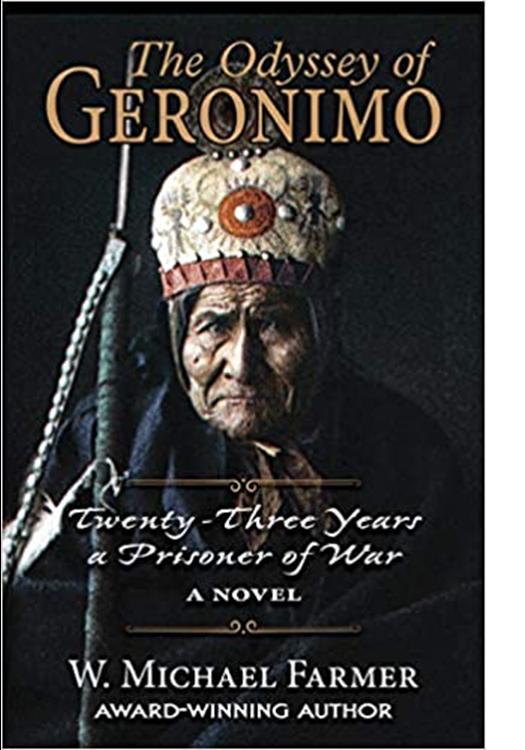
W. Michael Farmer’s The Odyssey of Geronimois one of those rare books, a true biographical fiction that doesn’t sugar-coat the less comfortable characteristics of its protagonist.

I find the title of this book, with its homage to the Odyssey of Homer, especially appealing. Like Homer’s hero, Farmer’s is also a wily man whose actions do not always seem admirable to us today. And yet he lingers in our consciousness. Even though we don’t quite know how to think about it, his story endures. Geronimo, an Apache warrior whose deeds of war made him feared across the American Southwest, continued in captivity and beyond to exert a powerful influence on the American psyche, as Odysseus’s has on the European imagination.

The Odyssey of Geronimo provides context for the old warrior’s actions before, during, and after his capture, and draws an illuminating portrait of a man who spent twenty-three years bridging the gap between his culture and the one he was thrust into by circumstances beyond his control.

This is a book about survival, with all its complexities. I highly recommend it.

New Old New Mexico Ebook Set Available!

New Old New Mexico Ebook Set Available!

I’m pleased to announce that the first three novels of my Old New Mexico series, Not Just Any Man, Not My Father’s House, and No Secret Too Small are now available in ebook form as a “boxed set” titled The Locke Family Saga.

This story of secrets, prejudice, and the power of love, is told in three books, each from the perspective of a different family member. 

In Not Just Any Man, Gerald must survive the Sangre de Cristo mountains, the Mohave Indians, the arid south rim of the Grand Canyon, and the fellow trapper who hates him for the color of his skin before he can return to Taos and the girl he hopes is waiting for him. Can he prove to himself and to her that he is, after all, not just any man?

In Not My Father’s House, Suzanna does her unhappy best to adjust to married life in an isolated valley of the Sangre de Cristos, but postpartum depression, the cold, and the lack of sunlight push her to the edge. However, the mountains contain a menace far more dangerous than Suzanna’s internal struggles. The man Gerald killed in the Gila wilderness two years ago isn’t as dead as everyone thought. And his lust for Suzanna is even stronger than his desire for Gerald’s blood.

In No Secret Too Small, 1837 New Mexico is teetering on the verge of revolution when the Locke family experiences an upheaval of its own. Eight-year-old Alma’s father, Gerald, has never told her mother that his grandmother was a runaway slave. When his father shows up, the truth comes out. Stunned and furious, Suzanna leaves, taking Alma and six-year-old Andrew with her. However, by the time they reach Santa Fe, rebellion has broken out. Will the Locke family survive the resulting chaos? 

The Locke Family Saga is available at your favorite ebook retailer, Amazon.com, and Barnes and Noble.

U.S. Mail Heads to Santa Fe!

U.S. Mail Heads to Santa Fe!

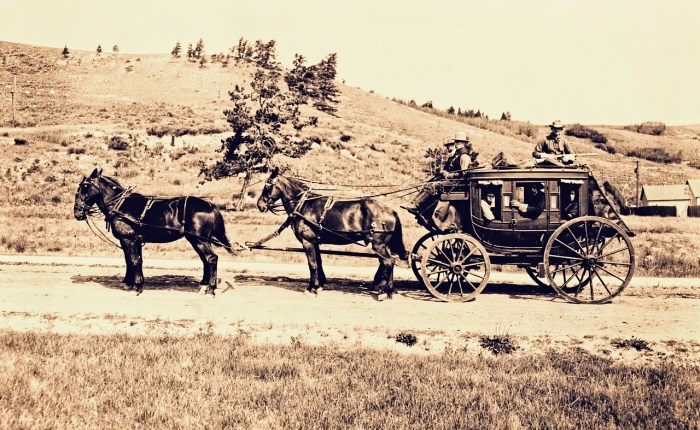
On Monday, July 1, 1850, the first stage-transported U.S. mail left Independence, Missouri for Santa Fe, New Mexico with eight men guarding the mule-drawn coach.

This was the first Congressionally authorized four-year contract for mail transported by vehicle between Independence and New Mexico. It had initially been set to leave Fort Leavenworth but the contract was modified to send it out of Independence instead, reducing the route distance from 885 to 840 miles.

The mail contractors in 1850 were Dr. David Waldo of New Mexico and Jacob Hall of Independence. The stage not only carried the mail, it also provided passenger service, with fares of $100 in the summer and $150 during the winter. A letter of less than half an ounce cost $0.10 and could be sent collect, postage to be paid by the recipient.

The company that Waldo and Hall formed in 1850 dissolved four years later, when Hall bought Waldo out and teamed up with John M. Hockaday to transport the mail for the next contract period. In 1857, service moved to semimonthly and the following year Hall again placed a successful bid, this time as sole proprietor. In 1862, he bid again, but the contract was awarded to George H. Vickroy and Thomas J. Barnum.

The Eastern terminus for the stage also shifted that year, moving west to Kansas City. Now the shortening of the line that had begun on the first run accelerated, responding to the growth of the railroads. Stage service to Santa Fe would end completely in 1880 with the arrival of the Atchison, Topeka, and Santa Fe. But the idea of the stage and its symbolic connection to the American frontier would linger much longer.  

Book Review: First Mail West

Book Review: First Mail West
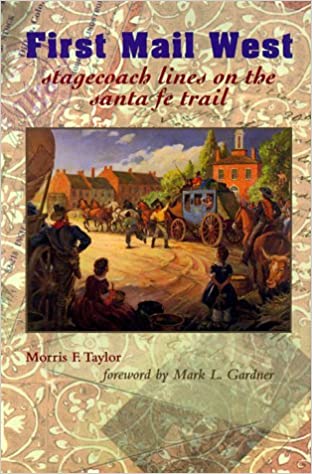
by Morris F. Taylor, UNM Press, 2000

For many Americans, the stagecoach symbolizes the 1800s in the West. And yet, stage mail and passenger service to Santa Fe lasted just thirty years, from 1850 to 1880. In that time, the route grew shorter and shorter, as the railroad crept toward New Mexico and finally ended the stagecoach era completely.

Morris F. Taylor’s book First Mail West: Stagecoach Lines on the Santa Fe Trail tells that story and much more.  It begins with equine transport of military dispatches and goes on to describe when and how the first Post Office Department contracts were put in place and the many details connected with the mail stage system.

But this is not a dry fact-and-figures kind of book. It’s filled with the names of people associated with New Mexico history—the Bent brothers, David Waldo, Ceran St. Vrain, William W.H. Davis, Kit Carson, Governors Lane and Meriwether, and many more. It also identifies lesser-known individuals, including the stage conductors and drivers, and provides fascinating glimpses into life along the route to Santa Fe—descriptions of the stage stops, how they were operated, the people who ran them, and the dangers they encountered. In addition, because the stage had connections into Denver, there’s a good overview of the early Colorado mine fields and the towns that sprang up around them.

First Mail West is a pleasure to read and full of information you never realized you wanted to know. I recommend it to anyone researching New Mexico and Colorado history in the 1846-1880 time frame and also to those who’d simply like another approach to Old West history.

THAT’LL TEACH EM

Gregorio, as the youngest of the trapping expedition’s camp keepers, was responsible for preparing the morning tortillas. He placed a small barrel of flour on the ground, scooped what he needed into a large wooden bowl, cut in the proper amount of fat, and mixed in water from his canteen. The mixing was more a matter of feel than attention and he glanced lazily across the campsite as he worked.

Then his head jerked. “Apache!” he exclaimed.  

The trappers all turned at once. A loose line of long-haired warriors stood among the rocks and pines at the far side of the clearing. The man in the center sported a large palmetto hat and a bright red long sleeved shirt. He was clearly the Chief. Three warriors were positioned on his left, two on his right. Another stood slightly back, an arrow fletched in his lightly-held bow. 

There was a long silence. Then Ewing Young, as the trapper leader, made a welcoming motion.

The man in the hat moved forward. He paused by the fire and looked slowly around the clearing, as if calculating the value of every item in sight, including the rifle in Thomas Smith’s hands. Smith scowled and the chief permitted himself a small smile before moving on.

Then his gaze fell on Gregorio. He pointed at the barrel of flour. “Meal!” he commanded.

Ewing Young frowned, then nodded reluctantly. The Chief stepped to one side, lifted a wool blanket from a nearby rock and flicked it open, an edge in each hand.

“That’s mine!” Enoch Jones protested.

Smith jerked his head at him. “I’ll give you mine,” he said. Then he stepped backward, into the trees, and began circling toward Gregorio and the flour.

The Chief positioned himself in front of the barrel and let Jones’ blanket sag slightly between his hands to form a crude container. Ewing Young waved Gregorio aside, leaned over the barrel, and began scooping out double handfuls of flour. As he dropped them into the blanket, a dusty haze rose into the morning air.

The Apache turned his head and gave his men a satisfied smile. He didn’t see Thomas Smith step from the evergreens behind Gregorio, his rifle cocked and ready.

Young poured yet another double handful of flour into the blanket and held up his white-dusted palms to show that he was finished.

The Apache growled something unintelligible in response.

Young scowled and raised two fingers. “Two more,” he said.

The Chief nodded and lifted the blanket slightly, ready for more.

As Young reached into the barrel again, Thomas Smith stepped past Gregorio, shoved the rifle’s muzzle up under the blanket, and pulled the trigger. The bullet exploded through the cloth and blood-spattered flour splashed across the Chief’s torso.

As the Apache crumpled to the ground, his men dashed into the clearing. Gunfire erupted. Arrows flew. A trapper dropped, then an Apache, then another.

Ewing Young, his upper body coated in white flour, shook his deafened head. Then an arrow flashed through the air and bit into the ground at his feet. He lunged for his rifle and aimed into the trees. But the Indians were already gone, vanished into the rocks and the pines.

Their Chief lay where he’d fallen, his red sleeves dusted with white, his chest an incongruous paste of flour and blood.

Thomas Smith stood over him. “That’ll teach ’em!” he chortled. He grinned at Enoch Jones, who was crouched beside a dead Apache, the man’s beaded knife sheath in his hands. “That’s worth a hole in a blanket, ain’t it?”

Jones grinned back at him, his eyes glittering. “Three dead, four t’ go!” he agreed. “They can’t be far yet.”

“Three dead’s enough,” Ewing Young said grimly as he beat flour from his clothes. “That was a stupid stunt, Smith. You think we’ve seen the last of them? If that band doesn’t come after us by nightfall, it’ll only be because they haven’t decided yet who their new leader is.” His eyes glared from his white spattered head. “Next time you decide to shoot an Indian, don’t do it in my face, or I may just mistake you for one.”

from Old One Eye Pete

What’s a Buckboard Wagon?

In my new novel No Secret Too Small, Suzanna and the kids spend quite a bit of time riding in a buckboard wagon. Today, I thought I’d explain what a buckboard wagon looks like.

A buckboard is basically a big rectangular wooden box with four sides, no top, and four wheels. It’s called a buckboard because an extra board is added to the wagon box directly in front of the driver’s seat. This protects the driver and passengers from the mule or horse’s hooves in case they buck. The board also acts as a footrest.

Below is a picture of a modern-day buckboard. This seat has a back, unlike the one on the Locke wagon.

Hitching an animal to one of these was not a simple task. Here’s a video of a pony being hitched to a cart. Imagine that animal a good deal bigger and you’ll get the idea.

You can see from this why Suzanna was glad to have help hitching up her mules! I enjoy learning and writing about Old New Mexico, but I have to admit that I’m glad we have more modern transportation available to us!

CULTURE CLASH

Ewing Young and his trappers were well into the Gila wilderness and moving steadily through its rocks and pines the afternoon the string of four men and three mules came into view. The strangers were working their way up a dry arroyo that intersected with Young’s path.

Young held up a hand and his men all stopped in their tracks and watched the other group scramble toward them, though Enoch Jones huffed impatiently at the delay.

“Chalifoux!” Young said when the newcomers got within speaking distance. “I thought you were trapping south with James Baird.”

“Baird, he is dead,” the tallest of the two long-haired Frenchmen said. “La maladie, it got him.”

“I’m sorry to hear that.”

“We came on anyway,” Chalifoux said. He gestured behind him. “Me, my brother, Grijalva, and him.”

The men behind Chalifoux nodded at Young politely. The youngest, the one with the dark skin and tightly-curled black hair, seemed to tense as Young’s gaze landed on him, but Young only nodded absently and turned to Chalifoux. “We’ve got thirty in our troop,” he said. “I figure that’s about all the Gila can handle at any one time. You headin’ that way?”

“It is as God wills,” Chalifoux said. “Perhaps to the north, toward the salt bluffs[1] of the Navajo.” He scratched his bandanna-covered forehead and nodded toward the third man in his small train. “Grijalva here, he shot a buck.” He jerked his head toward the pack animal being led by the dark-skinned young man. “A good size one. You want we share the meat tonight?”

“Sure, why not?” Ewing Young grinned and jerked his head toward the end of his own train. “Fall in behind and we’ll help you to cut that deer down to a more packable size.”

The Frenchman’s party stood and waited as Young’s men filed past. The trappers eyed the dead buck with interest. A good meal of venison would make for a pleasant evening.

But it wasn’t quite as pleasant as it could have been. The visitors produced whisky to accompany the meal and Enoch Jones took more than his share. Jones was apt to be more surly than usual when he drank and the presence of the young black man seemed to aggravate him.

He was leaning sullenly against a large rock that jutted from the ground a few yards beyond the fire, nursing yet another drink, when the younger man approached, a small book in his hand. The stranger crouched down beside the stones that circled the fire, opened the book, and angled its pages so the light would fall on them.

Jones scowled and leaned forward. “What’re ya doin’ there?” he demanded. He set his tin cup on top of the big rock, stepped forward, and nudged at the black man with his foot. “Hey! I asked a question! What’re ya doin’?”

The man looked up. “I’m reading,” he said. He turned the book so Jones could see the spine. “It’s a play by Mr. Shakespeare called Othello.”

Jones scowled at him. “What’s yer name, anyway?”

“I’m called Blackstone.” The man considered Jones for a long moment, then asked. “And what is your name?”

Jones stalked away into the night. Blackstone’s eyes followed him thoughtfully, then returned to his book.

But Jones was back a few minutes later, followed by Chalifoux. Jones jabbed a thumb toward Blackstone. “You see what he’s doin’?” he demanded.

Chalifoux grunted. “It appears to me that he is reading.” He turned away, but Jones blocked his path.

“That’s illegal!” Jones said. “Ya can’t let him do that!”

“He is a free man, Mr. Jones,” Chalifoux said. “He can do as he likes.”

Jones’ face turned red. “He’s a nigger! He ain’t allowed t’ read!”

Chalifoux raised an eyebrow. “This is a new law? One I know nothing of?” He turned to Blackstone. “What is this law?”

The younger man looked up, moved a small ribbon to mark his place, and closed the book. “I believe there is a law in South Carolina which makes it illegal for slaves to learn to read or write.” He shifted the book into his left hand, lifting it as if its very bulk was pleasant to him. “However, as you say, I’m a free man. So the law wouldn’t apply to me even if we were still in the United States.”

“Which it is certain we are not,” Chalifoux said. He bent, picked up a stray pine cone, and tossed it into the fire.

Blackstone glanced at Jones, then away. “And there’s certainly no such law here,” he said.

“Damn uppity nigger!” Jones said. He surged past Chalifoux, leaned down, and grabbed Blackstone’s arm. “You talkin’ back t’ me?”

Blackstone rose in one easy motion, elbowing Jones aside. “I was speaking to Mr. Chalifoux,” he said evenly.

Jones reached for the Shakespeare, but Blackstone lifted it out of his reach. Then Jones’ foot struck sideways, into Blackstone’s shin, and the younger man stumbled and lost his grip on the book, which landed, page end down, on the stones beside the fire.

“You bastard!” Blackstone turned and shoved Jones with both hands. Jones sprawled backward, away from the fire and onto the ground beside the big rock.

Blackstone swung back to the fire and the Shakespeare, but Chalifoux had already leaned down and lifted it away from the licking flames.

As the Frenchman handed the book to Blackstone, Jones heaved himself from the ground. He was halfway to the fire again, his fists doubled and ready for battle, when Ewing Young stepped from the darkness.

“What’s goin’ on?” Young asked.

Jones stopped short. “Nigger bastard sucker punched me!” he growled. He glared at Blackstone. “You ain’t seen the last o’ me.” Then he turned and stalked into the night.

“Is he always so pleasant, that one?” Chalifoux asked Young.

Young spread his hands, palms up. “There’s one in every bunch.”

Chalifoux shrugged expressively, then tilted his head back to study the trees and the stars overhead. “We will move north in the morning,” he said. “My party and me to the salt bluffs, I think. They tell me they are a sight worth the seeing.”

from Old One Eye Pete

WILD KNOWLEDGE

He wasn’t a man to pay much attention to girl children, but this one was different. She didn’t seem interested in cooking or clothes. More likely, she’d be in the canyon, fishing the Cimarron River. Her brother was the dreamy one, the one watching the fish swim ’stead of trying to catch ’em.

So the man was surprised when she came around the curve of the path and stopped to watch him cook the wild carrot root. He’d cut off the flowers and was slicing the root into the pot on the fire.

“Good eatin’,” he told her. “Back home, they say these make your eyes strong.”

She frowned. “Not that,” she said, shaking her head.

He was hungry. He lifted the last piece to his mouth.

“No!” she said sharply.

He raised an eyebrow at her and lowered his hand.

“That isn’t carrot,” she said. “It’s poison hemlock.”

from Valley of the Eagles