
When the last of the men from the Texas Santa Fe Expedition reached El Paso del Norte (today’s Juarez) in early November 1841, they must have felt as if they’d come out of hell into paradise.
They had traveled roughly 1000 miles from Austin, Texas to New Mexico, starving a good deal of the way, then about 500 more, as prisoners, from eastern New Mexico to the Rio Grande, then south, a route that included the desert-like Jornada del Muerto, or Journey of the Dead Man. They had endured unbearable heat on the plains and snow and icy winds on the Jornada. Now, though they were still prisoners, life had become much easier.
The very weather had changed. George Wilkins Kendall noticed it the night before they arrived, when, he says, “the evening air was of a most wooing temperature mild and bland” (Kendall, II, 23). As the Texans reached the outskirts of El Paso, they saw that the very plant life was different. The valley, irrigated by a canal from the Rio Grande, boasted abundant wheat, onions up to four pounds in weight, fruit trees, and extensive vineyards (Timmons, 195).
Even Kendall, who spent almost all his time in Mexico complaining, liked El Paso del Norte. Although his report doesn’t mention its famous building, the mission of Guadalupe de los Mansos, he does rhapsodize about the city’s “delightful situation in a quiet and secluded valley, its rippling artificial brooks, its shady streets, its teeming and luxurious vineyards, its dry, pure air and mild climate, and, above all, its kind and hospitable inhabitants” (Kendall, II, 42).
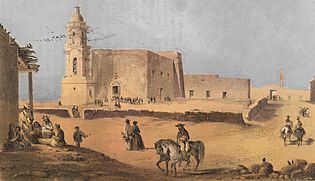
Source: es.wikipedia.org/wiki/Misión_de_Guadalupe_de_los_Mansos_en_el_Paso_del_río_del_Norte Accessed 10/17/23
Part of the reason Kendall was so impressed by the hospitality was that he was one of several Texans hosted by Presidio Commander José María Elías González. And hosted lavishly. Kendall reports the afternoon hot chocolate, the evening wine in glasses the size of New England tumblers, the tasty blood puddings, and other details of the table with great glee.
But the party couldn’t go on forever. The Texan prisoners were on the road again on Tuesday, November 9, heading to Chihuahua en route to Mexico City, where life would again become difficult. The idyll of El Paso was over, and prison and the whims of President Santa Anna, who the Texans had humiliated at San Jacinto, waited ahead.
Partial Sources: Ruben Cobos, A Dictionary of New Mexico & Southern Colorado Spanish, Santa Fe: Museum of New Mexico Press; George Wilkins Kendall, A Narrative of the Texan Santa Fe Expedition, Vol. II, Harper and Brothers: New York, 1847; W.H. Timmons, El Paso, A Borderlands History, El Paso: Texas Western Press, 2004.

 Fiction and Fact From Old New Mexico