 If you’re looking for a fun read set in the southern Rocky Mountains, Delilah by Kaye Lynne Booth might be just the ticket. Ms. Booth calls it a frontier romance. I’d call it feminist Louis L’Amour with a gift for colorful language. The heroine hails from the San Luis Valley, suffers through and prevails over a number of adverse circumstances that would destroy a lesser woman, and ends up in Leadville, CO as . . . . But you’ll have to read it yourself to find out! It’s available here.
Category: fiction
Damn Pup
“Where’d that damn pup get to now?” Old Pete muttered as he and the mule reached the rocky outcropping that overlooked the southern part of the valley. He could see through the ponderosa into a good stretch of grassland below, but there was no evidence of the curly-haired black Indian dog. Pete shook his head in disgust, jammed his rabbit-fur hat farther down on his head, and snapped the mule’s lead rope impatiently.
At least the mule didn’t need voice direction. Which was more than could be said for the dog, but Pete wasn’t callin’ the damn thing, no matter how aggravated he might feel. There’d likely be Jicarilla Apaches roamin’ the valley for elk, and Pete was taking no chance of being found before he wanted to be. The dog could go to hell, for all he cared. He grunted irritably as he worked his way down the hillside. Idiot pup.
He paused at the tree line, getting his bearings, the air crisp on his face. A light snow powdered the ground. A good-sized elk herd was bunched on the hillside to his left. He squinted. They seemed a mite restless. Then he saw the wolves, eight or nine of them waiting downwind while two big ones trotted the herd’s perimeter, checking for weakness.
Then he caught the sound of a low whine emanating from the prickly ground-hugging branches of a nearby juniper. As Pete watched, the black pup eased from the tree’s grip and came to crouch at his feet, tail between its legs. It looked anxiously toward the elk and whined again.
“Not as dumb as I took ya fer,” Old Pete said, readjusting his hat.
Copyright © 2016 Loretta Miles Tollefson
Apache Canyon
There was a reason it was called Apache Canyon and Old Pete proceeded cautiously, aware that there’d been a recent outbreak of hostilities between the Jicarillas and the locals. Somebody had gotten twitchy-brained and shot off their gun without thinkin’ twice and now the whole Sangre de Cristos was on edge. Didn’t matter that he’d had no part in the original quarrel.
However, Pete hadn’t seen a soul in three days, and he was beginning to think he was gonna get to Taos in one piece after all, if the damn half-grown dog taggin’ him would quit wanderin’ off then comin’ back, widening the scent trail with his idiot nosin’ around. Pete scowled as the puppy reappeared, this time from a thicket of scrub oak, dead leaves rattling on the ground. The dog went into a half-crouch as it came closer. It was holding something in its mouth, its curly black tail drooping anxiously.
“What ya got there?” Pete asked. He squatted and held out his hand and the dog released the item into his palm. “Shit!” Pete said, dropping it. Then he leaned closer and sniffed. It really was shit. Human, too. Fresh enough to still stink. He rose, studying the slopes on either side, turning to examine the pass behind him. So much for bein’ alone.
“Thankee pup,” he muttered. “I think.”
Copyright © 2016 Loretta Miles Tollefson
Half-Grown Pup
The half-grown pup had followed Old Pete and the mule from the Ute Indian encampment down-canyon. It was a gangly thing, large for an Indian dog, with dirt-matted curly black hair. Pete looked at it in disgust as it half-crouched at his feet.
“Damned if the thing ain’t smilin’,” Pete muttered. He poked the dog’s side with his foot. “You a doe or a buck?” The animal rolled over obligingly, paws in the air. “Buck.” Pete toed it again. “Well, you won’t last long, I expect. Be runnin’ off to the first camp with a bitch in heat.” He turned and twitched the mule’s lead rope. “Giddup.”
They trailed the Cimarron River up-canyon through the afternoon and settled into camp under an overhanging sandstone boulder as the light began to fade. It was still early: the sunlight went sooner as the canyon walls narrowed. But Old Pete was in no particular hurry and the pup was acting a mite tired.
“Gonna hafta keep up,” Pete told it as he cut pieces of venison off the haunch he’d traded from the Utes. The dog slunk toward the fire and Pete tossed it a scrap. “Too small fer my roaster anyway,” he muttered as he skewered a larger chunk onto a sharpened willow stick and lifted it over the flames.
Copyright © 2016 Loretta Miles Tollefson
First Divorce
Augusta Meinert stood firmly in the center of the makeshift courtroom, her eyes on the judge. At thirty-seven, she was still attractive, though the stubborn tilt to her chin said she didn’t often take “no” for an answer.
Judge Watts studied her. “You understand what divorce means?” He spoke slowly, as if unsure her English could withstand the strain of the concept.
Augusta’s chin went up. “I understand no longer the bastard takes the money I earn.” A ripple of suppressed laughter ran through the onlookers behind her. She turned and glared, and the men fell silent.
“You will be a marked woman,” Judge Watts warned. “This isn’t Germany.”
She frowned. “In Germany, he takes my money, and I can do nothing.” She smiled suddenly, her eyes twinkling. “It is why I like America.”
The Judge nodded and gaveled the rough wooden planks of the table before him. “The first divorce in Colfax County, New Mexico Territory, is hereby declared final,” he announced.
Calling the Jury, Elizabethtown, New Mexico Territory
Judge Palen flattened his palms against the rough wooden table that served as the Court bench and scowled at Sheriff Calhoun. “Are you telling me that you called twenty-one men for jury duty and only seven showed up?”
Calhoun was a big man, but he fingered the broad-brimmed hat in his hands like a schoolboy. “Yes, sir.”
“Well, go get fourteen more.”
The Sheriff nodded, turned, and crossed the creaking wooden floor.
Palen turned his attention to his seven potential jury members. “All right,” he said. “Now how many of you are going to have good excuses for not fulfilling your civic duty?”
Three of them sheepishly raised their hands. Palen nodded to his court clerk to begin taking their excuses and closed his eyes. And he’d thought this appointment as Chief Justice of New Mexico Territory and Judge of its First Judicial District was a logical step up from postmaster of Hudson, New York. He suppressed a sigh. How he missed the broad sweep of the river, the bustle of the town’s port. He grimaced and opened his eyes. Only four jurymen left. Damn this town, anyway. The whole of New Mexico Territory, for that matter.
from Moreno Valley Sketches II
Shadows
Dusk was falling on the back country road. The old car rattled on the washboard surface. Susan was driving, giving Carl a break. It had been a long and discouraging day. A shadow moved across the road ahead of her and she slowed. Carl opened his eyes.
“I thought I saw a deer,” she told him. “Up there on the left.”
He leaned forward, scanning the bank. “Stop a minute,” he said. “Look right there, next to the big ponderosa.”
She braked and looked, blinked and looked again. “That’s not a deer,” she whispered.
He shook his head. “It’s a cat. A big one.”
“A cougar,” she said. “Awesome.” And then there was nothing to see but shadows, rocks, and trees.
They grinned at each other. What a great day.
Wild Knowledge
He wasn’t a man to pay much attention to girl children, but this one was different. She didn’t seem interested in cooking or clothes. More likely, she’d be in the canyon, fishing the Cimarron River. Her brother was the dreamy one, the one watching the fish swim ’stead of trying to catch ’em.
So the man was surprised when she came around the curve of the path and stopped to watch him cook the wild carrot root. He’d cut off the flowers and was slicing the root into the pot on the fire.
“Good eatin’,” he told her. “Back home, they say these make your eyes strong.”
She frowned. “Not that,” she said, shaking her head.
He was hungry. He lifted the last piece to his mouth.
“No!” she said sharply.
He raised an eyebrow at her and lowered his hand.
“That isn’t carrot,” she said. “It’s poison hemlock.”
Fishing
Almost as soon as he woke that morning, he decided to go fishing. There were chores to do, sure, but the sky was slightly overcast and the breeze was light and cool on his skin when he stepped onto the cabin’s porch. Good fishing weather.
He let the chickens out of their pen and gathered the eggs, then cut himself some bread. The cow hadn’t calved yet, so there was no butter, but that was all right.
He collected his pole and headed to the river. As he settled onto his heels just below the beaver ponds, he heard the swoosh of wings overhead. He looked up. A bald eagle was settling itself onto a snag at the head of the pool. A heron stood in the water below, apparently ignoring both eagle and man.
“Why in tarnation would any man want to live in a town?” the man wondered.
Elizabethtown is Named Colfax County Seat

In early March 1869, the first election ever held in Colfax County centered on two questions: Would Elizabethtown be the county seat? Who would be Probate Judge? The voters decided that Elizabethtown (also known as Etown) would indeed be the county seat and that Lucien Maxwell, by a large majority, would be probate judge. He received almost unanimous support in Cimarron and Ute Park, where he owned much of the land and employed the majority of the residents.
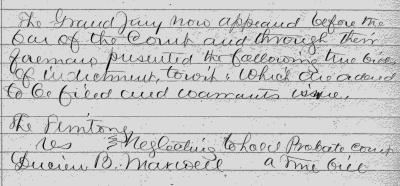
There seems to have been some irregularity in the way Maxwell carried out his duties, because the Territory of New Mexico brought a lawsuit against him the following Spring for neglecting to hold probate court. By the time he paid the $50 fine for this offence, in the Fall of 1870, he had sold the Maxwell land grant and was in the process of moving to the recently-abandoned Fort Sumner on the Pecos River.
Sources: Lawrence R. Murphy, Philmont a history of New Mexico’s Cimarron Country, UNM Press, Albuquerque, p. 97; Spring and Fall 1870 NM Territory Court Records, District 1, Case #92
 Fiction and Fact From Old New Mexico